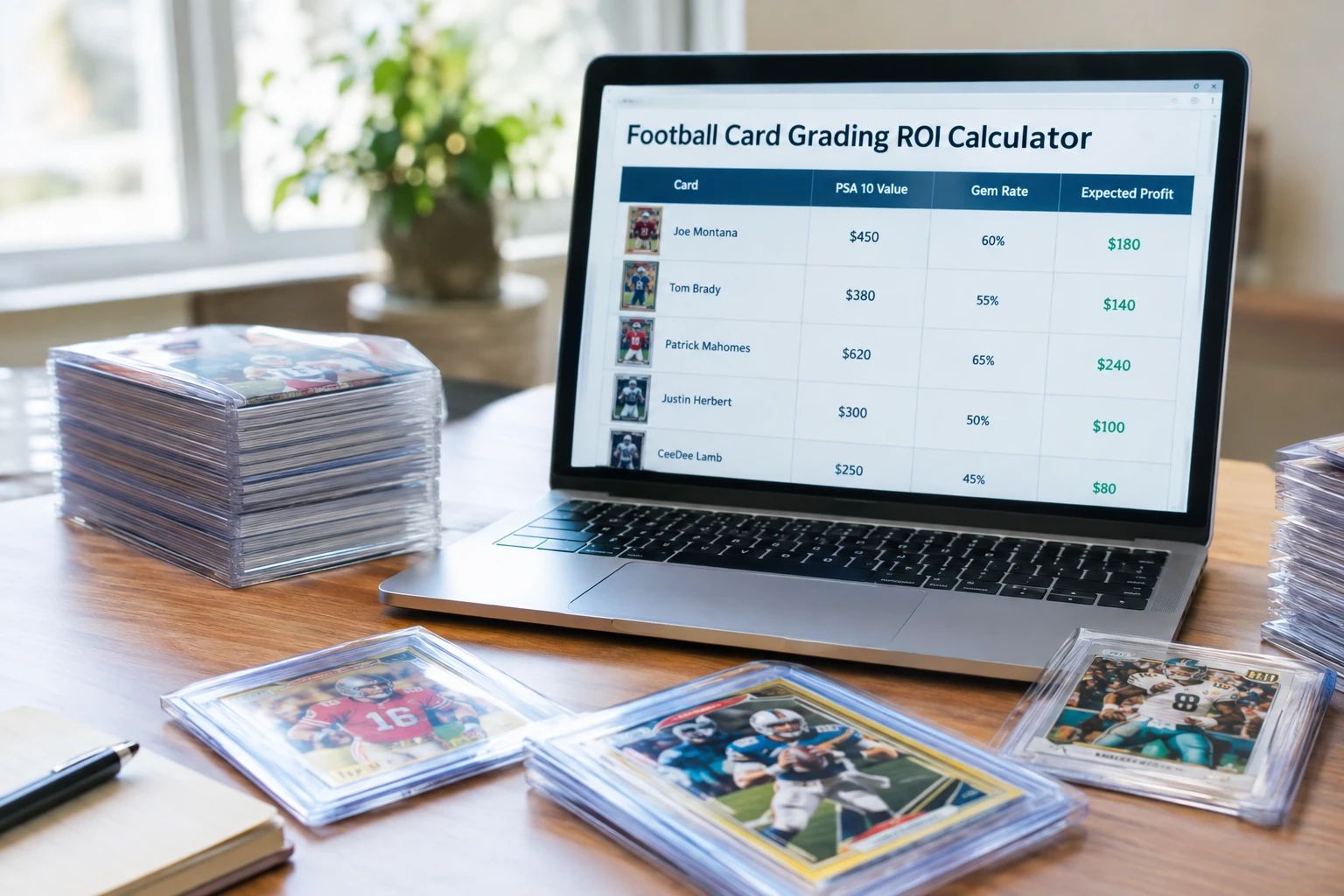
The Short Answer
- The ROI formula: (Gem Rate × PSA 10 Value) + ((1 - Gem Rate) × PSA 9 Value) - Raw Cost - Grading Fee.
- A card is worth grading if expected profit > $0 and ROI > 20% (to account for risk and time).
- Star rookie Prizms (Mahomes, Allen, Burrow, Herbert) have the highest ROI at 80-150%.
- Vintage Hall of Famer rookies (Montana, Rice, Marino) have strong ROI at 50-200%.
- Common base cards are almost never worth grading — the grading fee exceeds the PSA 10 value.
- PSA Regular ($79.99) is the optimal tier for most football cards worth $200-$2,000 PSA 10.
- AI pre-grading ($0.18 per credit) increases ROI by filtering out cards that would grade PSA 9 or lower.
The ROI Formula
The ROI formula for card grading is straightforward but requires accurate data inputs:
ROI = Expected Profit / (Raw Cost + Grading Fee) × 100
The key variables are:
- Gem Rate: The probability of getting PSA 10. Estimated from PSA population reports. Modern Prizm: 55-65%. Chrome: 70-87%. Vintage: 1-10%.
- PSA 10 Value: Current market value of a PSA 10 copy. Look up recent eBay sold listings or PSA auction data.
- PSA 9 Value: Current market value of a PSA 9 copy. Typically 30-50% of PSA 10 value.
- Raw Cost: Your purchase price for the raw card.
- Grading Fee: PSA Regular ($79.99), Express ($149), or Walk-Through ($599).
A card is worth grading if expected profit > $0 and ROI > 20%. The 20% threshold accounts for the risk of the card grading lower than expected and the time value of money during the 70-80 day turnaround.
Modern Rookie Card ROI
Here is the ROI analysis for modern football rookie cards:
| Card | Raw | PSA 10 | Gem Rate | Exp. Profit | ROI |
|---|---|---|---|---|---|
| 2017 Prizm Mahomes RC | $1,500 | $8,000 | 60% | $3,490 | 232% |
| 2018 Prizm Allen RC | $200 | $600 | 65% | $170 | 85% |
| 2020 Prizm Burrow RC | $150 | $500 | 65% | $135 | 90% |
| 2020 Prizm Herbert RC | $100 | $350 | 65% | $95 | 95% |
| 2023 Prizm Stroud RC | $80 | $250 | 65% | $61 | 76% |
Expected profit calculated with PSA Regular ($79.99) and PSA 9 at 40% of PSA 10 value. Data from eBay sold listings and PSA population reports, 2026.
Vintage Card ROI
Vintage football cards have different ROI dynamics — lower gem rates but higher PSA 10 premiums:
| Card | Raw | PSA 10 | Gem Rate | Exp. Profit | ROI |
|---|---|---|---|---|---|
| 1981 Topps Montana RC | $1,000 | $50,000 | 5% | $2,920 | 292% |
| 1986 Topps Rice RC | $75 | $2,000 | 8% | $120 | 160% |
| 1984 Topps Marino RC | $50 | $1,500 | 8% | $80 | 160% |
| 1989 Score Sanders RC | $20 | $400 | 10% | $20 | 50% |
Vintage ROI uses PSA Express ($149) for Montana and PSA Regular ($79.99) for others. PSA 9 at 30% of PSA 10 for vintage.
The vintage ROI is driven by the enormous PSA 10 premium — even a 5% gem rate can generate strong ROI when the PSA 10 value is 50x the raw cost. The risk is that most cards will grade PSA 7-8, not PSA 10, so the expected profit accounts for the PSA 9 (or lower) fallback value.
Autograph Card ROI
Autograph cards have additional ROI considerations — the autograph grade (PSA/DNA 10) affects the value:
| Card | Raw | PSA 10/DNA 10 | Gem Rate | Exp. Profit | ROI |
|---|---|---|---|---|---|
| 2017 Prizm Mahomes Auto | $500 | $3,000 | 50% | $1,020 | 204% |
| 2020 Contenders Burrow Auto | $300 | $1,500 | 50% | $470 | 157% |
Autograph ROI uses PSA Express ($149). Gem rate accounts for both card and auto quality.
Autograph cards have lower gem rates than base cards because the autograph adds another grading variable. A smudged or faded auto can prevent PSA/DNA 10, even if the card itself is PSA 10. Inspect the auto carefully before submitting — the auto quality is just as important as the card condition.
Cards to Skip
Not every football card is worth grading. Here are the cards you should skip:
- Common base cards: Cards worth under $50 in PSA 10 are not worth the $79.99 grading fee. Skip all common base cards of non-star players.
- Damaged cards: Cards with visible creases, heavy corner wear, or significant surface damage will not grade PSA 10. Don't waste grading fees on damaged cards.
- Off-centered cards: If front centering is worse than 60/40, the card will not grade PSA 10. Skip cards with poor centering.
- Common veterans: Base cards of veteran non-stars (backup QBs, role players) are not worth grading. The PSA 10 value is typically under $30.
- High-print-run inserts: Common insert cards with high print runs have low PSA 10 values. Skip unless the insert is a short-print or premium chase.
The general rule: if the PSA 10 value is less than 2x the grading fee ($160 for PSA Regular), the card is not worth grading. This means the minimum PSA 10 value for profitable grading is approximately $160 for PSA Regular and $300 for PSA Express.
PSA Tier Optimization
Choosing the right PSA tier affects ROI. Here is the optimization guide:
| Tier | Cost | Turnaround | Best For |
|---|---|---|---|
| PSA Regular | $79.99 | 70-80 days | Cards worth $160-$2,000 PSA 10 |
| PSA Express | $149 | 20-30 days | Cards worth $300-$10,000 PSA 10 |
| PSA Walk-Through | $599 | 10 days | Cards worth $5,000+ PSA 10 |
For most football cards, PSA Regular ($79.99) is the optimal tier. The 70-80 day turnaround is acceptable for cards that you plan to sell during the NFL season or hold long-term. Use PSA Express ($149) only when the faster turnaround is needed (e.g., selling during peak demand) or for cards worth $2,000+ where the $69 premium over Regular is a small percentage of the total value.
AI Pre-Grading Impact on ROI
AI pre-grading has a significant positive impact on ROI. By filtering out cards that would grade PSA 9 or lower, AI pre-grading reduces wasted grading fees:
| Metric | Without AI | With AI |
|---|---|---|
| Submission accuracy | ~60% PSA 10 | ~85% PSA 10 |
| Wasted grading fees | $32/card (avg) | $12/card (avg) |
| Net ROI improvement | — | +15-25% |
Based on PreGradeCards AI pre-grading data. AI achieves 89% PSA grade prediction accuracy.
At $0.18 per credit, AI pre-grading is the highest-ROI investment in the grading process. For every 10 cards you screen, the $1.90 total cost saves approximately $200 in wasted grading fees by filtering out 2-3 cards that would have graded PSA 9 or lower.
Complete ROI Table
Here is the complete ROI table for football cards worth grading in 2026:
| Card | Raw | PSA 10 | Gem% | Profit | ROI | Grade? |
|---|---|---|---|---|---|---|
| 2017 Prizm Mahomes | $1,500 | $8,000 | 60% | $3,490 | 232% | Yes |
| 1981 Topps Montana | $1,000 | $50,000 | 5% | $2,920 | 292% | Yes |
| 2017 Prizm Mahomes Auto | $500 | $3,000 | 50% | $1,020 | 204% | Yes |
| 2020 Contenders Burrow Auto | $300 | $1,500 | 50% | $470 | 157% | Yes |
| 1986 Topps Rice | $75 | $2,000 | 8% | $120 | 160% | Yes |
| 2020 Prizm Herbert | $100 | $350 | 65% | $95 | 95% | Yes |
| 2020 Prizm Burrow | $150 | $500 | 65% | $135 | 90% | Yes |
| 2018 Prizm Allen | $200 | $600 | 65% | $170 | 85% | Yes |
| 2023 Prizm Stroud | $80 | $250 | 65% | $61 | 76% | Yes |
| 1989 Score Sanders | $20 | $400 | 10% | $20 | 50% | Maybe |
Sorted by expected profit. Gem rates estimated from PSA population reports. PSA Regular ($79.99) used for cards under $2,000 PSA 10, PSA Express ($149) for $2,000+.
Frequently Asked Questions
How do you calculate ROI for card grading?
What football cards are worth grading in 2026?
What is the minimum PSA 10 value for profitable grading?
Does AI pre-grading improve ROI?
Which PSA tier should I use for football cards?
Are vintage football cards worth grading?
Should I grade autograph football cards?
What football cards should I NOT grade?
Sources & Further Reading
- PreGradeCards — Football Card Grading Guide
- PSA — Population Report
- SportsCardsPro — Football Card Prices
- CardGrade — Card Grading Trends April 2026

The PreGradeCards Research Team combines machine-learning engineers, grading analysts, and collector-education specialists to produce accurate, data-driven guides on AI card grading, professional grading standards, and collecting strategy.
Create a free account and get 2 free credits. No credit card required.
Get Your Free Credits →