The Short Answer
- Alt-art MS (Mobile Suit) cards and secret rares are the grading tier; base-set commons don't pay the fee.
- Bandai stock is thinner than Pokemon — edge whitening is the top pack-fresh defect.
- The game launched mid-2025, so pop reports are still small and premiums volatile.
- Japanese-exclusive promos and event cards carry outsized collector demand.
- Pre-grade before submitting — young-market premiums reward only genuine 10-candidates.
The Gundam Card Game market in 2026
Bandai launched the Gundam Card Game worldwide in mid-2025 after a Japanese soft-launch, bringing the mecha franchise to the same trading-card ecosystem it built for One Piece and Digimon. Within months the game developed a real secondary market — alt-art Mobile Suit cards and secret rares pulling $80–600 raw on release waves, with early graded copies selling at meaningful premiums on thin population reports.
For collectors, the Gundam TCG inherits Bandai's typical market structure: a broad base set, a narrow chase tier, and a playerbase that skews toward franchise collectors over pure TCG investors. The graded premium concentrates almost entirely on the alt-art and secret-rare tier — Gundam Wing, Unicorn and Seed-era suits with alternate artwork drive nearly all the slab value.
What makes Gundam different from grading a mature game is the combination of new-card-market volatility and franchise-collector demand. The buyers aren't just TCG players — they're Gundam fans who've collected models and merch for decades, which gives the chase cards a demand floor that pure-play TCG markets don't have. That's good news for graded copies; it means the premium isn't purely speculative.
2 free credits — check the likely grade before the fee.
Card quality: Bandai stock vs Pokemon
Bandai prints the Gundam TCG on the same thinner stock it uses for One Piece and Digimon — noticeably lighter than Pokemon's card. The practical consequences for grading:
- Edges whiten faster. The thinner board shows white along cut edges more readily, and edge wear is the most common pack-fresh defect on Bandai cards.
- Corners stay sharper out of the pack but show damage sooner once handled — sleeve promptly.
- Print quality is high. Bandai's production is generally clean; print lines exist but are less common than on early-wave Riftbound or older One Piece runs.
- Centering is usually good — Bandai's modern presses run tighter centering than early Pokemon waves, though individual cards still drift past 60/40.
The upshot: Gundam cards tend to grade well if they were pulled and sleeved cleanly — the cards that fail are almost always edge or corner issues, not print quality. That's also what makes them deceptively treacherous to self-check: a card can look flawless laid on a table and still carry the edge whitening that costs it the 10.
Handling matters more than on thicker-stock games. The light board flexes easier, so even normal pack-opening handling can introduce the corner softness that separates a 9 from a 10. Pull, sleeve immediately, and don't shuffle the card around admiring it — every flex is a potential grade point.
Which Gundam cards are actually worth grading
Grade the chase, skip the bulk:
- Alt-art Mobile Suit cards — the flagship chase, where raw prices of $80–600 make a PSA 10 premium real money.
- Secret rares — the top rarity tier, thin print runs, collector demand.
- Event/championship promos — limited distribution plus organized-play scarcity.
- Japanese-exclusive promos — the Gundam collector base crosses markets, and JP-only cards carry premium demand in the West.
- First-edition/first-wave parallels — if the game distinguishes print waves, early copies tend to hold premium.
Skip: standard foils, uncommons, and anything where the raw price is under ~$40. On a $30 all-in fee, the graded premium has to clear ~$65+ just to break even — and on Gundam's concentration-at-the-top market structure, the cards below the alt-art tier rarely produce that premium even in a 10. The exception worth noting: if you're grading for your own collection and don't care about resale, the math changes entirely — a $15 card you love is a fine $30 display expense.
When in doubt, check the sold comps for the specific card at PSA 10 before submitting. The Gundam market is thin enough that comps for the exact parallel matter more than set averages — a “rare” in one set might sell for less graded than an “uncommon” alt-art in another.
The pack-fresh defects that cost grades
Inspect before you assume pack-fresh means 10-ready:
- Edge whitening — the #1 grade-killer on Bandai stock. The thin board exposes white core along cut edges, especially where the pack's seal stress concentrates. Check all four edges against a dark surface under bright light.
- Top-edge chipping — the pack-separation edge takes the most stress during the pull; even a clean rip can leave a chip on the top edge.
- Corner fraying — microscopic lifting at the corner tips, invisible at arm's length but fatal under a grader's loupe.
- Surface roller marks — faint indentations from production machinery, visible only when the card is tilted under raking light.
- Centering drift — Bandai's centering is usually tight, but individual cards drift past 60/40; measure, don't assume.
- Foil scratches — the parallel-foil surface picks up hairline scratches from any contact with other cards.
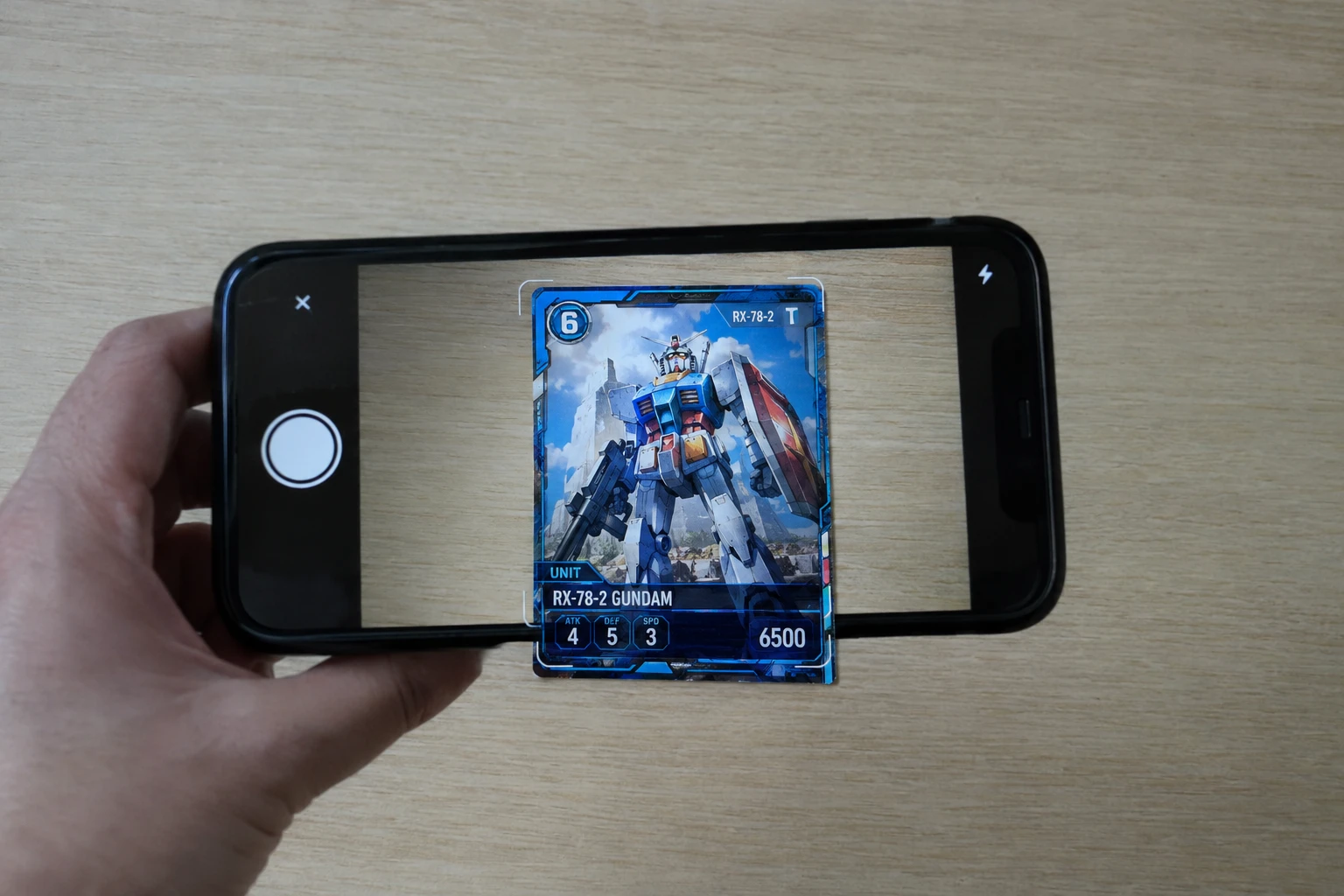
The practical check is the same one every professional submitter runs: pull the card, sleeve it immediately, and inspect it under bright indirect light with the card tilted at 45° so defects catch the reflection. Then run an AI pre-grade to catch what your eye missed — the edge whitening on the top edge is exactly what photo analysis is built to detect.
The grading-fee math on Gundam cards
Run the numbers before you ship. An all-in grading cost of ~$30 per card (fee + return shipping share + insurance + packaging) means a Gundam card only pays for its slab if the graded version sells for ~$65+ more than raw. On the flagship alt-arts that's a real bar — a $150 raw card that sells for $400 as a PSA 10 clears it easily. On a $50 secret rare it often doesn't.
The thin stock changes the math in one subtle way: pack-fresh Gundam cards fail on edges and corners more often than on Pokemon. Where a Pokemon pull might grade a 9.5+ most of the time, a Gundam pull has a real chance of coming back a 9 because of edge whitening you'd never notice at arm's length. That's precisely why the cheap pre-grade is the highest-value step — it catches the defect that decides whether the fee pays.
And because the market is young, the premium curve is steep and narrow: the top few cards in each set carry nearly all the graded value. Mid-tier foils and ungraded-bulk staples almost never clear the fee, no matter how clean they are.
Grading company choice for Gundam
- PSA — resale king on popular TCG cards; the default for investment-intent alt-arts.
- CGC — cheaper fee and faster turnaround; smart on a volatile young market where premiums can compress during a 3-month PSA queue.
- TAG — the defect report suits a collector-leaning playerbase.
Pre-grade first either way — on a young market, submitting a card that can't earn the grade that pays is the most expensive mistake.
The bottom line
The Gundam Card Game has a real grading market — the alt-arts and secret rares carry premiums that justify fees. Bandai's stock is thin but print quality is high, so the cards that fail are usually edge or corner issues that a pre-grade would have caught. Scan every candidate, submit only the true 10s, and let the thin pop reports work for you.
2 free credits, browser-based, no download.
Frequently Asked Questions
0
1
2
3
4
5
6
7
Sources & Further Reading
Emily Rodriguez analyzes grading cost, population, and pricing data across PSA, BGS, SGC, CGC, and TAG. She built the PreGradeCards ROI calculator and submission planner, and her market reports on grading backlog, turnaround times, and slab premiums are cited by collectors and dealers worldwide.
Create a free account and get 2 free credits — enough for 2 complete AI gradings with market pricing. No credit card required.
Get Your Free Credits →