The Short Answer
- AI appraisal tools can value a card in 30 seconds — upload a photo and get identification, condition assessment, and market price instantly.
- Always use sold prices, not listed prices — eBay sold listings and TCGPlayer market prices reflect what buyers actually pay.
- PSA pop reports show scarcity — a card with 5,000 PSA 10s is worth less than one with 50 PSA 10s, all else being equal.
- Professional appraisals cost $50-$200 per session — needed for insurance, estate planning, and high-value transactions.
- Card identification is the first step — check the set symbol, card number, edition stamp, and language to identify the exact printing.
- Condition is the biggest variable after rarity — a NM card is worth 2-5x a LP card of the same printing.
- Grading ROI is simple math — if graded value minus grading cost exceeds raw value, grading is worth it.
What Is a Trading Card Appraisal?
A trading card appraisal is the process of determining the fair market value of a card or collection. An appraisal answers three questions: What is this card? What condition is it in? What is it worth on the current market? Whether you are selling a single card, insuring a collection, or settling an estate, you need an accurate appraisal to make informed decisions.
In 2026, there are two ways to appraise cards: AI appraisal and professional appraisal. AI appraisal uses image recognition and market data to value a card from a photo in about 30 seconds. Professional appraisal involves a human expert who physically examines the card and provides a written valuation. AI appraisal is fast, free or cheap, and great for screening. Professional appraisal is slower, costs $50-$200+, and is needed for insurance, estate, and high-value transactions.
For most collectors, the right approach is to start with a free AI appraisal to get a ballpark value, then confirm with sold comps on eBay and TCGPlayer. For collections worth $10,000+ or for official purposes (insurance, taxes, estate), hire a professional appraiser.
Free AI Appraisal Tools
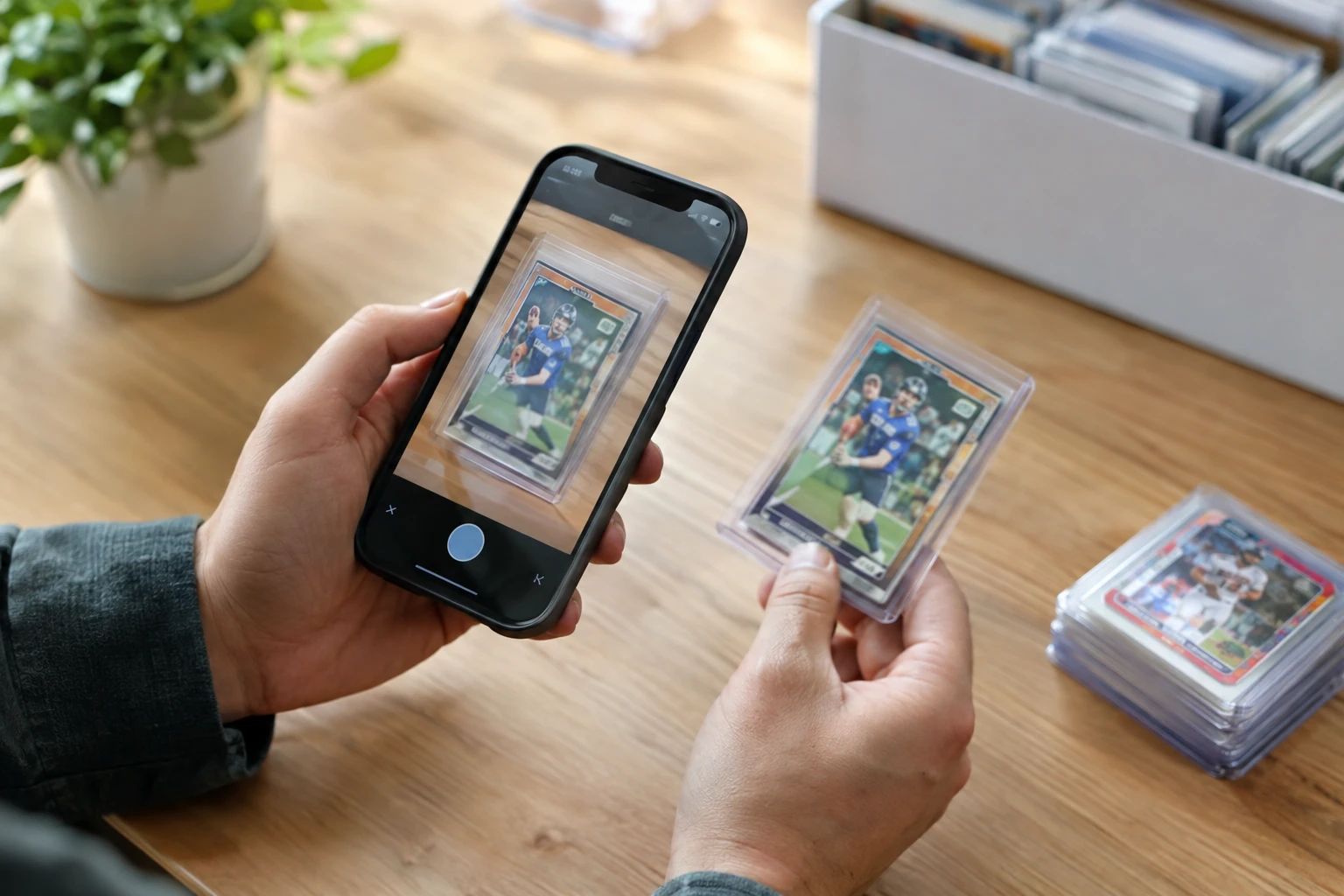
AI appraisal tools have transformed how collectors value cards. Upload a photo and the AI identifies the card, evaluates condition, and pulls market prices — all in under a minute. Here are the best options in 2026:
PreGradeCards AI
Our own tool provides the most comprehensive appraisal: card identification, condition grading across centering/corners/edges/surface, predicted PSA/BGS/CGC grade, and market value — all from a single photo. The AI also calculates grading ROI, telling you whether professional grading is worth the cost for your specific card. Try it free.
Pokeval
Free Pokemon card appraisal from a single photo. Identifies the card in 3 seconds, provides market price from eBay/Cardmarket/TCGPlayer, authenticity score, and grading ROI recommendation. Completely free with no sign-up required.
CardGrading.app
AI appraisal with card identification, condition grading, and live market value from PokeTrace, eBay, and TCGPlayer. 3 free scans with no credit card required. Plans start at $3.49/month for 30 appraisals.
Guardian TCG Scanner
Free scanner for 14+ TCGs including Pokemon, MTG, Yu-Gi-Oh!, One Piece, and Lorcana. Compares prices across TCGPlayer, eBay, and CardMarket in one scan. Unlimited free scans with Pro for full condition reports.
Card Codex Scanner
Pokemon-focused scanner using TinEye image recognition. Identifies the exact printing (not just "a Pikachu") and pulls TCGPlayer market prices. 5 free scans per week; Pro for 250 scans/month.
Step 1: Identify Your Card
Before you can value a card, you need to know exactly what it is. Two cards that look identical to a casual observer can be worth vastly different amounts depending on the printing, edition, and set. Here is what to check:
Card Name and Set
The card name is usually at the top. The set is identified by the set symbol, typically located near the bottom right of the card. Each set has a unique symbol — for example, Pokemon Base Set has a "1st Edition" stamp and no symbol, while Jungle has a flower symbol. Use a set symbol guide to identify the set.
Card Number
The card number is at the bottom of the card, usually in the format "X/Y" where X is the card number and Y is the total cards in the set. This identifies the exact card within the set and is essential for looking up prices.
Edition Stamp
For vintage Pokemon cards, check for a "1st Edition" stamp. 1st Edition cards are worth significantly more than unlimited printings. Also check for "Shadowless" printing (no shadow around the artwork box), which is rarer than unlimited but less rare than 1st Edition.
Rarity Symbol
The rarity symbol (circle = common, diamond = uncommon, star = rare, star H = holo rare) tells you the card's rarity tier. For modern sets, additional rarity tiers exist (Ultra Rare, Secret Rare, Special Art Rare, etc.) that significantly affect value.
Language
English cards are the standard for the US market, but Japanese, French, German, and other language printings can have different values. Japanese Pokemon cards are often worth more than English for rare cards due to the larger Japanese collector base.
Step 2: Find Real Sold Prices
The most important rule in card appraisal: use sold prices, not listed prices. Listed prices (Buy It Now prices on eBay, asking prices on TCGPlayer) reflect what sellers hope to get. Sold prices reflect what buyers actually pay. The gap between listed and sold prices can be enormous — sometimes 50% or more.
eBay Sold Listings
The gold standard for card pricing. Search for your card on eBay, then filter by "Sold Items" and "Completed Listings." Look at the last 30-90 days of sales. Ignore outliers (unusually high or low sales) and focus on the median sold price. This gives you the real market value.
TCGPlayer Market Price
For TCG cards (Pokemon, MTG, Yu-Gi-Oh!), TCGPlayer's Market Price is the standard. It reflects recent sales across their marketplace. TCGPlayer also shows "Listed Price" (what sellers are asking) and "Lowest Price" (cheapest current listing) — always use Market Price for appraisal purposes.
130point.com
130point provides historical eBay sales data, including cards that may no longer appear in eBay's 90-day sold listings window. Useful for cards that sell infrequently and need a longer lookback period.
Card Ladder
For graded cards, Card Ladder tracks historical prices across PSA, BGS, CGC, and SGC. Subscription-based but essential for serious investors. Shows price trends over time, which helps you understand whether a card is appreciating or depreciating.
PSA Card Price Guide
PSA maintains a price guide for graded cards across all sports and TCGs. The prices are updated regularly and reflect recent PSA-graded sales. Free to search on psacard.com.
Step 3: Check PSA Population Reports
A PSA population report ("pop report") shows how many cards have been graded at each grade level for a specific card. This is essential for understanding scarcity. A card with 5,000 PSA 10s is much more common than one with 50 PSA 10s, and the values will reflect that difference.
To check a pop report, go to psacard.com/pop, search for your card by set and card number, and look at the grade distribution. Pay attention to:
- Total PSA 10 population: Lower = more scarce = potentially higher value
- PSA 10 vs PSA 9 ratio: If most submissions grade 10, the 10 is not special. If most grade 8-9, a 10 is genuinely rare.
- Total graded: A card with only 50 total graded across all grades is much rarer than one with 10,000 graded.
Pop reports are also available for BGS, CGC, and SGC. Cross-reference multiple graders to get a complete picture of a card's scarcity. A card might have 2,000 PSA 10s but only 50 CGC 10 Pristines, which could make the CGC version more valuable despite CGC's generally lower resale premium.
Step 4: Calculate Grading ROI
Once you know your card's identity, condition, and raw market value, the next question is whether grading is worth it. The math is straightforward:
Grading Profit = (Expected Graded Sale Price × (1 - 0.13 eBay fee)) - (Raw Card Value + Grading Fee + Shipping)
If grading profit is positive, grading is worth it. If it is negative, sell raw. Here is a practical example:
- Raw card value: $50
- Expected PSA 10 sale price: $200
- Grading fee (PSA Regular): $80
- Shipping to/from PSA: $15
- eBay fee (13%): $26
- Net graded proceeds: $200 - $26 - $5 shipping = $169
- Grading profit: $169 - $50 - $80 - $15 = $24
In this example, grading is worth it — but barely. The $24 profit assumes the card grades PSA 10. If it grades PSA 9 (worth ~$100), the math flips: $100 - $13 - $5 = $82, minus $50 + $80 + $15 = $145. You would lose $63.
This is why pre-screening is critical. Use PreGradeCards AI to get a predicted grade before submitting. If the AI predicts PSA 9, do not submit — sell raw. If it predicts PSA 10 with high confidence, the math works. See our grading ROI guide for the complete break-even analysis.
Professional Appraisal Services
For high-value cards and collections, a professional appraisal provides a written valuation that is accepted by insurance companies, the IRS, and courts. Here is when you need one and where to get it:
When You Need a Professional Appraisal
- Insurance scheduling: Collections worth $25,000+ typically need scheduled coverage with professional appraisals
- Estate planning: Inherited collections need appraised values for probate and tax purposes
- Divorce or legal disputes: Courts require professional valuations for asset division
- Donations: If you donate cards to a charity, you need a professional appraisal for tax deduction purposes (over $5,000)
- High-value sales: For cards worth $10,000+, a professional appraisal can support the asking price
Where to Get a Professional Appraisal
- PSA Written Appraisal: PSA provides written appraisals with fees tied to declared value — $200 for cards worth $2,000-$4,999, $250 for $5,000-$9,999, up to $1,000 for items over $100,000. Includes detailed PDF report and valuation certificate.
- Value My Stuff: Online appraisal service delivering valuations within 48 hours. Typically $30-$50 per item.
- Local card shops: Many local card shops offer appraisal services for $50-$200 per session. Quality varies — ask about the appraiser's credentials and experience.
- Auction houses: Heritage, Goldin, and PWCC provide free valuations for items they are consigning. This is effectively a professional appraisal at no cost if you are planning to sell.
Appraising a Full Collection
Appraising a full collection is different from appraising individual cards. For a collection of 100+ cards, appraising each card individually is impractical. Here is the efficient approach:
- Sort by value tier: Separate cards into "high value" ($100+), "mid value" ($20-$100), and "bulk" (under $20).
- Appraise high-value cards individually: Use AI appraisal or eBay sold comps for each card worth $100+. These cards represent the majority of your collection's value.
- Sample the mid-value tier: Appraise 10-20 representative cards from the mid-value tier and extrapolate. Most mid-value cards in the same set will have similar values.
- Estimate bulk at a flat rate: Bulk commons and uncommons are typically worth $0.05-$0.25 each. Count the total and multiply by a conservative average.
- Use a tracker app: Apps like Cards AI or CollX can scan and value dozens of cards quickly, giving you a running total.
- Add grading premium: If you have graded cards, use PSA/BGS/CGC sold comps rather than raw card prices. Graded cards typically sell for 2-10x raw value depending on the grade.
For insurance purposes, keep an updated spreadsheet with card descriptions, grades, and current values. Update annually. See our graded card insurance guide for detailed instructions on insuring your collection.
Appraisals for Insurance and Estate Planning
If your collection is worth more than a few thousand dollars, you need to think about insurance and estate planning. Standard homeowner's insurance typically caps collectible coverage at $1,500-$5,000 and reimburses based on depreciated value, not current market worth. This leaves over 95% of card collections at risk.
Insurance Appraisals
For collections worth $25,000+, most insurers require scheduled coverage with professional appraisals. This means each valuable card is listed individually on the policy with its appraised value. You will need to provide certification numbers (for graded cards), photos, and descriptions.
Specialized collectibles insurance providers offer tailored policies that cover accidental damage, theft, and loss during transit. The average annual premium for a $50,000 collection ranges from $500 to $1,500, depending on coverage levels and deductibles.
Estate Planning
Inherited cards receive a stepped-up basis to fair market value at the date of death. This is a significant tax advantage — if you inherit a card worth $5,000 and sell it for $5,000, there is no taxable gain. But to claim the stepped-up basis, you need a professional appraisal of the collection as of the date of death.
For estate planning purposes, get a professional appraisal every 3-5 years to keep values current. Card values can change dramatically, and an outdated appraisal can cause problems during probate. See our trading card tax guide for more on how inherited collections are taxed.
Frequently Asked Questions
How can I appraise my trading cards for free?
How accurate are AI card appraisals?
Where can I find real sold prices for trading cards?
What is a PSA population report and why does it matter?
How much does a professional card appraisal cost?
Do I need an appraisal for insurance?
Sources & Further Reading
- PSA Price Guide and Pop Reports
- TCGPlayer Market Prices
- Card Ladder Price Tracking
- 130point eBay Sales Data
Emily Rodriguez analyzes grading cost, population, and pricing data across PSA, BGS, SGC, CGC, and TAG. She built the PreGradeCards ROI calculator and submission planner, and her market reports on grading backlog, turnaround times, and slab premiums are cited by collectors and dealers worldwide.
Create a free account and get 2 free credits — enough for 2 complete AI gradings with market pricing. No credit card required.
Sign Up Free →