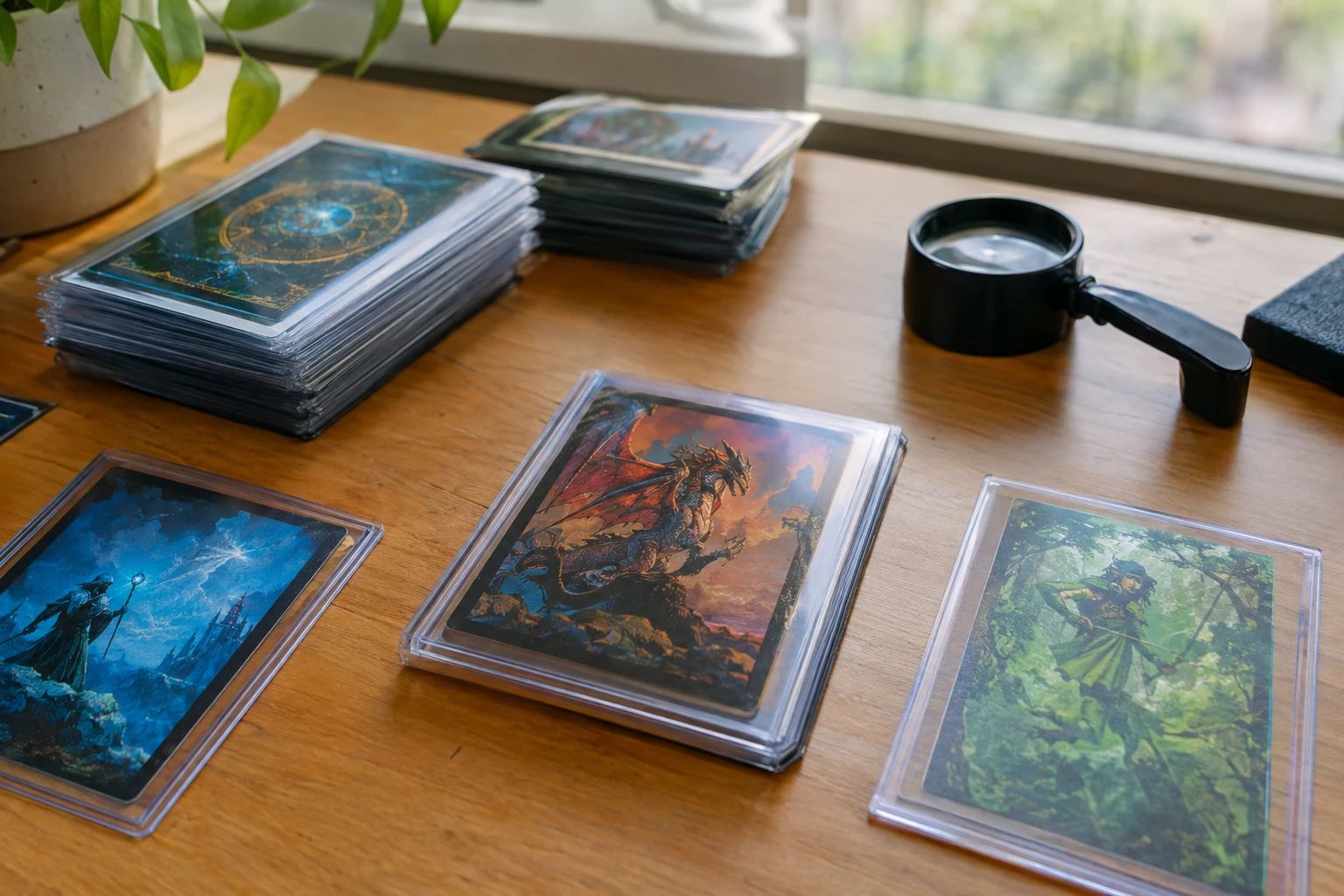
The Short Answer
- The back of the card is the single hardest part to counterfeit. Compare the blue swirl and Poké Ball design against a known-genuine card — fakes run too dark, too purple, with muddy detail.
- The light test is the fastest screening tool: hold the card up to a bright light. Genuine cards have an opaque dark core layer that blocks most light. Cheap fakes glow bright because they lack the core layer.
- Modern "super fakes" in 2026 have started adding dark middle layers, so no single test is conclusive. Use multiple checks: light test + back print + font comparison + texture feel + holo pattern.
- Counterfeit PSA, BGS, and CGC slabs are also a growing problem. Always verify certification numbers on the official grader database before buying any graded card.
- Free AI card grading from PreGradeCards can help identify suspicious cards — if the AI cannot identify the card or flags unusual characteristics, it may be counterfeit. Use it as a first-pass screening tool.
Short Answer: How to Tell If a Pokémon Card Is Fake
You can tell if a Pokémon card is fake by running a series of checks: the light test (real cards block light, fakes glow), the back print check (compare the blue swirl and Poké Ball against a known-genuine card), the texture feel (real modern holos have etched grooves, fakes feel smooth), and the font/text check (fakes often have misspellings, wrong fonts, or incorrect spacing).
No single test is 100% conclusive on its own. The best approach is to run multiple checks in sequence. If a card fails two or more tests, it is almost certainly fake. If it passes all tests but still feels off, consult a professional grading service or experienced collector for a final verdict.
The rise of "super fakes" in 2026 — counterfeits that add dark middle layers, mimic texture patterns, and use higher-quality printing — means the old single-test approach is no longer sufficient. Collectors must be more vigilant than ever, especially when buying high-value cards from unfamiliar sellers.
Why Fake Cards Are a Growing Problem
As Pokémon card values have climbed to record heights — the Pikachu Illustrator sold for $16.49 million, 1st Ed Base Charizard PSA 10s trade at $500,000+ — counterfeits have evolved from flea-market jokes to genuinely dangerous fakes of specific high-value cards. The 30th Anniversary celebration in 2026 has brought new collectors into the hobby, many of whom are unfamiliar with authentication techniques.
Counterfeiters target the most valuable cards: 1st Edition Base Set holos, Gold Stars, full art trainer cards, and modern alt arts. They also produce counterfeit sealed product — fake booster packs and boxes that look identical to genuine product from the outside. The Bitdefender 2026 Pokémon card scam report identified fake grading cases mimicking PSA, BGS, and CGC as a growing threat.
The financial impact of buying a fake can be devastating. A collector who pays $5,000 for what they believe is a genuine 1st Ed Base Charizard, only to discover it is counterfeit, loses their entire investment with no recourse if the seller has disappeared. This is why authentication skills are essential for any collector buying cards worth more than $50.
Physical Tests (10 Seconds Each)
These are the fastest screening tests you can run on any card. They take about 10 seconds each and will catch most cheap counterfeits:
1. The Light Test: Hold the card up to a bright light source (a phone flashlight works well) in a dim room. Genuine English Pokémon cards are built like a sandwich, with a thin dark core layer between the front and back that blocks most of the light, leaving a faint, even glow. A cheap fake on single-layer stock lights right up — sometimes you can clearly see through it. Note: 2026 "super fakes" have started adding dark middle layers, so treat this as a first-pass screen, not a final verdict.
2. The Layer Check: Look at the edge of the card. Genuine Pokémon cards have a thin dark line running through the middle — that is the core layer. If the edge is solid white with no dark line, the card is fake. However, some counterfeiters attach a fake front to a genuine low-value card, so the presence of a core layer does not guarantee authenticity.
3. The Feel Test: Drag a fingernail lightly across the front of a modern holo or full art. Genuine cards have fine etched grooves — a subtle rasp, almost like tracing the surface of a record. Counterfeits usually feel smooth, glossy, or waxy. Some better fakes print a texture pattern that looks convincing under glass, but the surface is flat, so your nail just glides. For vintage cards and plain non-holos that are naturally smoother, compare the feel against a known-genuine card from the same era.
4. The Weight and Measure: A genuine English card runs roughly 1.7 to 1.8 grams and measures 63mm by 88mm. Japanese cards are slightly smaller at about 60mm by 86mm. A jeweler's scale that reads to 0.01g can flag a suspiciously light card. However, weight is one of the weakest tests — many modern fakes land close enough to pass.
Print Verification: The Counterfeit Killers
After the physical tests, print verification is where you catch the more convincing fakes. These checks require a known-genuine card for comparison and optionally a jeweler's loupe or phone macro lens:
1. Back Print Quality: This is the single most reliable tell. Compare the back of the suspect card against a known-genuine card from the same era. The light blue diagonal sweep to the upper right of the Poké Ball should be dappled with flecks of darker blue underneath. On a fake, that sweep tends to go solid, washed out, or too light, with the dappling missing entirely. Off-center Poké Balls and a blue that leans purple are common red flags.
2. Font and Text Check: Counterfeiters are sloppy with text. Look for misspellings, a missing accent on the é in Pokémon, fonts that sit too bold or too thin, and evolution or typing errors. Check the HP number, energy symbols, attack text, and copyright line. Official fonts are hard to counterfeit exactly — compare letter spacing, thickness, and alignment against a verified copy. Pay close attention to the word "Pokémon," energy-type names, and copyright information.
3. Rosette Pattern: Under a jeweler's loupe or phone macro lens, genuine card printing shows a fine, regular dot pattern (rosette pattern). Many fakes show blurry or irregular dots, especially in the artwork. This is because genuine cards use a structured commercial printing process with controlled color layers, while cheaper fakes reproduce the entire card as a single scanned image.
4. Color Consistency: Counterfeit cards often use colors that are too bright, too dark, too dull, or too saturated. Pay particular attention to the blue border on the back, the yellow Pokémon logo, and the front border. Blurry artwork, fuzzy text, color bleeding, or visible banding are warning signs.
5. Set Symbol and Collector Number: Check that the set symbol, collector number, and rarity mark are the correct size, position, and style. Counterfeiters often get these details wrong — the symbol may be the wrong shape, the number may not match the set, or the rarity treatment may be incorrect.
Holographic Pattern Checks
Holographic foil is one of the hardest things for counterfeiters to reproduce correctly. Here is how to check holo patterns:
Tilt Test: Tilt a genuine holo or Special Illustration Rare slowly under a lamp. The pattern shifts with real depth — the rainbow flowing across the artwork with genuine dimension. Fakes tend to show a flat, uniform shimmer, or a holo effect that pixelates and breaks up at certain angles. The foil should move and interact with the artwork, not just sit as a static rainbow sheen.
Foil Placement: Check where the foil should appear. Many cheap fakes use a generic rainbow sheen across the entire surface, even when the authentic card has foil only in specific areas. Compare against a reference image from the official Pokémon card database or a trusted grading company.
Texture on Ultra Rares: Modern ultra rares carry embossed texture. A flat "textured" card is fake. Texture in the wrong pattern is also fake. Run your fingernail across the card — genuine texture has a distinct tactile feel that printed-on texture cannot replicate.
Reverse Holo Pattern: For reverse holos, check that the holo pattern extends correctly across the card. Some fakes apply a uniform holo where the genuine card has a specific pattern (cosmos, parallel holo, etc.) that varies by set and era.
Existence Verification: Does the Card Actually Exist?
One of the strongest counterfeit checks is also one of the simplest: confirm that Pokémon officially printed the exact card in front of you. Counterfeiters invent cards that were never printed — wrong set numbers, impossible rarity/holo combinations, gold-bordered everything.
How to verify: Look up the card name, set, and collector number in the official Pokémon card database at pokemon.com, or use TCGPlayer's catalog. If your "119/086" does not match the printed card 119/086, the card is fake. Check the following details match exactly:
- Pokémon or Trainer name
- Card artwork and credited illustrator
- Set name, set symbol, and collector number
- HP, type, and Evolution information
- Ability, attack names, Energy costs, and damage
- Weakness, resistance, and Retreat Cost
- Rarity treatment and holographic finish
- Copyright line, regulation mark, and language
Counterfeiters often copy real artwork while combining it with the wrong collector number, HP, attacks, rarity, or set symbol. Confirm the entire card, not merely the featured Pokémon. A card with the correct artwork but wrong HP or attack text is a fake.
How to Spot Fake Graded Slabs
Fake graded card slabs are a growing problem in 2026. Counterfeit PSA, BGS, CGC, and SGC slabs can deceive even experienced collectors. Here is how to protect yourself:
1. Verify the certification number. Every genuine graded slab has a unique certification number. Go to the official grader database (psacard.com/cert, cgccards.com/certlookup, beckett.com/verify, sgccard.com) and enter the cert number. If the number does not exist, does not match the card, or shows a different grade, the slab is fake.
2. Examine slab construction quality. Genuine slabs are ultrasonically sealed with clean, consistent edges. Fake slabs may show glue residue, uneven seams, or visible tool marks. Compare the slab to a known-genuine slab from the same company and era.
3. Check label fonts and holograms. Each grading company uses specific fonts, colors, and security features on their labels. PSA labels have a specific holographic pattern. CGC labels have a UV-reactive element. Compare the label against known-genuine examples — fake labels often have slightly wrong fonts, colors, or hologram placement.
4. Compare to known authentic slabs. If you have access to a genuine slab from the same company, compare them side by side. Look at the thickness, the corner radius, the label placement, and the interior padding. Any deviation is a red flag.
5. Buy from reputable sellers. The best protection is to buy graded cards only from established sellers with high feedback, verified sales history, and clear return policies. Be wary of new sellers offering high-grade slabs at below-market prices.
What to Do If You Find a Fake
If you discover that a card you purchased is counterfeit, here are the steps to take:
If bought on eBay: Open a "Significantly Not As Described" (SNAD) case through eBay's Money Back Guarantee. eBay protects buyers against counterfeit items. You will need to return the card (do not destroy it) and provide evidence of the counterfeit — photos showing the failed tests, comparison images with a known-genuine card, and any expert opinions.
If bought on TCGPlayer: Contact TCGPlayer seller support and open a dispute. TCGPlayer has buyer protection for counterfeit items. Provide clear evidence and return the card.
If bought locally or via Facebook: If you paid via PayPal Goods & Services, open a dispute for "Item Not As Described." If you paid via Venmo or Zelle, contact the platform's support — recovery is more difficult but not impossible for fraud cases. If you paid cash, your options are limited — consider it an expensive lesson and report the seller to local authorities if the amount is significant.
Report the seller: Leave honest feedback warning other buyers. Report counterfeit listings to the platform (eBay, TCGPlayer, Facebook). If the counterfeiting operation is large-scale, report to the Pokémon Company's legal team and local law enforcement.
Do not resell the fake. Selling a counterfeit card, even if you disclose it, is illegal in most jurisdictions and harms the hobby. Destroy the card or keep it as a reference example for future authentication.
Frequently Asked Questions
How can I tell if my Pokémon card is fake?
What is the fastest way to check if a Pokémon card is fake?
Are there fake PSA graded slabs?
What are "super fakes" in 2026?
Can AI detect fake Pokémon cards?
What should I do if I bought a fake Pokémon card?
Are Japanese Pokémon cards harder to fake?
Sources & Further Reading
- Beckett: How to Spot a Fake Pokémon Card
- TCGrader: How to Authenticate Pokémon Cards 2026
- Bitdefender: Pokémon Card Scams 2026
- PSA Certification Verification
- PreGradeCards Free AI Card Grading

The PreGradeCards Research Team combines machine-learning engineers, grading analysts, and collector-education specialists to produce accurate, data-driven guides on AI card grading, professional grading standards, and collecting strategy.
Create a free account and get 1 free credit — enough for 1 complete AI grading with market pricing. No credit card required.
Sign Up Free →