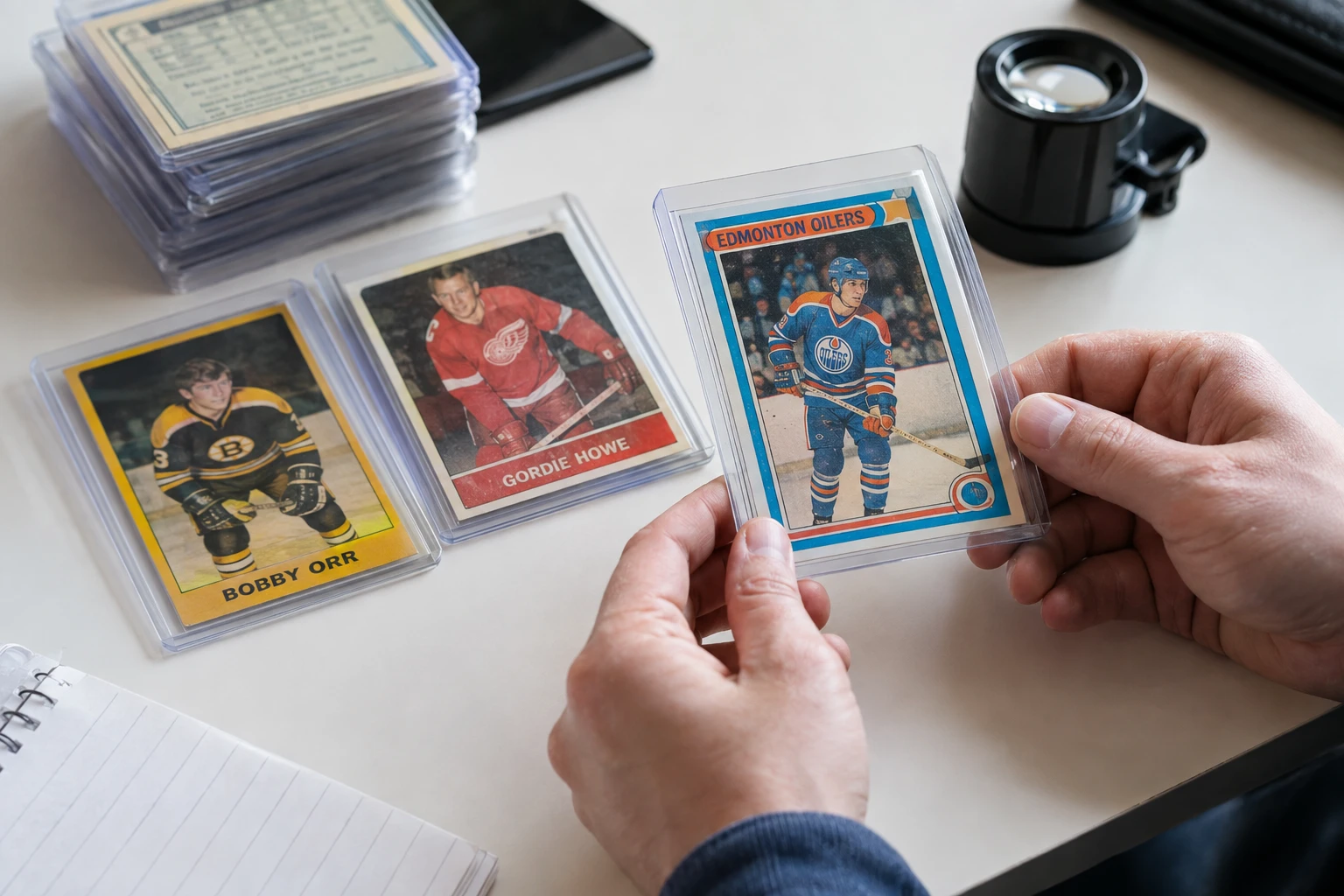
The Short Answer
- The 1979-80 O-Pee-Chee Wayne Gretzky rookie is the Holy Grail of hockey cards — a PSA 10 sold for $5.2M, while even NM copies sell for ~$9,700.
- Vintage hockey cards have different grading standards than modern cards: rough-cut edges are not defects on older issues, and centering tolerances are more lenient.
- SGC is preferred by many vintage collectors for its clean black-tuxedo slab and fair grading, while PSA commands the highest resale premium.
- The 1951 Parkhurst Gordie Howe rookie is one of the most valuable vintage cards, with recent sales around $3,050 for mid-grade copies.
- The 1966 Topps Bobby Orr rookie is another key vintage target, with high-grade copies commanding significant premiums.
- Even mid-grade vintage hockey cards are worth grading because authentication alone adds substantial value — unlike modern cards, where the grade premium is the primary driver.
- The 2005-06 Upper Deck Young Guns class (Crosby/Ovechkin) is now considered "emerging vintage" — 20+ years old and increasingly difficult in high grade.
Vintage vs Modern: The Grading Difference
Grading vintage hockey cards is fundamentally different from grading modern cards. If you approach a 1951 Parkhurst Gordie Howe the same way you approach a 2024-25 Upper Deck Young Guns, you will make expensive mistakes. Here are the key differences:
1. Rough-Cut Edges Are Not Defects
Many vintage hockey cards — particularly O-Pee-Chee issues from the 1960s and 1970s — have rough-cut edges that look like damage to the untrained eye. These are not defects. They are a manufacturing characteristic of the era, caused by the cutting methods used at the time. PSA and SGC graders know this and do not penalize rough-cut edges on vintage cards. If you see a vintage card with rough edges, do not assume it will grade poorly — it may grade just fine.
2. Centering Tolerances Are More Lenient
PSA applies more lenient centering standards to vintage cards. While modern cards need 55/45 front centering for a PSA 10, vintage cards from the 1950s and 1960s are graded with an understanding that manufacturing precision was lower. A vintage card with 60/40 or even 65/35 centering may still receive a high grade if the corners, edges, and surface are clean.
3. Paper Stock Degrades Over Time
Vintage cards were printed on paper stock that degrades over decades. Foxing (brown spots), discoloration, and brittleness are common. These are age-related issues, not handling defects, but they still affect the grade. A card with significant foxing will not grade highly regardless of how well it was stored.
4. Authentication Is the Primary Value Driver
For modern cards, the grade premium (PSA 10 vs PSA 9) is the primary value driver. For vintage cards, authentication is the primary value driver. A PSA 5 Gordie Howe rookie is worth far more than a raw Howe rookie because the PSA case proves it is authentic and not a counterfeit. The grade matters, but the slab itself is what creates the value.
The 1979-80 O-Pee-Chee Wayne Gretzky Rookie
The 1979-80 O-Pee-Chee Wayne Gretzky rookie card is the Holy Grail of hockey card collecting. It is the most valuable hockey card ever produced, and it holds the record for the highest hockey card sale of all time.
There are two versions of the Gretzky rookie: the 1979-80 O-Pee-Chee (Canadian issue) and the 1979-80 Topps (American issue). The O-Pee-Chee version is more valuable because it is scarcer and because O-Pee-Chee is the iconic Canadian hockey card brand. The Topps version is less valuable but still a significant card.
| Version | PSA 10 Value | PSA 9 Value | PSA 5-7 Value | NM Raw Value |
|---|---|---|---|---|
| 1979-80 OPC Gretzky RC | $5,200,000 | $50,000-$150,000 | $5,000-$20,000 | ~$9,700 |
| 1979-80 Topps Gretzky RC | $500,000+ | $10,000-$30,000 | $1,000-$5,000 | ~$2,225 |
Values are estimates based on recent auction results and private sales as of August 2026. The PSA 10 OPC sale was a private transaction in 2021.
The $5.2 million PSA 10 OPC Gretzky sale in 2021 was a private transaction and remains the all-time hockey card record. The Celebrini $1.28M sale in August 2026 is the second-highest, but it is still less than a quarter of the Gretzky record. The gap between vintage and modern is still enormous, but it is narrowing.
For collectors who cannot afford a Gretzky rookie in any grade, the Topps version is a more accessible entry point. A NM raw Topps Gretzky recently sold for $2,225, and even a low-grade PSA 1 or PSA 2 is worth owning as a piece of hockey history. The key is authentication — a PSA-graded Gretzky, even in poor condition, is worth more than a raw Gretzky because the slab proves authenticity.
1951 Parkhurst Gordie Howe: The Original Grail
The 1951 Parkhurst Gordie Howe rookie card is one of the most important vintage hockey cards in existence. Gordie Howe, known as "Mr. Hockey," played 26 seasons in the NHL and is widely considered one of the greatest players of all time. His 1951 Parkhurst rookie card is the foundational piece of any serious vintage hockey card collection.
The card was produced by Parkhurst, a Canadian candy company that produced hockey cards as a promotional item. The 1951 Parkhurst set is one of the earliest post-war hockey card sets, and the Howe rookie is the most sought-after card in the set. The card features a young Howe in a Detroit Red Wings uniform, with a simple design that reflects the era.
A recent sale of a mid-grade Howe Parkhurst rookie reached $3,050. High-grade copies are extraordinarily rare — the card is 75 years old, and most surviving copies have significant condition issues. The paper stock is fragile, the corners are easily damaged, and the surface is susceptible to staining and discoloration.
For grading purposes, the Howe Parkhurst rookie should always be graded if you own one. Even a PSA 1 or PSA 2 is worth grading because authentication adds substantial value. The card is valuable enough in any authenticated condition that the grading fee is easily justified. Use PSA or SGC — both are respected for vintage hockey, with PSA commanding a higher resale premium and SGC having a strong following among vintage purists.
1966 Topps Bobby Orr: The Defensive Genius
The 1966 Topps Bobby Orr rookie card is another cornerstone of vintage hockey card collecting. Bobby Orr revolutionized the defenseman position, winning eight consecutive Norris Trophies and three Hart Trophies. His rookie card is one of the most valuable hockey cards of the 1960s.
The 1966 Topps Orr rookie features a young Orr in a Boston Bruins uniform. The card has a distinctive design with a large photo and a colored border that is prone to chipping. The card was printed on relatively thin stock, and the colored borders show wear very easily — making high-grade copies scarce.
Common condition issues with the 1966 Topps Orr rookie include:
- Corner wear: The thin stock and colored borders make corner dings very visible. Most surviving copies have at least some corner wear.
- Border chipping: The colored borders are susceptible to chipping and flaking, which PSA considers when grading.
- Centering: The 1966 Topps set has known centering issues, with many cards being off-center in one direction.
- Surface staining: The paper stock is susceptible to staining and discoloration over 60 years.
Despite these challenges, the Orr rookie is always worth grading. Even mid-grade copies command significant premiums over raw cards because authentication is critical for a card of this age and value. High-grade PSA 7 or PSA 8 copies can sell for $10,000-$50,000+, while PSA 9 or PSA 10 copies are extraordinarily rare and valuable.
Key Vintage Hockey Sets to Know
Beyond the individual grail cards, several vintage hockey sets are important for collectors to know:
| Set | Year | Key Rookies | Grading Difficulty | Notes |
|---|---|---|---|---|
| Parkhurst | 1951-52 | Gordie Howe, Maurice Richard | Very Hard | Fragile paper stock, 75+ years old |
| Topps | 1966-67 | Bobby Orr | Hard | Colored borders chip easily, centering issues |
| O-Pee-Chee | 1979-80 | Wayne Gretzky, Ray Bourque | Moderate | Rough-cut edges are normal, not defects |
| O-Pee-Chee | 1980-81 | Wayne Gretzky 2nd year, Mark Messier | Moderate | More accessible than the rookie year |
| O-Pee-Chee | 1984-85 | Mario Lemieux | Moderate | Lemieux rookie, key 80s set |
| Upper Deck | 1990-91 | First Young Guns class, Jaromir Jagr | Easier | First year of Young Guns, modern print quality |
| Upper Deck | 2005-06 | Sidney Crosby, Alex Ovechkin | Hard | "Emerging vintage" — 20+ years old, heavily handled |
Vintage Grading Standards and Tolerances
PSA and SGC apply different standards to vintage cards than to modern cards. Understanding these differences is essential for vintage hockey card collectors:
Centering
For vintage cards (pre-1980), PSA applies more lenient centering standards. A card that would receive PSA 8 for centering on a modern issue might receive PSA 9 on a vintage issue, because the grader understands that manufacturing precision was lower. The specific tolerances vary by set and era, but the principle is consistent: vintage cards are not penalized for manufacturing limitations.
Edges
Rough-cut edges, which are common on O-Pee-Chee cards from the 1960s and 1970s, are not considered defects. They are a manufacturing characteristic. However, smooth-cut edges with visible wear, fraying, or chipping are still penalized. The key distinction is between manufacturing characteristics (not penalized) and handling damage (penalized).
Corners
Corner wear is the most common condition issue on vintage cards and is penalized the same as on modern cards. A card with rounded or dinged corners will not grade highly regardless of age. This is because corner wear is a handling issue, not a manufacturing issue.
Surface
Surface issues on vintage cards include staining, foxing, discoloration, and print defects. Some of these (staining, foxing) are age-related and are penalized less severely than handling damage (scratches, creases). Print defects that were present when the card was manufactured are generally not penalized.
PSA vs SGC for Vintage Hockey: The Debate
The choice between PSA and SGC for vintage hockey cards is one of the most debated topics in the hobby. Here is the comparison:
| Factor | PSA | SGC |
|---|---|---|
| Resale Premium | Highest (baseline) | 75-90% of PSA |
| Vintage Reputation | Strong, industry standard | Preferred by vintage purists |
| Slab Design | Classic, clean | Black tuxedo, vintage aesthetic |
| Grading Consistency | Generally consistent | Known for fair, honest grades |
| Turnaround (Aug 2026) | 70-80 days (Regular) | 40-50 days (Standard) |
| Price | $79.99 (Regular) | ~$15-25 (Standard) |
The decision comes down to your goals. If you plan to sell the card, PSA is the better choice because it commands a 10-25% resale premium over SGC for the same card in the same grade. If you plan to keep the card in your personal collection and value the vintage aesthetic, SGC is an excellent choice — its black-tuxedo slab is preferred by many vintage collectors, its grading is known for being fair and honest, and it is significantly cheaper and faster than PSA in the current market.
For the highest-value vintage cards (Gretzky OPC rookie, Howe Parkhurst rookie, Orr Topps rookie), always use PSA. The resale premium on a $50,000+ card is too significant to leave on the table for the sake of saving $60 on the grading fee.
Vintage Hockey Card Value Guide
Here is a comprehensive value guide for the most important vintage hockey cards:
| Card | Year | PSA 8 Value | PSA 5 Value | NM Raw Value | Grade? |
|---|---|---|---|---|---|
| OPC Gretzky RC | 1979-80 | $50,000-$150,000 | $5,000-$20,000 | ~$9,700 | Always — PSA |
| Topps Gretzky RC | 1979-80 | $10,000-$30,000 | $1,000-$5,000 | ~$2,225 | Always — PSA |
| Parkhurst Howe RC | 1951-52 | $10,000-$30,000 | $1,000-$5,000 | ~$3,050 | Always — PSA |
| Topps Orr RC | 1966-67 | $10,000-$50,000 | $1,000-$5,000 | ~$2,000-$5,000 | Always — PSA |
| OPC Lemieux RC | 1984-85 | $2,000-$8,000 | $300-$1,000 | ~$500-$1,500 | Yes — PSA |
| UD Crosby YG | 2005-06 | $3,000-$8,000 | $500-$1,500 | ~$500-$1,000 | Yes — PSA |
| UD Ovechkin YG | 2005-06 | $1,500-$4,000 | $200-$600 | ~$200-$500 | Yes — PSA |
Values are estimates based on recent auction results as of August 2026. Actual sale prices vary by timing, platform, and specific card condition.
Submission Strategy for Vintage Cards
Vintage hockey cards require a different submission strategy than modern cards. Here is the recommended approach:
For High-Value Vintage (Gretzky, Howe, Orr rookies)
Always use PSA. The resale premium is too significant to leave on the table. Use PSA Regular ($79.99, 70-80 days) for cards worth $1,000-$10,000, and PSA Express ($149, 20-30 days) for cards worth $10,000+. The grading fee is a tiny fraction of the card's value, so speed and brand recognition are more important than cost.
For Mid-Value Vintage ($200-$1,000)
PSA Regular ($79.99) is still the best choice for maximum resale value. However, SGC Standard (~$15-25, 40-50 days) is a viable alternative if you plan to keep the card in your personal collection. SGC's vintage slab is preferred by many collectors, and the cost savings is significant relative to the card's value.
For Low-Value Vintage ($50-$200)
SGC Standard (~$15-25) is the best choice. The PSA fee ($79.99) is too high relative to the card's value. SGC provides authentication and a fair grade at a fraction of the cost. Use CGC Economy ($20, 90 days) as an alternative if SGC is not available.
For "Emerging Vintage" (2005-06 Crosby/Ovechkin Young Guns)
Treat these as modern cards, not vintage. Use PSA Regular ($79.99) for the base Young Guns and PSA Express ($149) for numbered parallels. The PSA 10 premium is the primary value driver, not authentication, so the strategy is the same as for modern Young Guns.
Buying Graded Vintage: What to Look For
If you are buying graded vintage hockey cards rather than submitting raw cards, here is what to look for:
1. Buy PSA for Maximum Liquidity
PSA-graded vintage cards are the most liquid — they have the largest buyer pool and the highest resale values. If you are buying vintage as an investment, PSA is the safest choice. You can always sell a PSA-graded card quickly and at a fair price.
2. Check the Population Report
Before buying, check the PSA population report for the card. If there are 500 PSA 10s in existence, the card is not scarce. If there are 5 PSA 10s, the card is genuinely rare. Population data helps you understand whether the asking price is justified by scarcity.
3. Inspect the Slab
Check the PSA slab for cracks, scratches, or damage. A damaged slab reduces the card's value and may need to be re-holdered. PSA offers a re-holdering service for a fee. If the slab is damaged, negotiate the price down or pass on the card.
4. Verify Authenticity
Counterfeit PSA slabs exist, particularly for high-value cards like the Gretzky rookie. Buy from reputable dealers or auction houses. Verify the certification number on the PSA website. If the cert number does not match the card, do not buy.
5. Consider SGC for Personal Collections
If you are buying for a personal collection and do not plan to sell, SGC-graded vintage cards offer excellent value. They typically sell 10-25% below PSA-graded cards of the same grade, and the SGC black-tuxedo slab is widely considered the most aesthetically pleasing vintage slab design.
Frequently Asked Questions
What is the most valuable vintage hockey card?
Are rough-cut edges on vintage hockey cards considered defects?
Should I use PSA or SGC for vintage hockey cards?
Is a low-grade vintage hockey card worth grading?
What is the 1951 Parkhurst Gordie Howe rookie worth?
How much is a 1979-80 Topps Gretzky rookie worth?
Are 2005-06 Crosby and Ovechkin Young Guns considered vintage?
What vintage hockey sets should I collect?
Sources & Further Reading
- PreGradeCards — Hockey Card Grading Guide 2026
- CardBiz — What's Driving the Hockey Card Market
- The Hockey News — Celebrini Card Sells for Record $1.28M
- Sports Collectors Daily — Celebrini Young Guns 1/1 Sets Record
- GradingMetric — Hockey Card Grading with AI
- The Hockey News — Senators Cards After Celebrini Sale

Emily Rodriguez analyzes grading cost, population, and pricing data across PSA, BGS, SGC, CGC, and TAG. She built the PreGradeCards ROI calculator and submission planner, and her market reports on grading backlog, turnaround times, and slab premiums are cited by collectors and dealers worldwide.
Create a free account and get 1 free credit — enough for 1 complete AI grading with market pricing. No credit card required.
Sign Up Free →