The Short Answer
- Bird's rookie is panel #34 on the shared 1980-81 Topps strip with Magic Johnson and Julius Erving.
- Separated panels ask $80 to $250; intact strips and graded 9s run to $2,500 and $5,000.
- The 1981-82 Topps #4 is the first solo Bird at $20 to $90 raw and the best value in the ladder.
- Perforation creases are the main grading risk and the reason PSA 9 panels are scarce.
- Certified autographs at $190 to $325 are cheaper and more liquid than signed vintage panels.
- The 2026 Chrome Update 1980-81 auto /50 at about $700 is the modern Bird grail.
Why Larry Bird's rookie is a panel, not a card
Larry Bird's rookie card is card #34 on the 1980-81 Topps three-panel strip, printed alongside Magic Johnson (#139) and Julius Erving (#174). It is the same piece of cardboard as Magic's rookie, and the two markets are permanently linked because of it.
Separated panels ask $80 to $250 depending on condition; intact strips ask more, and graded examples run from about $2,500 for a PSA 9 to $5,000 for a high-end 9 and beyond. The 1981-82 Topps #4 is the first solo Bird card and a $20 to $90 entry point.
Bird adds a second dimension to the panel: he is the Celtics legend, the three-time MVP and the reason the 1980s NBA became a television product. That matters for demand, because Boston collectors bid differently from Lakers collectors, and the panel sits in the middle of both.
The modern angle is real. Topps Chrome Update released a 1980-81 Topps autograph insert in 2026, and a gold-geometric /50 version sold with an ask near $700. If you want a Bird autograph with vintage design and modern authentication, that is the card. The basketball card index links the full run.
Bird's market has a second engine that Magic's does not: Boston. The Celtics have one of the deepest collector bases in American sports, and Bird is the player that base gravitates to. That shows up in auction results, where a Bird panel with New England provenance can beat a cleaner copy from a West Coast consignor, and it shows up in the way dealers price Bird singles against Magic singles of the same grade.
| Card | Raw | PSA 9 | PSA 10 | Tier |
|---|---|---|---|---|
| 1980-81 Topps #34 panel (separated) | $80–$250 | ~$2,500 (PSA 9) | ~$5,000 | Blue chip |
| 1981-82 Topps #4 | $20–$90 | ~$150 | ~$700 | Core |
| 1981-82 Topps #101 Super Action | $15–$35 | ~$80 | ~$200 | Entry |
| Certified autograph | $190–$325 | — | — | Core |
| 2026 Topps Chrome Update 1980-81 auto /50 | ~$700 | — | — | Modern grail |
Graded columns are typical asks, not sales. A separated panel and an intact strip are different cards at different prices.
1. 1980-81 Topps #34 — the panel rookie
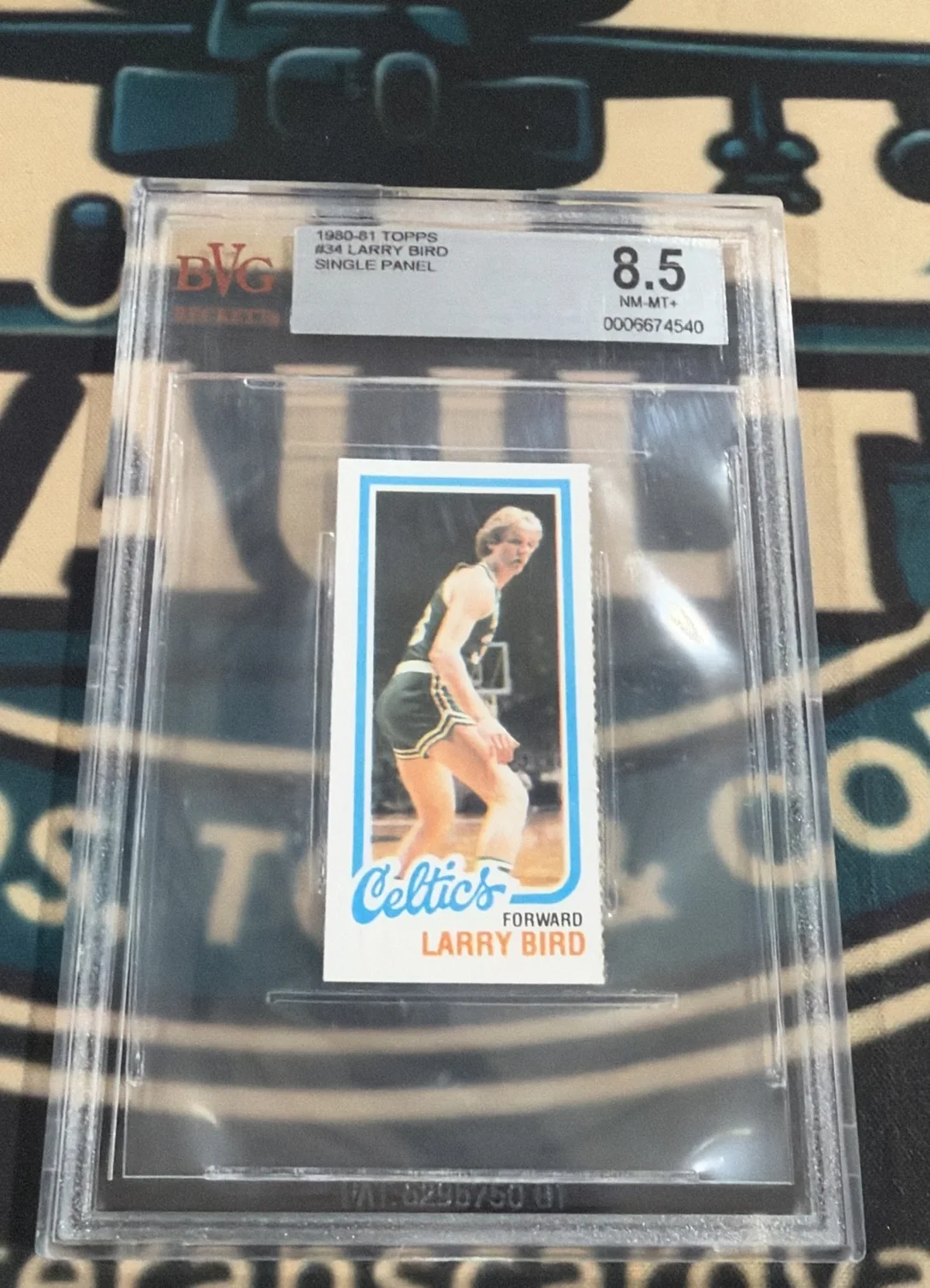
Card #34 sits on the same three-panel strip as Magic Johnson and Julius Erving. Separated panels ask $80 to $250, intact strips more, and the condition of all three panels matters because the strip is graded as one card.
The Bird panel is the most collected of the three in New England and the least collected on the West Coast, which produces a real regional price spread. A copy that sells for $140 in California can bring $220 in Massachusetts.
Check recent eBay sold prices for the 1980-81 Topps #34 panel →
2. 1981-82 Topps #4 — the first solo Bird
The 1981-82 Topps #4 is Bird's first solo Topps card and the best value in this ladder. Raw copies ask $20 to $90 depending on centering, and it is a genuinely attractive card with the Celtics green and a clean portrait.
High-grade examples are scarce for the era: a PSA 9 recently asked $1,700, which is an outlier against $150-ish PSA 8s. That spread is the reason to buy raw and enjoy it rather than chase a grade.
Check recent eBay sold prices for the 1981-82 Topps #4 →
3. 1981-82 Topps #101 — the Super Action card
The East Super Action subset card is the cheapest vintage Bird with an action photo. Raw copies ask $15 to $35, and it is the card to buy if you want a 1981 Bird for the price of a modern insert.
It is also the card most often confused with the #4 in listings, because both are 1981-82 Topps Birds and neither title usually names the subset. Check the number.
Check recent eBay sold prices for the Super Action card →
4. Certified autographs — the affordable Bird signature
Certified Bird autographs ask $190 to $325 for licensed on-card examples, with premium low-numbered cards running higher. The 1988 Fleer signed card in a PSA/DNA 10 holder sits at the top of the normal range.
As with every autograph in this series, the risk is unverified ink. A $100 "signed" Bird with a generic COA is not the same asset as a $250 slabbed auto, and the market prices the difference correctly.
Check recent eBay sold prices for certified Bird autographs →
5. 1980-81 panel in PSA 9 — the graded grail
A PSA 9 panel is the vintage grail in this article. Recent asks sit at $2,500 to $5,000 depending on centering and whether the strip is intact, and the population is small because perforated strips rarely survive forty-five years without a crease.
The premium over a raw panel is roughly ten times, which is steep even by vintage standards. That tells you the market values the slab more than the cardboard, and it is why buying the grade is usually cheaper than submitting.
Check recent eBay sold prices for graded Bird panels →
6. 2026 Topps Chrome Update 1980-81 auto /50 — the modern grail
Topps put a 1980-81 Topps autograph insert into 2026 Chrome Update, and the gold-geometric /50 version asks around $700. It is a modern card with vintage artwork and a certified on-card signature, which is a combination the hobby has been chasing all year.
The appeal is liquidity. A /50 modern auto is easy to sell, easy to authenticate and does not depend on a forty-five-year-old strip surviving intact. The downside is that it is not a rookie card and never will be.
Check recent eBay sold prices for the 2026 Chrome Update Bird auto →
How to buy a Bird rookie without confusing the panels
The single biggest mistake in this market is buying a separated panel at intact-strip money. Ask for a photo of the full strip, confirm the perforations are intact, and check that the Bird panel is #34 rather than a reprint of the artwork.
If you want a graded example, buy the grade. The raw-to-9 spread is ten times, so a $200 submission on a $200 card is a lottery ticket with terrible odds. A PSA 8 at a third of the 9 price is the sensible collector buy.
If you want the signature, buy the 2026 Chrome auto instead. It is liquid, authenticated and cheaper than a signed vintage panel with a questionable COA. The Magic Johnson guide covers the same panel from the other side, and the vintage grading guide covers the era.
Handle the strip like the fragile object it is. The perforations are forty-five years old, and a strip that arrives folded in a plain envelope is a strip that has just lost half its value. Insist on rigid packaging, photograph the strip on arrival before you open anything, and keep the packaging until you have confirmed the panels are intact.
When you sell, do not separate the strip to "improve" it. Intact strips are the card, separated panels are fragments, and the market pays for completeness. The only reason to break a strip is if one panel is damaged beyond collecting and the others are clean, which is a decision for a dealer rather than a collector.
The 2026 Chrome Update autograph is the other side of that trade. It is a modern card with a certified signature and a vintage design, priced around $700 for the /50, and it will always be easier to sell than a forty-five-year-old strip. If your goal is a Bird signature rather than a Bird rookie, the modern insert is the better purchase; if your goal is the rookie, the panel is the only answer and the signature is a bonus you should not pay a premium for. The one exception is a panel signed by all three players: that card is scarce enough that the combined signatures carry their own premium, and it should be priced as a multi-player autograph rather than a Bird rookie with ink on it.
- Confirm the card is the intact three-panel strip, not a separated #34.
- Check all three panels for creases along the perforations.
- Verify the Bird panel is #34 and the strip carries #139 and #174 as well.
- For graded copies, match the cert number to the PSA database.
- Compare regional sale prices — Bird panels sell higher in New England than on the West Coast.
A pre-grade scores centering and corners but cannot confirm the strip is intact. Use the AI pre-grade on a full-strip photo, and check current pricing before submitting.
Run a free AI pre-grade on your card →
Watch and learn
Two packs of 1980 Topps basketball opened on camera in a hunt for the Larry Bird rookie. Useful for seeing how the three-panel strips come out of the pack.
Video: Opening TWO 1980 TOPPS Basketball Packs! Hunt for Larry Bird Rookie! — Jim's Classic Cards on YouTube
Frequently Asked Questions
Is the 1980-81 Topps #34 Larry Bird's rookie card?
What is a Larry Bird rookie card worth in 2026?
Is a separated Bird panel worth buying?
Why is the Bird panel more expensive than a solo second-year card?
What is the 1981-82 Topps #101 Super Action card?
Are 2026 Topps Chrome Update Bird autographs a good buy?
How often do 1980-81 Topps panels grade a 9?
Should I buy Bird or Magic on the same panel?
What should I check before buying a signed Bird rookie?
Are there reprints of the 1980-81 Topps Bird panel?
Does the Bird panel grade better than the Magic panel?
Sources & Further Reading
- eBay sold listings — 1980-81 Topps Larry Bird 34 rookie
- Basketball-Reference — Larry Bird career stats
- PSA CardFacts — population reports
- CardLadder — basketball market data
- Topps — 2026-27 Flagship Basketball
- PSA — 1980-81 Topps Basketball set registry
Create a free account and get 2 free credits. No credit card required.
Get Your Free Credits →