The Short Answer
- Prizm's chrome construction is a double-edged sword — the opti-chrome layering that makes Silver and color pops so desirable also makes print lines, micro-pits, and surface scratches visible at any angle.
- Print lines are the #1 PSA 10 killer. A line visible to the naked eye under light is functionally disqualifying for Gem Mint — faint ghost lines that only appear at 45° under magnification can still slide into a 10.
- Prizm runs a documented left-right centering bias — many modern products trend toward 55/45 or worse out of the pack, and PSA's front standard caps at 55/45. Measure, don't eyeball: the Prizm logo creates a visual illusion that hides bottom-border skew.
- Silver-border chipping is factory-born. Micro-chips under ~0.1mm can survive a 10; visible chips in the silver border frame cap you at 8–9.
- Not all parallels grade equally — thick, multi-layered parallels (Mojo, choice black/gold) show more surface drama than base Silver, and sticker autos carry their own edge risk.
- Pre-screen every Prizm. At PSA's $59.99+ open tiers, submitting a print-lined or off-center Prizm is paying retail for a PSA 8 that sells at raw price. Two minutes with a lamp — or a scan through an AI pre-grade — filters most of them out.
Why Prizm Is the Hardest Flagship to Gem
Panini Prizm has been the modern basketball flagship since 2012-13 and the measuring stick for football chromium since 2016 — it's the most-submitted modern product at PSA, and it produces a disproportionate share of disappointed submissions. The reason is structural: Prizm isn't printed on card stock like a Topps flagship. It's an opti-chrome laminate — foil layers fused to board under high-speed rollers. Every layer seam, every roller pass, every die-cut is a potential visible defect, and chrome shows all of it.
Paper cards hide minor flaws in texture. Chrome cards can't. A surface micro-scratch invisible on paper reads as a bright scar across a Prizm Silver. That manufacturing reality is why Prizm PSA 10 rates lag paper-based flagship products and why the product dominates both "should I grade this" searches and junk-slab inventory.
Our own set-level condition data tracks this systematically — the Panini Prizm Basketball condition profile documents a 42% gem rate with micro-pit incidence running roughly 350% higher in the 2020–24 high-volume era, plus a persistent ~55/45 left-right centering skew baked into the cutting process. In other words: the product ships with a majority of copies that can't gem, straight out of the pack.
The Four Defect Classes That Kill Prizm Grades
1. Print lines (roller marks)
The most notorious Prizm defect. A microscopic debris piece caught in the chrome lamination press leaves a straight groove — usually vertical — across the card face. PSA treats visible print lines as surface defects: a line you can see under normal light without magnification effectively eliminates a 10. The nuance that matters: ghost lines (a colorless shallow seam visible only at a specific tilt angle) frequently pass, while roller marks (physical depth you can feel with a fingernail, or lines crossing the player's face) cap the card at 8–9. The 2023-24 basketball run had an especially heavy incidence — treat any copy from that era as suspect until inspected.
2. Silver-border micro-pits and chipping
The iconic Silver Prizm border is thin foil over cut edges. Mechanical cutting leaves micro-pits — tiny depressions in the refractive layer — concentrated near the border. PSA's tolerance: a single pin-point pit invisible at arm's length can survive a 10; two or more visible pits, or any chip that breaks the border frame line, caps the card around 8.5–9. Our set profile logs this as the "two pits = capped at 8.0/8.5" rule.
3. Edge chipping on the cut
Chromium layers don't cut cleanly like paper — they flake. Check all four edges under raking light for silver flecks missing from the edge line, especially corners. Edge chipping reads as "edge wear" to a grader even though it's factory-born, and it hits the edges sub-grade directly.
4. Surface scratches and wipe marks
Chrome scratches if you look at it wrong — sleeve rub from a too-tight fit, a careless wipe with a dry cloth, even sliding into a semi-rigid. These are owner-caused (not factory) and graders treat them identically to wear. Handle Prizm with gloves or clean dry hands, and only ever soft-penny-sleeve fresh pulls.
The Centering Problem Nobody Sees
Ask PSA submitters what kills Prizm grades and most say print lines. The data says otherwise: centering is the quiet serial killer. Modern Prizm cutting produces a left-right bias — copies trend 55/45 or worse straight from the pack, right at PSA's Gem Mint boundary. The 2012-13 debut set (the most valuable Prizm vintage) is notoriously bad.
Two optical traps specific to this product:
- The silver border reflects ambient light, making a skewed card look centered at a glance. The flash that makes Silver attractive actively camouflages off-center cutting.
- The Prizm logo placement at the bottom border visually fattens the lower frame — a card can measure 60/40 top-to-bottom on the back while looking "fine" on the front.
PSA's standard is 55/45 front / 75/25 back for a 10. On a product that ships biased to 55/45, a huge fraction of fresh pulls live within one measurement error of the line. This is the single highest-value thing to actually measure before submitting — our centering analysis reads the exact ratios from a photo, which beats the ruler-and-squint routine.
Which Prizm Parallels Actually Grade Well
Prizm's parallel rainbow is a grading minefield with real variance:
| Parallel tier | Grading behavior | Submit? |
|---|---|---|
| Base Silver | Best-conditioned copies; thin chrome shows pits but card is structurally stable | Yes — if measured clean |
| Color parallels (Red, Blue, Green, Purple) | Colored edges chip visibly; edge flaws show MORE against colored borders | Yes — inspect edges twice |
| Premium patterns (Mojo, Hyper, Choice) | Extra pattern layers = more surface defects; heavier stock | Carefully — surface first |
| Serial-numbered color | Same defect profile, but the print run raises stakes on every flaw | Yes — highest ROI targets |
| Sticker autos | Sticker edges lift, peel, and attract surface scrutiny | Only on clean copies |
| Downtown / case hits | Full-bleed art, thicker stock, edge and corner fragility | Yes — worth grading even at 9 |
The pattern: card value changes the math more than the card type does. A numbered color parallel at PSA 9 can still profit; a base Silver at PSA 9 of the same player usually doesn't cover the fee.
Year-by-Year: Where the Landmines Are
Prizm quality is not constant — Panini's volume surges degraded QC in specific windows:
- 2012-13 (the grail set): Kawhi/Giannis/Lillard rookie year. First-year opti-chrome produced severe centering variance — true 50/50s from this set are legitimately scarce. The highest-stakes grading Prizm there is; measure everything.
- 2016-19 (football expansion): Mahomes 2017 era. Quality stabilized but edge chipping on early football color parallels is endemic.
- 2020-24 (volume era): Post-boom print runs exploded. Micro-pit incidence spiked ~350% per our profile data, and 2023-24 carries the heaviest print-line contamination of the chrome era. If you pulled retail Prizm in those years, assume surface inspection is mandatory, not optional.
- 2025-26 (current): Volume stayed high but QC complaints shifted toward centering drift on retail SKUs (blasters/megas worse than hobby). Hobby-box pulls still grade best.
Retail vs Hobby: Where Gemmable Prizm Actually Comes From
Not all Prizm enters the market equal. The SKU you pulled from changes the copy's defect odds before you ever look at it:
- Hobby boxes produce the best-conditioned copies — tighter QC windows, better collation, fewer handling defects between pack and sleeve. If you're buying raw to grade, hobby-sourced singles are the safer inventory.
- Retail blasters/megas are the worst performers in complaint data: looser wrap tolerances let cards shift in transit, and the retail print runs carry heavier centering drift. The retail-exclusive parallels are worth grading because they're retail — scarcity outweighs the defect tax — but expect a higher rejection rate at pre-screen.
- Choice/First Off The Line sit between the two — better QC than retail, with premium-pattern parallels that bring extra surface risk of their own.
The practical implication for flippers: when you're buying raw Prizm on the secondary market, provenance is a grading variable. A "pack fresh" claim from a hobby break is worth a few dollars more than the same card from an unknown retail rip — and worth even more if you can see the break video.
The PSA 10 Economics of Prizm
Prizm grading math punishes optimism because the 9-to-10 cliff is the steepest in the modern market. On a typical star rookie Silver: raw sells around $40–60, PSA 9 around $60–80, PSA 10 at $300+. At a $59.99 fee plus shipping, the PSA 9 outcome is break-even at best — you're grading for the 10 or you're donating fees.
That shapes the strategy: only submit copies that pass all four gates — measured centering ≤55/45 front, zero visible print lines under raking light, clean border frame (no pits breaking the silver line), and untouched edges. A Prizm that clears all four has a real shot at the multiple that pays for the misses. One that fails any gate is raw inventory, period.
For numbered parallels and case hits, relax the grade floor: a /99 Green at PSA 9 can still beat raw by enough to justify the fee, because scarcity inflates every rung of the ladder.
The 90-Second Prizm Pre-Screen
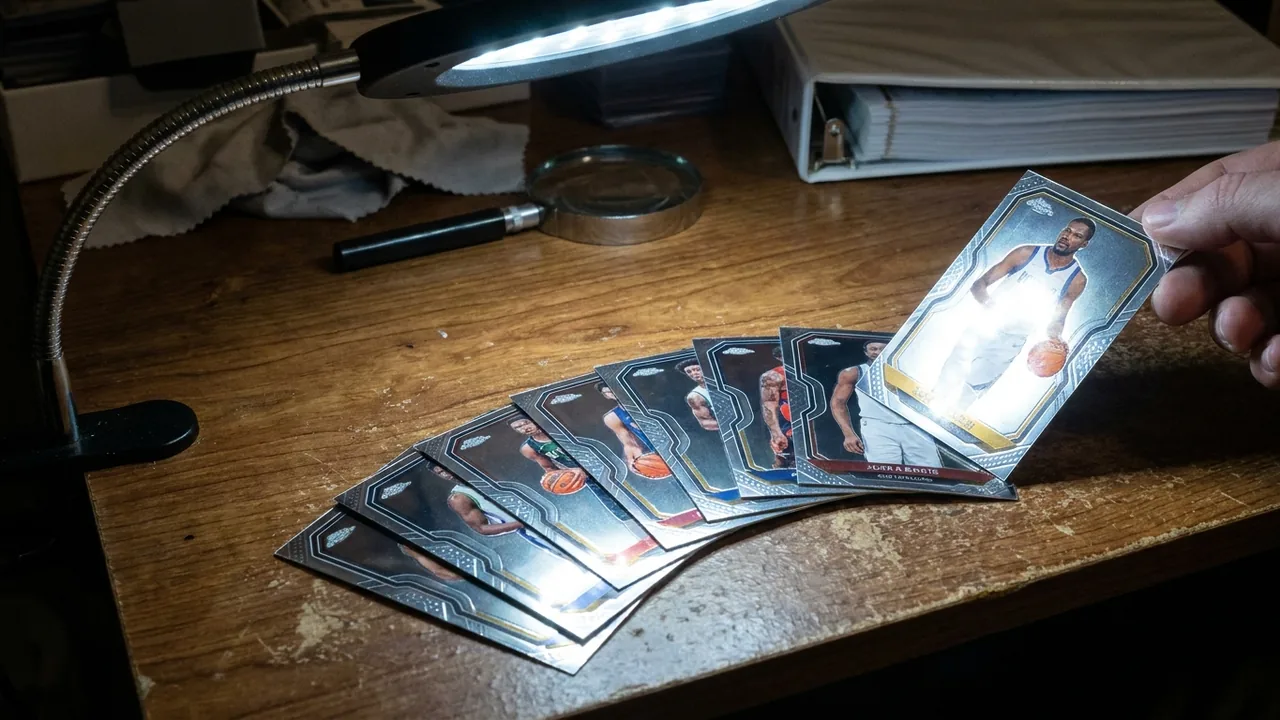
- Raking light, both faces. LED desk lamp, card tilted ~30–45°. Any line that appears at multiple angles = roller mark = cap at 9. Ghost lines only visible at one extreme angle are candidates for a 10.
- Border frame check. Trace all four silver borders for pit clusters and chips breaking the frame line. Two visible pits = done.
- Edge scan. Rotate through raking light along each edge for chrome flaking — worst at corners.
- Measure centering. Don't trust your eye on silver borders — the shine lies. Use a centering tool, calipers, or a centering scan. Over 55/45 front is an automatic hold.
- Back check. The back is where missed print lines live — inspect it with the same raking-light pass.
- Handle like a crime scene. Fresh sleeves, clean hands, no bare-thumb contact with the chrome face — a fingerprint you add today is a surface defect on the grader's desk in 60 days.
Or skip the ritual and run the card through an AI pre-grade — the model reads centering ratios, edge whitening, and surface defects from a photo in seconds, and for Prizm specifically it catches the print lines that hide until you're tilting the card in exactly the wrong light. Screen a stack of pulls, submit the ones that clear all four gates, and your Prizm submissions stop being a donation.
The collectors who profit on Prizm aren't luckier — they're the ones who understood before submitting that the product fights you at the factory level, and they priced the fight into which copies ever saw a submission form.
Frequently Asked Questions
Do print lines on Prizm cards kill the PSA 10?
A print line visible to the naked eye under normal light effectively eliminates Gem Mint 10. Faint ghost lines visible only at extreme tilt angles under magnification can still sneak into a 10 — but any line you can feel with a fingernail or that crosses the player image caps the grade at 8–9.
Why are Prizm cards so hard to grade?
Prizm's opti-chrome laminate construction — foil layers fused under high-speed rollers — creates factory-born defects paper cards don't have: roller print lines, silver-border micro-pits, edge flaking on the cut, and a documented ~55/45 centering bias. Chrome shows every flaw; paper hides them.
What PSA 10 rate should I expect on Prizm?
Lower than paper products. Set-level condition data puts modern Prizm basketball gem rates around 40% for submitted copies — and raw-from-pack rates are worse since most people submit the good-looking ones. The 2020–24 volume era has the worst defect incidence, especially print lines in 2023-24.
Is it worth grading Prizm cards?
Only for copies that pass all four checks: measured ≤55/45 front centering, no visible print lines, clean border frames, and untouched edges — and only when the PSA 10 premium dwarfs the ~$60+ all-in fee. Base Silvers at PSA 9 rarely profit; numbered parallels and case hits can profit at 9.
Which Prizm parallels are best to grade?
Serial-numbered parallels and case hits (Downtown) have the strongest grading economics because scarcity inflates every grade rung. Base Silvers are the highest-volume submissions but need a true gem copy to pay. Premium pattern parallels (Mojo, Choice) carry extra surface-defect risk from additional print layers.
What should I check first on a Prizm before grading?
Centering — it's the most common disqualifier and the least visible one. Silver borders optically hide skew, so measure rather than eyeball. Then raking-light surface inspection for print lines, then the border frame for pits and chips.
Sources & Further Reading
- PreGradeCards Set Condition Profile: Panini Prizm Basketball
- PSA Grading Standards
- Cardszn: Prizm Print Lines Explained
- Business of Card Grading: Complete PSA Grading Guide
With submission floors rising, pre-screening is no longer optional. Use our AI Pre-Grade Calculator to score a card's PSA 10 odds before you pay, and the Submission Planner to pick the right tier.