The Short Answer
- Whitening is the white card core showing through the printed border — caused by friction, handling, or pack insertion
- Pokemon's blue card backs make whitening far more visible than on white-bordered cards
- PSA 10 requires near-perfect edges; even light whitening usually caps a card at PSA 8-9
- Check edges under angled bright light — whitening hides in direct light and reveals itself in reflection
- Factory whitening from pack insertion can still grade 9-10 if minimal; grader tolerance varies by era
- AI pre-grading catches edge whitening systematically across all four edges before you pay to submit
The Defect That Kills More PSA 10s Than Any Other
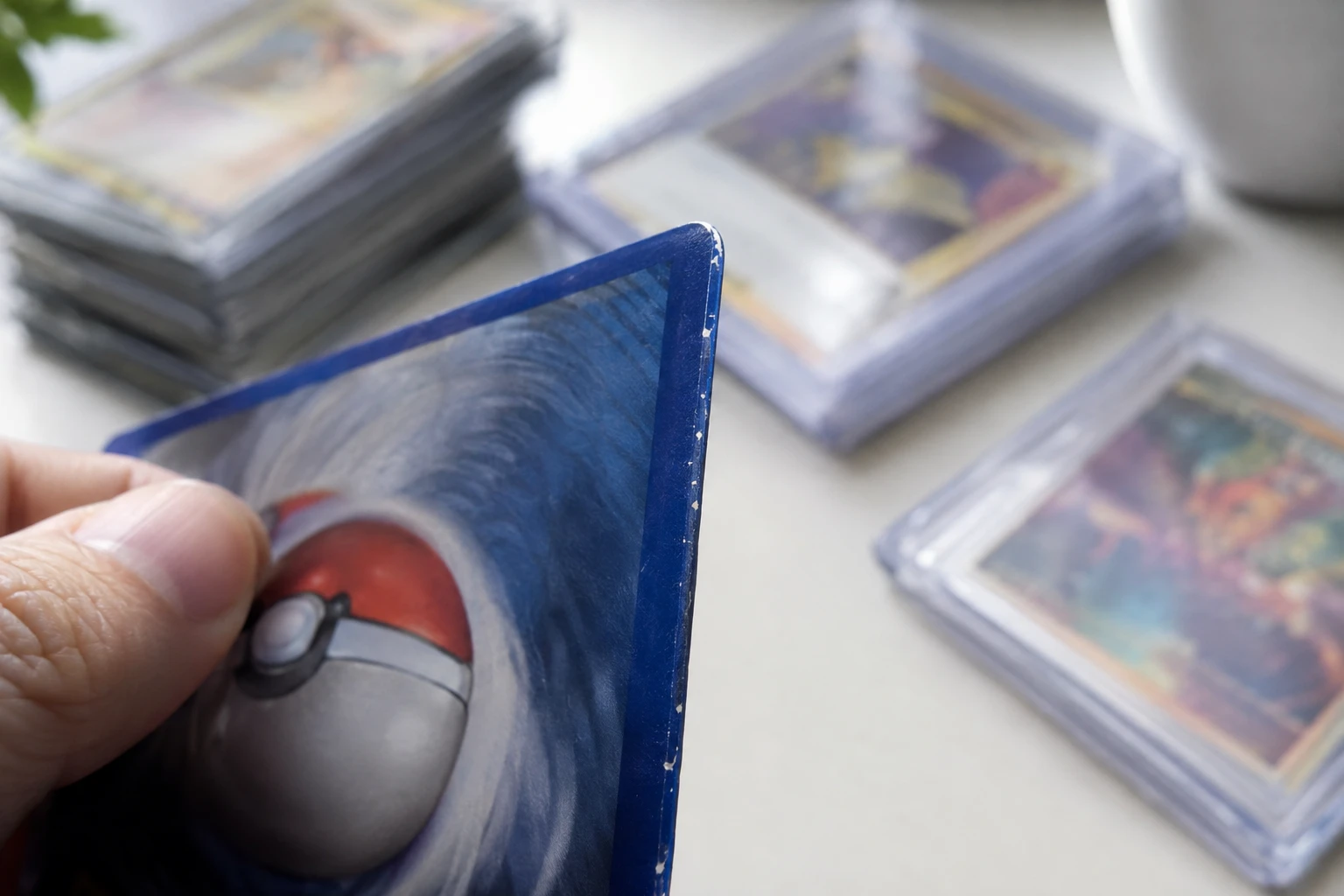
Whitening is the white interior core of a trading card showing through its printed border along the edges — appearing as tiny white specks, dots, or a faded line along the card's perimeter. On Pokemon cards it concentrates on the blue-bordered back, where white-on-blue contrast makes even microscopic damage visible.
Ask any volume submitter what single defect most often turns an expected PSA 10 into an 8 or 9 and the answer is whitening — precisely because it's the easiest flaw to miss. A card can look perfect face-up on a table and carry edge whitening that only appears under angled light.
This guide covers how whitening forms, the lighting technique that reveals it, how each grading company weighs it, and the submit-or-don't decision framework.
What Is Whitening, Exactly?
A trading card is a layered construct: printed surfaces over a fibrous white (or blue-core) interior. When an edge's printed layer is abraded, nicked, or imperfectly cut, the white core becomes visible — that's whitening, also called edge wear, silvering, or edge chips depending on severity and who you ask.
Whitening appears in three forms:
- Specks: isolated white dots along an edge — often from factory cutting or pack insertion.
- Edge lines: continuous or patchy white lines along a side — typically friction wear from storage or handling.
- Corner whitening: white breakthrough specifically at the four corners — the most heavily weighted location, since corners are also graded independently.
Related but distinct: chipping is physical loss of material (visible notch), and rough-cut edges are factory-deckled edges that show core fiber without wear — common on vintage and some modern TCG stock.
Why Pokemon Cards Show It Worst
Pokemon cards are uniquely vulnerable to visible whitening for one simple reason: the deep blue border on every card back. White core against dark blue produces maximum contrast — a single speck that would be invisible on a white-bordered card or a light-backed card stands out on a Pokemon back like a paint chip on a black car.
Compounding factors:
- Holos and full-arts: textured and foil surfaces scratch and edge-wear readily, and collectors submit them disproportionately.
- Pack insertion: cards are machine-inserted into tight packs — rear-edge whitening straight from the pack is common, especially on chase cards collectors then submit.
- Japanese vs English stock: Japanese Pokemon cards use slightly different card stock and coatings; their whitening patterns differ, and grading-community tolerance conventions differ by market.
- Back-first damage: fronts face plastic in packs and sleeves — backs take the friction.
Bottom line: on a Pokemon card, assume the back edges deserve more scrutiny than the front.
How to Check Edges for Whitening
Whitening is invisible under flat, direct light — the technique is angled illumination:
- Lighting: a bright desk lamp or phone flashlight held at a low angle (15-30°) to the card edge, not shining straight at it.
- Rotation: slowly tilt and rotate the card so light rakes across each of the four edges in turn.
- Edge-on inspection: hold the card edge-on and look along its length — edge wear creates a slightly ragged, lighter-colored line profile.
- Magnification: a 10x jeweler's loupe resolves specks the naked eye blurs — worth it on any card you're paying $50+ to grade.
- All eight edges: don't forget the front border and the back — and each corner individually.
Or skip the manual work: AI pre-grading inspects every edge pixel-by-pixel from front/back photos and flags whitening systematically — it doesn't have a tired-eye problem.
How Whitening Affects the Grade
| Whitening Severity | Typical PSA Outcome | Typical CGC/BGS Outcome |
|---|---|---|
| None visible at 10x | 10 possible | 10 / Pristine possible |
| 1-2 micro specks, non-corner | 9 likely, 10 possible | 9.5 likely |
| Visible specks or short edge line | 8-9 | 9-9.5 |
| Continuous line or corner whitening | 8 or lower | 8.5-9 |
| Heavy wear + chips | 7 or lower | 8 or lower |
Grader tolerance notes: PSA historically shows slight leniency toward a single pinhead speck if everything else is perfect — that's why "possible 10" appears on the first line. BGS subgrades expose the damage explicitly (Edges subgrade), so a strong card can still total 9.5 with an 8.5 edge. CGC grades comparably to PSA.
Era leniency: graders implicitly calibrate to era — a pack-fresh 1999 Base Set card gets more benefit of the doubt on micro-factory imperfections than a 2026 card. Don't rely on it.
Factory Whitening vs Handling Wear
Not all whitening is equal in origin:
Factory whitening — the card left the pack with it. Common causes: pack insertion friction, cutting-edge dullness, and sealed-booster pressure points. Graders often view isolated factory specks more charitably than wear — a truly pack-fresh card with one factory speck can still 10.
Handling wear — from storage, sleeving technique, binder friction, or shuffling. Wear tends to be distributed along an edge or corners rather than isolated, and graders read it as use, not manufacture.
The practical implication: if you're opening fresh product for grading candidates, the risk isn't you — it's the pack. Sleeve chase cards immediately on pull, and edge-check before the card ever touches a binder page.
Grade or Don't: The Whitening Decision
Whitening changes the submit decision on a case-by-case basis:
Still worth grading:
- High-value vintage where an 8 still carries significant value.
- Cards where a 9 retains most of the value (many modern chase cards).
- Minimal specks on an otherwise flawless card — the 10 lottery ticket is live.
Probably skip:
- Modern cards needing a 10 to profit, showing visible edge lines — your realistic outcome is 8-9, underwater after fees.
- Low-value cards with any whitening — grading cost exceeds any realistic outcome.
The systematic answer: run the card through AI pre-grading first — it maps edge defects explicitly and returns a grade prediction, turning the whitening judgment from guesswork into a measured decision. Check our PSA 10 requirements checklist for how edge condition fits into the full grading standard.
Frequently Asked Questions
What is whitening on a Pokemon card?
Can a card with whitening still get a PSA 10?
How do you check a Pokemon card for whitening?
Is whitening worse on Japanese or English Pokemon cards?
Does whitening affect BGS subgrades?
Sources & Further Reading
- PSA Grading Standards
- Beckett Grading Services
- PreGradeCards — PSA 10 Requirements Checklist
- PreGradeCards AI Card Grading
The PreGradeCards Research Team combines machine-learning engineers, grading analysts, and collector-education specialists to produce accurate, data-driven guides on AI card grading, professional grading standards, and collecting strategy.
With submission floors rising, pre-screening is no longer optional. Use our AI Pre-Grade Calculator to score a card's PSA 10 odds before you pay, and the Submission Planner to pick the right tier.