The Short Answer
- PSA 10 centering tolerance: approximately 60/40 or better on the front, 90/10 on the back
- All four corners must be sharp — no whitening, rounding, or dings visible under scrutiny
- Edges must be clean — whitening on dark borders is the most common 10-killer
- Surface must be free of print lines, scratches, dimples, stains, and wax
- PSA 10 allows only the most minute factory imperfections — 'virtually perfect' is the standard
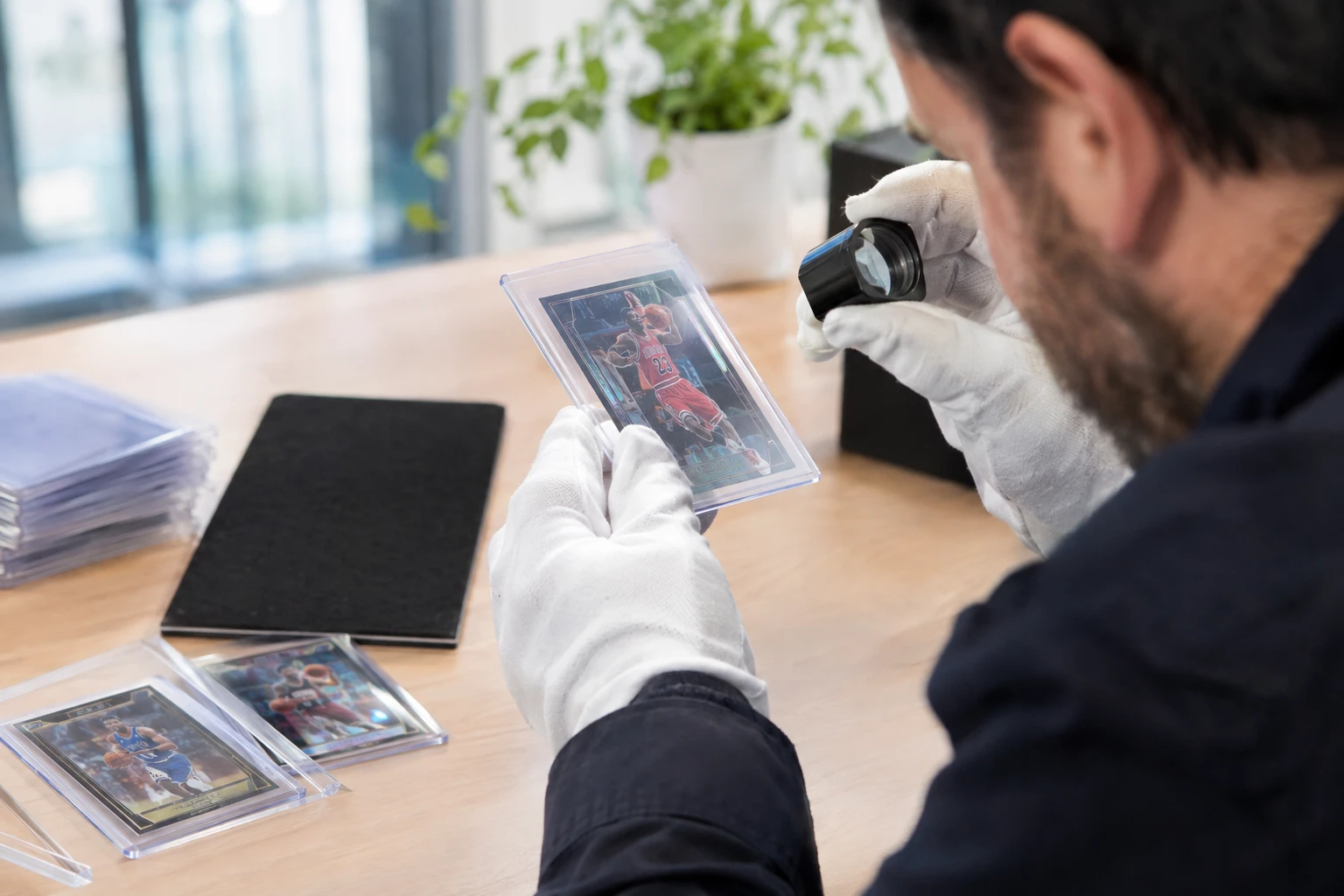
- Pre-screening with AI grading or a loupe raises your effective gem rate 2-4x vs blind submission
What PSA 10 Actually Means
PSA defines Gem Mint 10 as "a virtually perfect card" — sharp corners, full original gloss, no surface defects, and centering that falls within tight tolerances. It's the only grade that tolerates essentially nothing.
That single sentence carries more nuance than it looks. "Virtually perfect" is a judgment call exercised by human graders against thousands of cards daily — which is why understanding the practical tolerances (not just the official language) is what separates profitable submissions from donation boxes.
This checklist breaks the standard into its four graded components, gives you the actual tolerance numbers, and provides a repeatable self-inspection method.
The Official PSA 10 Standard
Per PSA's grading standards, a Gem Mint 10 card exhibits:
- Four sharp corners — no wear, whitening, or softening visible under scrutiny
- Sharp focus and full original gloss — no dullness, fading, or surface degradation
- No staining — though a minor printing imperfection is acceptable if it doesn't impair overall appeal
- Centering within approximately 60/40 front, 90/10 back (see tolerances below)
- No flaws visible to the naked eye under normal viewing
Read that last line again: "no flaws visible to the naked eye" is the operative phrase. Graders work under good light with years of pattern recognition — "naked eye" at PSA's bench is a much higher bar than naked eye on your kitchen table.
Centering: The Mathematical Filter
Centering is the only component with a quasi-numeric standard, making it the easiest to check objectively:
| Grade | Front Centering | Back Centering |
|---|---|---|
| PSA 10 | ~60/40 or better | ~90/10 or better |
| PSA 9 | ~65/35 or better | ~90/10 or better |
| PSA 8 | ~70/30 or better | ~90/10 or better |
| PSA 7 | ~75/25 or better | ~90/10 or better |
How to measure: centering is expressed as the ratio of border widths — left/right (or top/bottom, whichever is worse). A card with a 4mm left border and 2.6mm right border is 60/40 — the outer limit for a 10. Measure with a ruler, a centering tool, or our free centering checker.
Which axis counts: both — the card must satisfy tolerance on its worst axis. And modern cards fail front centering far more often than back, since backs use a fixed design.
Corners: Zero Tolerance Zone
All four corners must present as sharp and unworn. What graders reject at 10:
- Whitening — white core showing at the corner tip
- Softness/rounding — even slight radius from handling
- Bends or creases — corner dings are an automatic cap well below 10
- Factory nicks — cutting imperfections at the tip still count
Check corners under magnification at an angle — corner whitening shows clearly under a raking light even when invisible face-on. Corners are graded front AND back; a clean front corner with a whitened back corner is still a defect.
Edges: Where Most Modern Cards Die
Edge requirements for a 10: clean, consistent border color along all four sides, front and back, with no whitening, chipping, or roughness attributable to wear.
The dominant failure mode on modern cards — especially dark-bordered Pokemon backs — is edge whitening: micro-specks of white core showing through the printed border from pack insertion or handling. Deep-dive in our whitening detection guide.
Tolerance in practice: a single pinhead speck that appears factory-caused can survive on an otherwise perfect card. A continuous whitening line or multiple specks caps at 8-9.
Surface: The Invisible Killers
Surface must be free of defects under inspection — this is where print-era problems concentrate:
- Print lines — roller lines across holo surfaces; the signature modern killer on chrome and foil cards
- Scratches — hairline surface marks from handling or pack friction
- Dimples/indents — small pressure spots
- Wax, gum stains, residue — vintage issue
- Loss of gloss — dull or wiped surface finish
- Ink defects — minor print dots may pass as "imperfections," but anything distracting does not
Detection method: tilt the card slowly under a bright lamp — surface lines and scratches only appear at reflection angles. Face-on under diffuse light, they're invisible.
The 5-Minute Self-Inspection Method
- Centering (60 sec): measure front borders on both axes; check back. Fail = not a 10.
- Edges (90 sec): raking light, rotate through all four edges both sides. Note any whitening.
- Corners (60 sec): loupe or macro photo each corner at an angle. White tip = defect.
- Surface (90 sec): tilt-and-scan under bright light, front and back, hunting lines/scratches/dimples.
- Honesty check: if you found anything you had to convince yourself was "probably fine," it isn't.
Faster alternative: AI pre-grading runs the same four-component inspection from photos — centering measurement, edge maps, surface defect flags — and returns a predicted grade range in seconds.
Realistic Expectations
Two truths to hold simultaneously:
Most cards can't grade 10. Published gem rates on modern cards run 25-60%; vintage is under 10%. See our gem rate guide for the distribution data.
Your odds aren't the published odds. The population rate includes every unscreened submission. Screened submissions — the four-component check above, or AI pre-grading — routinely run multiples of the population rate because you're filtering out the 8s before they ship. Pre-screening is the entire edge.
And remember the economics: at ~$60-95 all-in per card, submitting a card that grades 9 when you needed 10 is a loss. Grade the ones that pass the checklist cleanly.
Frequently Asked Questions
What are the requirements for a PSA 10?
What centering does PSA 10 allow?
Can a card with whitening get PSA 10?
Is PSA 10 hard to get?
What kills a PSA 10 most often?
Sources & Further Reading
- PSA Grading Standards
- PreGradeCards Centering Checker
- PreGradeCards AI Grading
- PSA Population Report
The PreGradeCards Research Team combines machine-learning engineers, grading analysts, and collector-education specialists to produce accurate, data-driven guides on AI card grading, professional grading standards, and collecting strategy.
With submission floors rising, pre-screening is no longer optional. Use our AI Pre-Grade Calculator to score a card's PSA 10 odds before you pay, and the Submission Planner to pick the right tier.