The Short Answer
- Mega Darkrai ex SIR is the set's top grading target at $2,875 PSA 10 (PriceCharting data), with raw prices settled at $150–$250.
- Post-launch raw prices have settled — the initial hype premium has faded, making grading economics clearer than at launch.
- Only 5–7 cards in Pitch Black justify PSA Regular at $79.99/card based on current PSA 10 premium math.
- Textured full-art cards (SIRs) are the primary grading targets — they carry the highest raw values and strongest graded premiums.
- Pre-screen every Pitch Black pull with AI before submitting. The set's dark color scheme makes surface issues harder to spot visually.
How have Pitch Black card prices changed since launch?
Mega Evolution—Pitch Black released on July 17, 2026, and four weeks of market data have now settled the raw price landscape. The initial launch hype premium has faded, and cards are trading at more sustainable levels. This is actually good news for grading economics — when raw prices are stable, you can run accurate break-even math instead of guessing.
The general pattern for modern Pokemon sets is a 30–50% raw price decline in the first 4–6 weeks after launch, followed by a slower decline or stabilization as the market absorbs the supply. Pitch Black has followed this pattern. Cards that debuted at $300+ raw on launch weekend have settled to $150–$200. The chase cards are still valuable, but the speculative premium has been competed away.
For grading purposes, the post-launch period is when the real math becomes clear. At launch, a $300 raw card with a potential PSA 10 value of $600 looks like a strong grade candidate. Four weeks later, that same card at $175 raw with a PSA 10 value of $500 is still profitable — but the margin is thinner and the pre-screening filter matters more. You cannot afford to submit a card that comes back PSA 9 when the margin is $250 instead of $400.
The key data point: PSA 10 premiums for Pitch Black chase cards are running at 3–10x raw value, depending on the card. This is consistent with recent Scarlet & Violet era sets. The premium is highest for the Special Illustration Rares and Hyper Rares — the textured, full-bleed chase cards that collectors want to display in slabs.
Which Pitch Black cards should you grade?
Based on four weeks of post-launch price data, here are the Pitch Black cards that justify PSA Regular at $79.99/card. Each card is listed with its settled raw price, estimated PSA 10 value, and the net grading profit after submission costs:
| Card | Rarity | Raw Price | PSA 10 Est. | Net Profit |
|---|---|---|---|---|
| Mega Darkrai ex SIR | Special Illustration Rare | $175–$250 | $2,875 | ~$2,575 |
| Mega Darkrai ex Hyper Rare | Hyper Rare (gold) | $120–$180 | $1,200–$2,000 | ~$1,000–$1,800 |
| Mega Zeraora ex SIR | Special Illustration Rare | $80–$120 | $600–$900 | ~$420–$720 |
| Mega Chandelure ex SIR | Special Illustration Rare | $60–$90 | $400–$600 | ~$250–$450 |
| Mega Darkrai ex Illustration Rare | Illustration Rare (full-art) | $50–$80 | $250–$400 | ~$100–$250 |
| Mega Excadrill ex SIR | Special Illustration Rare | $50–$70 | $250–$400 | ~$100–$220 |
These 5–6 cards are the only Pitch Black pulls that clearly justify the $79.99 PSA Regular fee. Every one of them is a Special Illustration Rare, Hyper Rare, or high-value Illustration Rare. The pattern is consistent across modern Pokemon sets: only the top-tier chase cards with textured, full-bleed artwork carry enough PSA 10 premium to cover the submission cost.
For each of these cards, pre-screen with AI before submitting. The net profit figures above assume PSA 10 — if the AI predicts PSA 9, the profit drops significantly. A Mega Zeraora ex SIR at PSA 9 might sell for $200–$300, barely covering the $79.99 fee. Pre-screening ensures you only submit cards with genuine PSA 10 potential.
Which Pitch Black cards are not worth grading?
The majority of Pitch Black cards should not be graded at current PSA pricing. Here is what to skip:
Standard Ultra Rares ($20–$50 raw)
The standard holographic Mega Evolution ex cards — Mega Darkrai ex UR, Mega Zeraora ex UR, Mega Chandelure ex UR — have settled at $20–$50 raw. PSA 10 values for standard Ultra Rares typically run $80–$150. At $79.99 submission cost, the margin is $10–$70 at best — and that is if you get a 10. If you get a 9, you lose money. Skip these or use CGC Economy at $15–18.
Illustration Rares Under $50 Raw
Most Illustration Rare (full-art, non-textured) cards from Pitch Black have settled under $50 raw. The grading math does not work at this price level. PSA 10 values of $100–$200 minus $79.99 submission fee leaves $20–$120 — and that is the best case. A PSA 9 would be worth $60–$100, losing money on the submission. Skip these.
Secret Rare Energy and Trainer Cards ($10–$30 raw)
The special-finish Energy cards and full-art Supporter cards in the secret-rare slot have modest raw values. While they have smaller PSA populations than Pokemon cards, the collector base for premium Energy sets is also smaller, limiting the graded premium. Skip these unless you are a dedicated Energy collector.
Prerelease Promos ($15–$40 raw)
Mega Slowbro ex, Mega Delphox ex, and Jett promos from the prerelease window have lower raw supply but also lower demand. Their graded populations will be lower, but the current raw prices do not justify $79.99 submission. Skip these or sell raw.
Common, Uncommon, and Standard Rare Foils
These should never be graded at any pricing tier. Sell raw, trade, or keep in a binder.
Mega Darkrai ex: is it the best grading target in Pitch Black?
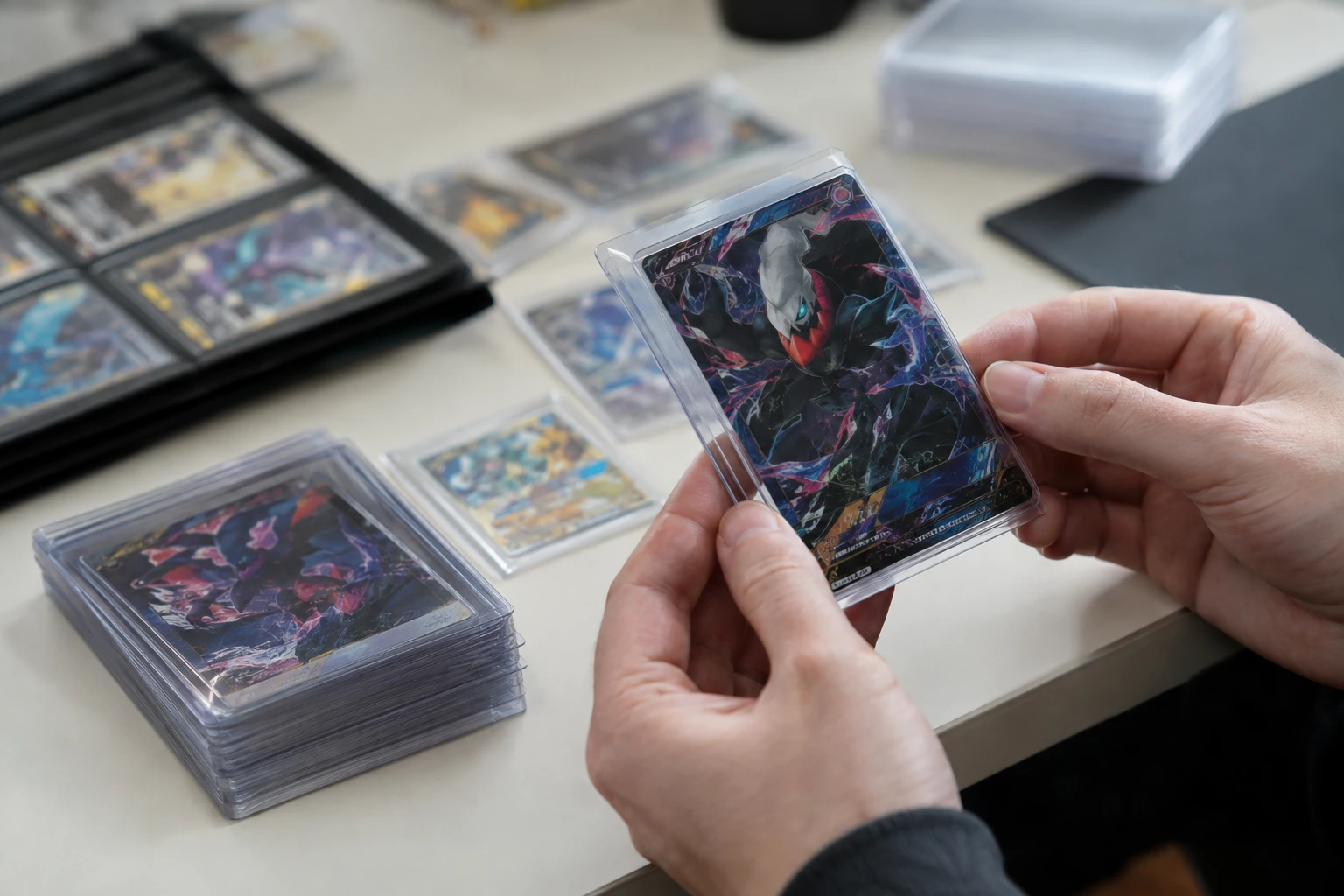
Yes. Mega Darkrai ex is the face of Pitch Black — the set mascot, the marketing headliner, and the card every collector wants. It appears in multiple rarities, and the Special Illustration Rare (SIR) version is the set's grail card.
The SIR version features full-bleed, textured artwork with Mega Darkrai ex in a dramatic, dark scene that matches the set's "Pitch Black" theme. The card is visually stunning, which drives collector demand for graded copies — collectors want this card in a slab because it is a display piece, not just an investment.
The grading economics for Mega Darkrai ex SIR are the strongest in the set:
- Raw price: $175–$250 (settled, post-launch)
- PSA 10 estimated value: $2,875 (PriceCharting data)
- PSA 10 premium: 11–16x raw value
- Submission cost: $79.99 (PSA Regular) + ~$20 shipping/insurance = ~$100
- Net profit if PSA 10: ~$2,575
- Net profit if PSA 9: ~$200–$400 (PSA 9 estimated at $300–$500)
The risk-reward is exceptional. Even if the card comes back PSA 9 instead of 10, you still make a small profit. But the real money is in the PSA 10 — and that is why pre-screening is critical. A Mega Darkrai ex SIR with 55/45 centering, clean edges, sharp corners, and no surface issues is a $2,875 card. The same card with a single edge whitening spot is a $400 card. The $0.19 AI pre-grade is the best insurance you can buy on a $2,500 grading decision.
The Hyper Rare (gold) version of Mega Darkrai ex is also a strong grading target. Gold cards have a dedicated collector base, and the Hyper Rare treatment is visually distinctive. Raw prices of $120–$180 and PSA 10 values of $1,200–$2,000 make it a clear grade candidate. The gold surface shows scratches more readily than standard holo, so surface inspection under angled light is especially important.
How do you grade textured full-art cards from Pitch Black?
Special Illustration Rares and Hyper Rares have textured, full-bleed artwork that creates specific grading challenges. The texture is a physical feature of the card — embossed or debossed patterns that you can feel with your fingertips. This texture affects how light interacts with the surface and how graders inspect the card.
Surface Inspection on Textured Cards
The texture makes surface inspection harder. Scratches and print lines can hide in the texture pattern, becoming visible only when light hits at specific angles. The standard raking light inspection method still works, but you need to rotate the card through more angles to catch defects hidden in the texture. Use a single bright LED source and slowly tilt the card through 0–90 degrees on each side.
Edge Inspection on Full-Bleed Cards
Full-bleed cards (artwork extends to the card edge with no border) show edge whitening differently than bordered cards. On a standard bordered card, edge whitening appears as a white line between the border and the card edge. On a full-bleed card, edge whitening appears as a white line directly on the artwork edge — which can be more or less visible depending on the artwork colors. Pitch Black's dark color scheme actually makes edge whitening more visible, because the white core contrasts sharply against the dark artwork.
Centering on Full-Bleed Cards
Full-bleed cards do not have traditional borders, so centering is measured differently. Look for the distance between recognizable elements — the card name, set symbol, HP box — and the card edge. Compare these distances on opposite sides. The centering analysis tool can measure full-bleed card centering by detecting these reference points automatically.
Handling Textured Cards
Textured cards are more susceptible to surface damage from handling than standard cards. The texture creates micro-peaks and valleys that can collect dust and oils. Handle only by the edges, use cotton gloves if possible, and never slide a textured card across another surface. Sleeve immediately after pulling, and use a perfect-fit sleeve inside a standard sleeve for double protection.
What Pitch Black-specific pre-screening tips should collectors know?
Pitch Black has several set-specific characteristics that affect pre-screening:
Dark Color Scheme Shows Whitening More
The set's dark, atmospheric artwork means edge whitening is more visible than on brighter sets. The white cardstock core contrasts sharply against dark artwork, making even tiny edge chips immediately visible. Check all four edges under raking light at 10x magnification, paying special attention to the bottom edge where pack contact is most common.
Foil Surface Issues on All Mega Evolution Cards
All Mega Evolution ex cards in Pitch Black are foil, and the foil treatment on the full-art and SIR variants is particularly glossy. This gloss shows surface scratches more readily than matte cards. Inspect under angled LED light at multiple angles. The AI pre-grade catches these surface issues automatically from a photo.
Centering on the 120-Card Set
Pitch Black is a smaller set (120 cards: 84 base + 36 secret rares), which means tighter print runs and potentially more consistent centering than larger sets. However, the secret rare portion of the set (085/084 to 120/084) may have different centering characteristics than the base set because secret rares are printed on different sheets. Always check centering on secret rares separately.
AI Pre-Grading Workflow for Pitch Black
- Photograph front and back under bright, even light. For SIR and Hyper Rare cards, take multiple photos at different angles to capture the texture under various lighting conditions.
- Upload to PreGradeCards AI grading. The AI identifies the card, analyzes all four criteria, and returns predicted PSA and BGS grades with sub-scores.
- Check centering separately using the centering analysis tool — especially important for full-bleed SIR cards where centering is harder to eyeball.
- Sort by predicted grade: PSA 9.5–10.0 cards go to PSA at $79.99. PSA 9.0 cards go to CGC Economy at $15–18. Below PSA 9.0, sell raw.
At $0.19 per card, pre-screening your entire Pitch Black collection costs less than a single wasted PSA submission fee. The set's dark color scheme and foil surfaces make pre-screening more valuable than for brighter, matte sets — the AI catches issues that are harder to spot visually on dark cards.
Should you submit Pitch Black cards now or wait?
The timing window for Pitch Black grading is now. Here is why:
Submit now (August 2026): PSA Regular has a 40–50 business day turnaround. Cards submitted in mid-August will return in October–November 2026. This is the optimal window because:
- Pop counts are still low. Early PSA 10 slabs from any set command the highest premiums because scarcity supports value. The longer you wait, the more PSA 10 copies enter the market.
- Raw prices have settled. You can run accurate break-even math with real market data instead of speculative launch prices.
- The 30th Celebration set launches September 16, which will shift collector attention and spending away from Pitch Black. Submitting now means your graded cards return before the 30th Celebration market absorbs collector budgets.
- The November 6 30th Celebration premium product wave will generate a fresh surge of Pokemon TCG buying activity. Having Pitch Black PSA 10s listed during this period maximizes visibility.
Do not wait for PSA Value tiers to reopen. PSA's backlog is 12.4 million cards, and Value tier reopening is not expected until winter 2026 at the earliest. If your Pitch Black cards are worth grading, grade them now at Regular pricing. The premium for early PSA 10s will likely exceed any savings from waiting for cheaper tiers.
For CGC submissions: CGC Economy at $15–18 has a 60–100 business day turnaround. Cards submitted in August will not return until January–March 2027. This is a longer wait, but the lower cost makes CGC the right choice for mid-value Pitch Black cards (Illustration Rares, standard Ultra Rares) where the PSA resale premium does not cover the $65 price difference.
How will the 30th Celebration set affect Pitch Black card values?
The 30th Celebration set launches September 16, 2026 — just two months after Pitch Black. This creates a complex dynamic for Pitch Black card values:
Short-Term: Attention Shift
When 30th Celebration launches, collector attention and spending will shift dramatically toward the anniversary set. Pitch Black raw prices may dip slightly as buyers redirect their budgets to 30th Celebration products. This is a temporary effect — it happened when Prismatic Evolutions launched after Surging Sparks, and when Temporal Forces launched after Paldean Fates.
Medium-Term: Grading Queue Impact
30th Celebration is an all-foil set with guaranteed Pikachu cards per pack and a new Futuristic Rare tier. It will generate a massive wave of grading submissions — potentially the largest of any 2026 set. This will further strain PSA's already backlogged capacity (12.4 million cards) and could push turnaround times longer for all submissions, including Pitch Black cards. Submitting Pitch Black cards before the 30th Celebration submission wave is strategically smart.
Long-Term: Pitch Black Values Should Hold
The 30th Celebration set does not directly compete with Pitch Black for collector demand. They are different products: 30th Celebration is an anniversary nostalgia set with reprints and a new rarity tier, while Pitch Black is a standard expansion with Mega Evolution mechanics. Collectors who want Mega Darkrai ex will not substitute a 30th Celebration card for it. The chase cards from Pitch Black — particularly Mega Darkrai ex SIR and Hyper Rare — should hold their values independently of 30th Celebration.
The Strategic Play
Submit Pitch Black chase cards for grading now, in August 2026. Your PSA 10 slabs will return in October–November, just as 30th Celebration launches and the Pokemon TCG market is at peak attention. A PSA 10 Mega Darkrai ex SIR listed during the 30th Celebration launch window benefits from the overall surge in Pokemon TCG buying activity — even though the card is from a different set. The collectors who are buying 30th Celebration products are also the collectors who want Pitch Black chase cards in slabs.
For raw Pitch Black cards that are not worth grading, consider selling now before the 30th Celebration attention shift. Raw prices may dip slightly during the 30th Celebration launch period, then recover as the market absorbs the new set. If you are holding raw cards for long-term value, the dip is temporary — but if you are looking to sell raw, August is a better window than October.
Frequently Asked Questions
Is Mega Darkrai ex SIR worth grading?
When should I submit Pitch Black cards for grading?
Which Pitch Black cards are not worth grading?
How does the 30th Celebration set affect Pitch Black card values?
Should I use PSA or CGC for Pitch Black cards?
How do you pre-screen textured full-art cards from Pitch Black?
Sources & Further Reading
- Pokemon Mega Evolution—Pitch Black: Pre-Grade Guide (PreGradeCards)
- Pokemon Card Price Guide 2026 (PriceCharting)
- PSA 10 Requirements: What It Really Takes to Get Gem Mint (CardGrader)
- Pokemon 30th Celebration Grading Guide (PreGradeCards)
Marcus Chen has evaluated over 50,000 sports cards and TCG cards across PSA, BGS, SGC, and CGC standards. Before joining PreGradeCards, he worked as a submission specialist for a major grading company and trained collectors and dealers on condition assessment.
With submission floors rising, pre-screening is no longer optional. Use our AI Pre-Grade Calculator to score a card's PSA 10 odds before you pay, and the Submission Planner to pick the right tier.