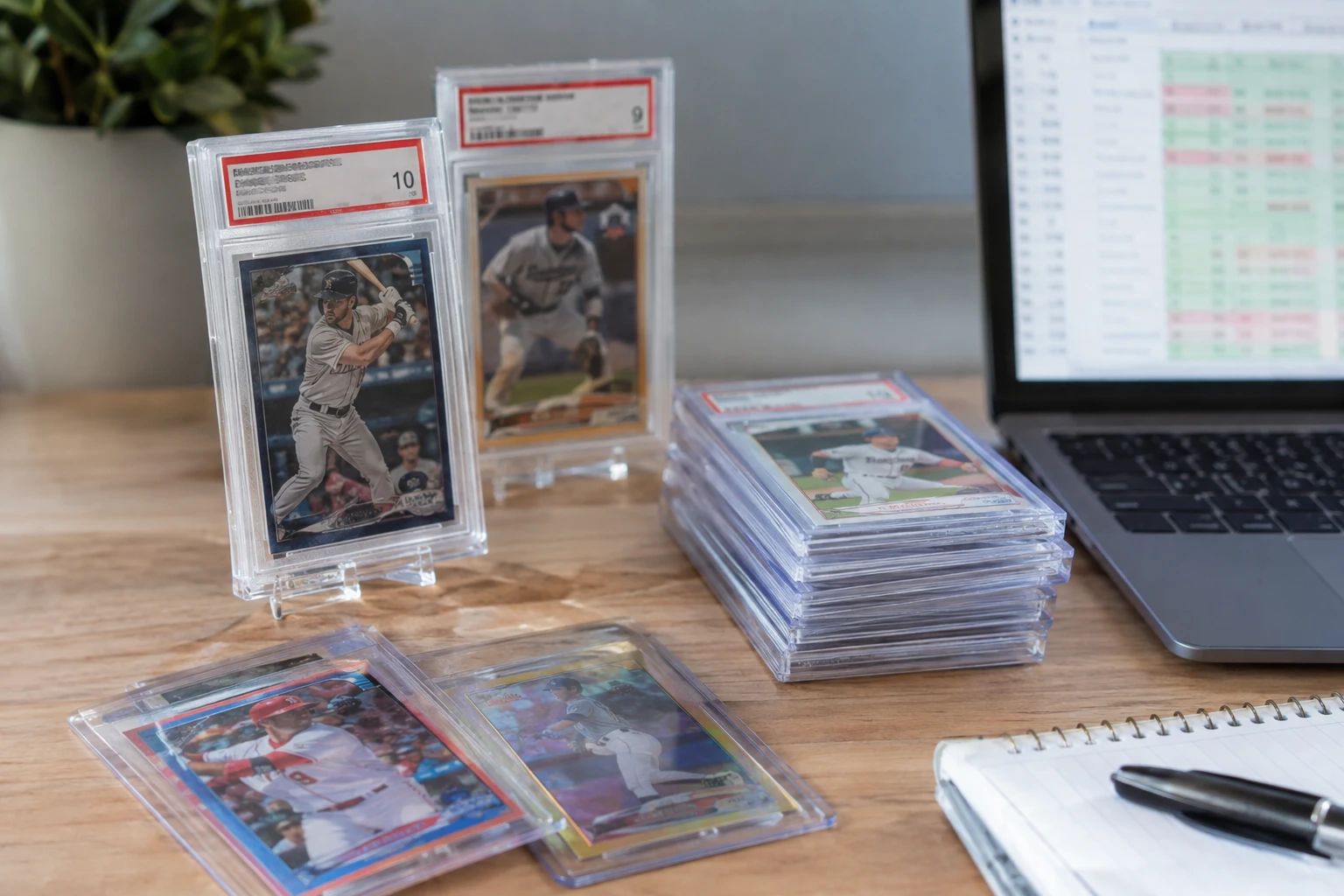
The Short Answer
- #PSAUp-Gate — A submitter sold 11 cards to PSA's Direct Buyback as PSA 9s; they reappeared in PSA's system as PSA 10s, potentially multiplying their resale value several times over.
- Structural conflict of interest — PSA sets the grade, sets the buyback price, and potentially re-grades the same cards — all within the same company.
- Card show organizers suspended PSA submissions — Dealers Score More Points and Three Point publicly cut ties with PSA.
- PSA CEO Nat Turner called it a "systematic failure" while Collectors Holdings described it as an "isolated grading error."
- 60%+ of submitted 1952 Mantles are fake — PSA's May 2026 fraud report highlights authentication challenges alongside the buyback controversy.
- Collectors are diversifying — sending vintage cards to SGC and modern cards to CGC, treating PSA grades as "one opinion worth double-checking."
What Happened: The #PSAUp-Gate Timeline
In late 2025, a high-volume card submitter known in hobby circles as "Cali-Cards" sent PSA a batch of 30 modern cards for grading. The submission included 2019 Panini Prizm Zion Williamson rookies and Pokémon Tag Team cards — popular modern cards with active resale markets.
Nearly all of the cards came back graded PSA 9 — near mint to mint, but not gem mint. Instead of reselling them as PSA 9s, Cali-Cards used PSA's Direct Buyback Program, a service launched in November 2024 that allows submitters to cash out at PSA's own valuation rather than selling on the open market. PSA paid him $35 per card for the PSA 9 copies.
Weeks later, Cali-Cards checked PSA's public certification tracker out of habit. Eleven of the same cards — identifiable by their certification numbers — had reappeared in the PSA system, now graded PSA 10. A one-grade jump from PSA 9 to PSA 10 can multiply a card's resale value several times over, depending on the card and its population count.
The #PSAUp-Gate Timeline
| Event | Date | Details |
|---|---|---|
| PSA Direct Buyback Program launches | November 2024 | PSA offers to buy graded cards directly from submitters at PSA-set valuations |
| Cali-Cards submits 30 modern cards | Late 2025 | Zion Williamson Prizm rookies and Pokémon Tag Team cards |
| Cards return graded PSA 9 | Late 2025 / Early 2026 | Nearly all 30 cards receive PSA 9, not PSA 10 |
| Cali-Cards sells cards to PSA Buyback | Early 2026 | PSA pays $35/card for the PSA 9 copies |
| 11 cards reappear as PSA 10s | Discovered 2026 | Certification tracker shows same cert numbers with upgraded grades |
| #PSAUp-Gate spreads on Reddit | 2026 | r/sportscards and r/PokeGrading threads dissect the timeline |
| Dealers cut ties with PSA | 2026 | Score More Points and Three Point publicly sever relationships |
The discovery spread through the hobby under the hashtag #PSAUp-Gate. Threads on Reddit's r/sportscards and r/PokeGrading dissected the timeline for weeks. The core allegation: PSA under-graded cards to buy them cheaply through its own buyback program, then re-graded them at higher levels to sell at a profit.
The Structural Conflict of Interest
The #PSAUp-Gate scandal exposed a structural conflict that had been sitting in plain sight since the Direct Buyback Program launched in November 2024. PSA occupies three roles simultaneously in the buyback process:
- PSA sets the grade on a submitted card through its grading team.
- PSA sets the buyback price through its own valuation of that grade.
- PSA controls the re-grading process if the card is submitted again or reviewed internally.
This means PSA has a financial incentive to grade cards conservatively when they enter the buyback program — a lower grade means a lower buyback payout. If the card is then re-graded at a higher level, PSA (or its parent company) captures the upside. The collector who sold the card at the lower grade loses the difference.
In a traditional grading model, the grading company has no financial stake in the grade it assigns — it charges a flat fee per card regardless of the outcome. The Direct Buyback Program changes this dynamic by making PSA a market participant, not just a service provider. The company that grades the card is also the company buying it.
Why This Matters for Baseball Card Collectors
For baseball card collectors, the conflict of interest is particularly concerning for vintage cards, where grade differences translate to enormous value swings. A 1952 Topps Mickey Mantle graded PSA 7 vs PSA 8 can represent a $500,000+ difference. If PSA has a financial incentive to grade conservatively when buying back cards, collectors who use the Direct Buyback Program may receive lower payouts than the open market would offer.
The scandal also raises a broader question: if PSA can re-grade a PSA 9 as a PSA 10 after buying it back, how confident can collectors be in the original PSA 9 grade? The same graders, using the same standards, looked at the same card and arrived at different conclusions. This is consistent with the known 85–90% self-consistency rate in professional grading — but in the context of a buyback program, that inconsistency becomes a financial conflict rather than just a quality issue.
Industry Response: Dealers and Shows React
The hobby's response to #PSAUp-Gate was swift and visible. Card show organizers began suspending PSA submissions at their events. Two prominent dealers — Score More Points and Three Point — publicly cut ties with PSA.
Dealer and Show Responses
- Score More Points — Removed PSA branding from its shop entirely and switched its on-site grading submissions to rival CGC. The dealer publicly stated that it could not in good conscience continue representing PSA to its customers.
- Three Point — Publicly severed its relationship with PSA, citing the buyback conflict of interest and the grade discrepancies.
- Card show organizers — Multiple shows suspended on-site PSA submission services, citing collector concerns about grading integrity. Some shows replaced PSA with CGC or TAG as their on-site grading partner.
- Reddit communities — r/sportscards and r/PokeGrading hosted extensive threads analyzing the timeline, sharing similar experiences, and debating whether the buyback program should be discontinued.
The dealer response is significant because PSA's business model depends on relationships with high-volume submitters. Dealers like Score More Points and Three Point submit thousands of cards per year — their departure represents real revenue loss for PSA and a credibility hit that extends beyond the specific incident.
The shift to CGC is also notable. CGC, the second-largest grading company by market share, is not owned by Collectors Holdings — making it an independent alternative. While CGC has faced its own scrutiny in the hobby, its independence from the Collectors umbrella is an attractive feature for collectors concerned about the PSA conflict of interest.
PSA's Response and the CEO's Statements
The response from PSA and its parent company, Collectors Holdings, was inconsistent — which itself became part of the story.
Contradictory Statements
Collectors Holdings, PSA's parent company, described the incident as an "isolated grading error caught during an internal review." This framing suggests a single mistake that was self-corrected through quality assurance processes.
However, PSA CEO Nat Turner characterized it differently in a string of replies to collectors online. At one point, Turner called it a "systematic failure" — language that implies a broader problem with processes and controls, not a one-off error. The discrepancy between the parent company's "isolated error" framing and the CEO's "systematic failure" characterization fueled further collector skepticism.
What PSA Has Not Addressed
- The financial outcome — PSA has not disclosed whether the buyback program generated profit from the grade discrepancies, or whether Cali-Cards was compensated for the difference.
- Process changes — PSA has not announced specific changes to the Direct Buyback Program to prevent similar conflicts, such as requiring independent re-grading or separating the grading and buyback teams.
- Scope of the problem — PSA has not stated whether other buyback transactions have been reviewed for similar grade discrepancies, or whether the 11 cards represent the full scope of the issue.
- Third-party audit — No independent audit of the buyback program has been announced, leaving collectors to rely on PSA's internal review.
PSA continues to process approximately 19 million cards per year and remains the dominant grading company by volume. In February 2026, the company raised grading fees for the second time in five months while extending turnaround times. The combination of the buyback scandal, rising prices, and the value tier pause has created the most challenging period for PSA's collector relationships in recent memory.
Broader Context: Antitrust and Monopoly Concerns
The #PSAUp-Gate scandal cannot be separated from the broader market structure of the card grading industry. Collectors Holdings — PSA's parent company — has been acquiring competitors, creating a grading monopoly that has drawn attention from lawmakers.
Collectors Holdings' Market Position
- PSA — The largest grading company by volume, grading approximately 19 million cards per year.
- SGC — Acquired by Collectors in 2023. SGC has a strong vintage card reputation but has declined sharply post-acquisition (down 75% year-over-year in June 2026).
- Beckett (BGS) — Acquired by Collectors in 2025. BGS is the third-largest grading company by market share.
Combined, Collectors Holdings controls roughly 80% of the trading card grading market by volume. This means the same parent company that owns PSA — the company at the center of the buyback scandal — also owns two of the other top four grading companies. Collectors looking for alternatives to PSA may find themselves submitting to another Collectors Holdings brand.
A federal lawmaker has called for antitrust scrutiny over this ownership structure, though no formal investigation has been opened as of July 2026. The concern is that market concentration reduces competition, limits consumer choice, and creates the kind of structural conflicts exposed by #PSAUp-Gate.
Independent Alternatives
The grading companies not under the Collectors Holdings umbrella are:
- CGC — Second-largest by market share, independent. Known for comics and magazines in addition to cards. CGC Standard at $55/card is cheaper than PSA Regular at $79.99.
- TAG — Growing rapidly (54,000 cards in June 2026, up 55% in the first week of July). TAG has launched its own Backlog Tracker with more detail than PSA's. Currently at capacity for lower-priced tiers.
- C3 Grading — The most affordable independent option. Recognized by Mantle as one of the best grading companies in 2025.
The longer PSA stays paused on value tiers and the more trust issues accumulate from the buyback scandal, the more opportunity these independent rivals have to reshape the grading hierarchy. Some collectors have already begun spreading their submissions across multiple graders rather than relying exclusively on PSA.
What Collectors Should Do to Protect Themselves
The #PSAUp-Gate scandal does not mean PSA grades are worthless — PSA remains the market standard and its slabs command the highest resale premiums. But it does mean collectors should approach grading with more awareness and take specific steps to protect themselves.
1. Do Not Use the PSA Direct Buyback Program
The simplest protection is to not participate in the program that created the conflict. If you want to sell graded cards, use the open market — eBay, Goldin, Heritage, Fanatics Collect, or other auction platforms. Open market sales ensure you receive fair market value, not a price set by the same company that graded your card.
2. Verify Grades Through the Certification Tracker
PSA's public certification tracker is a valuable tool. Before buying any PSA-graded card, enter the certification number from the slab label into the tracker to verify the grade matches. If you are selling, include the certification number in your listing so buyers can verify independently.
3. Diversify Your Grading Across Companies
Do not submit exclusively to PSA. Consider the card type when choosing a grader:
- Modern baseball cards (Topps Chrome, Prizm): CGC is a viable alternative. CGC Pristine 10 carries meaningful value, and CGC is independent of Collectors Holdings.
- Vintage baseball cards (pre-1980): SGC has a strong vintage reputation and faster turnaround. However, SGC is owned by Collectors Holdings — if independence is your priority, CGC grades vintage cards as well.
- High-value vintage (1952 Mantle, T206 Wagner): PSA still commands the highest resale premium. For cards worth $100,000+, the PSA premium justifies the submission despite trust concerns.
4. AI Pre-Grade Before Every Submission
AI pre-grading provides an independent assessment of your card's condition before you pay for professional grading. If AI predicts PSA 9 and the card comes back PSA 8, you have a data point for comparison. If AI predicts PSA 7 and the card comes back PSA 9, that is a red flag worth investigating. AI pre-grading costs ~$0.19 per card — a small price for an independent second opinion.
5. Document Your Submissions
Take high-resolution photos of every card before submission — front and back, with the card's condition clearly visible. If a card comes back with a different grade than expected, your photos serve as evidence of the card's pre-submission condition. This documentation is essential if you need to dispute a grade or file a claim.
6. Treat Any Grade as One Opinion, Not a Final Verdict
The most fundamental shift is mental: treat a PSA grade as one informed opinion, not an absolute truth. The 85–90% self-consistency rate means 10–15% of grades would change on resubmission. For high-value cards, consider cross-grading — submitting to a second company for an independent assessment. If PSA says PSA 8 and SGC says SGC 8.5, you have converging evidence. If they disagree significantly, you have a data point for your own decision-making.
How AI Pre-Grading Reduces Dependency on a Single Grader
The #PSAUp-Gate scandal highlights a structural problem in the card grading industry: there is no independent verification of a grade other than submitting the same card to another grading company. AI pre-grading offers a partial solution by providing an independent, data-driven assessment before any money is spent on professional grading.
What AI Pre-Grading Provides
- Independent condition assessment — AI analyzes centering, corners, edges, and surface from a scan without any financial stake in the outcome. The AI does not buy cards, does not set buyback prices, and has no conflict of interest.
- Consistent results — AI grading achieves 99%+ consistency on the same card scanned multiple times, compared to 85–90% self-consistency for human graders. The same image always produces the same prediction.
- Centering measurement — AI centering predictions match physical ruler measurements within 2 percentage points on 99.2% of cards. This is more precise than human visual estimation (85–90% accuracy).
- Cost-effective screening — At ~$0.19 per card, AI pre-grading allows collectors to screen entire collections before deciding which cards to submit. This reduces dependency on any single grader by ensuring only the best candidates are submitted.
AI Pre-Grading Limitations
AI pre-grading is not a replacement for professional grading. It cannot authenticate cards, detect trimming or alteration, or provide a slabbed grade that carries market value. AI accuracy on vintage pre-1960 cards is 71% within one grade point — lower than modern cards (93%) due to unique aging patterns and paper stock variation. AI is a screening tool, not a final verdict.
However, in the context of #PSAUp-Gate, AI pre-grading serves a critical function: it provides an independent baseline assessment that collectors can compare against the grade returned by any professional grading company. If the AI says PSA 9 and PSA returns PSA 7, the collector has a data point suggesting a re-grade might be worthwhile. If the AI says PSA 8 and PSA returns PSA 10, the collector should examine the card carefully — the grade may be correct, but the discrepancy warrants verification.
The Future of Grading Transparency
The #PSAUp-Gate scandal may ultimately accelerate the adoption of AI in the grading industry. PSA itself has stated that its human graders now work alongside AI imaging models to detect counterfeits and flag trimming. As AI technology improves and becomes more accessible, collectors will have increasingly powerful tools to verify grades independently — reducing the trust gap that the buyback scandal exposed.
For now, the best strategy is to use AI pre-grading as a first opinion, professional grading as a second opinion, and the open market — not a buyback program — as the final arbiter of a card's value.
Frequently Asked Questions
What is the PSA buyback scandal (#PSAUp-Gate)?
Is the PSA Direct Buyback Program safe to use?
Did PSA admit wrongdoing in the buyback scandal?
Should I still use PSA for grading after the scandal?
Does Collectors Holdings own all the major grading companies?
How does AI pre-grading help with the trust gap?
Sources & Further Reading
- PSA's Buyback Scandal Is Testing How Much Trust a Trading Card Grade Still Carries — Nerdbot
- Where the Major Card Grading Companies Stand After PSA, TAG Pauses — SI Collectibles
- PSA Backlog Falls to 12 Million — SI Collectibles
- Card Grading Backlog 2026 — CardGrade.io
- AI vs Human Card Grading — CardGrade.io
Marcus Chen has evaluated over 50,000 sports cards and TCG cards across PSA, BGS, SGC, and CGC standards. Before joining PreGradeCards, he worked as a submission specialist for a major grading company and trained collectors and dealers on condition assessment.
Create a free account and get 1 free credit — enough for 1 complete AI grading with market pricing. No credit card required.
Sign Up Free →