The Short Answer
- Special (SP) parallels are the top chase tier — median $143 with the best copies above $500, far ahead of every other rarity.
- Ultimate Rare (UR) features alternate artwork and unique frame treatment, topping out around $425 per card.
- Super Legendary (SL) is the premium parallel of Legend-rarity cards — roughly 1 per box, with a median near $5 but chase examples at $79+.
- English launched June 2023 — graded SVE populations are still tiny, so early PSA 10 slabs carry low-pop premiums.
- Collaboration sets drive outsized value — Uma Musume, iDOLM@STER Cinderella Girls, and Princess Connect crossover cards attract collectors from outside the game.
- CGC Economy ($15/card) fits most SVE submissions — Bushiroad cardstock is familiar territory for CGC, while PSA Regular suits $400+ chase cards.
Shadowverse: Evolve Grading in 2026: A Growing Niche With Low Pop Counts
Shadowverse: Evolve is the physical trading card game adaptation of Cygames' Shadowverse, one of Japan's most successful digital card games. Published by Bushiroad in Japan since April 2022 and in English since June 2023, SVE has built a dedicated competitive scene with 17+ booster sets and a steady stream of crossover collaborations.
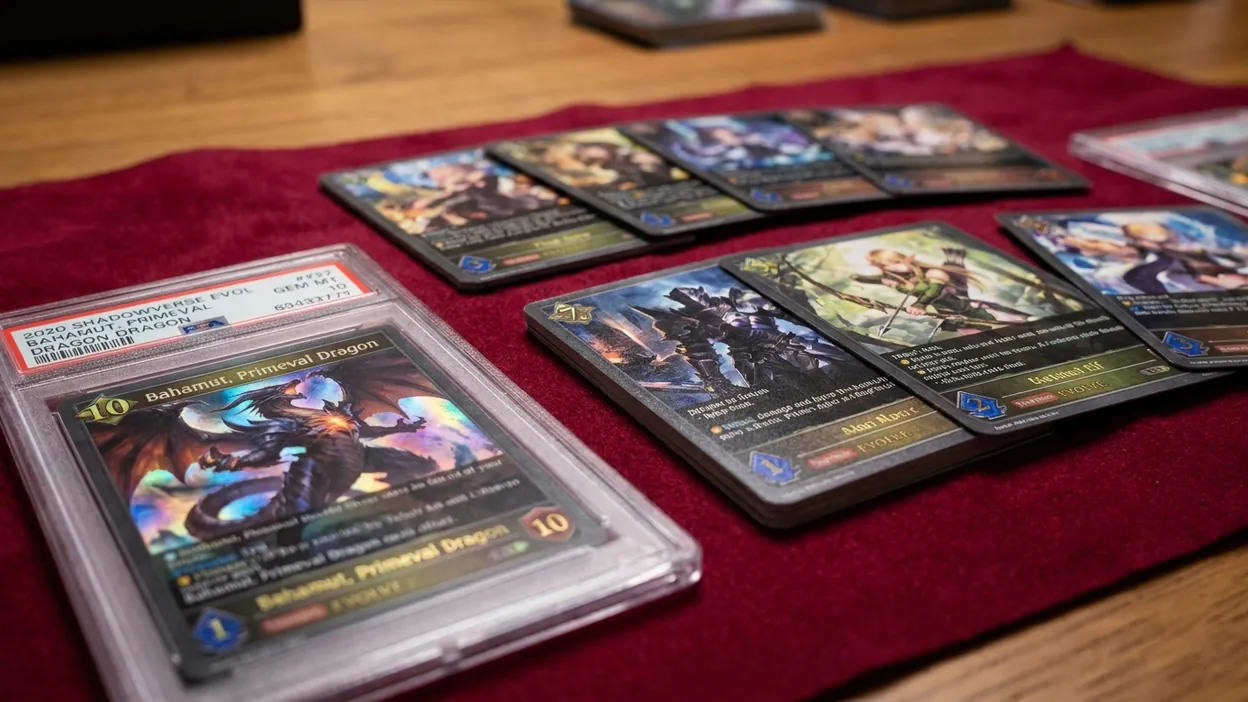
For grading, SVE occupies a sweet spot: the game is established enough to have real chase-card value — Special parallels trade at a $143 median with tops above $500 — yet new enough that graded populations remain very low. Most SVE cards have never been submitted to PSA or CGC in meaningful numbers, which means early gem-mint slabs carry a genuine scarcity premium.
The game's crossover strategy also expands its collector base beyond players. Uma Musume Pretty Derby, iDOLM@STER Cinderella Girls, Cardfight Vanguard, and Princess Connect Re:Dive collaboration cards attract fans of those franchises — collectors who buy singles, not boxes, and who strongly prefer graded copies for display.
Why SVE Grading Demand Is Growing
- 17+ booster sets since April 2022 (Japan) and 10+ English sets since June 2023
- Special (SP) parallels command $143+ median — real grading-tier value
- Crossover collabs pull in Uma Musume and Idolmaster collectors who buy graded
- Very low graded populations — most chase cards have single-digit PSA 10 counts
- Bushiroad quality control is solid — modern SVE sets have consistent centering
Shadowverse: Evolve Rarity Tiers Explained: BR to SP
SVE uses a base rarity ladder plus three parallel-treatment tiers. Understanding which symbol sits on your card — and whether it is a base or parallel version — is the first grading decision.
Complete SVE Rarity Hierarchy (2026)
| Rarity | Treatment | Median Value | Grade Worth It? |
|---|---|---|---|
| Bronze (BR) | None / standard foil | $0.19 | No |
| Silver (SR) | None / standard foil | $0.25 | No |
| Gold (GR) | Standard foil | $0.37 | No |
| Legend (LG) | Premium foil | $2.10 | Only top-played staples |
| Super Legend (SL) | Parallel of LG, unique frame | $4.75 | If raw > $30 |
| Ultimate Rare (UR) | Alt art + unique frame | $46.94 | Yes |
| Special (SP) | Signature-style alt treatment | $143.01 | Yes — always |
| Leader | Character leader cards | Varies | If raw > $30 |
| Promo / PR | Event & shop promos | $1.82 | If raw > $30 — tops at $413 |
The critical insight: SVE's value concentrates in the parallel tiers, not the base rarities. A base Legend is worth $2 on median — but its Super Legendary parallel, Ultimate Rare, or Special version can be worth 20–200x more. Always check the card number suffix and frame before deciding a card is bulk.
The Three Parallel Tiers
SL (Super Legend) — a re-framed, premium-foil version of Legend-rarity cards from the same set. Roughly one per box. Median $4.75, but popular characters reach $79+.
UR (Ultimate Rare) — alternate artwork with a unique frame design, different from the base card entirely. Seven or fewer per set. Median $46.94, tops at $425.
SP (Special) — the signature-style chase treatment, often reprinting popular cards with stamped autograph-style art. Six or fewer per set. Median $143 — the tier where grading fees are trivially justified.
Which Shadowverse: Evolve Cards Deserve Grading
Grading economics favor cards where the slab premium exceeds total fees (~$18–$85 depending on tier). For SVE, that threshold lands around $30–$40 raw.
Automatic Grade Candidates
- All SP parallels — median $143, tops $500+. Every SP pull is a grade candidate.
- UR cards of popular characters — Dark Angel Olivia, Cerberus, Ginsetsu, and other fan-favorite followers from crossover and core sets.
- Collaboration chase cards — Uma Musume, Cinderella Girls, and Princess Connect SP/UR cards sell to two collector bases.
- High-end promos — tournament and shop promos topping $400 raw should always be graded.
- Seaside Memories UR set — the 2025 special set's Ultimate Rares (Dark Angel Olivia U29, Alice U28) are display-grade chase cards.
Conditional Candidates
- SL parallels above $30 — worth grading only for popular characters or meta staples.
- Leader cards above $30 — playable leaders of iconic classes hold value.
- Early-set Legends (BP01–BP03) — first-print cards from the game's launch window carry vintage potential as the game matures.
Skip
- Base BR/SR/GR cards — bulk, never worth fees
- Base LG below $30 raw
- Tokens and campaign application cards (unless stamped premium)
PSA vs CGC vs BGS for Shadowverse: Evolve
SVE is Bushiroad cardstock — the same manufacturer behind Weiss Schwarz, Vanguard, and hololive OCG. That matters for grader selection.
| Grader | Tier | Cost | Best For |
|---|---|---|---|
| CGC | Economy | $15 | All SVE $30–$400 — best value |
| PSA | Regular | $79.99 | SP/UR $400+ (max resale) |
| BGS | Express | $79.95 | Top chase where subgrades help |
| TAG | Standard | $18 | Transparency + digital report |
CGC's experience with Bushiroad stock (Weiss Schwarz is a major CGC category) makes it the default choice. For SP parallels above $400, PSA's resale premium usually outweighs the higher fee — SVE chase cards sold to crossover collectors perform best in PSA slabs on eBay.
AI Pre-Grading for Shadowverse: Evolve Cards
PreGradeCards AI pre-grading handles SVE's parallel treatments with foil-aware surface analysis — the same pipeline calibrated on Weiss Schwarz and other Bushiroad stock.
SVE-Specific Analysis Points
- Multi-layer foil textures: SP and UR treatments create complex light refraction. The AI's edge-spread surface analysis separates intentional foil texture from genuine scratches and print lines.
- Full-art UR frames: UR cards use unique frame layouts, so the AI locates the artwork boundary rather than assuming standard border geometry.
- Signature stamps on SP: stamped autograph-style elements are detected as print features, not surface defects.
- Bushiroad cutting: SVE cards occasionally show the soft "rolled" edge characteristic of Bushiroad die-cutting — the AI weighs this differently than a true edge ding.
Cost Savings Example
A player cracks 4 boxes of the latest SVE set and pulls: 2 SP ($150–$400 raw), 6 UR ($20–$80), 4 SL ($5–$30), and assorted Legends. Submitting everything to CGC Economy: 12 cards × $15 + $20 shipping = $200.
AI pre-grading all 12 at $0.19/card costs $2.28. Suppose the AI flags 2 URs and 3 SLs with centering or corner issues below 55% PSA 10 probability. Submitting only the 7 strong candidates: $105 + $20 = $125 — saving $75 while keeping only the cards most likely to gem.
SVE Cardstock and Centering: What to Check Before Grading
Shadowverse: Evolve cards are printed on Bushiroad's standard TCG stock — a mid-weight card with a smooth finish, similar to Weiss Schwarz. Quality control is generally good, but a few SVE-specific patterns are worth checking.
Common Issues by Category
- Centering: Modern SVE sets typically run 50/50 to 55/45. Early Japanese sets (BP01–BP03) show slightly more variance. Measure borders — do not eyeball.
- Edge whitening: The darker border colors on many SVE designs make edge whitening more visible — check all four edges under angled light.
- Foil print lines: SP and UR treatments occasionally show faint roller lines across the foil. Under magnification these are uniform; scratches are not. AI analysis distinguishes them reliably.
- Corner softness: Bushiroad's die-cut sometimes leaves micro-burr on a single corner — usually the bottom-left in our scans.
- Surface dimples: Occasional small indentations on high-foil cards from the foil-stamping process — usually grade-relevant only on otherwise-perfect candidates.
Photography Tips for SVE
Use diffused lighting and a 90-degree overhead angle. For SP and UR cards, take a second photo at a slight tilt — this lets the AI map the foil's reflective pattern and separate texture from defects. Avoid direct flash, which blows out the signature-stamp detail on SP cards.
SVE Grading ROI: The Math Behind Profitable Submissions
Grading pays when expected graded value exceeds raw cost plus fees. Worked example with a mid-tier UR chase card.
Worked Example: SVE Ultimate Rare ($60 raw)
| Variable | Value |
|---|---|
| Raw card cost | $60 |
| P(10) from AI | 60% |
| P(9) from AI | 28% |
| P(≤8) | 12% |
| CGC 10 value | $140 (2.3x raw) |
| CGC 9 value | $80 (1.33x) |
| CGC 8 value | $62 (1.03x) |
| Grading + shipping | $18 |
| Selling fee | 13.25% |
Expected Value = (0.60 × $140) + (0.28 × $80) + (0.12 × $62) = $84 + $22.40 + $7.44 = $113.84
Net = $113.84 − $18 − (13.25% × $113.84) = $113.84 − $18 − $15.08 = $80.76
Profit = $80.76 − $60 = $20.76 (35% return)
Positive ROI — but only because AI pre-grading established the 60% gem probability. The same card at a 35% gem probability produces negative expected value. For SP parallels above $400 raw, the multipliers are larger and the ROI stronger — but the screening discipline is identical.
Complete AI Pre-Grading Workflow for SVE Cards
Follow this step-by-step workflow to maximize Shadowverse: Evolve grading ROI.
Step 1: Sort by Parallel Tier
Separate SP, UR, SL, Leader, and high-value promos from base-rarity bulk. Verify parallel status by card-number suffix — a card that looks like a Legend may be its SL parallel.
Step 2: Price Check
Check current raw values on TCGplayer and eBay solds. Set aside anything below $30 raw unless it is a genuinely rare promo.
Step 3: Photograph for AI Analysis
Diffuse lighting, 90-degree overhead, dark background, 300+ DPI equivalent. Second tilted shot for SP/UR foils.
Step 4: Upload to PreGradeCards AI
Run each candidate through PreGradeCards AI grading for PSA 10 probability, subgrade breakdown, and defect mapping.
Step 5: Filter and Submit
Submit cards with 55%+ PSA 10 probability to CGC Economy ($15). For SP/UR chase above $400 raw, use PSA Regular — and submit even at 45% probability since the 2–3x multiplier justifies the risk.
Step 6: Track Populations
SVE populations are so low that each new PSA 10 may be pop-1 through pop-10. Check the PSA pop report when your slab returns — early low-pop slabs deserve patience before selling.
Frequently Asked Questions
Is Shadowverse: Evolve worth grading?
What is the most valuable Shadowverse Evolve card to grade?
What is the difference between SL, UR, and SP in Shadowverse Evolve?
Should I use PSA or CGC for Shadowverse Evolve cards?
Are Shadowverse Evolve collaboration cards worth grading?
How do I tell if my Shadowverse Evolve card is a parallel?
Sources & Further Reading
- Shadowverse: Evolve Official English Site — Bushiroad
- Shadowverse Evolve Rarity Price Guide — tcgrate
- Shadowverse Evolve Set Lists & Cards — Player One Collectibles
- Shadowverse EVOLVE Product Announcements — Bushiroad
Marcus Chen has evaluated over 50,000 sports cards and TCG cards across PSA, BGS, SGC, and CGC standards. Before joining PreGradeCards, he worked as a submission specialist for a major grading company and trained collectors and dealers on condition assessment.
Create a free account and get 1 free credit — enough for 1 complete AI grading with market pricing. No credit card required.
Sign Up Free →