The Short Answer
- Alpha foils dominate the market — Courtesan Thaïs foil tops $3,999, Philosopher's Stone $3,899, Ruler of Thul $2,600.
- Unique is the top base rarity — averaging $201 per card, every Unique is a grade candidate.
- Kickstarter-scarcity economics — Alpha was a crowdfunded first printing with limited supply; graded copies are exceptionally rare.
- Hand-painted art attracts MTG crossover collectors — buyers compare Sorcery to early Magic, and graded slabs validate condition for a non-tournament audience.
- Curio and promo cards are ultra-scarce — artist proofs, playtest cards, and event promos can outvalue regular Uniques.
- CGC or PSA depending on value — CGC for $30–$500 cards; PSA for Alpha foils and $500+ chase where the label premium is strongest.
Sorcery: Contested Realm Grading in 2026: Scarcity Meets Painted Art
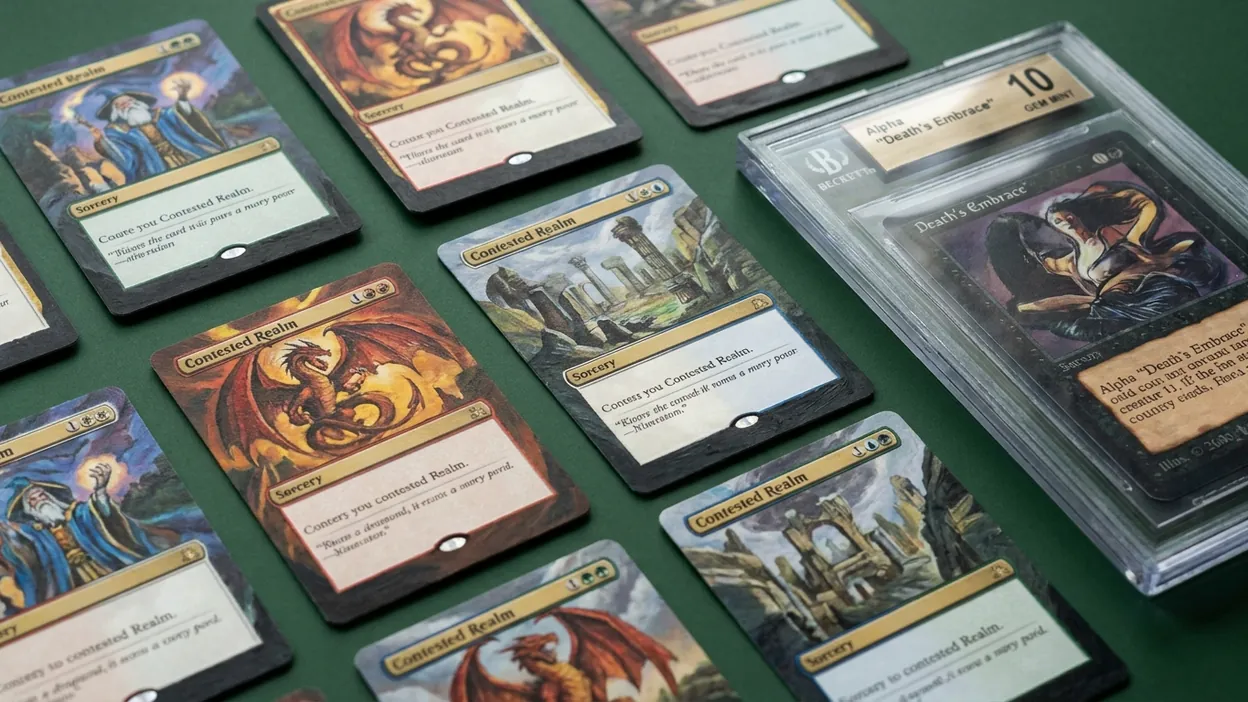
Sorcery: Contested Realm launched from a $4M+ Kickstarter in 2022–2023, created by Erik Olofsson (Erik's Curiosa). Its pitch: a TCG built entirely from traditional hand-painted artwork — no digital art, no AI art — wrapped in a spellbook aesthetic that deliberately evokes early Magic: The Gathering.
That positioning made Sorcery a collector's game from day one. Print runs are modest, foils are scarce, and the player base overlaps heavily with vintage MTG collectors — buyers who think in graded slabs. The result: Alpha foils already trade at four figures (Courtesan Thaïs $3,999, Philosopher's Stone $3,899, Ruler of Thul $2,600), and even mid-tier Uniques average $201.
For grading specifically, Sorcery is one of the strongest modern opportunities. Graded populations are tiny — most Alpha cards have never been submitted — and the collector base explicitly values condition documentation. A PSA 10 Alpha foil is a low-pop display piece targeting exactly the audience that pays slab premiums.
Why Sorcery Grading Demand Is Rising
- Hand-painted art — every card is traditionally painted; display collectors outnumber players
- Kickstarter scarcity — Alpha had a limited crowdfunded print run with no mass retail
- Four-figure chase cards — Alpha foils at $2,500–$4,000 justify any grading tier
- Growing set catalog — Alpha, Beta, Arthurian Legends, Dragonlord, Gothic, and promo sets through 2026
- MTG-collector overlap — the audience already thinks in PSA/BGS terms
Sorcery Rarity Tiers Explained: Ordinary to Unique
Sorcery uses a fantasy-flavored rarity ladder plus foils and special subsets. Every rarity exists in both non-foil and foil versions, and foil multiplies value dramatically — especially in Alpha.
Complete Sorcery Rarity Hierarchy (2026)
| Rarity | Median | Top | Grade Worth It? |
|---|---|---|---|
| Ordinary | $0.70 | $306 | Only top foils |
| Exceptional | $0.98 | $145 | Foils above $30 |
| Elite | $3.50 | $2,500 | Foils + popular cards |
| Unique | $25.88 | $2,600 | Yes — always |
| Promo / Curio | $62 | $496+ | Yes — always |
The pattern mirrors Sorcery's collector DNA: base rarities are cheap, but foils of any tier can be valuable — even an Ordinary foil topped $306. Unique cards are the reliable grading tier (median $26, average $201), and Alpha foils of Elite/Unique cards are the four-figure endgame.
Curios and Ultra-Rare Subsets
Beyond the main ladder, Sorcery has documented ultra-rare items: artist proofs (25 copies per artist, blank-backed Kickstarter proofs even rarer), playtest cards, creator-made cards, and event/prize promos — one early promo has a confirmed print run of just 100 copies. Arthurian Legends added gilded art cards by Elvira Shakirova, treated by collectors as a chase subset of their own. Any of these should be graded on sight.
Which Sorcery: Contested Realm Cards Deserve Grading
Sorcery's market rewards scarcity and iconic painted art. The grading populations:
Automatic Grade Candidates
- Alpha foils — all of them — even Elite foils reach $2,500 (Avatar of Water); Ordinary/Exceptional foils regularly clear $100–$600.
- All Unique cards — median $26, average $201, tops at $548+ (Great Old One foil) and $2,600 for premium versions.
- Curio, artist proof, and event promo cards — print runs as low as 100 copies.
- Avatars and Elemental Cores — the Avatar cycle and Core cards are Sorcery's signature chase; Alpha foils run $900–$3,900.
- Iconic painted cards — Death Dealer ($513+), Donnybrook Inn ($612 foil), Mirror Realm ($1,099 foil) — the famous paintings grade best.
Conditional Candidates
- Beta/Arthurian/Gothic foils above $30 — later sets are more available but top foils still grade.
- Elite staples of played decks — competitive demand adds a floor to grading-worthy cards.
- Gilded art subset (Arthurian Legends) — the Elvira Shakirova gilded cards are a dedicated chase.
Skip
- Non-foil Ordinary and Exceptional cards
- Modern-set non-foils below $30
PSA vs CGC vs BGS for Sorcery: Contested Realm
Sorcery's audience overlaps vintage MTG collectors — the most label-sensitive buyers in the hobby.
| Grader | Tier | Cost | Best For |
|---|---|---|---|
| CGC | Economy | $15 | Uniques & foils $30–$500 |
| PSA | Regular | $79.99 | Alpha foils & chase $500+ |
| BGS | Express | $79.95 | MTG-crossover buyers who trust BGS |
| TAG | Standard | $18 | Fast, transparent mid-tier |
For Alpha foils and $500+ cards, PSA captures the widest resale premium — Sorcery buyers skew toward vintage-MTG habits where PSA is the default high-end label. CGC Economy handles the $30–$500 Unique/foil tier efficiently. BGS is a legitimate third option here specifically because the MTG-crossover audience has long trusted BGS subgrades.
AI Pre-Grading for Sorcery: Contested Realm Cards
Sorcery's painterly surfaces and matte finish need treatment-aware analysis — PreGradeCards AI is calibrated for exactly this.
Sorcery-Specific Analysis Points
- Matte painterly finish: Sorcery's textured matte surface shows handling differently than glossy TCG stock — the AI maps micro-abrasion patterns rather than gloss reflection.
- Dark border designs: many Sorcery cards use dark painted borders where edge whitening is highly visible — a common hidden grade-killer the AI catches early.
- Foil variants: Sorcery foils have a subtle sheen (not the heavy rainbow of modern TCGs); foil-specific surface profiles separate stamping texture from scratches.
- Thicker card stock: Sorcery uses slightly heavier stock than average, making corner-layer separation a specific defect the AI checks for.
Cost Savings Example
You pull 3 Uniques and 8 foils from Alpha-era product worth $800 combined. Submitting all 11 to CGC: $165 + $20 = $185. AI pre-grading costs $2.09 and flags 4 cards (edge whitening on dark borders, one corner separation). Submitting the 7 clean cards: $105 + $20 = $125 — saving $60 and skipping four likely CGC 8–9 returns on four-figure-potential cards.
Sorcery Cardstock and Centering: What to Check Before Grading
Sorcery cards are printed on a heavier matte stock with painted full-art treatments. The physical profile differs from mainstream TCGs in ways that matter for grading.
Common Issues
- Edge whitening on dark borders: the single most common Sorcery defect. Painted dark borders show every micron of white core — inspect all four edges under bright angled light.
- Corner layering: heavier stock can show slight layer separation at corners; check with a loupe.
- Print consistency: as a smaller-run game, Sorcery shows occasional print variance — light ink density or minor misregistration is usually a print issue, not damage, but graders notice.
- Surface abrasion: the matte finish marks more easily than gloss stock; even careful shuffling leaves micro-wear visible under raking light.
- Centering: generally good, but check — full-bleed painted cards have no border reference, so use the text box position as the guide.
Photography Tips
Matte surfaces photograph differently: use broad diffused light (not a point source) to avoid hot spots on the textured finish, and a 90-degree overhead angle. The matte texture actually helps the AI — surface defects contrast well against the non-gloss finish.
Sorcery Grading ROI: The Math Behind Profitable Submissions
Worked example: an Alpha Unique foil.
Worked Example: Alpha Unique Foil ($150 raw)
| Variable | Value |
|---|---|
| Raw card cost | $150 |
| P(10) from AI | 55% |
| P(9) from AI | 30% |
| P(≤8) | 15% |
| PSA 10 value | $380 (2.5x) |
| PSA 9 value | $200 (1.33x) |
| PSA 8 value | $155 (1.03x) |
| Grading + shipping (PSA) | $85 |
| Selling fee | 13.25% |
Expected Value = (0.55 × $380) + (0.30 × $200) + (0.15 × $155) = $209 + $60 + $23.25 = $292.25
Net = $292.25 − $85 − (13.25% × $292.25) = $292.25 − $85 − $38.72 = $168.53
Profit = $168.53 − $150 = $18.53 (12% return) — thin; CGC improves it
At PSA pricing this is marginal — which is exactly why AI screening matters. Using CGC Economy instead ($18 total): net jumps to ~$235, profit ~$85 (57%). For $500+ Alpha foils, PSA becomes the right call again because the resale premium overwhelms the fee difference.
Complete AI Pre-Grading Workflow for Sorcery Cards
Follow this step-by-step workflow for Sorcery: Contested Realm grading ROI.
Step 1: Separate the Grading Population
Pull all foils (any rarity), all Uniques, all promos/Curios. Non-foil Ordinary/Exceptional cards go to the play box.
Step 2: Verify Set and Version
Alpha vs Beta vs later printings matters enormously — an Alpha foil can be worth 10–40x its later-set equivalent. Check set symbols carefully.
Step 3: Edge Inspection First
Dark painted borders make edge whitening Sorcery's #1 defect. Inspect all four edges under bright angled light before anything else.
Step 4: AI Pre-Grade
Run candidates through PreGradeCards AI grading — front and back, diffused light. The matte finish photographs cleanly.
Step 5: Submit by Value Tier
- CGC Economy ($15): Uniques and foils $30–$500
- PSA Regular ($79.99): Alpha foils and chase $500+
- BGS Express: when subgrades help four-figure cards
Step 6: Market to the Right Audience
Sorcery buyers are art collectors and MTG crossovers. List with the painting's artist name, set, and rarity prominent — and be patient: low-pop graded Sorcery appreciates with the game.
Frequently Asked Questions
Is Sorcery: Contested Realm worth grading?
What is the most valuable Sorcery Contested Realm card?
What are the rarity levels in Sorcery Contested Realm?
Should I use PSA or CGC for Sorcery cards?
What is the most common defect on Sorcery cards?
Are Sorcery Alpha cards worth more than later sets?
Sources & Further Reading
- Sorcery: Contested Realm Official Site — Erik's Curiosa
- Sorcery Card Prices — Guardian TCG
- Sorcery Rarity Price Guide — tcgrate
- The Rarest Cards in Sorcery: Contested Realm — Collector Arthouse
Marcus Chen has evaluated over 50,000 sports cards and TCG cards across PSA, BGS, SGC, and CGC standards. Before joining PreGradeCards, he worked as a submission specialist for a major grading company and trained collectors and dealers on condition assessment.
Create a free account and get 1 free credit — enough for 1 complete AI grading with market pricing. No credit card required.
Sign Up Free →