The Short Answer
- Tennis is up 127% YoY — the fastest-growing sport in card collecting, outpacing basketball, soccer, and racing.
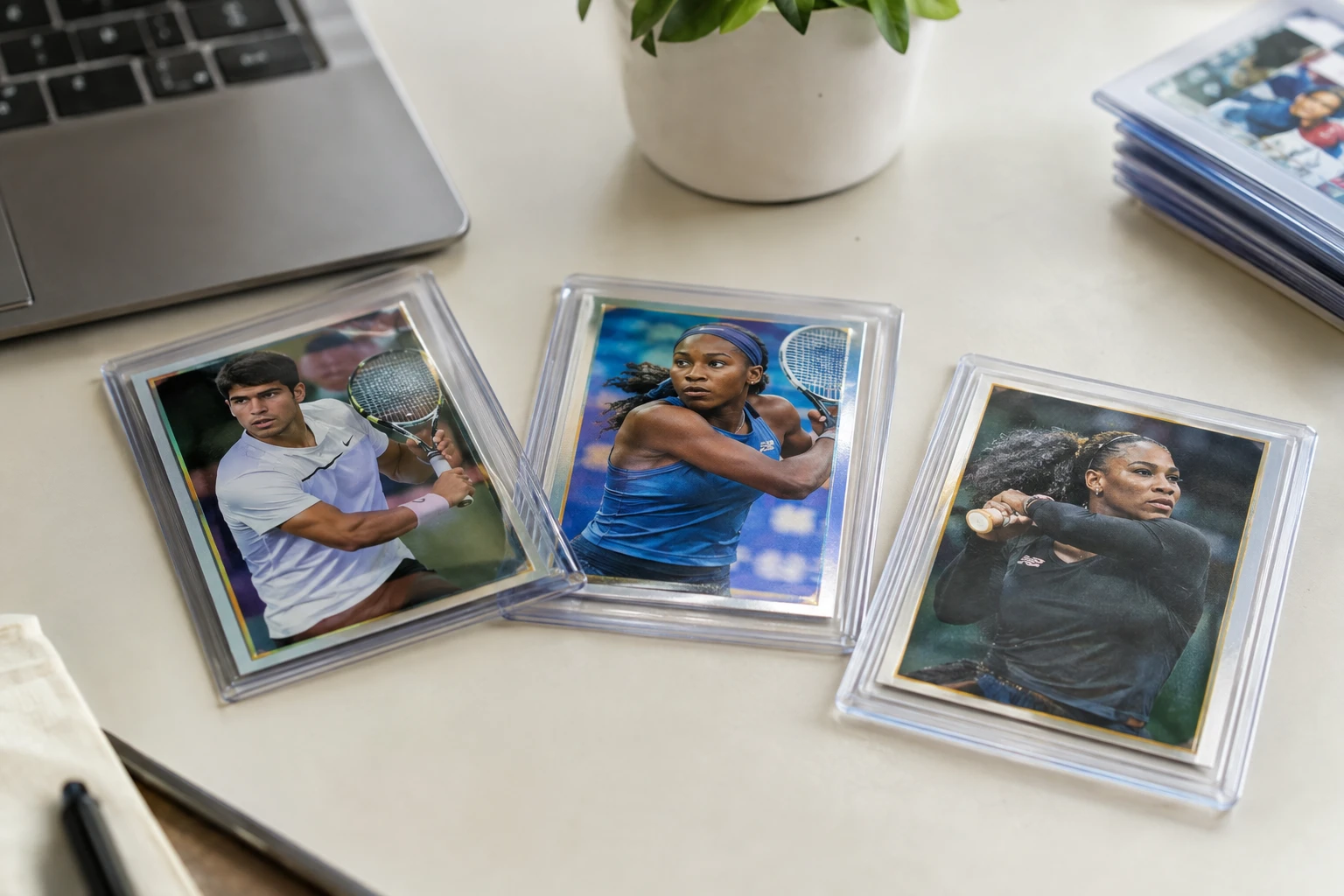
- Carlos Alcaraz and Jannik Sinner are the top men's tennis card targets, with growing Grand Slam legacy demand.
- Coco Gauff and Serena Williams lead women's tennis card values, benefiting from the broader women's sports card boom.
- Tennis card PSA populations are near-zero for most modern releases, creating extreme scarcity for early graders.
- SGC is recommended for tennis cards — their vintage sports expertise and clean slab design suit tennis aesthetics.
- Sportscards International and NetPro are the primary tennis card manufacturers, with limited but growing print runs.
Tennis Card Grading in 2026: A 127% Growth Rate That Rivals Any Sport
Tennis card collecting is the fastest-growing sport in the trading card hobby, with market data showing a staggering 127% year-over-year increase in card sales volume. This growth rate outpaces basketball (50%+), soccer (50%+), racing, and every other tracked sport. The reasons are clear: a new generation of charismatic Grand Slam champions, the broader women's sports card boom, and increasing global interest in tennis as a premium lifestyle sport.
Yet despite this explosive growth, tennis card grading remains almost completely untapped. The PSA population for most modern tennis cards is near-zero — many cards have zero graded copies in any condition. This creates an extraordinary ground-floor opportunity for collectors who grade tennis cards now: the first wave of PSA 10 tennis slabs will be population-1 items in a rapidly growing market.
Why Tennis Cards Are Surging
- Carlos Alcaraz: Young, charismatic, multiple Grand Slam titles — the "next Nadal" narrative drives collector demand
- Jannik Sinner: World #1, Italian global fan base, expanding tennis card market in Europe
- Coco Gauff: American star, US Open champion, benefiting from the women's sports card boom
- Serena Williams retirement: Legendary career creating vintage card demand similar to Tiger Woods in golf
- Global tennis popularity: Tennis is one of the most globally watched sports, with fans in every major market
- Limited card supply: Tennis cards have smaller print runs than baseball or basketball, creating natural scarcity
- Cross-sport migration: Collectors from basketball and soccer are diversifying into tennis cards
The 127% Growth Rate in Context
To put the 127% year-over-year growth in perspective: basketball cards are up approximately 50% YoY, soccer cards are up approximately 50% YoY, and the overall sports card market is growing at roughly 30% YoY. Tennis at 127% is growing more than twice as fast as any other sport. While the absolute market size is smaller (tennis cards represent a fraction of total sports card volume), the growth trajectory suggests tennis will become a significant grading category within 2–3 years.
Collectors who establish PSA 10 populations now — while the market is still small and competition is minimal — will benefit disproportionately as the market grows. This is the same dynamic that early Pokémon graders experienced in 2018–2019, and that early Lorcana graders experienced in 2023–2024.
Tennis Card Manufacturers and Releases: What Exists to Grade
The tennis card market is smaller and more fragmented than baseball or basketball, with a few key manufacturers producing cards. Understanding what releases exist is essential for identifying grading targets.
Sportscards International (2024–2026)
Sportscards International is the primary modern tennis card manufacturer. Their releases include:
- Sportscards International Tennis 2024: Base set with rookies and veterans, multiple parallel tiers
- Sportscards International Tennis 2025: Expanded checklist, autograph inserts, serial-numbered parallels
- Sportscards International Tennis 2026: Latest release with Carlos Alcaraz, Jannik Sinner, Coco Gauff as headliners
NetPro Tennis Cards (2003–2012, Vintage)
NetPro was the original tennis card manufacturer, producing sets from 2003 to 2012. These vintage cards are the "pre-war" equivalent of tennis card collecting:
- NetPro 2003: First modern tennis card set, includes young Serena Williams and Roger Federer cards
- NetPro 2004–2007: Peak NetPro era, includes Rafael Nadal rookie-era cards
- NetPro 2008–2012: Later sets with Novak Djokovic and Andy Murray cards
NetPro cards are particularly valuable for grading because they represent the rookie cards of tennis legends. A NetPro 2003 Roger Federer card in PSA 10 would be the tennis equivalent of a 1952 Topps Mickey Mantle — the foundational rookie card of an all-time great.
Other Tennis Card Releases
- 2026 Grand Slam Inserts: Special insert sets commemorating Grand Slam victories
- Tournament-Exclusive Promos: Cards given out at tennis tournaments, extremely rare
- Autograph Cards: Signed cards from Sportscards International releases, the highest-value tennis cards
- Memorabilia Cards: Cards with match-used material (racquet strings, apparel patches)
Top Tennis Cards to Grade by Player: From Alcaraz to Serena
The tennis card grading market is player-driven. The most valuable cards are those of Grand Slam champions and rising stars with championship potential. Here are the top grading targets by player.
Men's Tennis Grading Targets
| Player | Key Cards | Est. Raw Value | Grading Priority |
|---|---|---|---|
| Carlos Alcaraz | 2024–26 rookies, autos, parallels | $10–$500+ | ★★★★★ |
| Jannik Sinner | 2024–26 rookies, autos, parallels | $10–$400+ | ★★★★★ |
| Novak Djokovic | NetPro 2008–12, modern autos | $20–$1,000+ | ★★★★★ |
| Rafael Nadal | NetPro 2004–07 rookies | $30–$2,000+ | ★★★★★ |
| Roger Federer | NetPro 2003 rookie | $50–$5,000+ | ★★★★★ |
| Daniil Medvedev | 2024–26 base, parallels | $5–$100 | ★★★☆☆ |
| Alexander Zverev | 2024–26 base, parallels | $5–$80 | ★★★☆☆ |
| Ben Shelton | 2025–26 rookies | $5–$150 | ★★★☆☆ |
Women's Tennis Grading Targets
| Player | Key Cards | Est. Raw Value | Grading Priority |
|---|---|---|---|
| Serena Williams | NetPro 2003, modern autos | $50–$3,000+ | ★★★★★ |
| Coco Gauff | 2024–26 rookies, autos | $10–$500+ | ★★★★★ |
| Aryna Sabalenka | 2024–26 base, parallels | $5–$200 | ★★★★☆ |
| Iga Swiatek | 2024–26 rookies, autos | $10–$300+ | ★★★★☆ |
| Elena Rybakina | 2024–26 base, parallels | $5–$100 | ★★★☆☆ |
| Steffi Graf | NetPro vintage cards | $20–$500+ | ★★★★☆ |
| Maria Sharapova | NetPro vintage cards | $15–$400+ | ★★★☆☆ |
| Naomi Osaka | 2024–26 base, parallels | $10–$200 | ★★★☆☆ |
The five-star grading targets are: Roger Federer (NetPro 2003 rookie is the holy grail of tennis cards), Rafael Nadal (NetPro rookie-era cards), Novak Djokovic (NetPro + modern), Serena Williams (NetPro + modern autos), Carlos Alcaraz (modern rookies), Jannik Sinner (modern rookies), and Coco Gauff (modern rookies + autos).
The Federer NetPro 2003 Rookie: Tennis's Holy Grail
The NetPro 2003 Roger Federer card is the single most important card in tennis card collecting. It is the rookie card of the man widely considered the greatest tennis player of all time. PSA 10 copies are extraordinarily rare — the NetPro 2003 print quality was inconsistent, with centering and edge issues common. A PSA 10 Federer NetPro 2003 could command $5,000+ at auction, and the PSA population is likely fewer than 10 copies worldwide.
PSA vs SGC vs CGC for Tennis Cards: Which Grader Is Best?
The choice of grading company for tennis cards depends on card value, vintage vs modern, and resale premium goals.
PSA for Tennis Cards
PSA commands the highest resale premium for tennis cards, as it does for all sports cards. PSA is particularly important for vintage NetPro cards, where the PSA population report is the industry standard reference. PSA Regular costs $79.99/card. For vintage NetPro cards (2003–2012), PSA is the only recommended grader — SGC and CGC have minimal market acceptance for vintage tennis.
SGC for Tennis Cards — Recommended for Modern
SGC is recommended for modern tennis cards (2024–2026 Sportscards International) for several reasons:
- Vintage sports expertise: SGC's grading standards are well-suited to the smaller-format tennis cards
- Clean slab design: SGC's minimalist black-and-white label complements tennis card aesthetics
- Cost-effective: SGC is generally more affordable than PSA for equivalent service levels
- Faster turnaround: SGC typically has shorter turnaround times than PSA
CGC for Tennis Cards
CGC Economy at $15/card is the most affordable option for bulk grading of modern tennis base cards and lower-value parallels. CGC 10 Pristine tennis cards are beginning to establish resale premium track records.
BGS for Tennis Cards
BGS is recommended for tennis autograph cards, where subgrades can document the card condition separately from the autograph grade. BGS Express costs $79.95/card.
| Grader | Tier | Cost | Best For |
|---|---|---|---|
| PSA | Regular | $79.99 | Vintage NetPro, high-value modern ($100+) |
| SGC | Standard | $25–$40 | Modern tennis — best value |
| CGC | Economy | $15 | Bulk modern base cards |
| BGS | Express | $79.95 | Autograph cards (subgrades) |
AI Pre-Grading for Tennis Cards: Multi-Manufacturer Calibration
AI pre-grading for tennis cards requires calibration for multiple cardstock types, as tennis cards have been produced by different manufacturers with different materials over the years. PreGradeCards achieves approximately 83% accuracy within ±1 PSA grade for tennis cards.
Manufacturer-Specific Calibration
- NetPro (2003–2012): Older cardstock with more centering variation and edge issues. The AI uses vintage card calibration with more tolerant centering thresholds. NetPro cards are the most challenging to AI grade due to inconsistent print quality.
- Sportscards International (2024–2026): Modern cardstock with better quality control. The AI uses standard modern card calibration. Centering is typically 50/50 to 55/45.
- Autograph cards: The AI evaluates the card condition separately from the autograph quality. Autograph smearing, fading, or skipping are noted but do not affect the card condition grade.
The NetPro Vintage Challenge
NetPro cards from 2003–2012 are the most challenging tennis cards to grade, both for human graders and AI. Common NetPro issues include:
- Inconsistent centering: NetPro printing had significant centering variation, with many cards at 60/40 or worse
- Edge chipping: NetPro cardstock was thinner and more prone to edge chipping than modern cards
- Surface print defects: Print lines, dot patterns, and other manufacturing defects are common
- Gloss variation: NetPro cards have inconsistent gloss application, making surface analysis more difficult
For NetPro vintage cards, AI pre-grading is especially valuable because it identifies which cards have the best chance of achieving PSA 10 despite the manufacturing inconsistencies. A NetPro 2003 Federer rookie that AI grades as 65% PSA 10 probability is an immediate submission candidate — the potential value of a PSA 10 Federer rookie justifies the grading fee many times over.
Cost Savings Example
Consider a collector with 10 modern tennis cards (Alcaraz, Sinner, Gauff rookies and parallels) worth $10–$100 each. Without AI pre-grading, submitting all 10 to SGC ($30/card average) costs $300 plus $20 shipping = $320. If 4 come back SGC 9, the premium may not cover fees on those 4.
With AI pre-grading at $0.19/card, screening all 10 costs $1.90. The AI identifies 6 cards with 65%+ PSA 10 probability. You submit only the 6 strong candidates: $180 + $20 = $200. You save $120 and avoid 4 likely sub-10 returns. Net savings: $118.10.
Tennis Cardstock and Centering: NetPro vs Modern
Tennis card centering quality varies dramatically between manufacturers and eras. Understanding these differences is critical for grading decisions.
Centering Quality by Manufacturer and Era
| Manufacturer/Era | Typical Centering | Est. PSA 10 Rate | Notes |
|---|---|---|---|
| NetPro 2003–2007 | 60/40 to 70/30 | ~25% | Worst centering — early print runs |
| NetPro 2008–2012 | 55/45 to 65/35 | ~35% | Improved but still inconsistent |
| SCI 2024–2025 | 50/50 to 55/45 | ~60% | Modern quality standards |
| SCI 2026 | 50/50 to 55/45 | ~62% | Best tennis card QC to date |
NetPro vintage cards have significantly worse centering than modern Sportscards International releases. This means NetPro vintage cards are harder to grade PSA 10 — but also means PSA 10 NetPro cards command much higher premiums due to their scarcity. A NetPro 2003 Federer rookie in PSA 10 could be worth 10–20x the raw value, compared to 3–5x for a modern SCI card.
Autograph Card Considerations
Tennis autograph cards require special attention before grading:
- Autograph clarity: The signature must be clearly visible and not smeared or faded
- Autograph placement: The signature should be within the designated autograph area, not overlapping card text or borders
- Card condition around the autograph: The card surface around the autograph should be clean — fingerprints or smudging near the signature can reduce the grade
- Autograph authenticity: PSA and BGS verify autograph authenticity as part of the grading process. AI pre-grading does not authenticate autographs — it only assesses card condition
Women's Tennis Cards: The Next Caitlin Clark Effect
The women's sports card market has experienced explosive growth, driven primarily by Caitlin Clark in basketball. Tennis is uniquely positioned to benefit from this trend because women's tennis has genuine parity with men's tennis in terms of global viewership, prize money, and cultural significance.
Why Women's Tennis Cards Are Poised for a Breakout
- Serena Williams legacy: Serena is the Tiger Woods of tennis — a transcendent figure whose cards will appreciate as her legacy solidifies. Her NetPro 2003 cards are the equivalent of Tiger Woods' 1996 rookie cards.
- Coco Gauff star power: American US Open champion with massive commercial appeal. Her rookie cards are the tennis equivalent of Caitlin Clark basketball cards.
- Iga Swiatek dominance: World #1 with multiple Grand Slam titles. Polish and European collector base adds international demand.
- Aryna Sabalenka power: Current Grand Slam champion with growing collector following.
- Global women's tennis popularity: The WTA has events in every major market, creating a global collector base for women's tennis cards.
- Extremely low PSA populations: Women's tennis cards have even lower PSA populations than men's, creating extreme scarcity for early graders.
The Serena Williams NetPro 2003 Card
The NetPro 2003 Serena Williams card is the women's tennis equivalent of the Federer NetPro 2003 rookie. It captures Serena early in her career, before she became the most dominant force in women's tennis history. PSA 10 copies are extraordinarily rare due to NetPro's inconsistent printing. As Serena's legacy continues to grow (she is widely considered the GOAT of women's tennis), the value of her rookie-era cards in PSA 10 will only increase.
If you own a NetPro 2003 Serena Williams card in apparently clean condition, AI pre-grade it immediately. If the AI gives 50%+ PSA 10 probability, submit to PSA — the potential value of a PSA 10 Serena rookie justifies the $79.99 fee many times over.
Tennis Card Grading ROI Calculator: The Math Behind Profitable Submissions
Here is the ROI formula with worked examples for both vintage and modern tennis cards.
Worked Example 1: NetPro 2003 Roger Federer ($100 raw, vintage)
P(10) = 25% (NetPro vintage centering challenges)
P(9) = 40%
P(≤8) = 35%
PSA 10 value = $5,000 (estimated — extremely rare)
PSA 9 value = $500
PSA 8 value = $150
Grading fee (PSA) = $79.99
Expected Value = (0.25 × $5,000) + (0.40 × $500) + (0.35 × $150) = $1,250 + $200 + $52.50 = $1,502.50
Net ROI = $1,502.50 − $79.99 − $3 − (13.25% × $1,502.50) = $1,502.50 − $82.99 − $199.08 = $1,220.43
Profit = $1,220.43 − $100 = $1,120.43 (1,120% return!)
The vintage NetPro Federer is an extraordinary grading opportunity. Even with only 25% PSA 10 probability, the 50x PSA 10 premium makes the expected value overwhelmingly positive. This is why vintage tennis cards are the top grading priority — the combination of low PSA populations and high collector demand creates massive ROI potential.
Worked Example 2: Carlos Alcaraz 2026 SCI Rookie ($30 raw, modern)
P(10) = 60% (modern SCI quality)
P(9) = 30%
P(≤8) = 10%
PSA 10 value = $120 (estimated 4x raw)
PSA 9 value = $50
PSA 8 value = $35
Grading fee (SGC) = $30
Expected Value = (0.60 × $120) + (0.30 × $50) + (0.10 × $35) = $72 + $15 + $3.50 = $90.50
Net ROI = $90.50 − $30 − $3 − (13.25% × $90.50) = $90.50 − $33 − $11.99 = $45.51
Profit = $45.51 − $30 = $15.51 (52% return)
Modern tennis cards have more modest but still positive grading ROI. The 4x PSA 10 premium for star player rookies is profitable when using SGC ($30) rather than PSA Regular ($79.99). As Alcaraz's career achievements accumulate, the PSA 10 value of his rookie cards will increase, making early grading submissions even more profitable in hindsight.
Complete AI Pre-Grading Workflow for Tennis Cards
Follow this step-by-step workflow to maximize your tennis card grading ROI.
Step 1: Sort by Player Significance and Card Type
Pull all cards of Grand Slam champions (Federer, Nadal, Djokovic, Serena, Alcaraz, Sinner, Gauff, Swiatek) and rising stars. Separate vintage NetPro cards from modern SCI cards — they require different grading strategies. Set aside base cards of non-star players.
Step 2: For Vintage NetPro Cards — Careful Condition Assessment
NetPro cards require especially careful pre-grading assessment due to their inconsistent manufacturing:
- Check centering — NetPro centering is often 60/40 or worse, which will prevent PSA 10
- Check edges — NetPro edge chipping is common and difficult to distinguish from handling damage
- Check surface — look for print lines, dot patterns, and gloss variation under direct light
- For star player NetPro cards (Federer, Nadal, Serena), submit even at 20% PSA 10 probability — the potential value justifies the risk
Step 3: For Modern SCI Cards — Standard Pre-Grading
Modern SCI cards have better quality control and are more straightforward to assess:
- Check centering (typically 50/50 to 55/45 — good)
- Check corners for dinging
- Check surface for scratches and print lines
- For autograph cards, check autograph clarity and placement
Step 4: Photograph for AI Analysis
Take front and back photos: diffuse lighting, 90-degree overhead angle, dark background, 300+ DPI. For NetPro vintage cards, use 400+ DPI to capture fine detail for surface analysis.
Step 5: Upload to PreGradeCards AI
Upload each card to PreGradeCards AI grading and receive your pre-grade report with PSA 10 probability, subgrades, and defect identification.
Step 6: Match Grader to Card Type and Value
- PSA Regular ($79.99): All vintage NetPro cards of star players, modern star rookies $100+ raw
- SGC Standard ($25–$40): Modern tennis cards $10–$100 raw — best value
- CGC Economy ($15): Bulk modern base cards of star players
- BGS Express ($79.95): Autograph cards where subgrades add value
Step 7: Package, Ship, Track, and Sell
Package in penny sleeves and semi-rigid holders. Ship via USPS Priority Mail with insurance. Once graded cards return, check population reports. With tennis card PSA populations at near-zero, your PSA 10 will likely be population-1 or population-5. Consider holding for appreciation — the 127% YoY growth rate means today's PSA 10 values will likely be significantly higher in 12–24 months.
The Ground-Floor Opportunity
Tennis card grading in 2026 is one of the most compelling ground-floor opportunities in the entire card collecting hobby. The sport is growing at 127% YoY, the PSA populations are near-zero, the star power (Federer, Nadal, Djokovic, Serena, Alcaraz, Gauff) is extraordinary, and the women's card market is poised for a Caitlin Clark-style breakout. Collectors who grade tennis cards now will own some of the first gem-mint tennis slabs in existence — in a market that is growing faster than any other sport.
Frequently Asked Questions
Are tennis cards worth grading?
What is the most valuable tennis card to grade?
Should I use PSA or SGC for tennis cards?
How fast is tennis card collecting growing?
Are women's tennis cards worth grading?
What are NetPro tennis cards?
Sources & Further Reading
- State of the Hobby: Booming Card Sales, Grading, and Wax Prices — SI Collectibles
- State of the TCG Hobby 2026 Mid-Year Report — Collectr
- TCG Market Trends Q1 2026 — TCG Price Lookup
- Best-Selling Trading Card Games Q2 2026 — TCGplayer
- AI Sports Card Grading Guide — PreGradeCards

Marcus Chen has evaluated over 50,000 sports cards and TCG cards across PSA, BGS, SGC, and CGC standards. Before joining PreGradeCards, he worked as a submission specialist for a major grading company and trained collectors and dealers on condition assessment.
Create a free account and get 1 free credit — enough for 1 complete AI grading with market pricing. No credit card required.
Sign Up Free →