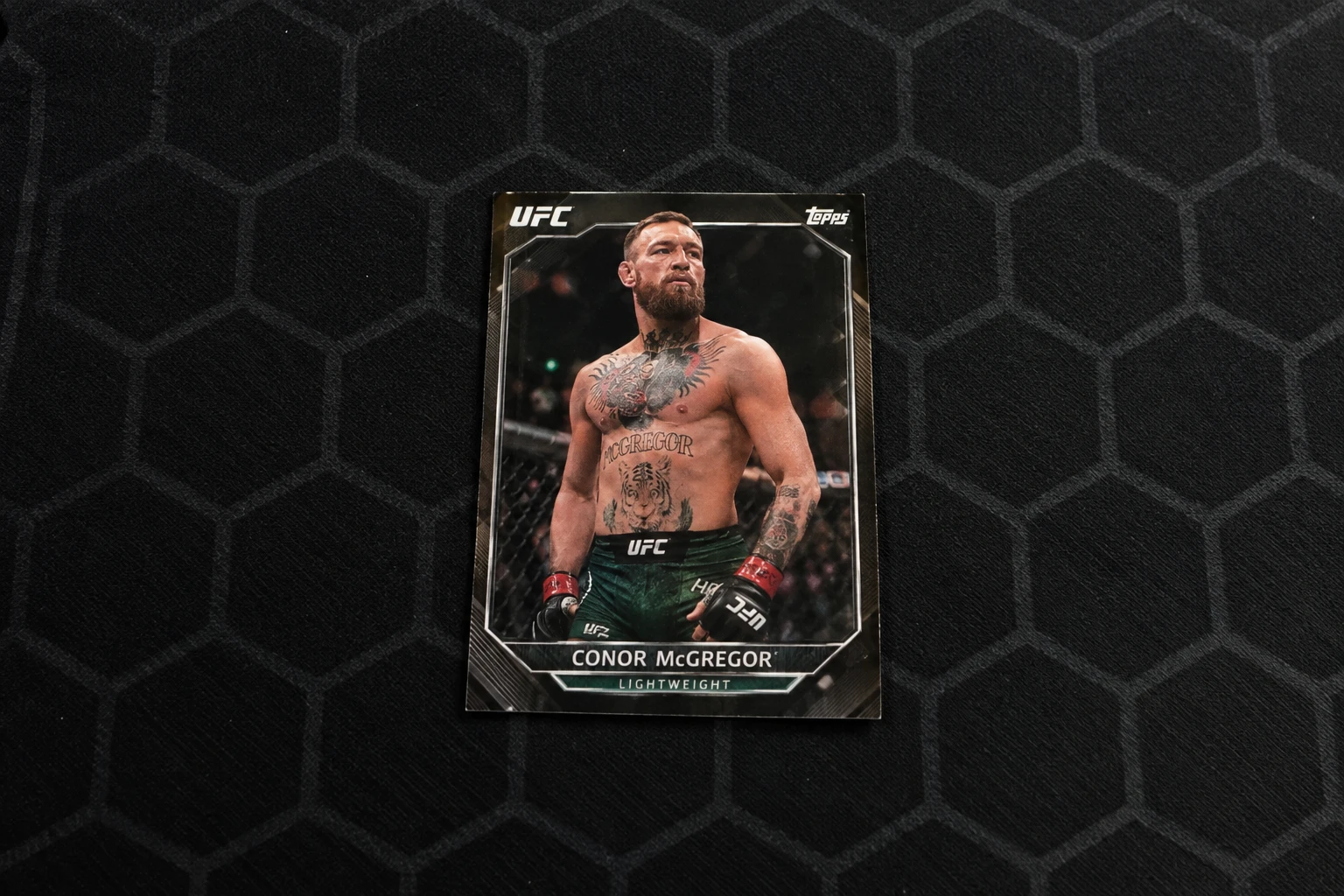
The Short Answer
- Champion-tier Prizm rookies (McGregor-era, Khabib, Jones, current champs) carry the graded premiums.
- The market is thin — graded buyers exist for maybe 15–20 fighters total.
- Panini stock centers well; surface print lines are the common 10-killer.
- Numbered parallels and autos are the strongest grading candidates.
- Check sold comps on the exact fighter + parallel before paying any fee.
The UFC card market in 2026
Panini picked up the UFC license in 2021 and turned MMA cards from a fringe collectible into a structured market with the same Prizm/Select/Donruss template as the NBA. The result: a real graded-card market, but a narrow one — concentrated almost entirely on the champions, the legends (McGregor, Khabib, Jones, Silva, GSP), and the current title-picture fighters.
The defining feature of MMA card grading is the depth problem. There are real buyers for maybe 15–20 fighters' cards — everyone else's cards have almost no graded market regardless of condition. That's the opposite of the NBA, where even a role player's rookie has graded buyers. On UFC, the fighter matters more than the card; a perfect 10 of a nobody is still a fee loss.
The other structural difference from mainstream sports is volatility tied to fights. A fighter's card market can swing 30–40% on a single fight result — a champion who loses the belt sees their graded premiums compress fast, while a challenger who wins gold sees their cards reprice overnight. That makes timing matter more in MMA than in stat-driven sports: you're not just grading a card, you're grading into a market that might look completely different after the next PPV.
For collectors, the practical upshot is that MMA card grading is a fighter-selection game first and a condition game second. Get the name right — a champion with a real market — and the card condition discipline is the same as any sport. Get the name wrong and no amount of perfect centering saves the fee.
2 free credits — check the grade before the fee.
Which UFC cards are worth grading
Grade the champions and legends; skip the roster:
- Prizm rookies of champions — the flagship card of a title-holder. Raw $50–400 for current champs; McGregor/Khabib rookies much higher.
- Numbered parallels of top fighters — /99, /49, /25 on the names that have graded markets.
- Champion autographs — auto + grade premium on fighters with real signatures.
- First Panini-era rookies — the debut Prizm year (2021–2022) of fighters who became champions later.
- Vintage MMA — the old Topps UFC era cards and the pre-Panini issues of the GOAT-tier fighters, which pull collectors outside the modern card market.
Skip: midcard fighters' base cards, non-numbered inserts, and anything by a fighter without a graded market. The brutal filter: if you can't find a sold PSA 10 of the same fighter's comparable card, there's probably no buyer for yours either.
Which fighters actually have graded markets
The graded-buyer list is short and it's the whole game:
- Legend tier: McGregor, Khabib, Jones, Silva, GSP, Cormier — the fighters casual collectors recognize. Their rookie cards and autos have deep enough demand to grade into.
- Current champions: whoever holds belts at print time — the market follows the title picture, so the list rotates with the sport.
- Star prospects: fighters the market is betting on before they win gold — the speculative tier where early slabs appreciate if they become champions.
- Everyone else: the 80% of the roster whose cards are effectively ungradeable at profit.
The discipline here is harsher than in mainstream sports: you're not grading a card, you're grading a fighter's card. If the name doesn't move collectors, condition is irrelevant — a PSA 10 of a prelim fighter is a $30 slab nobody buys.
Print quality and the defects that cost grades
Modern Panini UFC stock is identical to its NBA stock — tight centering, glossy Prizm finish, clean production. The defect profile is the same too:
- Surface print lines — the most common 10-killer, faint production lines hiding on the glossy surface.
- Corner softness — Panini's characteristic soft corner, microscopic but grade-costing.
- Edge whitening — less common than TCG stock but check the dark-bordered parallels.
- Centering drift — usually tight on Panini, verify before assuming.
Where UFC differs is handling: the collector base skews newer to cards, so more submissions arrive from casual pulls that weren't sleeved immediately. The cards that fail a 10 are usually the ones that saw real handling before grading was considered.
The other UFC-specific factor is how new the card market itself is — Panini's first UFC Prizm only launched in 2021, which means even the “vintage” modern UFC cards are barely five years old. There's no deep graded-population history to compare against, so the 10-vs-9 premium gap is less charted than in basketball. That uncertainty cuts both ways: it makes comps harder to find, but it also means early slabs on the legends could carry first-mover premiums as the market matures.
Why pre-grading matters more on UFC
The thin market makes every submission a bet with worse odds than a mainstream sport. The process:
- Confirm the fighter has a graded market. Search sold comps for a PSA 10 of the same fighter's comparable card — if it doesn't exist, don't grade it.
- Check the 10-vs-9 gap. On UFC cards the 10 premium is steep and the 9 market is nearly nonexistent for all but the legends — a likely 9 is almost always a fee loss.
- Pre-grade the card. An AI scan catches the print lines and corner softness that decide the 10-vs-9 outcome in ~30 seconds.
On UFC specifically, the discipline is double: the card has to be a 10-candidate and the fighter has to have a graded market. Failing either check makes the fee a loss.
Free scan — know if it's a 10-candidate first.
The bottom line
UFC cards are a grading market only for the champions and legends — the roster depth isn't there, so a perfect card of the wrong fighter is still a fee loss. When the fighter does have a market, the premiums are real and the steep 10-vs-9 curve makes grade accuracy everything. Check the fighter first, pre-grade the card second, and only submit when both checks clear.
Frequently Asked Questions
0
1
2
3
4
5
6
7
8
9
10
11
Sources & Further Reading

Emily Rodriguez analyzes grading cost, population, and pricing data across PSA, BGS, SGC, CGC, and TAG. She built the PreGradeCards ROI calculator and submission planner, and her market reports on grading backlog, turnaround times, and slab premiums are cited by collectors and dealers worldwide.
Create a free account and get 2 free credits — enough for 2 complete AI gradings with market pricing. No credit card required.
Get Your Free Credits →