The Short Answer
- Young Guns is Upper Deck's iconic NHL rookie subset, running since 1990-91. Short-printed at ~1:6 packs, it is the definitive hockey rookie card.
- PSA 10 hit rates for Young Guns range from 15-40% depending on set year, with older sets (2005-06 Crosby/Ovechkin) being the hardest to grade.
- Centering is the #1 reason Young Guns miss PSA 10. Upper Deck has historically struggled with centering on Series 1 flagship prints.
- The PSA 10 premium for star Young Guns is 6-15x the PSA 9 price — one of the largest grade premiums in any sport.
- Key parallels to grade: Exclusives /100, High Gloss /10, Canvas, and the new Outburst Gold 1/1.
- PSA dominates hockey card resale. BGS has Canadian heritage but lost share. CGC is a budget option. KSA is Canadian-domestic only.
- AI pre-grading is essential for Young Guns — the centering issues mean you need to measure before you spend $80 on PSA Regular.
What Are Upper Deck Young Guns?
Upper Deck Young Guns is the most important rookie card subset in hockey. It has been part of Upper Deck's flagship NHL set since the 1990-91 season, and it is the card that defines a player's rookie card portfolio. Every NHL rookie who enters the league has a Young Guns card, and for the league's biggest stars — Sidney Crosby, Alex Ovechkin, Connor McDavid, Connor Bedard, Macklin Celebrini — the Young Guns is the foundational piece that collectors build around.
Young Guns cards appear in Upper Deck Series 1 and Series 2 each year, with approximately 50 rookies per series. They are short-printed at about 1:6 packs, which means you need to open roughly six packs to pull one Young Guns card — and that card could be any of the 50 rookies in the series. For star rookies like Celebrini or Bedard, the odds of pulling their specific Young Guns are approximately 1:300 packs, which creates real scarcity.
The design is simple but iconic: the player photo, a bold Young Guns logo, and the team color scheme. The cards are printed on standard glossy stock, which makes them thinner and more condition-sensitive than many collectors realize. That condition sensitivity is what makes PSA 10 Young Guns so valuable — the cards are difficult to grade, and the supply of perfect copies is limited.
For collectors, the Young Guns card is the starting point. It is the most liquid, most recognized, and most traded hockey rookie card. If you are building a collection around a specific player, the Young Guns is the first card you buy. If you are investing in hockey cards, the Young Guns is the card you grade. And if you are opening packs, the Young Guns is the card you hope to pull.
Why Young Guns Are Hard to Grade
Young Guns cards are notoriously difficult to grade at PSA 10. There are three main reasons:
1. Centering
Upper Deck has historically struggled with centering on Young Guns, especially in Series 1 where the flagship set is printed in massive volume. A Young Guns card that looks centered under normal lighting may fail the 55/45 front centering standard when measured precisely. The Young Guns logo at the bottom of the card can make the bottom border appear larger than it is, creating an optical illusion that leads collectors to overestimate the centering quality.
2. Edge Wear
The thin stock on Young Guns makes them more prone to edge wear than thicker premium cards. Edge whitening is particularly visible on cards with dark borders, which describes many Young Guns designs. Even pack-fresh cards can have edge wear from the packaging process itself — the cards rub against each other in the pack, and the thin stock shows every nick.
3. Surface Issues
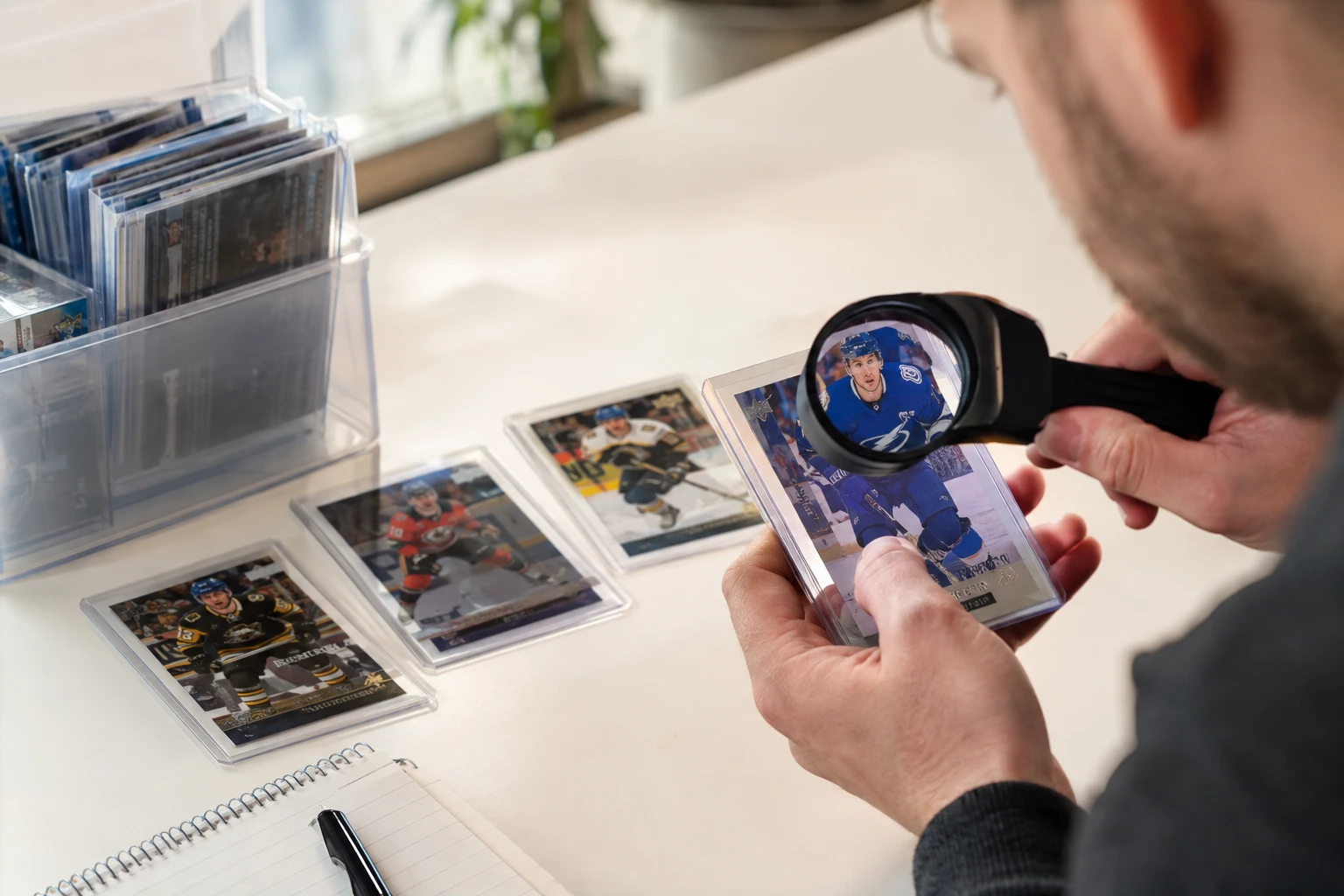
The glossy finish on Young Guns is susceptible to print lines, scratches, and dimples. Print lines are particularly common on high-volume print runs, and they can be difficult to see under normal lighting. A card that looks clean to the naked eye may have micro-scratches or print defects that are visible under 10x magnification — and PSA graders use magnification.
The combination of these three issues means that the PSA 10 hit rate for Young Guns is lower than for many other card types. A collector who submits 10 pack-fresh Young Guns might get 2-4 PSA 10s, compared to 5-7 for a comparable basketball or football product. This lower hit rate is exactly what creates the PSA 10 premium — scarcity drives value.
PSA 10 Hit Rates by Set Year
PSA 10 hit rates for Young Guns vary significantly by set year. Older sets are harder to grade because the cards were not preserved as carefully and because print quality in the mid-2000s was more variable. Here are estimated PSA 10 hit rates for key Young Guns sets:
| Set Year | Key Rookies | Est. PSA 10 Hit Rate | Difficulty | Why |
|---|---|---|---|---|
| 2005-06 | Crosby, Ovechkin | ~15% | Very Hard | Heavy handling, poor storage, variable print quality |
| 2015-16 | McDavid, Eichel | ~25% | Hard | Better preservation, but centering issues persist |
| 2016-17 | Matthews, Laine | ~28% | Hard | Similar to 2015-16, moderate centering variance |
| 2019-20 | Makar, Hughes | ~35% | Moderate | Improved print quality, better centering |
| 2023-24 | Bedard, Fantilli | ~38% | Moderate | Modern print quality, but still centering variance |
| 2024-25 | Celebrini, Michkov | ~40% | Moderate | Best modern print quality, but pack rub still an issue |
Hit rates are estimates based on PSA population data and collector submission reports. Actual rates vary by card, player, and condition of the specific copy submitted.
The 2005-06 Crosby and Ovechkin Young Guns are particularly difficult in PSA 10 because they were heavily handled at the time of release and many were stored in poor conditions. The cards were not seen as long-term investments in 2005 — they were just hockey cards. As a result, finding a pack-fresh Crosby or Ovechkin Young Guns that has survived 20+ years in gem-mint condition is extraordinarily rare, which is why a PSA 10 Crosby Young Guns can sell for $30,000-$80,000.
The Centering Problem: A Deep Dive
Centering is the single biggest reason Young Guns cards miss PSA 10. Understanding the centering standard and how to measure it is the most important skill for any hockey card collector who grades.
PSA requires 55/45 front centering for a PSA 10. This means the borders on the front of the card must be within a 55/45 ratio — the larger border cannot be more than 55% of the total border measurement. On the back, the standard is more lenient at 75/25.
For Young Guns specifically, centering is challenging for several reasons:
- High-volume printing: Series 1 is printed in massive quantities, and quality control on centering is less consistent than on low-numbered premium products.
- The Young Guns logo: The logo at the bottom of the card can make the bottom border appear larger than it is, creating an optical illusion that leads collectors to overestimate centering quality.
- Sheet cutting: Cards are cut from large sheets, and the cutting process can shift slightly, resulting in cards that are off-center in one direction. This is a manufacturing issue, not a handling issue — even pack-fresh cards can be poorly centered.
- Set-specific patterns: Some set years have known centering biases. For example, 2015-16 Upper Deck Series 1 is known for left-shifted centering on many Young Guns cards, including the McDavid #201.
To measure centering accurately, use a centering tool or app. Measure the left and right borders at the top, middle, and bottom of the card. Measure the top and bottom borders at the left, center, and right. Calculate the ratios. If any measurement exceeds 55/45 on the front, the card will not grade PSA 10 — no matter how clean the corners, edges, and surface are.
AI pre-grading tools can measure centering automatically from a photo of the card. This is the single most valuable use of AI pre-grading for Young Guns — it catches centering issues that the naked eye misses, saving you the cost of submitting a card that will grade PSA 9 at best.
Common Condition Issues by Set
Different Young Guns set years have different condition issues that collectors should be aware of before submitting:
| Set Year | Known Issues | Pre-Screening Focus |
|---|---|---|
| 2005-06 | Corner dings from handling, edge wear, surface scratches from poor storage | Corners first, then surface. Centering is secondary — most copies are already too worn for PSA 10. |
| 2015-16 | Left-shifted centering (McDavid #201 especially), edge whitening on dark borders | Centering is the gatekeeper. Measure left/right ratio carefully. Then check edges. |
| 2019-20 | Moderate centering variance, occasional print lines on glossy surface | Check for print lines under angled light. Centering is generally better. |
| 2023-24 | Pack rub on edges, occasional surface dimples from manufacturing | Edges first (pack rub), then surface dimples. Centering is usually acceptable. |
| 2024-25 | Best modern print quality, but pack rub still present. Some centering variance on Series 2. | Quick centering check, then edges. Most issues are edge-related from packaging. |
Young Guns Parallels: Which to Grade
Young Guns cards have several parallels, each with different scarcity and value. Here is the complete guide to which parallels are worth grading:
| Parallel | Print Run | Grade? | Recommended Grader | Notes |
|---|---|---|---|---|
| Base Young Guns | ~1:6 packs | Yes — if PSA 10 likely | PSA | The standard rookie card. Only grade if pre-screening shows PSA 10 potential. |
| Canvas | Limited | Yes | PSA | Matte-finish alternate art. Fan favorite. Strong PSA 10 premiums. |
| Exclusives /100 | 100 copies | Always | PSA | Numbered to 100. Significant premium. Always grade. |
| High Gloss /10 | 10 copies | Always | PSA Express | True short print. Major premium. Use faster tier for quicker resale. |
| Clear Cut / Printing Plates | 1/1 | Always | PSA Express | One-of-one. Ultimate rarity. Always grade with PSA. |
| Outburst Gold | 1/1 | Always | PSA Walk-Through | New parallel (2023-24+). Celebrini 1/1 sold for $1.28M. Use premium tier. |
| Young Guns Autographs | Very Limited | Always | PSA | Signed versions. Far scarcer than base. Separate, higher market. |
The rule is simple: if it is numbered, grade it. Numbered parallels have built-in scarcity that creates value even at PSA 9. For base Young Guns, only grade if pre-screening suggests PSA 10 is likely — the 6-15x premium for PSA 10 over PSA 9 is what makes the submission worthwhile.
PSA vs BGS vs CGC vs SGC vs KSA for Hockey
Five grading companies are relevant to hockey cards. Here is how they compare:
| Grader | Hockey Strength | Resale Premium | Best For |
|---|---|---|---|
| PSA | Dominant — US and international | Highest (baseline) | All Young Guns, all eras |
| BGS | Canadian heritage, historical strength | 80-95% of PSA | Modern high-end, Black Label chases |
| CGC | Strictest on centering, budget option | 70-90% of PSA | Mid-value modern, TCG crossover |
| SGC | Preferred for vintage, fair grading | 75-90% of PSA | Vintage OPC, pre-1980 |
| KSA | Canadian-domestic, limited international | 50-70% of PSA | Canadian market only, personal collection |
For hockey cards, PSA is the default choice. It commands the highest resale premium, has the most recognized brand, and is the grader that collectors and investors trust for Young Guns. BGS has a strong Canadian heritage and is popular for its subgrades, but it has lost market share to PSA in recent years. CGC is the strictest on centering, which can be a disadvantage for Young Guns (where centering is already the main issue) but makes it a good budget option for collectors who want tight standards. SGC is preferred for vintage hockey cards, particularly pre-1980 OPC issues. KSA is a Canadian-only grader with limited international resale value — use it only for personal collection cards you do not plan to sell internationally.
PSA 10 Values for Key Young Guns
Here is the current market value for PSA 10 Young Guns of the most important modern NHL rookies:
| Player | Set | PSA 10 Range | PSA 9 Range | 10/9 Premium |
|---|---|---|---|---|
| Sidney Crosby | 2005-06 UD YG #201 | $30,000-$80,000 | $3,000-$8,000 | ~10x |
| Alex Ovechkin | 2005-06 UD YG #443 | $15,000-$40,000 | $1,500-$4,000 | ~10x |
| Connor McDavid | 2015-16 UD YG #201 | $5,000-$15,000 | $500-$1,500 | ~10x |
| Auston Matthews | 2016-17 UD YG #201 | $1,500-$5,000 | $200-$600 | ~8x |
| Cale Makar | 2019-20 UD YG #201 | $800-$2,500 | $150-$400 | ~6x |
| Connor Bedard | 2023-24 UD YG | $600-$3,500 | $120-$500 | ~6x |
| Macklin Celebrini | 2024-25 UD YG | $3,500+ | $500-$1,000 | ~7x |
Values are estimated ranges based on recent auction results and marketplace data as of August 2026. Actual sale prices vary by timing, platform, and card condition.
The PSA 10 premium for Young Guns is one of the largest in any sport. A Crosby Young Guns PSA 10 can be 10-15x the PSA 9 price. This is because the PSA 10 population for star Young Guns is so low — the combination of centering difficulty, edge wear, and the age of older sets means that perfect copies are genuinely rare. This is why collectors are willing to buy multiple raw copies and submit them in hopes of finding one gem-mint candidate.
Pre-Screening Young Guns Before Submitting
Pre-screening is the most important step in the Young Guns grading process. At $79.99 per card for PSA Regular (the cheapest open PSA tier in August 2026), you cannot afford to submit cards that will grade PSA 9 or below. Here is the pre-screening protocol:
Step 1: Visual Inspection (5 minutes per card)
- Corners: Examine all four corners under 10x magnification. Look for dings, dents, and whitening. Even one damaged corner drops the card to PSA 8 or below.
- Edges: Check all four edges for chipping, fraying, and whitening. Young Guns with dark borders show edge wear more visibly.
- Surface: Tilt the card under a light source to catch scratches, print lines, and dimples. Look for gloss imperfections.
- Centering: Measure the borders. Use a centering tool or app. The front must be 55/45 or better for PSA 10.
Step 2: AI Pre-Grading (30 seconds per card)
Use AI pre-grading to get an objective assessment. AI tools analyze a photo of your card and provide a predicted PSA grade with specific defect identification. For Young Guns, the most valuable AI check is centering — the tool measures the border ratios precisely and tells you whether the card meets the 55/45 standard. This catches centering issues that the naked eye misses, especially given the Young Guns logo optical illusion.
Step 3: The Go/No-Go Decision
- Go: Card passes all four criteria with no visible defects. Centering is 55/45 or better. Submit to PSA.
- Maybe: Card has one minor issue (borderline centering, slight edge wear). Submit to CGC Economy ($20) as a budget alternative, or hold for a future submission.
- No-Go: Card has visible damage or centering worse than 60/40. Do not submit. Sell raw or keep for personal collection.
Submission Strategy in the 2026 Backlog
The 2026 grading crisis affects Young Guns submissions just like every other card type. Here is how to navigate it:
For High-Value Young Guns (Crosby, Ovechkin, McDavid)
Use PSA Regular ($79.99, 70-80 business days) or PSA Express ($149, 20-30 business days). These cards are worth thousands in PSA 10, so the fee is easily justified. The 70-80 day wait is long but acceptable for cards you plan to hold long-term.
For Mid-Value Young Guns (Matthews, Makar, Bedard, Celebrini)
Use PSA Regular ($79.99) for cards worth $500+ in PSA 10. For cards worth $100-$500, consider CGC Economy ($20, 90 working days) or CGC Standard ($55, 10 working days). The CGC resale discount is manageable for mid-value cards, and the cost savings is significant.
For Numbered Parallels
Always use PSA. The scarcity of numbered parallels means the PSA premium is largest relative to the fee. Use PSA Express ($149) for parallels worth $1,000+ and PSA Regular ($79.99) for parallels worth $200-$1,000.
For Common Young Guns (Non-Star Rookies)
Do not grade common Young Guns of non-star rookies. The PSA 10 value is typically $10-$50, which does not justify the $79.99 fee. Sell raw or keep for personal collection. If you have a large batch of 25+ common Young Guns, CGC Bulk ($17, 150 working days) is the only economical option.
Frequently Asked Questions
What are Upper Deck Young Guns cards?
Why are Young Guns hard to grade at PSA 10?
What is the PSA 10 premium for Young Guns?
Which Young Guns parallels should I grade?
Should I use PSA or BGS for hockey cards?
How do I pre-screen Young Guns for centering?
How much is a Connor McDavid Young Guns PSA 10 worth?
Can I grade Young Guns with CGC to save money?
Sources & Further Reading
- PreGradeCards — Hockey Card Grading Guide 2026
- SportCardScanner — Upper Deck Young Guns Values & Parallels
- CardSense AI — Connor McDavid Rookie Card Guide
- CardSense AI — Connor Bedard Rookie Card Guide
- CardSense AI — Upper Deck Young Guns Guide
- GradingMetric — Hockey Card Grading with AI
The PreGradeCards Research Team combines machine-learning engineers, grading analysts, and collector-education specialists to produce accurate, data-driven guides on AI card grading, professional grading standards, and collecting strategy.
Create a free account and get 1 free credit — enough for 1 complete AI grading with market pricing. No credit card required.
Sign Up Free →