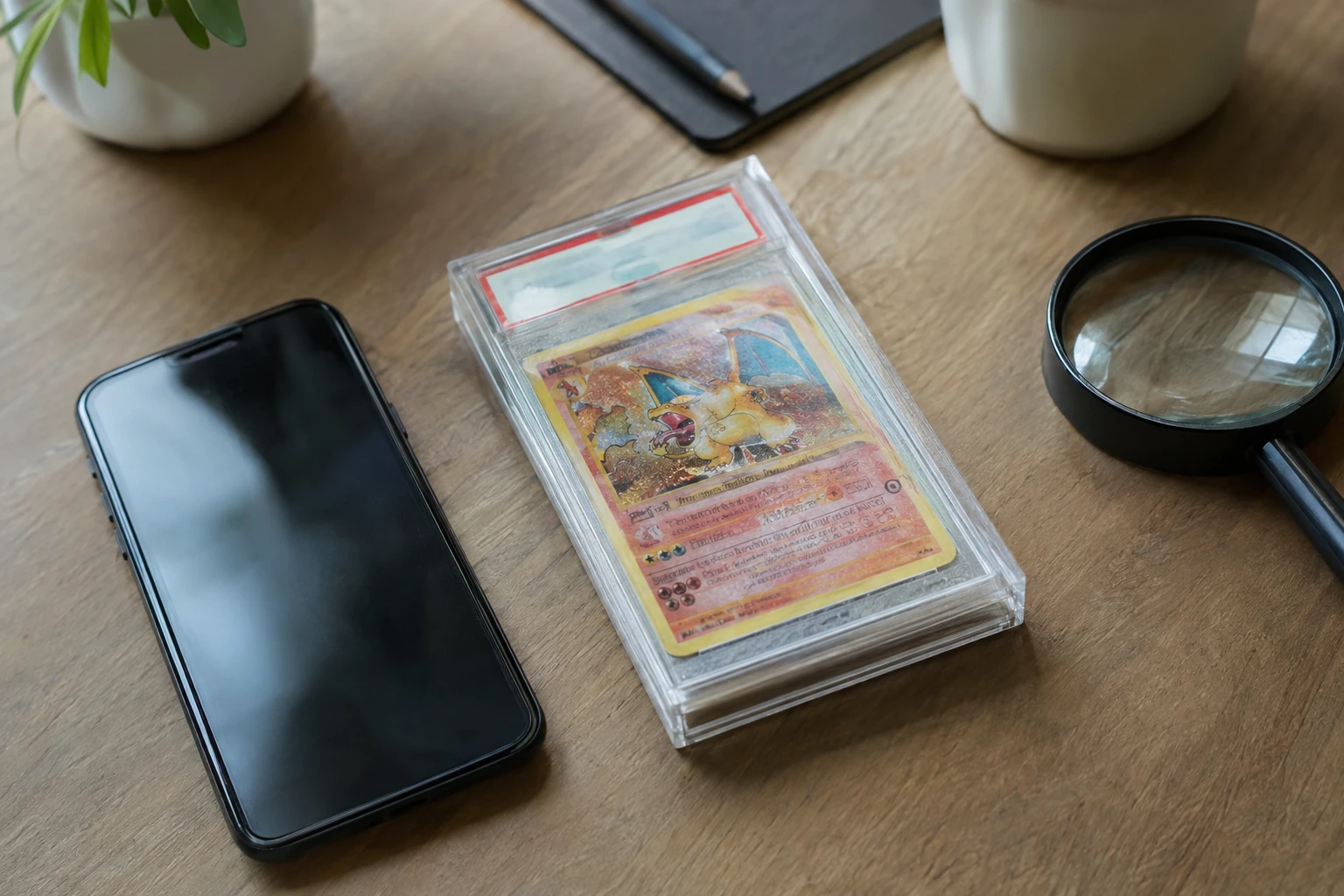
The Short Answer
- Every legitimate grader has a free public cert lookup — PSA, BGS, CGC, SGC, TAG, KSA, ACE, PCA, and CollectAura all verify serials online. No lookup = no trust.
- PSA's lookup shows the actual card's scan for most certs — if the scanned card differs from the slab in hand (centering, wear pattern, holo pattern), the cert is cloned.
- The QR code is not proof: fake slabs ship with QR codes that lead to cloned verification pages — always navigate to the company's domain yourself and re-enter the number.
- Cert cloning is the dominant 2026 fake: counterfeiters copy a real cert number onto a fake slab. Only side-by-side comparison with the company's cert images catches it.
- Verify before you pay, not after: 30 seconds on the lookup defeats 95% of fake-slab fraud — sellers who resist verification are telling you something.
Why Verifying the Cert Matters More Than Ever
Graded-card fraud has industrialized. The 2026 counterfeit playbook isn't crude photocopied labels — it's cert cloning: take a real cert number from a sold eBay listing, print it on a fake label, seal a lookalike card inside. The cert number 'checks out' because it's real. The card in the slab just isn't the card that was graded.
That's why verification has two mandatory steps now, not one: confirm the number exists, then confirm the cert data matches the physical slab. The second step is where almost all fakes die — and it's the step most buyers skip.
Search demand tells the story: 'PSA cert lookup' alone pulls thousands of monthly searches, and every grader's verification page is now a frontline defense. This guide walks each company's lookup, what a legitimate result shows, and the physical tells that catch what the database can't.
PSA Cert Verification
PSA's verification lives at psacard.com/certverification. Enter the 7–8 digit cert number from the label (no dashes) and the lookup returns:
- Card description — year, brand, card number, player/subject, variation
- Grade + any qualifiers (OC, ST, etc.)
- For most modern certs: actual front and back scans of the graded card
- Cert number confirmation and issue details
The card-image comparison is the kill shot for clones. Compare the cert page scan to the slab in hand: centering ratios, corner wear patterns, holo pattern, print marks. Two copies of the same card can share a cert-lookup-valid number but will never share the same centering or wear signature. If the scanned copy shows whiter corners or different centering than your slab, walk away.
Also check the PSA label generation: lighthouse-hologram labels (current), earlier lighthouse variants, and the vintage flip styles each have era-specific fonts, spacing, and hologram patterns. Our fake PSA slab guide walks the label forensics in detail, and our PSA cert lookup guide covers the deeper cert-page fields. Our own PSA cert lookup tool verifies numbers directly and pulls population data alongside.
BGS and CGC Verification
Beckett (BGS/BVG/BCCG)
Beckett's verification is at beckett.com/grading — 'Verify Cert.' BGS certs are 10-digit; the lookup returns the card description, overall grade, the four subgrades (centering, corners, edges, surface), and card detail. Subgrades are the verification bonus: a fake BGS slab must clone not just a number but four plausible-looking subgrades that match the physical card's actual defects — compare each subgrade to what the card really shows.
Caveat in 2026: Beckett's site has been intermittently unstable during its transition under Collectors ownership. If the cert page is unreachable, verify via the Beckett app or ask the seller to share the cert-page screenshot — then re-verify when the site is back.
CGC Cards
CGC verification runs at cgccards.com — 'Verify CGC Certification.' The lookup returns card description, grade, and — for most modern certs — graded-card images and a grader-notes field. CGC's cert pages are unusually information-dense: they show the exact card scanned at encapsulation, which makes cloned-cert comparisons easy. CGC also verifies comics/magazines on the same portal — make sure you're checking the card, not a same-numbered comic cert.
SGC and TAG Verification
SGC
SGC's cert lookup is at gosgc.com — cert verification. Enter the slab's cert number; the page returns card description and grade. SGC certs are shorter numeric strings than BGS's. The tuxedo slab's internal sleeve alignment is itself a tell — authentic SGC slabs seat the card label-flush with consistent margins; fakes often float the label or misalign the card.
TAG Grading
TAG's verification is the most data-rich in the industry: taggrading.com cert lookup returns not just the grade but TAG's full digital grading report — defect-level findings, centering measurements, the works. A real TAG cert page shows the kind of granular data a fake can't plausibly reproduce. If a TAG slab's cert lookup returns a bare grade with no report data, be suspicious.
KSA, ACE, PCA & International Cert Checks
Regional graders are equally verifiable — and verification matters more because fewer buyers know what real holders look like:
- KSA (Canada): every slab's unique serial is in KSA's online database — verify via the serial-number search on ksagrading.com.
- ACE (UK): cert lookup on acegrading.com shows the four subgrades plus millimeter-accurate centering data — a fake would need to clone real measurements.
- PCA (France): verification at pcagrade.com; certs carry sequential-expert review data.
- CollectAura (France): QR on the label back opens the digital grading certificate with front/back HD photos taken at intake — compare those intake photos to the slab directly.
- Aura (US): cert + pop report search on auragrading.com via label QR or direct lookup.
The universal rule holds everywhere: no public cert lookup means no trust. Any 'grader' whose slabs can't be verified online should be treated as a novelty holder, whatever the label claims.
Every Company's Cert Lookup (Bookmark Table)
| Company | Verify At | What the Page Shows |
|---|---|---|
| PSA | psacard.com/certverification (or our cert lookup tool) | Description, grade, qualifiers, card scans (most certs) |
| BGS/BVG/BCCG | beckett.com/grading → Verify Cert | Grade + four subgrades + description |
| CGC | cgccards.com → Verify CGC Certification | Grade, description, card images, grader notes |
| SGC | gosgc.com → cert verification | Description + grade |
| TAG | taggrading.com cert lookup | Grade + full digital grading report |
| KSA | ksagrading.com serial search | Card info + grade by serial |
| ACE | acegrading.com cert lookup | Subgrades + centering measurements |
| PCA | pcagrade.com verification | Grade + review data |
| CollectAura | Label QR → digital cert | Grade + intake HD photos |
Always navigate to the domain yourself. Never verify through a QR code printed on the slab or a link the seller sends — scan it if you want, but then re-enter the cert number on the company's site reached independently. Fake QRs leading to cloned verification pages are the second-most-common 2026 trick.
The Five Fake-Slab Tells That Beat Verification
Even with a 'valid' cert lookup, check these before paying:
- Cert-image mismatch. The lookup's card scan shows different centering, wear, or holo pattern than the slab in hand. #1 tell — the cert is real, the slab is a clone.
- Seal quality. Real sonic welds are uniform and clean; reseals show uneven weld lines, gaps, or a 'melted' look along the edges. Resealed genuine slabs with swapped cards are a growing fraud.
- Label font and alignment drift. Every company has era-specific label generations — fakes get fonts, spacing, or hologram patterns subtly wrong. Compare to a known-good slab image from the same era.
- Wrong-weight slab. Counterfeit acrylic is often lighter or flexier than genuine holders. A slab that feels hollow, rattles differently, or flexes under thumb pressure deserves scrutiny.
- Too-new cert on an old card. A '1989 Griffey' in a slab with a cert number issued last month isn't automatically fake — resubmissions happen — but it means the raw card's journey matters. Check the cert issue context and ask why it was graded recently.
Our counterfeit slab guide goes deeper on each tell with side-by-side photos.
When a Cert Number Fails to Verify — What It Actually Means
A failed lookup has four possible explanations, in rough order of frequency:
- Transcription error. The most common cause by far. Cert numbers confuse 0/O, 1/I, 5/S, and 8/B constantly — especially photographed under slab glare. Retype from the label directly, not the listing photo, and try the obvious substitutions before concluding anything.
- Database lag. Freshly graded slabs can take days (PSA) to weeks (smaller companies) to appear in the public database. A brand-new cert that doesn't resolve yet isn't proof of fraud — check the label's submission-era design against known samples and re-verify in a week.
- Company without a public database. Several regional graders have thin or no online verification (covered in the table above). Absence of lookup ≠ fake — it just means verification happens by email, phone, or not at all, which is itself a data point about the label.
- An actual counterfeit. If the number format is wrong for the era, the database returns a different card for that number, or the company confirms the number was never issued — you're holding a fake slab. Document everything before confronting anyone.
If the cert verifies but shows a different card: that's the more dangerous failure — a genuine cert number transplanted onto a counterfeit or swapped slab. The database result is your evidence; it proves the number is real and the pairing is not. This is exactly why the verification step is 'does the returned record match the slab' and not 'does a number exist.'
Reporting path: PSA accepts counterfeit reports through its customer service channel; eBay purchases route through eBay's authenticity/money-back process; show purchases go through the show promoter's dealer policy. Keep the slab — it's evidence, not trash.
Verifying Slabs In Person — Shows, Shops, and Parking-Lot Deals
Online lookup is step one; physical inspection is what catches what databases can't. At a show table or card shop counter, run this sequence in under a minute:
- Cert lookup on your phone, on YOUR connection. Never verify through a QR code printed by the seller or a link they send — counterfeit slabs carry QR codes pointing at cloned verification pages. Type the company's real URL yourself (or use our PSA cert lookup), enter the number manually, confirm the card name, set, and grade all match the physical label.
- Check the weld seams. Genuine PSA/BGS/CGC slabs have clean sonic welds — uniform seams with no gaps or pry marks. Re-sealed slabs show cloudy, uneven, or ground-down edges where the case was opened and re-fused.
- Label under angled light. Real labels have crisp print and correct holographic elements for the era. Blurry text, wrong fonts, or missing holo = reprint. Compare against a known-good photo of the same label generation — companies revise label designs every few years and fakers lag behind.
- The rattle test. A properly seated card doesn't move. A card rattling inside an oversized case, or one wedged with visible shims, suggests the card was swapped into a genuine holder.
- Weight and feel. Counterfeit cases are often a gram or two lighter and feel slightly flexible at the corners. Subtle — but after handling fifty real slabs, a fake feels wrong before you can say why.
And the rule that overrides all of it: if a deal requires you to decide before you can verify, the deal is designed to fail verification. Legitimate sellers welcome a sixty-second lookup; urgency is the counterfeit inventory-clearance strategy.
The Verdict
Verification is a 30-second habit that eliminates most graded-card fraud: find the number, verify it on the company's own domain, compare the cert images to the slab in hand. Three steps, every purchase, no exceptions.
The rule underneath it all: a cert number proves a card was graded — it doesn't prove this slab is that card. The lookup is the first half of the check; your eyes are the second half. Sellers who rush you past verification or 'can't find the cert right now' have already told you everything you need to know.
Frequently Asked Questions
0
1
2
3
4
5
6
7
Sources & Further Reading
- PSA — Cert Verification
- PreGradeCards — PSA Cert Lookup Tool
- KSA Certification — Serial Number Verification
- CollectAura — Certification Process (intake photography)
- PreGradeCards — How to Spot Fake PSA Slabs
- PreGradeCards — Counterfeit Slab Guide
Emily Rodriguez analyzes grading cost, population, and pricing data across PSA, BGS, SGC, CGC, and TAG. She built the PreGradeCards ROI calculator and submission planner, and her market reports on grading backlog, turnaround times, and slab premiums are cited by collectors and dealers worldwide.
Create a free account and get 1 free credit — enough for 1 complete AI grading with market pricing. No credit card required.
Sign Up Free →