The Short Answer
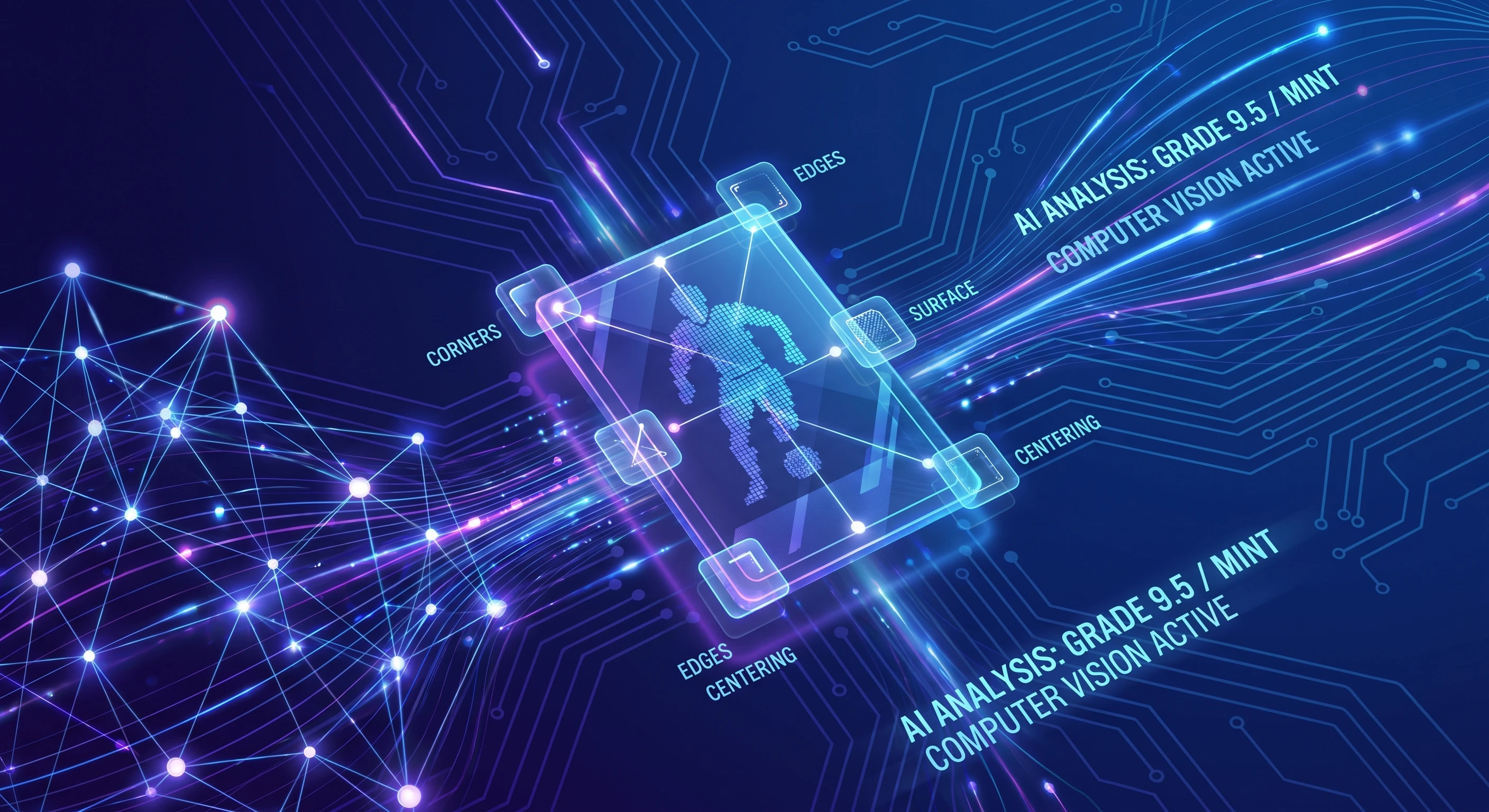
- Computer vision: AI grading tools use CNNs (Convolutional Neural Networks) to analyze card images pixel by pixel.
- Four condition factors: AI evaluates centering, corners, edges, and surface automatically.
- 89% accuracy: PreGradeCards matches PSA grades within one point — sufficient for pre-screening.
- Not professional grading: AI tools are pre-screening aids, not replacements for PSA/BGS/SGC.
- Free tiers available: PreGradeCards offers 5 free scans/month; CardGrade.io offers 3 free.
How Do AI Grading Tools Work?
AI grading tools use your smartphone camera or scanner to capture card images, then apply computer vision algorithms to evaluate condition factors:
The entire process takes 10-30 seconds per card. The AI looks at:
- Centering: Measures border ratios (55/45, 60/40, etc.)
- Corners: Detects rounding, whitening, fuzzing
- Edges: Identifies chipping, roughness, wear
- Surface: Finds scratches, print lines, clouding
The Technology Behind AI Grading
Computer Vision & Neural Networks
AI grading tools use several advanced technologies:
| Technology | How It's Used |
|---|---|
| CNNs | Convolutional Neural Networks analyze image pixels for patterns |
| Edge Detection | Identifies card borders, corners, and edges precisely |
| OCR | Optical Character Recognition reads card text/set info |
| Machine Learning | Trained on thousands of PSA-graded card images |
| Image Segmentation | Separates card from background, isolates condition factors |
The AI is "trained" on datasets of cards that have been professionally graded, learning to correlate visual patterns with specific grade outcomes.
Types of AI Grading Tools
| Type | Examples | Purpose |
|---|---|---|
| Pre-Screening Apps | PreGradeCards, CardGrade.io | Predict PSA grade before submitting |
| Hybrid AI Graders | TAG, AGS | AI + human for professional grading |
| Portfolio Tools | CollX, Alt | Track collection with grade estimates |
| Centering Tools | PreGradeCards centering feature | Measure border ratios precisely |
AI Accuracy vs Professional Graders
| Metric | PreGradeCards | CardGrade.io | TAG (Hybrid) |
|---|---|---|---|
| PSA Grade Match | 89% | 85% | 87% |
| Centering Accuracy | 99.2% | 97% | 98% |
| Surface Detection | 78% | 76% | 85% |
| Consistency | 100% | 100% | 95% |
Accuracy = percentage matching PSA grades within one grade point. Surface detection measures identification of print lines, scratches, and flaws.
AI Grading Tool Limitations
What AI Cannot Do
- Authentication: Cannot detect counterfeits, trimmed cards, or alterations
- Subtle surface flaws: Misses faint print lines, holo pattern issues
- Context awareness: Doesn't understand era-specific defects (vintage wax stains)
- Resale legitimacy: AI grades have zero secondary market value
- Camera quality dependent: Poor phone = poor accuracy
How to Use AI Grading Tools Effectively
- Scan in good lighting: Natural daylight, no shadows, flat card position
- Use quality camera: Modern smartphone (iPhone 8+, Galaxy S8+)
- Review all four factors: Check AI assessment of centering, corners, edges, surface
- Verify with magnification: Use 10x loupe to confirm surface detection
- Track your results: Compare AI predictions to actual PSA grades
- Filter strategically: Submit only AI-predicted 9+ candidates
Frequently Asked Questions
What are AI grading tools?
AI grading tools are software applications that use computer vision and machine learning to evaluate trading card condition. They analyze card images to assess centering, corners, edges, and surface, then predict professional grades (PSA/BGS). Leading tools include PreGradeCards (89% accuracy), CardGrade.io, and hybrid services like TAG. These are pre-screening aids, not replacements for professional grading.
Is there an AI card grading app?
Yes — several AI card grading apps exist: PreGradeCards (iOS/Android, 5 free scans/month, 89% PSA accuracy), CardGrade.io (mobile web, 3 free scans), and CollX (portfolio tracking with AI estimates). These apps scan cards with your phone camera and predict PSA grades. They're designed for pre-screening before professional submission, not as replacements for PSA/BGS.
Can AI do color grading?
That depends on context. In video/film production, yes — AI color grading tools like DaVinci Resolve's AI features or Runway ML can automatically adjust colors. In trading cards, AI grading tools don't "color grade" — they detect color-related defects like fading, discoloration, or print registration issues. Card grading AI focuses on condition assessment, not color correction.
Can AI grade work?
In the context of trading cards, AI can predict professional grades with 85-89% accuracy but cannot produce officially graded cards for resale. In education, AI can assist with grading essays and assignments (various ed-tech tools), but that's a different domain. For collectible cards, AI is a pre-screening tool only — final grading requires human professionals for authentication and market legitimacy.
How can AI help with grading?
AI helps with card grading by: (1) Pre-screening — identifying which cards are worth submitting (saving hundreds in fees), (2) Centering measurement — precise border ratio calculation (99.2% accuracy), (3) Consistency — same card always gets same assessment, (4) Speed — grades card in 10 seconds, (5) Documentation — creates digital condition records. AI doesn't replace professional grading but makes it more efficient.
Did PSA switch to AI grading?
No — PSA has not switched to AI grading. PSA uses human graders exclusively as of 2026. They've explored AI for authentication assistance but all final grades are assigned by human experts. TAG (Trading Card Grading) uses hybrid AI + human grading. AGS uses full AI. PSA's official position is that human expertise remains essential for authentication and subtle condition assessment.
Does PSA do AI grading?
No — PSA does not currently use AI for grading. All PSA grades are assigned by human experts. PSA has investigated AI for authentication support and quality control, but the company maintains that human graders are necessary for detecting alterations, authenticating cards, and assessing subtle condition factors. AI tools like PreGradeCards can predict PSA grades, but PSA itself does not use AI for their official grading process.
Does TAG do AI grading?
Yes — TAG (Trading Card Grading) uses hybrid AI + human grading. TAG employs computer vision to analyze card condition and provide measurements, then human graders review the AI assessment and make final grade decisions. TAG also provides QR-linked digital reports showing exact measurements. This hybrid approach aims to combine AI consistency with human expertise for authentication and subtle flaw detection.
How to do AI grading?
To use AI grading: (1) Download an AI grading app (PreGradeCards, CardGrade.io), (2) Scan card in good natural lighting with phone camera, (3) Review AI assessment of centering, corners, edges, surface, (4) Verify surface detection with 10x magnification, (5) Submit only cards AI predicts as 9+ to PSA/BGS, (6) Track results to calibrate your trust in AI predictions. AI grading is pre-screening, not a replacement for professional submission.
Sources & Further Reading
Dr. Andrew K. founded PreGradeCards in 2023 after building computer-vision systems for medical imaging and industrial defect detection. He holds a Ph.D. in machine learning, has published peer-reviewed work on convolutional neural networks for surface analysis, and oversees the grading model pipeline that has analyzed over 1.2 million cards.
With submission floors rising, pre-screening is no longer optional. Use our AI Pre-Grade Calculator to score a card's PSA 10 odds before you pay, and the Submission Planner to pick the right tier.