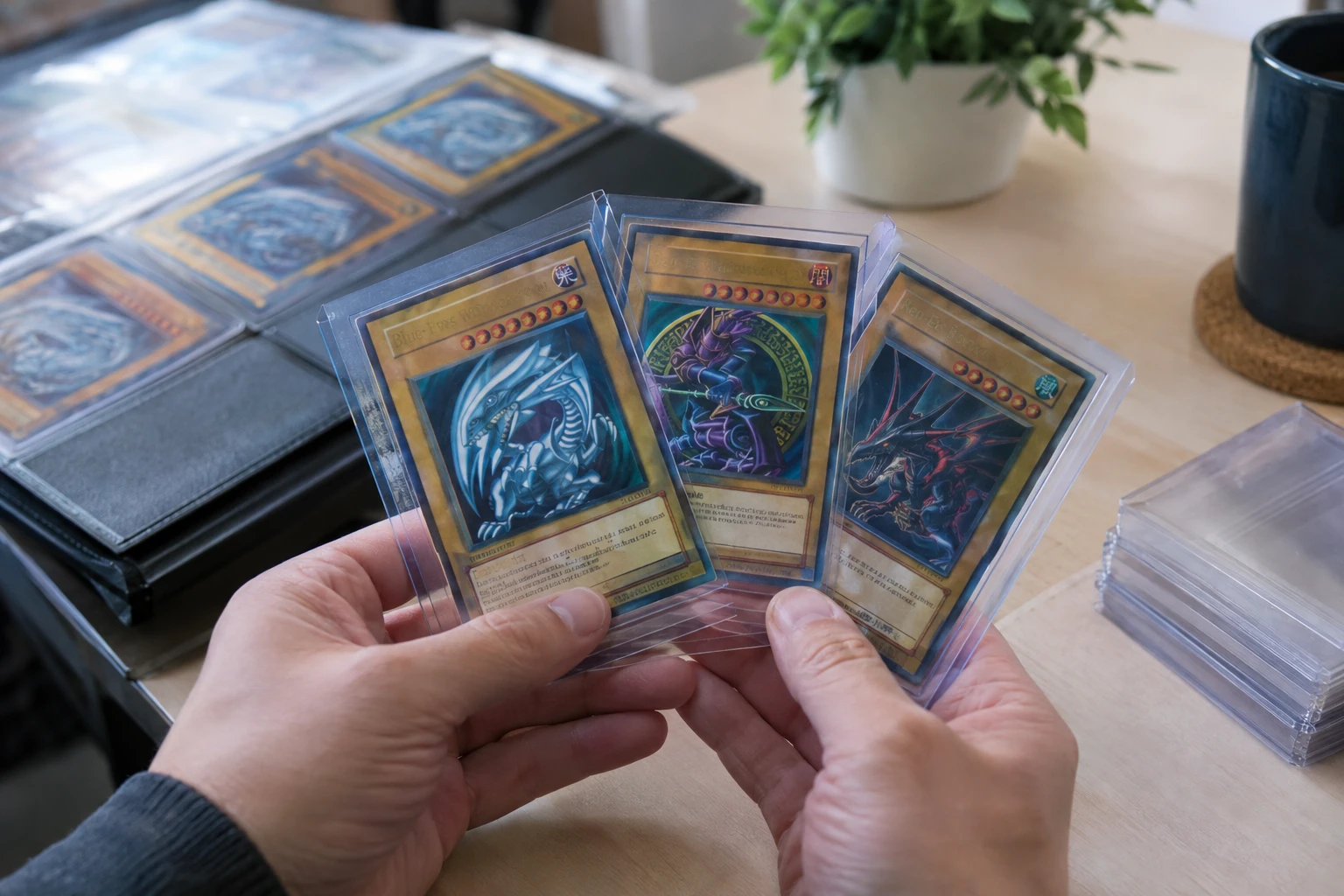
The Short Answer
- LOB 1st Ed Blue-Eyes White Dragon PSA 10 runs ~$8,000-15,000+ — the set's flagship
- North American 'wavy' and European 'glossy' 1st Ed prints carry different values — know which you have
- Dark Magician, Exodia pieces, and Gaia the Fierce Knight form the mid-chase tier (~$500-2,500 PSA 10)
- 2002-era printing produced heavy centering drift and print lines — PSA 10 LOB pops are genuinely thin
- Even PSA 8-9 LOB 1st Ed chases hold solid value — the downside cushion makes grading rational
- Reprints (LOB-EN unlimited, anniversary sets) are worth a fraction — verify the 1st Ed stamp
Yu-Gi-Oh!'s Base Set Moment
Legend of Blue Eyes White Dragon (LOB, March 2002) is Yu-Gi-Oh!'s Base Set — the first English booster, home of Blue-Eyes White Dragon, Dark Magician, and the Exodia pieces. Its 1st Edition run is the vintage grail tier of the game.
The grading math mirrors vintage Pokemon with one twist: the wavy vs glossy print split — a North American vs European printing difference that changes both value and identification. This guide covers it all.
LOB Context
- Released: March 2002 (English); the game's founding set
- Cards: 126 — including the game's defining monsters (Blue-Eyes, Dark Magician, Red-Eyes, Exodia pieces)
- Printings: 1st Edition (the grail), Unlimited, and later reprints — plus the wavy/glossy split within 1st Ed
- Why it grades well: true vintage scarcity + the anime's cultural weight; LOB PSA 10 pops are thin because 2002 print quality was rough
The Wavy vs Glossy Split — Check Your Cards
LOB 1st Edition exists in two printings:
- Wavy (North American): the holo foil has a rippled, 'wavy' finish — standard NA distribution
- Glossy (European/UK): a smoother, glossier holo — European distribution; scarcer in the US market and often carrying a premium
Identification: tilt the card — wavy foils show a distinctive ripple texture in the holo pattern; glossies are flat-smooth. Value impact: glossy 1st Ed copies typically comp higher (scarcity + condition is easier on the smoother foil), but both are legitimate grails. Don't mislabel the print when declaring or listing.
The Chase Cards
| Card | LOB # | Est. Raw (LP-NM) | Est. PSA 10 |
|---|---|---|---|
| Blue-Eyes White Dragon | LOB-001 | ~$300-800 | ~$8,000-15,000+ |
| Dark Magician | LOB-005 | ~$150-400 | ~$3,000-6,000 |
| Exodia pieces (5) | LOB-121..125 | ~$50-200 each | ~$800-2,500 each |
| Red-Eyes Black Dragon | LOB-070 | ~$80-250 | ~$1,500-3,500 |
| Gaia the Fierce Knight / Summoned Skull | LOB-007/089 | ~$50-150 | ~$800-2,000 |
| Swords of Revealing Light / other spell ultras | various | ~$30-80 | ~$300-800 |
Exodia note: all five pieces grade individually — a matched PSA 10 Exodia set (head + four limbs) commands a set premium. Grade them together for the full five-card outcome.
Screening 2002-Era Yu-Gi-Oh
- Centering drift: 2002 NA printing was loose — most LOB copies are visibly off-center; PSA 10 centering tolerance is the filter
- Print lines: the holo field shows roller lines — tilt-check under a lamp
- Silver/gold lettering wear: the name banner's foil stamping scuffs and flakes — check the name bar
- Edge whitening: Yu-Gi-Oh's thin stock whitens on edges — all four edges under angled light
- Surface scratches: 24-year-old cards have often been played — check holo field for scratches
- Corner whitening: the thin stock shows corner wear instantly
AI pre-grading screens all four components — on a card where a 10 is worth 10-20x the 9, the screen is essential.
ROI Analysis
Grade: Blue-Eyes, Dark Magician, Exodia pieces, Red-Eyes — clean copies. Even PSA 8-9 outcomes on 1st Ed hold hundreds to thousands.
Screen: mid-tier ultras/supers ($30-80 raw) — grade only strong copies at CGC Economy ($20) or PSA Standard.
Skip: commons/rares, unlimited reprints (fraction of 1st Ed value), anniversary-set reprints — unless the specific reprint comp supports it.
Verify the print (wavy vs glossy vs unlimited vs reprint) before grading — a misidentified card submitted with wrong declared value creates upcharge/insurance issues. Check comps at the pop tool.
Submission Notes
- Declared value: LOB Blue-Eyes PSA 10 comps $8,000+ — declare for the graded outcome (Premier-tier on the flagship); see declared value guide
- Cataloging: specify the print (wavy/glossy, 1st Ed vs unlimited) — PSA slabs reflect the printing
- PSA vs CGC: Yu-Gi-Oh collectors respect both; CGC Economy is the margin lane for mid-tier cards
Frequently Asked Questions
How much is a LOB 1st Edition Blue-Eyes White Dragon worth?
What is the difference between wavy and glossy LOB cards?
Is it worth grading LOB cards?
How can I tell if my LOB card is 1st Edition?
Why is LOB so hard to grade?
Sources & Further Reading
The PreGradeCards Research Team combines machine-learning engineers, grading analysts, and collector-education specialists to produce accurate, data-driven guides on AI card grading, professional grading standards, and collecting strategy.
With submission floors rising, pre-screening is no longer optional. Use our AI Pre-Grade Calculator to score a card's PSA 10 odds before you pay, and the Submission Planner to pick the right tier.