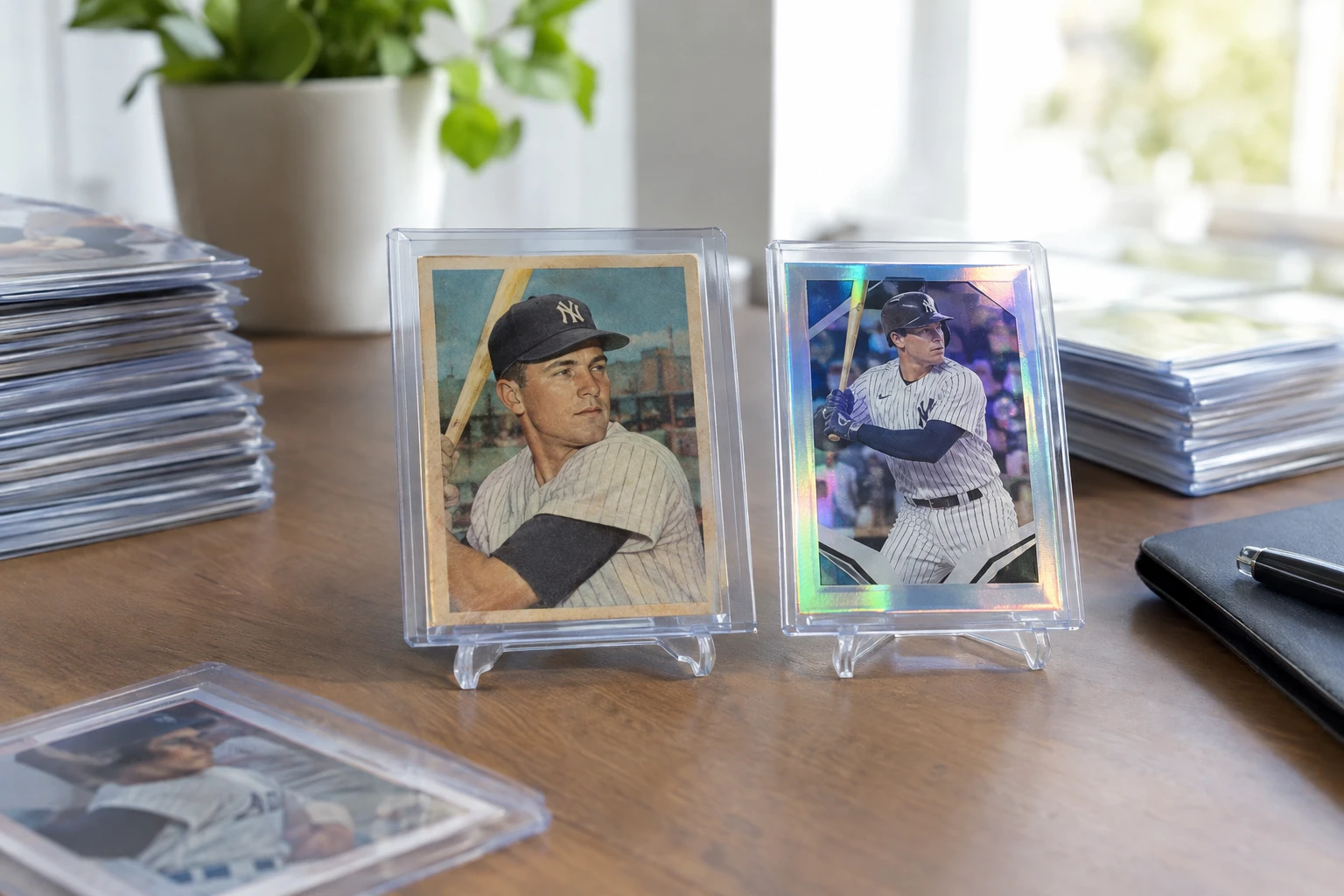
The Short Answer
- Graders calibrate expectations by era — vintage cards get contextual tolerance on factory defects
- Vintage centering was worse at the factory; graders apply era-relative judgment on print issues
- Modern cards are graded against a much harsher pack-fresh standard
- Wear-based damage (corners, edges, creases) counts similarly in both eras
- Vintage grading pays on authentication + scarcity; modern grading pays on gem-vs-gem distinction
- The 10-point price premium is far steeper for vintage — a PSA 10 vintage card is exponentially rarer
Same 1-10 Scale, Different Yardstick
A PSA 10 on a 1952 Mantle and a PSA 10 on a 2026 Prizm are technically the same grade — and practically very different achievements. Graders apply the standard relative to the card's era, because a 70-year-old card surviving pack-fresh is a fundamentally different event than a 6-month-old card staying clean.
Understanding the era-adjusted lens changes which cards you should submit. This guide breaks down how each grading component is actually applied to vintage vs modern stock.
The Era-Relative Lens
PSA's official standard describes Gem Mint 10 as "virtually perfect" — but "virtually" does heavy lifting across eras:
- Vintage (roughly pre-1980): graders tolerate factory-era flaws — light print rollers, era-typical centering drift, wax stains on occasion — that would cap a modern card. The reasoning: these defects are inherent to manufacture, not use, and a strict reading would put the era's gem rate at near-zero.
- Modern (roughly 1980s+): pack-fresh condition is expected and achievable; the tolerance for factory flaws narrows sharply because modern manufacturing makes clean cards common.
What doesn't flex: wear. Creases, corner rounding, and handling damage count against a vintage card just as they would a modern one — it's factory-born flaws that get era context.
Centering: The Era Exception
Centering tolerances are nominally the same (~60/40 front for a 10) — but apply differently:
- Vintage: era print technology produced systematically bad centering. A 1960s-70s card at 65/35 with everything else perfect may still earn a 9, and graders weigh centering within the era's norms. Some famously misprinted sets get intrinsic leniency because near-perfect centering essentially doesn't exist.
- Modern: little forgiveness. Modern presses center accurately, so a 65/35 modern card reads as a defect, not a manufacturing limitation — it caps at 9 or lower.
Practical note: OC qualifiers exist precisely for this gap — a vintage card with gem-everything-else but bad centering typically gets the qualified grade rather than a raw numeric punishment.
Factory Defects: Judged by Era
| Defect Type | Vintage Tolerance | Modern Tolerance |
|---|---|---|
| Print roller lines | Some tolerance if era-typical | Minimal — modern print lines are strongly penalized on chrome/holo |
| Centering drift | Era-relative | Strict numeric tolerance |
| Wax/gum stains | Sometimes tolerated (the era shipped wax) | Essentially never applicable |
| Rough cuts / factory deckle | Tolerated when era-typical | Penalized |
| Registration/focus blur | Era-adjusted | Penalized |
The general principle: if a defect came from the era's normal manufacturing process, vintage graders partially discount it. If it came from handling or time, nobody discounts it.
Wear That Counts in Both Eras
No era credit exists for:
- Creases and bends — the biggest grade killer in both eras
- Corner wear and rounding — though vintage tolerance is slightly more forgiving of micro-touch on genuinely old stock
- Edge wear — whitening and chipping count at any age
- Writing, stamps, tape residue — old-grade-school-owner damage counts the same in 1956 as 2026
- Surface scratches — handling damage is handling damage
Alteration is absolute: trimming, recoloring, pressing, and restoration attempts get a "Authentic Altered" or are rejected outright at any era — and it's the fastest path to a worthless slab.
The Economics Are Opposite
Vintage grading economics: the grade IS the product. A 1954 Aaron at PSA 5 vs PSA 7 is a multiple-of-money difference because populations are tiny and authenticated scarcity is everything. Any decent vintage card is worth slabbing for authentication alone — even a mid-grade vintage card in a legit holder sells better than raw, because authenticity is half the product.
Modern grading economics: a pure scarcity play. Modern pops are huge and mid-grades add no value — a 2025 Prizm silver at PSA 8 is usually worth raw-minus-fee. Only the 10 (or 9 on strong cards) creates profit, making pre-screening essential.
That distinction is the entire submission strategy: vintage = grade almost anything decent for authentication; modern = grade only screened gem candidates. AI pre-grading is built for the modern problem — it tells you whether a card has 10 potential before the fee.
Which Cards to Submit, by Era
Vintage (submit liberally):
- Star cards and rookies in any respectable condition
- Commons only if exceptionally clean or needed for a graded set
- Anything where authentication value alone justifies the fee
Modern (submit selectively):
- Only cards that pass a four-point inspection (centering/corners/edges/surface)
- Chase cards where the 10 premium exceeds all-in cost with margin
- Skip anything you'd describe as "probably a 9" on a mid-value card — 9s on modern bulk rarely cover fees
Cross-era nuance: 1990s-2000s junk-wax cards behave like modern (huge pops, 10-or-nothing) despite being nominally "older" — era economics follow print volume, not the calendar.
Frequently Asked Questions
Are vintage cards graded differently than modern cards?
Is it easier to get a PSA 10 on vintage or modern cards?
Should I grade vintage cards even if they're not mint?
Does centering matter less on vintage cards?
What counts as 'vintage' in card grading?
Sources & Further Reading
- PSA Grading Standards
- PSA Population Report
- PreGradeCards AI Grading
- SGC Grading (vintage specialist)

The PreGradeCards Research Team combines machine-learning engineers, grading analysts, and collector-education specialists to produce accurate, data-driven guides on AI card grading, professional grading standards, and collecting strategy.
With submission floors rising, pre-screening is no longer optional. Use our AI Pre-Grade Calculator to score a card's PSA 10 odds before you pay, and the Submission Planner to pick the right tier.