The Short Answer
- Raw 1969-70 Topps #25 Kareem rookies ask $650 to $1,150; a PSA 8 is about $2,100 and a PSA 9 around $5,000.
- The card is labelled Lew Alcindor because it was printed two years before the name change.
- The 1970-71 Topps #75 is the second-year card and the cheapest way into vintage Kareem at $90 to $225 raw.
- The 1972-73 All-Star #163 is a $9 to $24 vintage card that pairs Kareem with Wilt Chamberlain.
- Buy the PSA 8 rather than submitting raw: this market is thin and the grading downside is large.
- Vintage basketball trades at a discount to vintage baseball, which is the long-term case for the rookie.
Why the 1969-70 Topps Kareem rookie is still the vintage benchmark
The card says Lew Alcindor, not Kareem Abdul-Jabbar. That is the first thing to know about the 1969-70 Topps #25: it was printed before he changed his name in 1971, so every listing, every label and every PSA flip carries the name he used as a rookie. It is card 25 in a 99-card set, a high number from a series printed on a sheet that is notorious for poor centering.
The price ladder is short and steep. Raw copies ask $650 to $1,150, a PSA 8 sits near $2,100 and a PSA 9 is a four-figure card whenever one appears. That is cheap for a six-time MVP and the second-leading scorer in NBA history, and it is the reason Kareem is the anchor of this series rather than a footnote.
Vintage basketball still trades at a discount to vintage baseball of the same era, and Kareem is the clearest example. A 1969-70 Topps #25 in a PSA 8 costs less than a mid-grade 1958 Topps baseball common of a marginal Hall of Famer. If vintage basketball ever closes that gap, this is the card that moves first. The basketball card index places it against the rest of the run.
One warning before the ladder: the market is thin. Fewer than two dozen raw copies were listed in the 40-listing scan behind this article, so the median is a guide rather than a price. Check completed sales before you bid on anything above a PSA 6.
The set itself is worth understanding before you buy. 1969-70 Topps Basketball is 99 cards, issued in one series, with a tall-boy format that makes the cards harder to store and easier to damage than standard-size stock. The high-number cards, including Kareem at #25, sat on the right-hand side of the print sheet, which is why the left border on so many copies is wider than the right. That single sheet layout explains most of the centering complaints you will read in listings.
| Card | Raw | PSA 9 | PSA 10 | Tier |
|---|---|---|---|---|
| 1969-70 Topps #25 (Alcindor) | $650–$1,150 | ~$2,100 (PSA 8) | ~$4,500 | Blue chip |
| 1970-71 Topps #75 | $90–$225 | ~$300 | ~$700 | Core |
| 1972-73 Topps All-Star #163 | $9–$24 | ~$60 | ~$150 | Entry |
| 1980-81 Topps panel | $5–$10 | ~$40 | ~$120 | Budget |
| Certified autograph | $260–$550 | — | — | Core |
| 1969-70 Topps #25 PSA 9 | — | — | ~$5,000+ | Grail |
Graded columns list typical asks for that grade. The PSA 9 population is small enough that any sale is a market event, not a quote.
1. 1969-70 Topps #25 — the Lew Alcindor rookie
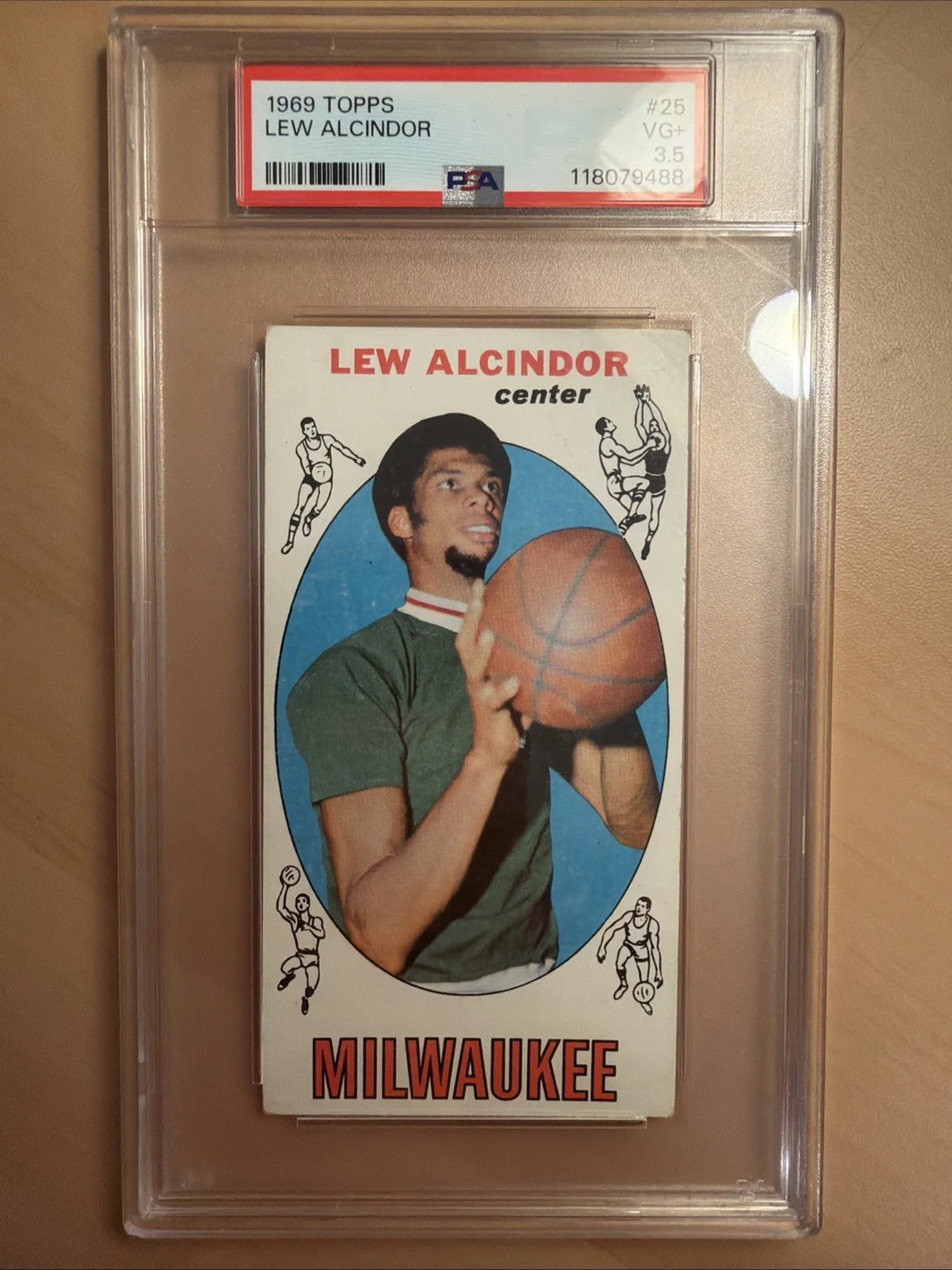
Card 25 of a 99-card set, printed before the name change and still labelled Lew Alcindor on every slab. The photo is a standard head-and-shoulders portrait in the Bucks green, and the back carries his UCLA and 1969 draft details.
This is the card that defines the player's market. Raw copies ask $650 to $1,150 depending on eye appeal; a PSA 8 near $2,100 is the realistic collector grade, and a 9 is a five-figure conversation starter. Centering on the sheet was poor, so a 55/45 copy is a good card, not a defect.
Check recent eBay sold prices for the 1969-70 Topps Kareem rookie →
2. 1970-71 Topps #75 — the second-year card
The second-year card is where most collectors start. It is still Alcindor on the front, still the Bucks, and it costs a fraction of the rookie: $90 to $225 raw, with clean centred copies at the top of that range.
The 1970-71 set is also better centred than 1969-70 on average, which makes a high-grade copy easier to find. PSA 8s ask near $300 and 9s near $700, so the grading math is friendlier than on the rookie even though the upside is smaller.
Check recent eBay sold prices for the 1970-71 Topps #75 →
3. 1972-73 Topps All-Star #163 — the affordable vintage insert
The All-Star subset card is the cheapest vintage Kareem with real age behind it. It is also the card that pairs him with Wilt Chamberlain on the same piece of cardboard, which is why it turns up in almost every 1970s basketball collection.
Raw copies trade for $9 to $24. A PSA 9 asks near $150, so the grading spread is real but small in absolute dollars — this is a card to buy for the collection, not to submit.
Check recent eBay sold prices for the 1972-73 All-Star card →
4. 1980-81 Topps panel — the budget vintage entry
The 1980-81 Topps set was printed in three-card panels, and Kareem appears on a strip with two other players. Separated panels are cheap, intact strips are not, and sellers routinely describe both as a "1980-81 Topps Kareem".
Raw singles trade at $5 to $10. The reason to own one is simple: it is a 45-year-old Kareem card for the price of a modern blaster, and it looks like the era it came from.
Check recent eBay sold prices for the 1980-81 Topps panel →
- 1969-70 Topps Basketball #25 Lew Alcindor RC Rookie SGC 1 Kareem Abdul Jabbar — $480.00 on eBay →
- Lew Alcindor 1969-70 Topps SGC 2.5 ROOKIE CARD (Kareem Abdul-Jabbar) MILWAUKEE — $750.00 on eBay →
- 1996 Topps Stars Lew Alcindor Kareem Abdul-Jabbar #1/50 RC Rookie Reprints NM+ — $12.95 on eBay →
- 1969-70 Topps Lew Alcindor #25 Basketball Rookie Card RC Kareem Abdul-Jabbar! — $650.00 on eBay →
Ad · Listings shown are from eBay. We may earn a commission when you buy through these eBay links. Prices and availability are set by eBay sellers and change often.
5. Certified autographs — the card graders cannot help with
Kareem autographs are the one part of this ladder that is not about condition. Certified on-card and sticker autos ask $260 to $550, and the premium is entirely about authentication: a cut index card with a signature sells for $200, a licensed Panini auto with a low serial sells for three times that.
The trap is the index-card cut. It is a real autograph, it is slabbed, and it is worth much less than a card because it has no design, no set and no eye appeal.
Check recent eBay sold prices for certified Kareem autographs →
6. 1969-70 Topps #25 in PSA 9 — the grail
A PSA 9 of the rookie is the card that ends this ladder. It is not a liquid market: the population is small, copies surface rarely, and the ask is whatever the last two bidders decide. Recent asks sit around $5,000, with the occasional premium for near-perfect centering.
That number is still modest against a six-time MVP with six rings, which is the argument for the card. It is also the argument against treating it as an investment you can exit quickly: a $5,000 vintage basketball card can sit for months between buyers.
Check recent eBay sold prices for PSA 9 Alcindor rookies →
How to buy a 1969-70 Topps rookie without getting burned
The 1969-70 Topps set has three problems that matter to buyers: poor centering, print snow on dark borders, and a long history of trimmed copies being sold raw. All three are visible in a good photo, which is why this is one of the few vintage cards where buying raw from a reputable seller is reasonable.
If you want one card, buy a PSA 8. It is the grade where the card looks like the card, costs about $2,100, and sits far enough below the 9 that you are not paying for a pop report. If you want to submit, buy a centred raw copy at $900 or less and accept that a 7 is a likely outcome.
For comparison shopping across the era, the vintage basketball grading guide covers the 1980s and 1990s cards that trade at similar money, and the Jordan value guide shows what the top of this market looks like.
Auctions and marketplaces price this card differently, and the difference is large enough to plan around. eBay listings are dominated by dealers asking retail-plus prices, while the major auction houses produce the comps that dealers then cite. If you are buying a PSA 8 or better, watch an auction cycle first; if you are buying raw, eBay is where the supply is and where a centred copy occasionally appears underpriced because the seller photographed it badly.
Budget for the holder as well as the card. A raw copy at $900 plus grading at about $30 plus shipping and insurance is a $960 card before you know the grade, and a 7 outcome leaves you with a $1,200 asset that cost $960 and is hard to sell quickly. That is not a disaster, but it is not the arbitrage the raw-to-9 spread implies, and it is why the guide recommends buying the 8.
- Measure centering on the front and back; 60/40 front is the practical bar for an 8 or better.
- Check the dark green border for print snow under angled light — it is normal, but heavy snow caps the eye appeal.
- Look for trimming: the card should measure 2-11/16 by 3-3/4 inches, and a short border on one side is the tell.
- Confirm the slab says Lew Alcindor and 1969-70 Topps, because reprints and 1970-71 cards are routinely mislabelled.
- Compare the ask against the last three PSA 8 sales before making an offer; this market is thin enough that one sale moves the reference.
A pre-grade cannot authenticate a vintage card, but it can tell you whether the corners and centering justify a submission. Try the AI pre-grade on photos before you ship anything, and check current pricing.
Run a free AI pre-grade on your card →
Watch and learn
A PWCC auction listing of a 1969 Topps Lew Alcindor rookie in an SGC 9 holder, useful for seeing what a high-end copy looks like under auction lighting.
Video: 1969 Topps Basketball Lew Alcindor ROOKIE #25 SGC 9 MINT — PWCC Premier Auction on YouTube


Ad · Listings shown are from eBay. We may earn a commission when you buy through these eBay links. Prices and availability are set by eBay sellers and change often.
Frequently Asked Questions
Is the 1969-70 Topps Kareem rookie a good buy in 2026?
Why does the card say Lew Alcindor?
What is a Kareem Abdul-Jabbar rookie card worth?
Is the 1970-71 Topps #75 a rookie card?
How many 1969-70 Topps Kareem rookies exist?
Should I grade a raw Kareem rookie?
Are Kareem autographs a better buy than his rookie?
Why is vintage basketball cheaper than vintage baseball?
What should I check before buying a 1969-70 Topps card raw?
Are there reprints of the 1969-70 Topps Kareem rookie?
How does Kareem compare with Wilt and Russell rookies?
Sources & Further Reading
- eBay sold listings — 1969-70 Topps Kareem Abdul-Jabbar 25 rookie
- Basketball-Reference — Kareem Abdul-Jabbar career stats
- PSA CardFacts — population reports
- CardLadder — basketball market data
- Topps — 2026-27 Flagship Basketball
- Old Sports Cards — 1969-70 Topps Basketball checklist
Marcus Chen has evaluated over 50,000 sports cards and TCG cards across PSA, BGS, SGC, and CGC standards. Before joining PreGradeCards, he worked as a submission specialist for a major grading company and trained collectors and dealers on condition assessment.
Create a free account and get 1.5 free credits. No credit card required.
Get Your Free Credits →