The Short Answer
- Boozer's Flagship #258 base asks $3 to $6 raw and about $60 in a PSA 10.
- The Green /99 at about $150 is the cheapest Boozer parallel with genuine scarcity.
- The New Applicants auto at $280 to $350 is the cheapest licensed Boozer signature.
- A Real One Black /10 auto reportedly sold for $3,150 in the first week.
- He is averaging 15.9 points and 9.8 rebounds, the most translatable rookie line in the class.
- Chrome arrives in December and will reset the flagship auto market.
Why Boozer is the safest rookie card in the 2026 class
Cameron Boozer went third to the Memphis Grizzlies and has been the most productive big man in the class: 15.9 points, 9.8 rebounds and 5.5 assists in 11 games, on 36.6% shooting that undersells how often he gets to the line. The rebound number is the one that matters for a rookie card, it is the statistic that translates.
His Flagship #258 asks $3 to $6 raw, which is the same bulk-card price as the rest of the class. The difference is that Boozer has the highest floor in the draft and a game that does not depend on a jump shot falling, which makes his base card the least speculative $5 in the set.
The numbered cards are already moving. A Yellow /399 asked $79, a Green /99 asked $150 and a Gold /2026 asked $55, and the New Applicants autograph asks $280 to $350. Those are real prices for a player three weeks into his career, and they reflect the class's consensus that Boozer is the safest bet.
This guide ranks six Boozer cards by price and purpose, from the base card you can stack to the auto you will hold through the Chrome release. The basketball card index has the full 25-player index.
Memphis is using Boozer as a hub rather than a post scorer: 5.5 assists a game from a 6-foot-8 forward is the number that separates him from the other big men in the class, and it is why his floor is higher than his shooting percentages suggest. A player who rebounds and passes will stay on the floor through a cold streak, and floor time is what drives card demand over a full season.
| Card | Raw | PSA 9 | PSA 10 | Tier |
|---|---|---|---|---|
| 2026-27 Topps #258 base | $3, $6 | ~$15 | ~$60 | Entry |
| 2026-27 Topps Gold /2026 | ~$55 | , | , | Entry |
| 2026-27 Topps Yellow /399 | ~$79 | , | , | Core |
| 2026-27 Topps Green /99 | ~$150 | , | , | Core |
| 2026-27 Topps New Applicants auto | $280, $350 | , | , | Core |
| Real One Black /10 auto | ~$3,150 | , | , | Grail |
The Real One Black /10 figure is an early reported sale from the first week of the product, not a stable quote.
1. 2026-27 Topps Flagship #258: the base rookie
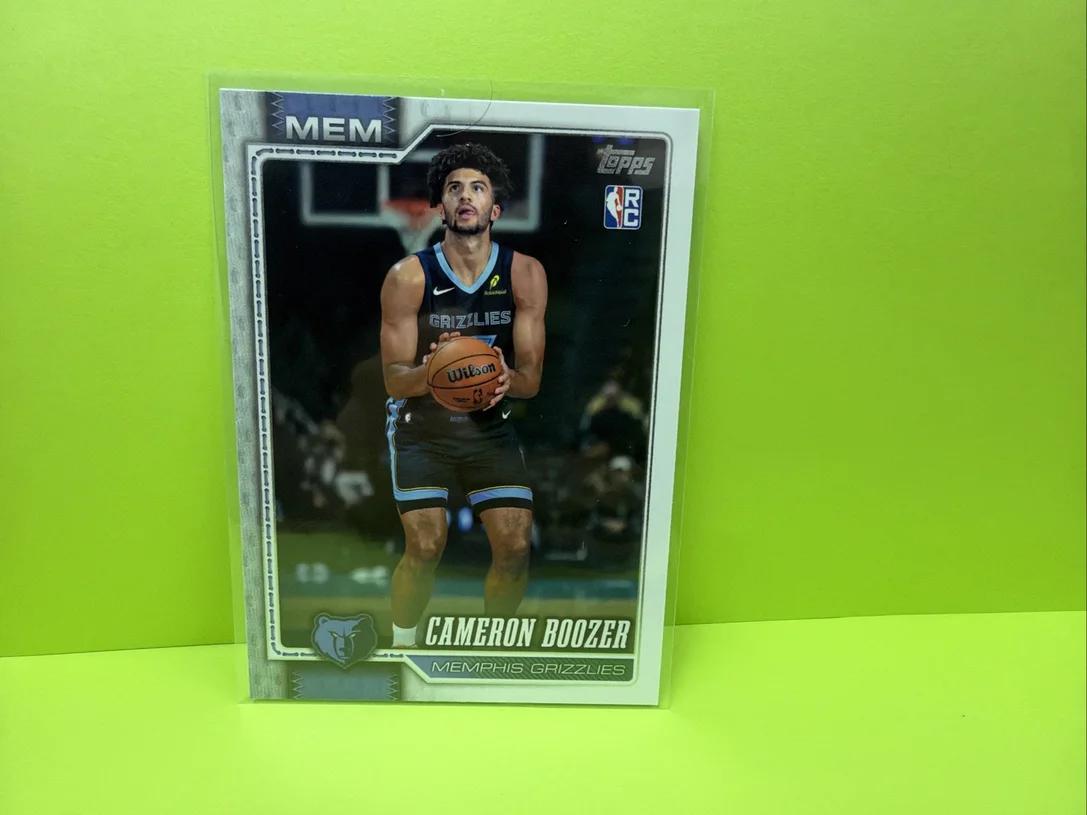
Card #258 is Boozer's first licensed NBA rookie, printed in the rookie block of the 300-card flagship set. It asks $3 to $6 raw, and it is the cheapest way to own the most productive big man in the class.
The base card is a volume play. Boozer's game is built on rebounds and free throws, which produce a steady line rather than viral highlights, so the base card is unlikely to spike on a single game. That makes it a hold, not a flip.
See current eBay listings for the Flagship #258 base →
2. 2026-27 Topps Gold /2026: the entry parallel
The Gold parallel is numbered to 2026 and asks around $55. It is the cheapest numbered Boozer card and the easiest one to find, because 2026 copies is a large print run by parallel standards.
That size is the point: it is a numbered card for collectors who want a serial but do not want to pay $150 for a Green /99. Do not expect it to behave like a scarce parallel.
See current eBay listings for the Gold /2026 →
3. 2026-27 Topps Green /99: the scarce colour
The Green /99 asks about $150 and is the first genuinely scarce Boozer parallel. A hundred copies of a top-three pick in a product three weeks old is a small number, and most of them are still in sealed boxes.
This is the card to watch if Boozer has a 20-15 game on national television. Scarce parallels are where the market expresses its enthusiasm, and the /99 is the cheapest version with real scarcity.
See current eBay listings for the Green /99 →
4. New Applicants autograph: the flagship signature
The New Applicants autograph asks $280 to $350 and is the cheapest licensed Boozer signature. It is an on-card or sticker auto in a flagship product, and the supply is small enough that listings move quickly.
Boozer's autograph is one of the more desirable in the class because he projects as a long-term starter rather than a highlight player. That shows up in the price: his base auto sits above Peterson's despite a lower draft slot.
See current eBay listings for the New Applicants auto →
- basketball cards — $2,900.00 on eBay →
- basketball cards — $100.00 on eBay →
- 100 Plus Basketball Cards — $25.00 on eBay →
- basketball cards auto numbered — $275.00 on eBay →
Ad · Listings shown are from eBay. We may earn a commission when you buy through these eBay links. Prices and availability are set by eBay sellers and change often.
5. Real One rookie patch: the memorabilia card
The Real One patch asks around $50 and is the cheapest memorabilia Boozer card. It is a player-worn swatch with no autograph, and it exists for set builders who want a relic without the four-figure price.
The low-numbered versions are the ones that matter. A Real One Black /10 autograph reportedly sold for $3,150 in the first week, which is the top of the Boozer market and a reminder that "Real One" covers a wide range of cards.
See current eBay listings for the Real One patch →
6. Real One Black /10 auto: the grail
The Black /10 Real One auto is the scarcest flagship Boozer card and reportedly sold for $3,150 in the first week of the product. Ten copies, an on-card signature and a memorabilia swatch is the combination the market pays for.
At that price the card is a collector's object, not a trade. The population is too small for a market, and the price is set by whichever two bidders want it most.
See current eBay listings for the Black /10 auto →
How to build a Boozer position without overpaying
Boozer is the class's safest hold, which means his cards are priced for safety rather than upside. The base card is cheap because base cards are always cheap; the autos are expensive because the market believes he will be a starter for a decade. Both can be right.
The value sits in the middle. A Green /99 at $150 is scarce enough to hold value and cheap enough to survive a bad month; a New Applicants auto at $300 is the card most collectors will want in five years. The base card is for volume grading, and the Black /10 is for someone else.
Watch the December Chrome release. Chrome rookies will be priced against these flagship cards, and if Chrome Boozer autos come to market at $400 the flagship autos will look cheap. The Flagg guide shows how a No. 1 pick's market matured in year two.
Rebounds translate to card value more reliably than points. A 15-point scorer who adds 10 rebounds produces a stat line that reads as professional in a box score, and collectors respond to that. Boozer's base card is the cheapest way to own the profile; his Green /99 is the cheapest way to own it with scarcity attached.
Selling into a big game is the standard play, and it works better on numbered cards than on base cards. If Boozer posts 25 and 15, the Green /99 can move 20% in a week while the base card barely moves. Keep one numbered card as a trading piece and the base stack as a long hold, and do not confuse the two.
Compare him with the other big men in the class before you buy. Boozer is the only rookie averaging better than nine rebounds and five assists, which is a combination that produces triple-double upside without asking him to become a shooter. That profile tends to age well in card markets because the stat line stays legible even in a bad month, and legible stat lines are what keep a base card from falling to bulk prices.
If you are choosing one card to hold for three years, choose the New Applicants auto over the Green /99. Numbered parallels are liquid only while the class is hot, and a /99 from a flagship product tends to fade once Chrome and Finest arrive with their own colour ladders. An autograph is a different asset: it stays collectible because the signature does not get reprinted, and Boozer's on-card signature is one of the cleaner ones in the class.
Check the serial on every numbered card before paying; Boozer has parallel versions at /2026, /399 and /99 and the prices differ by a multiple.
- Confirm the card is #258 in the base set.
- Check the serial on Gold, Green and Black parallels.
- Distinguish Real One relics from Real One autographs before paying.
- Grade the base card only if the centering is better than 60/40.
- Compare the auto price against Chrome supply before buying at the top.
Boozer's base rookie is cheap enough for a volume test. Run a photo through the AI pre-grade and check current pricing before submitting.
Run a free AI pre-grade on your card →
Watch and learn
A live pull of Cameron Boozer's on-card Gold auto /50 in a 2026-27 Flagship break, useful for seeing the autograph design and what the low-numbered cards look like in hand.
Video: Cameron Boozer's on-card Gold Auto /50 was pulled live, Top Bid Sports on YouTube


Ad · Listings shown are from eBay. We may earn a commission when you buy through these eBay links. Prices and availability are set by eBay sellers and change often.
Frequently Asked Questions
What is a Cameron Boozer rookie card worth in 2026?
Is Boozer the best rookie card in the 2026 class?
Should I grade the base Boozer rookie?
What is the Green /99 parallel?
How is Boozer playing in 2026-27?
Why did a Boozer Black /10 auto sell for $3,150?
Are Boozer autographs a better buy than his base card?
When does Topps Chrome Basketball release?
Does Memphis help or hurt Boozer card values?
Is Boozer a bust risk?
How does Boozer compare with his father's cards?
What is the best Boozer card under $100?
Sources & Further Reading
- eBay sold listings, 2026 Topps Cameron Boozer 258 rookie
- Basketball-Reference, Cameron Boozer stats
- PSA CardFacts, population reports
- CardLadder, basketball market data
- Topps, 2026-27 Flagship Basketball
- NBA.com, 2026 NBA Draft order
Create a free account and get 2 free credits. No credit card required.
Get Your Free Credits →