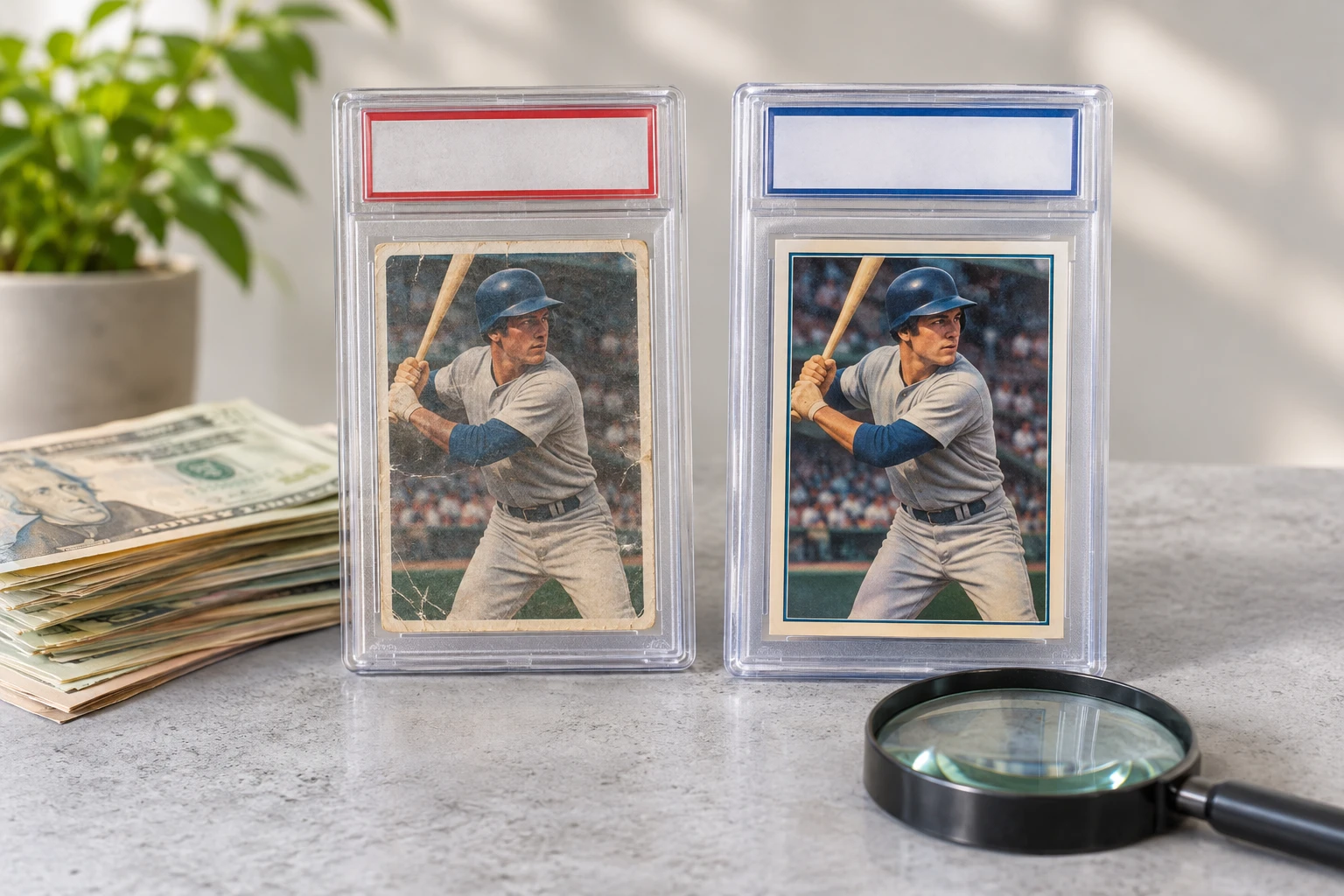
The Short Answer
- GMA's published ladder runs from about $9 a card on a 100-card Economy order to $18 a card on Gold Express, with minimums of 10 to 25 cards depending on tier.
- It is the cheapest encapsulation in the hobby and it is priced that way: no subgrades, no public certification lookup and no registry.
- The label carries no buyer premium. On a $300 card GMA has to retain roughly 86 percent of the PSA comp just to break even on fees, and the market discount is larger than that.
- Against CGC Bulk the gap closes to a few dollars a card, which makes the label discount, not the fee, the deciding number.
- Cheap grading is rational for personal collections, bulk storage and display, where nothing is being sold and the slab is the product.
- It is value-destructive on any card you intend to sell into a graded market, because the holder does not replace the premium it was bought to protect.
What GMA Grading is
GMA Grading and Authentication has been grading cards since 2003, which makes it older than most of the labels collectors argue about. It has spent those two decades competing on one axis: price. There is no technology story, no subgrade report, no public certification database and no set registry. You send cards, you get them back encapsulated with a numeric grade and a label, and you pay less than anywhere else in the market.
That is a legitimate product. A slab does three things: it protects the card, it makes the card displayable, and it tells a buyer someone looked at it. GMA delivers the first two completely and the third weakly, because the label carries little weight outside the budget tier of the hobby. Understanding which of those three jobs you are buying is the whole decision.
It is also not a scam, and saying so is fair to a company that has graded for two decades and publishes its prices. The criticism is not legitimacy. It is whether the money saved on grading survives contact with a buyer choosing between a GMA slab and a PSA slab of the same card.
The 2026 price ladder
GMA's published grid is simple and volume-driven. The cheapest rate requires a large pile, and every tier carries a minimum card count, so the headline number is rarely the number a single-card seller pays.
| Tier | Price per card | Minimum cards | Quoted turnaround |
|---|---|---|---|
| Economy, 100+ cards | $9 | 100 | 25 business days |
| Economy | $12 | 25 | 25 business days |
| Standard, 100+ cards | $12 | 100 | 15 business days |
| Standard | $15 | 20 | 15 business days |
| Gold Express, 100+ cards | $18 | 100 | 10 business days |
| Tiers and minimums as published on GMA's pricing page and recorded by Cardboard Journal's scorecard, checked 2026-11-14. Confirm on the order form before you ship; minimums and rates can change. | |||
Two things follow. A single card or a five-card order is not a $9 transaction; it is a $15-$18 transaction plus postage both ways, so the real landed cost lands near $35-$45. And the cheap tier is only cheap at volume, which is exactly the scenario where the label's weak resale matters least.
Postage is the hidden second fee. A padded envelope is not adequate for a slab return, so budget tracked, insured shipping both ways. On small orders it can exceed the grading fee.
Quoted versus actual turnaround
GMA publishes 10 to 25 business days depending on tier, and its own marketing has historically pointed at faster numbers at the top end. The published figure is a processing estimate from intake, which means it excludes your shipping to GMA and the return leg. A 10-business-day Gold Express order can easily be a month door to door.
The comparison that matters is against the alternative. PSA's affordable tiers are measured in months and CGC's bulk lane runs into triple-digit working days, so a three-week GMA turnaround is genuinely fast. For a personal-collection submission that speed is real value.
What GMA does not publish is a granular status dashboard. You get an order and a return, and if you check a tracker daily, that absence is a cost even when no invoice line shows it.
The practical rule: treat any quoted turnaround as intake processing only, add two weeks for postage both ways, and never plan a sale around a grading return date from any company.
The holder, the label and the missing data
The GMA holder is a sealed, tamper-evident case on a standard footprint that fits ordinary graded-card storage boxes and cases. It is functional, it displays a card, and it protects it. What it lacks is the ecosystem around the plastic.
The grade is a single numeric score on the familiar 1 to 10 scale, with no published subgrades for centering, corners, edges and surface. A buyer cannot see why a card received its number. In person that is a minor inconvenience; online, it is the difference between a grade that can be interrogated and one taken on faith.
The bigger gap is verification. GMA has no public certification lookup, so a buyer cannot independently confirm that a label's number corresponds to a real grading record. That single missing feature is the reason GMA slabs are excluded from eBay's Authenticity Guarantee programme and are not standard inventory at the major US auction houses. It is not a knock on the company; it is how institutional buyers manage risk.
If your only goal is that the card is protected and labelled, none of this matters. If your goal is that a stranger pays a premium on the strength of the label, all of it does.
What the market pays for a GMA slab
Here the conversation needs arithmetic instead of adjectives. Rather than print a premium percentage we cannot reproduce for your card, use the protocol below and compare medians: one sale is a data point, twenty sales of the same card in the same grade is a comp.
| Bucket to pull | Search | Minimum sample | Record |
|---|---|---|---|
| Raw copy, same card | Sold, condition-matched | 20 | Median sale, date range |
| PSA 10, same card | Sold, grade filter | 20 | Median sale, date range |
| CGC 10, same card | Sold, grade filter | 20 | Median sale, date range |
| GMA 10, same card | Sold, grade filter | 20 | Median sale, date range |
| Protocol and sample sizes checked 2026-11-14. GMA buckets are thin on many cards, which is itself the finding: a label with few comparable sales is priced by the seller's hope, not the market. | |||
Cardboard Journal's scorecard, scored on 5 October 2026, puts the resale position bluntly: buyers do not pay a premium for a GMA slab, GMA is listed in eBay's professional grader filter but is not covered by Authenticity Guarantee, and on a high-value card the practical buyer behaviour is to cut the card out and regrade it. That last line is the whole risk in one sentence — the plastic becomes a cost you paid twice.
The shape matters more than the inputs: on a cheap card both routes net almost nothing, and on an expensive card the label discount removes most of the upside. GMA does not lose because the fee is high; it loses because the sale price falls further than the fee saved.
GMA against CGC Bulk
The fair comparison is not GMA against PSA at $60 a card. It is GMA against CGC's bulk lane, which occupies the same budget slot with a recognised label. CGC's bulk pricing sits in the high teens per card at the checked date with a 25-card minimum, against GMA's $9 to $18 depending on tier. The full breakdown of what each tier costs after hidden fees is in our fees and hidden costs guide.
| Dimension | GMA | CGC bulk |
|---|---|---|
| Entry price | About $9 to $18 per card | High teens per card |
| Minimum order | 10 to 100 cards depending on tier | About 25 cards |
| Subgrades | None published | Published grading detail |
| Public cert lookup | None | Yes |
| Buyer recognition | Budget label, discount at sale | Recognised, especially TCG |
| Turnaround | 10 to 25 business days quoted | Long, often months |
| CGC figures are indicative at the checked date 2026-11-14; confirm on its fee page. Turnaround comparisons use published estimates, not guarantees. | ||
Put the fee gap in perspective: if GMA saves $8 a card against CGC bulk on a $300 card, GMA needs to retain about 97 percent of the CGC comp to break even. A label without certification lookup retaining 97 percent of a recognised label's price is not a realistic expectation, which is why the recommendation is unusually clean. If the choice is between two budget options and only one of them is recognised, pay the extra few dollars.
The diagonal is the break-even line: above it a label earns its fee, below it does not. GMA sits far left and low — cheap, but priced down by more than the fee it saves.
The exception is speed. GMA's quoted turnaround is far shorter than a bulk CGC order, and if you need 100 cards back this month for a personal collection, that difference is the product you are buying.
When GMA is rational
Cheap grading is a good decision whenever the slab is the destination rather than the vehicle. Three cases stand out.
- Personal collection. You want your set protected, labelled and displayable. The label's resale discount is irrelevant because you are not selling, and the per-card saving across a 200-card set is hundreds of dollars.
- Bulk storage and organisation. A slab is a better archive than a box of toploaders for cards you handle, and GMA's volume tiers make the arithmetic work in a way no major label does.
- Display and gifts. A slabbed card is a nicer object than a raw one. For a wall, a desk or a gift, the grade matters far less than the holder.
There is a fourth case that is less obvious: cards whose value is not grade-sensitive at all. A signed card, a childhood favourite, a card from a set nobody grades — none has a PSA 10 comp to protect, so the premium forgone is close to zero.
In those cases the correct comparison is not GMA versus PSA. It is GMA versus a toploader and a display case. The slab is a small luxury and the label is doing none of the work.
When the label destroys value
The same purchase becomes value-destructive the moment the card has a premium to protect. Three signals tell you it does.
The card has a meaningful PSA 10 comp. If a PSA 10 sells for multiples of the raw card, the premium is the asset. Encapsulating it in a label the market does not price turns a premium card into a raw card with plastic around it.
You intend to sell into a graded market. Auction houses, consignment platforms and eBay's authenticity programme are built around recognised labels. A GMA slab is excluded or priced down, and at worst the buyer factors in the cost of cracking and regrading — a cost you effectively pay.
The card is a modern sports card with a thin population. Population data is part of the price, and a label with no registry cannot contribute to a scarcity story.
If two of those three are true, the fee you saved is the smallest number in the transaction. The decision should be made from the card's exit market backwards, not from the fee forwards.
For the comparison across the whole budget tier, see our budget grader comparison and the grading company directory.
Submitting to GMA, step by step
- Confirm the tier and minimum. A 20-card Standard order and a 100-card Economy order have different prices and different clocks. Check the current grid on GMA's pricing page and size the batch with the submission planner before packing.
- Sort by purpose, not by value. Cards you will never sell go in the bulk order. Cards with a real comp go to a recognised label or stay raw.
- Value the shipment honestly for insurance. Postage both ways is part of the true per-card cost, and it is the line collectors forget.
- Pack rigid. Cards in savers inside a rigid box with padding. Loose cards in a mailer is how submissions arrive damaged.
- Photograph every card before shipping, front and back, with the order paperwork in frame.
- Log the return. Check each slab against your photographs on arrival; the label is not a certification database, so your own record is the audit trail.
Before you spend anything, run the card through a pre-grade check and a value estimate. The most expensive mistake is not the wrong company; it is grading a card that was never worth encapsulating.
Frequently Asked Questions
What is GMA Grading?
How much does GMA grading cost?
How long does GMA grading take?
Is GMA grading legit?
What is a GMA 10 worth?
Does GMA publish subgrades?
Is GMA better than CGC Bulk?
Can I sell a GMA slab on eBay?
When is GMA worth using?
Sources & Further Reading
- GMA Grading — official site and published pricing
- Cardboard Journal — GMA Grading scorecard (scored 5 October 2026)
- Rookie Collector — GMA Grading review
- Figoca — GMA Grading review
- CGC Cards — submission services and fees
- eBay — sold listings for GMA graded cards (sample checked 2026-11-14)
- eBay — sold listings for PSA 10 comparison bucket (checked 2026-11-14)
- PreGradeCards — grading company directory

JT Thompson has focused on vintage sports cards (pre-1980) for more than 20 years. He is a regular contributor to vintage collector forums, has consulted on authentication issues for high-value pre-war cards, and teaches collectors how to spot trimming, recoloring, and restoration on classic cardboard.
Create a free account and get 2 free credits. No credit card required.
Get Your Free Credits →