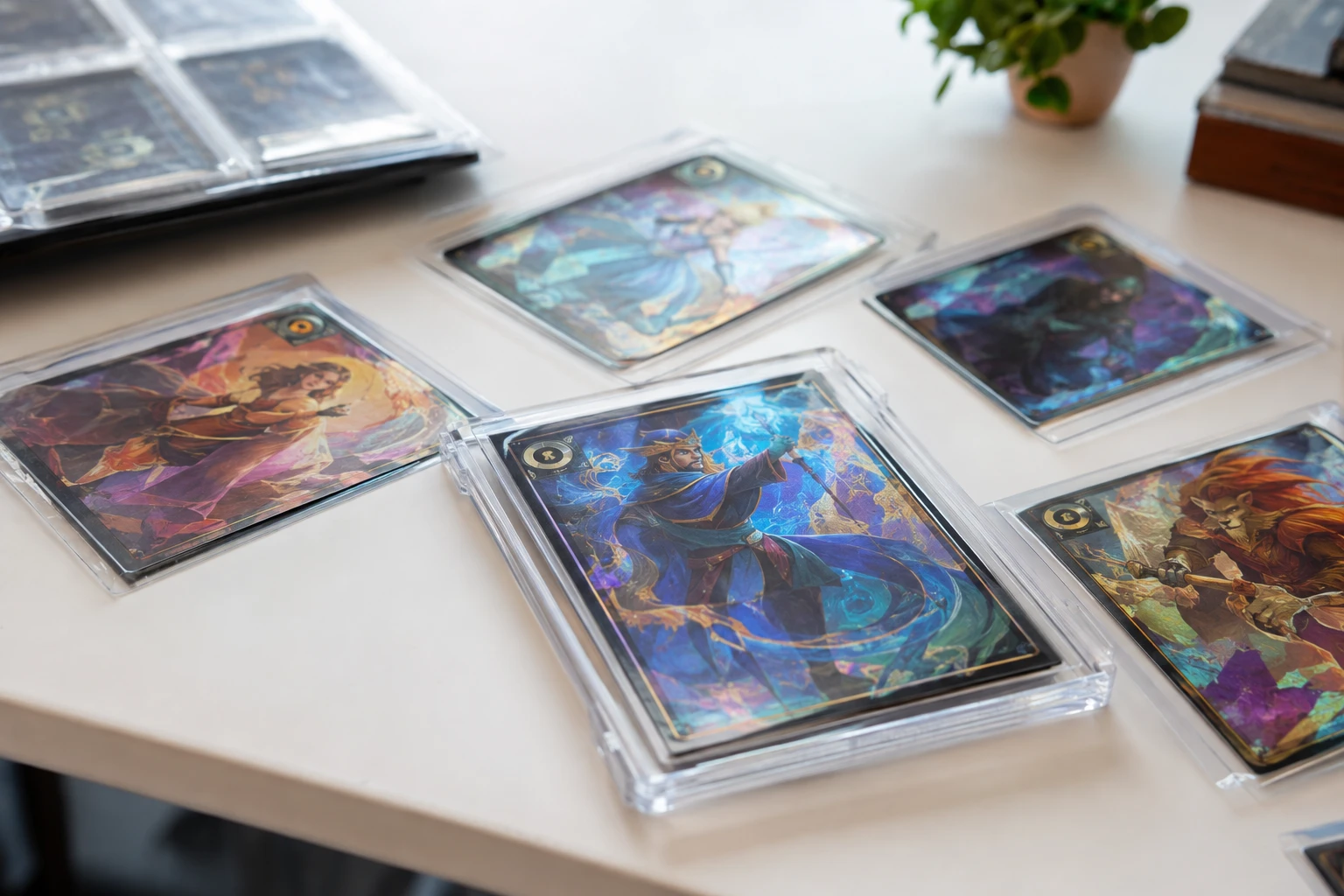
The Short Answer
- Enchanted Rares are the only Lorcana cards worth grading — PSA 10 values range from $150 to $2,500+ versus $40–$800 raw.
- 1/Set Special Illustration cards are the highest tier: $500–$5,000 raw, $2,000–$15,000+ in PSA 10.
- Lorcana has notorious back-edge whitening — the printing process at launch was not kind to sharp corners. Many "pack-fresh" cards have microscopic edge wear.
- Only grade cards where the PSA 9 to PSA 10 gap covers the risk — a $80 raw card at PSA 9 ($110) barely covers the $79.99 fee, but at PSA 10 ($300) it is profitable.
- The foil premium on Lorcana is smaller than MTG or Pokemon — a non-foil Legendary at $20 often has a foil version worth $25–$35, not 2x–5x.
Which Lorcana rarity tiers are worth grading?
Not every Lorcana card deserves a grading fee. The money in Lorcana collecting is concentrated in a small subset of cards at the top of the rarity ladder. Here is the complete rarity-to-value mapping based on early 2026 market data:
| Rarity | Raw NM Range | PSA 10 Range | Grade It? |
|---|---|---|---|
| Common / Uncommon | $0.10–$0.50 | Not worth grading | No |
| Rare | $0.50–$3 | Rarely graded | No |
| Super Rare | $1–$20 | $15–$80 | Only if playable + clean |
| Legendary | $2–$60 | $25–$250 | Only $50+ raw |
| Enchanted (chase) | $40–$800+ | $150–$2,500+ | Yes |
| 1/Set Special Illustration | $500–$5,000+ | $2,000–$15,000+ | Always |
The focus for grading should almost exclusively be on the higher rarity tiers: Enchanted Rares and 1/Set Special Illustration cards. Common, Uncommon, and most Rare cards, even in Gem Mint condition, will not see a significant increase in value due to grading alone. Super Rares and Legendaries are borderline — only grade if the card is worth $50+ raw and the AI pre-screen shows PSA 10 candidacy.
One thing that surprised collectors coming from other TCGs: the foil premium on Lorcana is much smaller than on Magic or Pokemon. A non-foil Legendary at $20 often has a foil version worth $25–$35 — a 25–75% premium, not the 2x–5x you would see on a Modern Masters MTG card. This means foil Legendaries are not automatically grade candidates just because they are foil.
Are Lorcana Enchanted Rares worth grading?
Yes — Enchanted Rares are the primary grading target in Lorcana. They are the chase tier: full-foil, alternate artwork, and the rarest cards in each set. A PSA 10 Enchanted Rare can command a price many times higher than its raw counterpart, especially if it features a highly sought-after character.
The "grade multiplier" for Enchanted Rares is well-established: a $100 raw Enchanted Rare might grade PSA 10 and be worth $300–$500. A $300 raw Enchanted Rare might reach $800–$1,500 in PSA 10. The premium is driven by collector demand for display-worthy copies of the game's most beautiful cards.
The top Enchanted Rare targets from each set:
- The First Chapter (1TFC, August 2023): Elsa — Spirit of Winter, Mickey Mouse — Brave Little Tailor, and Maleficent — Monstrous Dragon were the chase cards at launch. Expect $150–$500 raw Near Mint depending on the card. PSA 10 copies command significant premiums because 1TFC had the most QA issues — clean copies are genuinely scarce.
- Rise of the Floodborn (ROTF, November 2023): Anna — True Hearted, Rapunzel — Gifted Artist, and Robin Hood — Beloved Outlaw. ROTF had slightly better QA than 1TFC but still significant edge whitening issues.
- Into the Inklands (ITI, February 2024): Moana — Moana of Motunui, Tinker Bell — Giant Fairy, and Ursula — Sea Witch. ITI had improved print quality, making PSA 10 copies more achievable.
- Ursula's Return (UR, May 2024): Ursula — Deceiver of All, Ariel — Rescuer of Drowned Sailors. The set's Ursula-themed Enchanted Rares carry strong character demand.
- Shimmering Skies (SS, August 2024): The set's Enchanted Rares include fan-favorite characters with improved print quality. Better gem rate potential than earlier sets.
The practical rule for Enchanted Rares: if the raw value is above $80, grade it. Below that, the grading fee risk (getting a PSA 9 instead of 10) often equals the upside. Pre-screen every Enchanted Rare with AI before submitting to confirm PSA 10 candidacy.
What are Lorcana 1/Set Special Illustration cards and should you grade them?
The 1/Set Special Illustration is the highest rarity tier in Lorcana — literally one card per set with unique, full-bleed artwork. These are the Lorcana equivalent of Pokemon's most exclusive Secret Rares. Raw prices range from $500 to $5,000+, and PSA 10 copies reach $2,000 to $15,000+. These are auction-only territory.
If you pull a 1/Set Special Illustration, always grade it. The grading premium on these cards is enormous, and the raw value is high enough that even a PSA 9 is worth more than the raw card. The only question is which company to use:
- PSA Regular ($79.99): Best for resale value. PSA 10 carries the strongest premium on auction platforms.
- BGS Express ($79.95): Consider if you want subgrades. A BGS Black Label (all four subgrades at 10) would be worth an extreme premium — but the odds are approximately 1 in 500–600 submissions.
- CGC Pristine 10: If you are grading for personal collection rather than resale, CGC's lower cost may be appealing. But for a card worth $2,000+, the PSA resale premium justifies the higher fee.
Pre-screen the card with AI before submitting. Even at this value tier, a PSA 9 versus PSA 10 difference can be thousands of dollars. The AI pre-grade at $0.19 is trivial insurance on a $5,000 card.
Handle these cards with extreme care. Use cotton gloves, sleeve immediately after pulling, and photograph for pre-screening before placing in a toploader. The 1/Set cards are the most valuable Lorcana cards in existence — any handling damage is a direct financial loss.
Why do Lorcana cards have more QA issues than other TCGs?
Lorcana has a reputation for quality assurance issues that affect grading more than most TCGs. Ravensburger's manufacturing process, particularly in the early sets, produced cards with specific recurring problems:
Back-Edge Whitening
This is the #1 Lorcana grading problem. The printing process at launch was not kind to sharp corners, and a huge number of "pack-fresh" cards came out with microscopic edge wear. The back edges are particularly affected — white lines along the border that are invisible to the naked eye but immediately visible under a grader's light. This is the single most common reason Lorcana cards miss PSA 10.
Print Lines
Ravensburger had QA issues with early sets, particularly The First Chapter and Rise of the Floodborn. Print lines — thin horizontal or vertical lines embedded in the card surface during manufacturing — appear on a significant percentage of early cards. These are not the collector's fault but they affect the grade. Later sets (Into the Inklands onward) have fewer print line issues.
Surface Scratches on Foil
Enchanted Rares are full-foil, and the foil layer is extremely susceptible to surface scratches. Cards can pick up micro-scratches from pack friction during manufacturing — before the collector has even touched them. These scratches are invisible under normal light but clearly visible under angled LED light at 10x magnification.
Corner Sharpness
Lorcana cardstock tends to have softer corners than Pokemon or MTG cardstock out of the pack. Even pack-fresh cards may have corners that are not quite sharp enough for PSA 10. This is a manufacturing characteristic rather than a handling issue.
The practical implication: Lorcana's PSA 10 gem rate is lower than Pokemon's or MTG's because of these manufacturing issues. This is actually good news for grading economics — if your Lorcana card passes pre-screening as a PSA 10 candidate, it is scarcer than the average copy and will command a stronger premium. But it also means you must pre-screen more carefully than for other TCGs.
How do you pre-screen Lorcana cards for PSA 10 candidacy?
Lorcana pre-screening requires extra attention to back edges and surface condition. Here is the specific workflow for Lorcana cards:
Step 1: Check Back Edges First
This is the most important step for Lorcana. Flip the card over and examine all four back edges under raking light at 10x magnification. Look for white lines along the colored border — even a tiny speck of whitening will prevent PSA 10. If you find any back-edge whitening, the card's ceiling is PSA 9. Do not submit expecting a 10.
Step 2: Inspect Surface Under Angled LED Light
Hold the card at a 30–45 degree angle under a bright LED light. Slowly rotate through all angles. Look for print lines (especially on 1TFC and ROTF cards), foil scratches (especially on Enchanted Rares), and scuffs. Any visible surface defect under angled light will likely be caught by PSA graders.
Step 3: Check Centering
Measure centering on both axes using the centering analysis tool. PSA requires 55/45 or better on the front for PSA 10. Lorcana centering is generally better than early Pokemon sets but still varies by print run.
Step 4: Check Corners Under Magnification
Examine all four corners on both sides at 10x magnification. Lorcana cardstock tends to have softer corners — look specifically for whitening at the corner points and any rounding or dinging.
Step 5: AI Pre-Grade
Upload front and back photos to PreGradeCards AI grading. The AI analyzes all four criteria on both sides and returns predicted PSA and BGS grades with sub-scores. Cost: $0.19/card. The AI is particularly useful for Lorcana because it catches the back-edge whitening and surface issues that are the most common grade-killers for this TCG.
Step 6: Run the Break-Even Math
For Enchanted Rares: if raw value is $80+ and AI predicts PSA 9.5–10, submit to PSA at $79.99. If AI predicts PSA 9.0, consider CGC Economy at $15–18 — the PSA 9 resale premium may not cover the $65 price difference. If raw value is under $80, sell raw.
For 1/Set Special Illustrations: always grade, always PSA, always pre-screen first. The value is high enough that even PSA 9 is worth more than raw.
Which Lorcana sets have the best grading targets?
Each Lorcana set has different grading economics based on card values, print quality, and collector demand. Here is the set-by-set breakdown:
| Set | Release | Print Quality | Top Grading Targets |
|---|---|---|---|
| The First Chapter (1TFC) | Aug 2023 | Poor — most QA issues | Elsa, Mickey, Maleficent Enchanted Rares. Clean PSA 10s are scarce = high premium. |
| Rise of the Floodborn | Nov 2023 | Below average | Anna, Rapunzel, Robin Hood Enchanted Rares. |
| Into the Inklands | Feb 2024 | Improved | Moana, Tinker Bell, Ursula Enchanted Rares. Better gem rate potential. |
| Ursula's Return | May 2024 | Good | Ursula, Ariel Enchanted Rares. Strong character demand. |
| Shimmering Skies | Aug 2024 | Good | Enchanted Rares with improved print quality. |
| Reign of Jafar | 2025 | Very good | Jafar Enchanted Rares. Best gem rate potential. |
The counterintuitive insight: sets with worse print quality can be better grading targets. The First Chapter has the most QA issues, which means clean PSA 10 copies are genuinely scarce. A PSA 10 Elsa — Spirit of Winter from 1TFC is worth more than a PSA 10 of a comparable card from a later set with better print quality, because fewer 1TFC cards can achieve PSA 10. If your 1TFC Enchanted Rare passes pre-screening, it is a strong grade candidate.
For newer sets with better print quality (Shimmering Skies, Reign of Jafar), more cards will achieve PSA 10, which means the premium for a PSA 10 over raw may be smaller. But the cards are still worth grading if the raw value is above $80 and the AI pre-screen shows PSA 10 candidacy.
Should you use PSA or CGC for Lorcana cards?
The PSA vs CGC decision for Lorcana follows the same framework as other TCGs, with one Lorcana-specific consideration: because Lorcana's PSA 10 gem rate is lower (due to QA issues), the premium for a PSA 10 over a CGC 10 is potentially larger than for other TCGs. A clean PSA 10 Lorcana Enchanted Rare is scarcer than a clean CGC 10, which means the PSA resale premium may exceed the typical 15–25% gap.
For Enchanted Rares ($80–$800 raw): PSA Regular at $79.99 is the right choice if the AI pre-screen predicts PSA 9.5–10. The resale premium on a PSA 10 Enchanted Rare justifies the higher fee. If the AI predicts PSA 9.0, consider CGC Economy at $15–18 — the PSA 9 resale value may not cover the $65 price difference.
For 1/Set Special Illustrations ($500–$5,000+ raw): Always PSA. The value is high enough that the PSA resale premium is worth thousands of dollars. Do not risk a CGC slab on a $5,000 card.
For Legendaries ($50–$60 raw): CGC Economy at $15–18 is the better mathematical choice. The PSA resale premium on a $50 Legendary ($25–$250 PSA 10 range) may not cover the $65 price difference over CGC. Only use PSA if the card is a meta staple with strong tournament-driven demand.
For Super Rares and below: Do not grade. The raw values ($1–$20) are too low for any grading tier to make economic sense. Sell raw or keep raw.
What is the outlook for Lorcana graded cards in 2026?
The Lorcana graded card market has matured since the game's launch in August 2023. Two and a half years later, most cards have found their price floor, hype has cooled on some early staples, and a handful of sets have become quiet sleepers. The market is less speculative than it was in 2023–2024, which is generally healthy for long-term value.
Key trends shaping the Lorcana graded market in 2026:
- 90-day sold data shows Lorcana medians moving upward, with Enchanted Rares leading the pack at a significant multiplier over their raw counterparts when graded. The demand for high-grade, iconic character cards continues to fuel the market.
- The First Chapter Enchanted Rares (Elsa, Mickey, Maleficent) remain the market anchors. Despite several months of print runs, they still anchor the high end of the 1TFC Enchanted market at $150–$500 raw Near Mint. PSA 10 copies command proportionally higher premiums because clean copies are scarce.
- Reprint risk is moderate. Ravensburger has reprinted some cards, but reprints carry different set identifiers. Original-print Enchanted Rares, especially from 1TFC, retain their value better than reprinted versions.
- Tournament results drive Legendary values. Meta-relevant Legendaries spike with tournament results. If a Legendary becomes a tournament staple, its graded value can increase significantly — but this is speculative and difficult to predict.
- The format rotation question. Lorcana does not currently have a formal rotation, but if Ravensburger introduces one, older set cards (particularly 1TFC Enchanted Rares) could see increased demand from collectors seeking the original versions.
The bottom line for Lorcana grading in 2026: focus on Enchanted Rares and 1/Set Special Illustrations. Pre-screen every card for back-edge whitening and surface issues — the two most common Lorcana grade-killers. Use PSA for high-value cards and CGC for mid-value cards. And be honest about the AI pre-grade: if it predicts PSA 9, do not submit expecting a 10. The math only works when you submit cards that are genuine PSA 10 candidates.
Frequently Asked Questions
Are Lorcana Enchanted Rares worth grading?
What is the most valuable Lorcana card?
Why do Lorcana cards have so many grading issues?
Should I use PSA or CGC for Lorcana cards?
What is the foil premium on Lorcana cards?
How do I check Lorcana cards for back-edge whitening?
Sources & Further Reading
- Lorcana Card Value Guide (2026 Guide) (What The Slab)
- Disney Lorcana Card Prices: How Much Is Yours Worth? (2026) (TCG Price Lookup)
- Lorcana Card Grading in Portland: Enchanted & Foil 2026 (PreGradeCards)
- Lorcana Attack of the Vine! Set: Grading Dual Ink Enchanted Cards (PreGradeCards)
Emily Rodriguez analyzes grading cost, population, and pricing data across PSA, BGS, SGC, CGC, and TAG. She built the PreGradeCards ROI calculator and submission planner, and her market reports on grading backlog, turnaround times, and slab premiums are cited by collectors and dealers worldwide.
With submission floors rising, pre-screening is no longer optional. Use our AI Pre-Grade Calculator to score a card's PSA 10 odds before you pay, and the Submission Planner to pick the right tier.