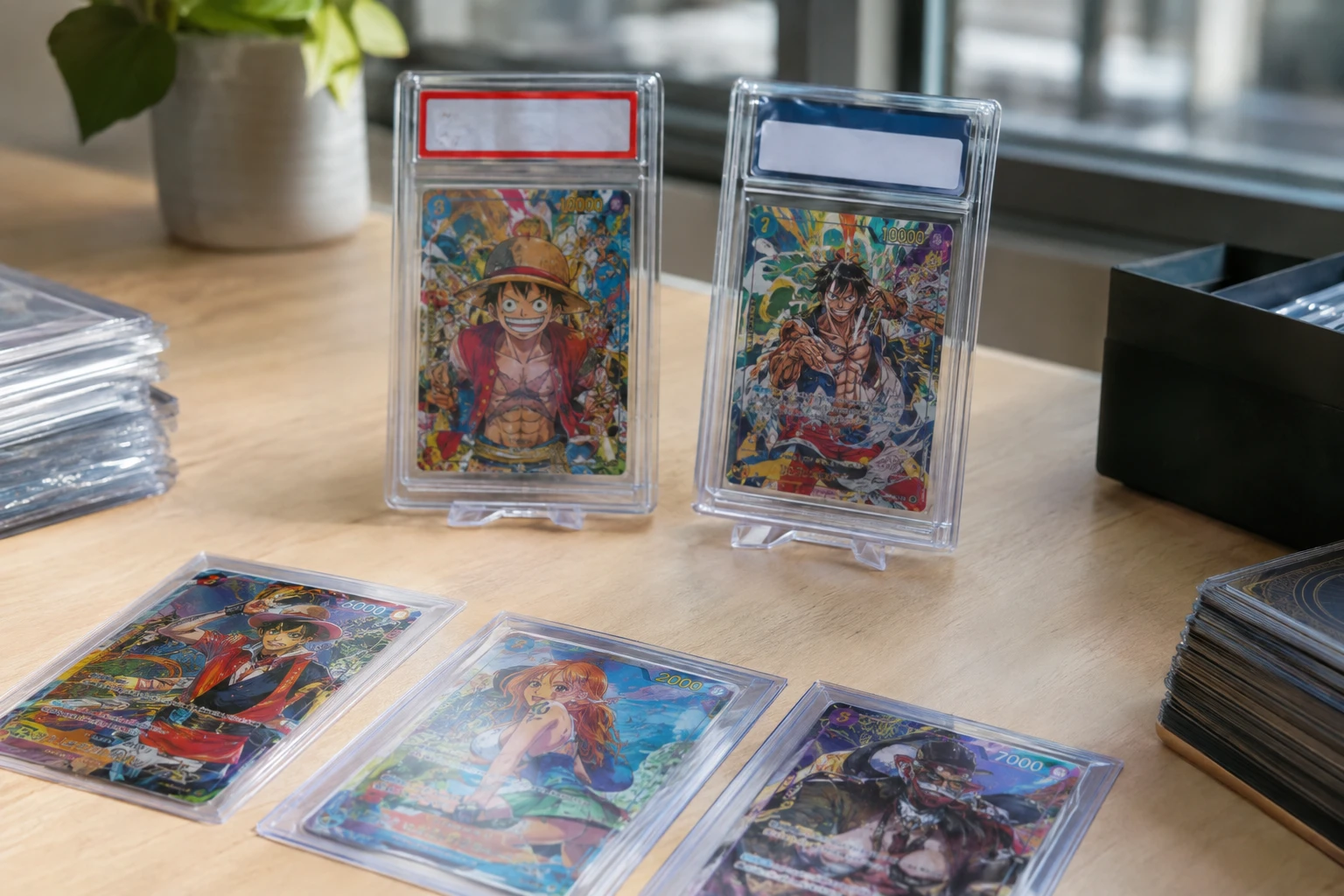
The Short Answer
- One Piece TCG card values rose 61% in 3 months and 119% in 6 months in early 2026, making it one of the fastest-appreciating TCG markets.
- PSA 10 adds 60–100% premium to OP-01 Manga Rare cards. The Luffy OP-01 Alt Art sells for $5,160 in PSA 10.
- CGC graded 451,000 One Piece cards in February 2026 alone, up 57% year over year — CGC is a legitimate first choice for OPTCG, not a fallback.
- Only grade cards worth $80+ raw at PSA pricing. OP-16 SEC Ace and Blackbeard have settled under $50 raw and no longer clear the grading cost math.
- Centering and surface are the two most common downgrade reasons for One Piece cards. Pre-screen both before submitting.
How big is the One Piece TCG graded card market in 2026?
The One Piece TCG graded card market has exploded in 2026. According to Card Ladder data, One Piece TCG card values rose by 61% over 3 months and 119% over 6 months in early 2026 — making it one of the fastest-appreciating segments in the entire trading card market. Over 200,000 One Piece cards have been graded by PSA across all series, and CGC graded 451,000 cards in February 2026 alone (up 57% year over year).
The market hierarchy for graded One Piece cards is clear: BGS Black Label > PSA 10 > CGC Pristine 10 ≥ BGS 10 Gold > CGC Gem Mint 10 > BGS 9.5. PSA 10 dominates in liquidity thanks to PSA's universal recognition (~70% of global grading volume). BGS Black Label surpasses it in raw value thanks to its exceptional rarity — only 0.1% of all submissions receive a Black Label, approximately 5–6 per 500–600 cards submitted.
For One Piece TCG specifically, the PSA 10 premium over raw cards is significant. A PSA 10 typically sells for 2 to 6 times the price of a raw card, and significantly more for Manga Rares or tournament promos. The Roronoa Zoro ST01-013 Treasure Cup reached $21,600 in PSA 10. The Nami Alt Art OP01-016 sells between $395 and $1,017 in PSA 10 — a premium of 3 to 7 times its raw value.
CGC is described by analysts as the "most balanced" choice for One Piece TCG: competitive pricing, fast turnaround, and Pristine 10 as a premium goal. Its main handicap remains market perception: a CGC Gem Mint 10 typically sells for 15–25% less than a PSA 10 for the same card. This gap is closing rapidly, especially on modern TCGs.
Which One Piece TCG cards have the highest PSA 10 values?
Based on real PSA 10 sold comps compiled by Graded.World (updated July 18, 2026), here are the top One Piece TCG cards ranked by PSA 10 fair market value. Population and gem rate data come from GemRate's PSA data:
| # | Card | Set | PSA 10 FMV | Pop 10 | Gem Rate |
|---|---|---|---|---|---|
| 1 | Luffy ST01 Serial /700 | ST01 | $120,000 | — | — |
| 2 | Gol D. Roger Manga Alt Art | OP09 | $18,600 | 1,657 | 89.9% |
| 3 | Luffy Manga Alt Art | OP05 | $16,200 | 4,421 | 85.4% |
| 4 | Luffy Manga Alt Art | EB02 | $7,200 | 938 | 84.7% |
| 5 | Luffy Alt Art | OP01 | $5,160 | 829 | 85.1% |
| 6 | Luffy Manga Alt Art | OP09 | $4,800 | 1,485 | 90.6% |
| 7 | Luffy Manga Alt Art | OP13 | $4,800 | 3,930 | 87.4% |
| 8 | Zoro Manga Alt Art | OP06 | $4,440 | 2,556 | 90.2% |
| 9 | Luffy Leader | EB02 | $4,200 | — | — |
| 10 | Ace Manga Alt Art | OP02 | $4,000 | 1,497 | 88.6% |
The data reveals clear patterns: Manga Rares and Alt Arts dominate the top of the value chart. Luffy is by far the most valuable character, appearing in 7 of the top 10 spots. The OP-01 Romance Dawn set has the strongest individual card values because it had a smaller print run and centering was inconsistent — making clean PSA 10 copies scarce. Sets with higher gem rates (OP09 at 90.6%) have more PSA 10 copies in circulation, which can moderate individual card prices.
Should you grade OP-16 One Piece cards?
OP-16 (English) launched on June 12, 2026. The original guidance was to wait 4–6 weeks before grading launch cards to let prices settle. That window is now open, and the grading landscape for OP-16 has clarified significantly:
Grade These (Strong Candidates)
- Admiral Manga Rares (Sakazuki, Kuzan, Borsalino): As of late July 2026, these are OP-16's strongest grade candidates. Raw prices are approximately $1,000–$1,600, and PSA 10 premiums are expected to be significant given the low pop counts at this early stage. Pre-screen and submit to PSA at Regular ($79.99) if the AI predicts PSA 9.5–10.
- Rob Lucci ($150–180 raw): Mid-tier chase card with dedicated Lucci collector demand. PSA 10 adds 60–80% premium. Strong candidate for PSA Value tier if it reopens, or CGC Economy at $15–18 currently.
Do Not Grade These (Below Threshold)
- OP-16 SEC Ace (alternate art): Settled at $47.89 raw as of late July 2026 (Limitless TCG data). Well under the $80 minimum-to-grade threshold. The submission fee alone exceeds the realistic PSA 10 upside. Skip grading.
- OP-16 SEC Blackbeard (alternate art): Settled at $33.76 raw. Even further below the threshold. Skip grading.
- Common and uncommon foils: Not worth grading at any pricing tier. Sell raw.
The lesson from OP-16 is that pre-launch price estimates are unreliable. The original estimates for SEC Ace ($300–500 PSA 10) and Blackbeard ($250–400 PSA 10) assumed raw prices the market never reached. Seven weeks post-launch, both cards settled well under $50 raw. This is why waiting 4–6 weeks before grading new set cards is essential — you need real market data to run the break-even math.
For the Admiral Manga Rares, the math works. At $1,000–$1,600 raw and a likely PSA 10 premium of 60–100%, the graded value could reach $1,600–$3,200. Submission cost at PSA Regular is $79.99. The premium comfortably covers the cost. Pre-screen with AI to confirm PSA 10 candidacy before submitting.
Are One Piece Manga Rare cards worth grading?
Manga Rares are the premium chase tier in One Piece TCG — full-bleed alternate artwork featuring manga panels from Eiichiro Oda's original series. They are the One Piece equivalent of Pokemon's Special Illustration Rares: high demand, low pull rates, and strong graded premiums.
The economic case for grading Manga Rares is clear from the data:
- OP-01 Manga Rare Luffy: PSA 10 market $500–$700+. The original chase card. OP-01 had a small print run and centering was inconsistent, making PSA 10 copies scarce. Grading a Gem Mint copy is the clearest financial win in OPTCG grading.
- OP-05 Manga Rare Luffy: PSA 10 FMV $16,200 (Pop 4,421, 85.4% gem rate). High pop but also high value — the Luffy brand drives demand regardless of scarcity.
- OP-09 Gol D. Roger Manga Alt Art: PSA 10 FMV $18,600 (Pop 1,657, 89.9% gem rate). The highest-value non-Luffy card. Roger's significance in the One Piece story drives collector demand.
- OP-13 Manga Rare Luffy: PSA 10 FMV $4,800 (Pop 3,930, 87.4% gem rate). Newer set with growing demand.
The general rule for Manga Rares: if the raw value is above $80, grade it. Manga Rares from OP-01 through OP-09 consistently meet this threshold. For newer sets (OP-13+), check current raw prices before submitting — newer Manga Rares may still be settling.
For Alt Arts (the tier below Manga Rares), the math is more selective. OP-01 Alt Art Luffy ($5,160 PSA 10) and Alt Art Nami ($1,000 PSA 10) justify grading. But Alt Arts from later sets with higher print runs may not clear the $80 raw threshold. Always check current sold comps before submitting.
Should you use PSA or CGC for One Piece TCG grading?
For One Piece TCG, the PSA vs CGC decision depends on the card's value and your goals:
| Factor | PSA | CGC |
|---|---|---|
| Cheapest available tier | Regular $79.99 | Economy $15–18 |
| Turnaround | 40–50 business days | 60–100 business days |
| Resale premium | Highest — PSA 10 sells 15–25% above CGC 10 | 15–25% below PSA 10 for same card |
| Pop report | 200,000+ OPTCG cards graded | 451,000 graded in Feb 2026 alone |
| Best for | Cards $250+ raw where resale premium matters | Cards $50–$250 raw; volume grading |
The decision framework is the same as for Pokemon: PSA for high-value cards where the resale premium covers the cost difference; CGC for mid-value cards where the lower fee makes the math work.
For a $300 raw Manga Rare: PSA 10 might sell for $600 (2x premium). PSA cost: $79.99. Net gain: $220. CGC 10 might sell for $480 (1.6x premium, 20% below PSA). CGC cost: $15. Net gain: $165. PSA wins by $55 on net gain despite costing $65 more — because the resale premium on a $300 card is large enough to absorb the higher fee.
For a $80 raw Alt Art: PSA 10 might sell for $160. PSA cost: $79.99. Net gain: $0.01 (break-even). CGC 10 might sell for $128. CGC cost: $15. Net gain: $33. CGC wins decisively — PSA is break-even at best, CGC is profitable.
CGC is also opening a full grading center in Frankfurt, Germany, which will reduce European turnaround times and eliminate customs issues for European collectors. This is particularly relevant for One Piece, which has a large European collector base.
How do you pre-screen One Piece TCG cards before grading?
One Piece TCG cards have specific pre-screening considerations that differ from Pokemon. The most common downgrade reasons for OPTCG are centering and surface condition — the two areas where Bandai's printing quality is most inconsistent.
Centering issues: OP-01 Romance Dawn is notorious for inconsistent centering. The small print run and early manufacturing setup meant many cards came off-center. This is actually good news for grading economics: if your OP-01 card has good centering, it is scarcer than the average copy and will command a stronger PSA 10 premium. Use the centering analysis tool to measure exact ratios before submitting.
Surface issues: One Piece cards use a different cardstock and foil treatment than Pokemon. The holo patterns can show print lines and surface scratches more readily. Inspect under angled LED light at 10x magnification, paying special attention to the manga panel artwork on Manga Rares — the detailed printing in these areas is more prone to imperfections.
Edge whitening: One Piece cards have colored borders that show whitening along edges. Check all four edges under raking light. The black borders on some Alt Arts are particularly prone to visible whitening.
AI pre-screening workflow: Upload front and back photos to PreGradeCards AI grading. The AI identifies the card (set, number, rarity, foil status), returns predicted PSA and BGS grades with sub-scores, and checks all four criteria. Cost: $0.19/card. Time: 5 seconds. This filters out cards that would come back below Gem Mint before you pay $79.99 for PSA or $15–18 for CGC.
For OP-16 cards specifically, wait at least 4–6 weeks after launch before pre-screening. Cards straight from packs may have manufacturing residue or surface issues that become visible after the card has been handled. The settling period also lets raw prices stabilize so you can run accurate break-even math.
What are the most common grading issues with One Piece TCG cards?
One Piece TCG cards have specific manufacturing and printing characteristics that create recurring grading issues. Understanding these helps you pre-screen more effectively:
Centering Inconsistency (OP-01 through OP-05)
Early One Piece sets (OP-01 through OP-05) have more centering variation than later sets. OP-01 Romance Dawn is the most affected — the small print run and early manufacturing setup produced cards with significant left-right and top-bottom centering shifts. If you are grading OP-01 cards, centering is the first thing to check. A card with 55/45 or better centering from OP-01 is genuinely scarce.
Foil Surface Scratches
One Piece holo and foil cards pick up micro-scratches from pack friction during manufacturing. The foil treatment on Manga Rares and Alt Arts is particularly susceptible. These scratches are invisible under normal light but appear clearly under angled LED light at 10x magnification. Always inspect foil surfaces under raking light before submitting.
Edge Whitening on Colored Borders
One Piece cards have colored borders (blue on the back, various colors on alt arts) that show whitening along edges more readily than Pokemon's standard yellow borders. Check all four edges under raking light at 10x magnification. The black borders on some Alt Arts are the most prone to visible whitening.
Corner Sharpness
One Piece cardstock is slightly different from Pokemon cardstock, and corner sharpness can vary. Cards from tightly-packed booster boxes may have factory corner dings from packaging contact. Inspect all four corners on both sides under magnification.
Print Lines
Print lines are manufacturing defects embedded during the printing process. They are not the collector's fault but still affect the grade. One Piece sets from 2022–2023 have more print line issues than 2025–2026 sets. Check the card surface under angled light for thin horizontal or vertical lines that appear to be embedded in the printing.
Is grading One Piece TCG cards a good investment in 2026?
The investment case for graded One Piece TCG cards is strong but selective. The market has appreciated rapidly — 61% in 3 months, 119% in 6 months in early 2026 — but that growth rate is not sustainable indefinitely. The question is whether current prices represent a floor or a peak.
Factors supporting continued growth:
- Growing global collector base: One Piece is the best-selling manga in history (over 500 million copies sold). The TCG launched in 2022 and is still acquiring new collectors globally. The collector base is expanding faster than the supply of graded cards.
- Low graded populations: With 200,000+ PSA-graded OPTCG cards, the graded population is small compared to Pokemon (millions of PSA-graded cards). Scarcity in graded populations supports value.
- CGC expansion: CGC's Frankfurt grading center will make grading more accessible to European collectors, expanding the market. CGC graded 451,000 OPTCG cards in February 2026 alone — the volume is growing but still small relative to Pokemon.
- Bandai reprint risk: Bandai reprints certain cards, but reprints carry different set codes and often distinct artwork. Original versions, especially first-edition Japanese cards, retain their value better. Grade early if the card is high-value — every day of handling increases degradation risk.
Factors to watch:
- Price sustainability: 119% growth in 6 months is bubble-adjacent. Some of the appreciation may correct as more graded copies enter the market. Focus on cards with fundamental scarcity (OP-01 Manga Rares, tournament promos) rather than cards whose value is driven by short-term hype.
- Reprint announcements: Watch for Bandai reprint announcements. Reprinted cards see their original-version values stabilize or increase (due to renewed interest), while the reprint versions have lower values. Grade original versions before reprints are announced.
- Set rotation: One Piece TCG does not currently have a formal set rotation like Pokemon, but if Bandai introduces one, older set cards could see increased demand. OP-01 cards would be the primary beneficiaries.
The bottom line: One Piece TCG grading is a legitimate investment strategy in 2026, but only for the right cards. Grade Manga Rares and high-value Alt Arts from early sets (OP-01 through OP-09). Skip SEC cards that have settled under $50 raw. Pre-screen everything before submitting. And always run the break-even math with current sold comps — not pre-launch estimates.
Frequently Asked Questions
Is One Piece TCG card grading worth it in 2026?
Which One Piece TCG cards are worth grading?
Should I use PSA or CGC for One Piece TCG?
How much is a PSA 10 One Piece card worth?
What are the most common grading issues with One Piece cards?
How fast is the One Piece TCG graded market growing?
Sources & Further Reading
- One Piece TCG Graded Card Prices — Complete Set Guide 2026 (Graded.World)
- One Piece TCG Card Grading: Is It Worth It in 2026? (ShonenTCG)
- Complete One Piece TCG Grading Guide — PSA, CGC, BGS (OPTCG)
- One Piece TCG OP-16 Global Release: How to Grade Treasure Rares (PreGradeCards)
Emily Rodriguez analyzes grading cost, population, and pricing data across PSA, BGS, SGC, CGC, and TAG. She built the PreGradeCards ROI calculator and submission planner, and her market reports on grading backlog, turnaround times, and slab premiums are cited by collectors and dealers worldwide.
With submission floors rising, pre-screening is no longer optional. Use our AI Pre-Grade Calculator to score a card's PSA 10 odds before you pay, and the Submission Planner to pick the right tier.