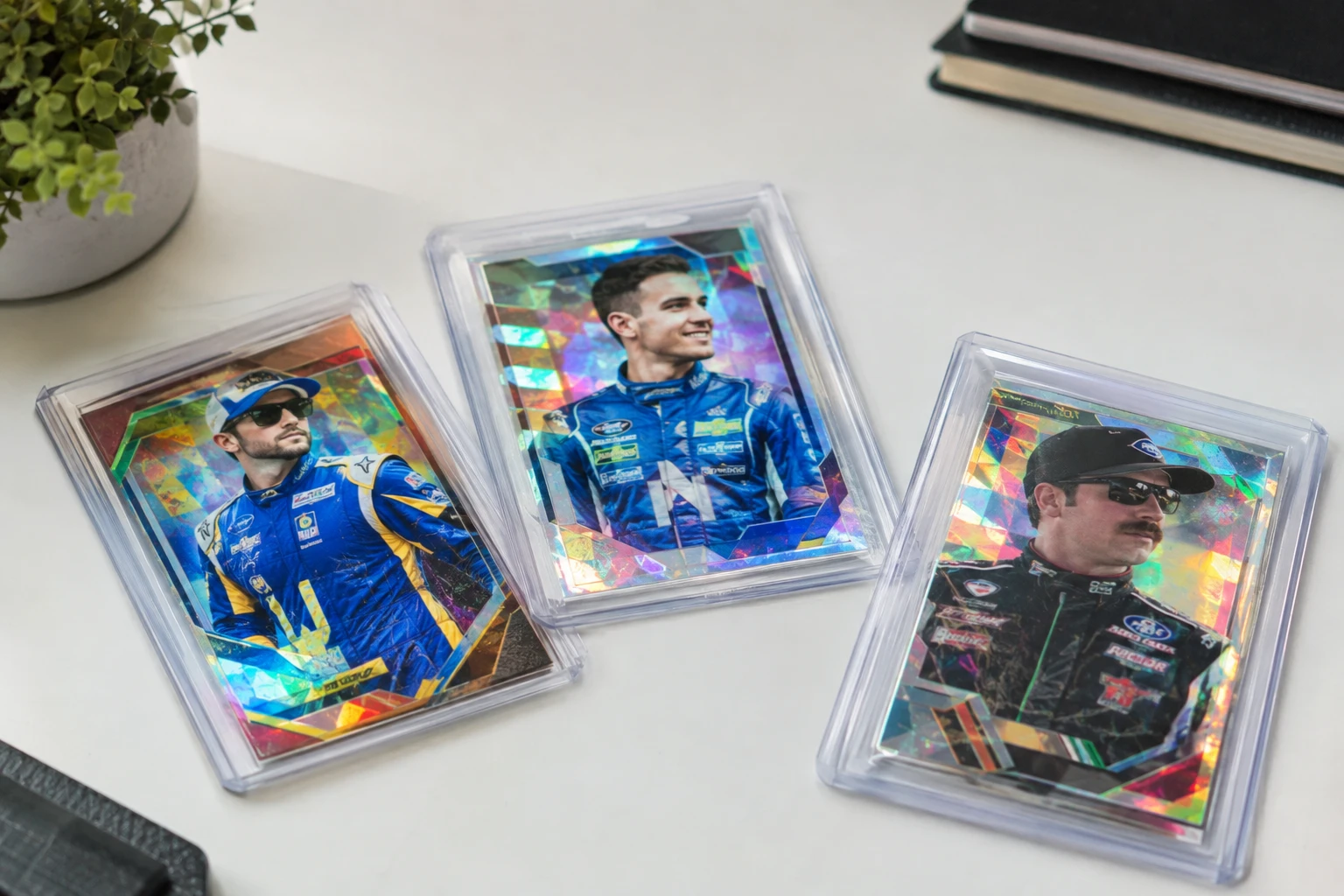
The Short Answer
- Panini Prizm NASCAR is the primary modern set, with Color Blast and Gold Vinyl /10 as the top parallel targets.
- Dale Earnhardt Sr. legacy cards remain the highest-value NASCAR cards — 1995 Maxx Earnhardt PSA 10 can reach $500+.
- Chase Elliott and Kyle Larson are the top active driver grading targets, with growing collector demand.
- Refractor parallels from Panini Prizm are the most accessible grading targets with consistent PSA 10 premiums.
- SGC is recommended for vintage NASCAR (pre-2000), while PSA is preferred for modern Panini cards.
- NASCAR card PSA populations are low for most modern parallels, creating scarcity premium for early graders.
NASCAR Card Grading in 2026: A Growing Niche With Undervalued Slabs
NASCAR card collecting occupies a unique position in the sports card market. While not as large as baseball, basketball, or football, NASCAR has a deeply dedicated fan base that translates into consistent collector demand for racing cards. The 2026 Panini Prizm NASCAR and Donruss NASCAR releases have expanded the modern card pool, while vintage cards from the 1990s and early 2000s continue to appreciate as legacy driver cards gain recognition.
The NASCAR card grading market is characterized by low PSA populations for most modern parallels and strong demand for vintage legacy cards. This combination creates opportunities for collectors who grade both modern stars (Chase Elliott, Kyle Larson, William Byron) and vintage legends (Dale Earnhardt Sr., Richard Petty, Jeff Gordon).
Why NASCAR Cards Are a Grading Opportunity in 2026
- Panini Prizm NASCAR 2026: New release with Color Blast, Gold Vinyl /10, and standard refractor parallels
- Dale Earnhardt Sr. legacy: The "Intimidator" remains the most collected NASCAR driver — his 1990s cards in PSA 10 are extremely rare
- Chase Elliott popularity: NASCAR's Most Popular Driver multiple years running, with a dedicated collector following
- Kyle Larson talent: One of the most talented drivers in NASCAR, with growing championship legacy
- Low PSA populations: Most modern NASCAR parallels have very low PSA 10 counts, creating scarcity premium
- Cross-sport migration: Collectors from other motorsports (F1, IndyCar) are discovering NASCAR cards
- 2026 NASCAR playoffs: Championship run driving singles demand for playoff driver cards
NASCAR Card Manufacturers: From Maxx to Panini
NASCAR cards have been produced by several manufacturers over the decades, each with unique characteristics that affect grading decisions.
Maxx (1992–1998) — Vintage NASCAR
Maxx was the premier NASCAR card manufacturer in the 1990s. Their 1995 Maxx set includes the iconic Dale Earnhardt Sr. card that is one of the most valuable vintage NASCAR cards. Maxx cards are on thinner cardstock with inconsistent centering — similar to NetPro tennis cards, they are challenging to grade PSA 10 but command high premiums when they do.
Press Pass (1999–2013) — Mid-Vintage
Press Pass took over NASCAR card production after Maxx. Their early 2000s sets include rookie cards of modern legends like Jimmie Johnson and Tony Stewart. Press Pass cards have better quality control than Maxx but still show centering variation.
Panini (2014–2026) — Modern Era
Panini is the current NASCAR card manufacturer. Their key releases include:
- Panini Prizm NASCAR 2026: The flagship modern NASCAR set, featuring refractor-style parallels in multiple tiers
- Panini Donruss NASCAR 2026: Premium release with Rated Rookie cards and serial-numbered parallels
- Panini Contenders NASCAR 2026: Autograph-focused release with Cracked Ice parallels
- Panini Select NASCAR 2026: Premium tier with three levels (Base, Premier, Court Side) and extensive parallel system
Upper Deck (2007–2014) — Mid-Era
Upper Deck produced NASCAR cards from 2007 to 2014, including some premium releases with memorabilia cards and autographs. Upper Deck NASCAR cards are on the thick, high-quality stock that Upper Deck is known for across all their sports products.
NASCAR Parallel Tiers Explained: From Base to Gold Vinyl /10
Panini NASCAR cards use the same parallel system as their other sports products. Understanding these tiers is essential for making profitable grading decisions.
Complete Panini NASCAR Parallel Hierarchy (2026)
| Parallel | Print Run | Typical Raw Value | Grade Worth It? |
|---|---|---|---|
| Base | Unlimited | $0.50–$5 | Only for star rookies |
| Silver Prizm | Unlimited | $2–$15 | Only for star drivers |
| Red/White/Blue Prizm | /149 | $10–$50 | If raw > $25 |
| Blue Prizm | /99 | $15–$75 | Yes — if star driver |
| Gold Prizm | /10 | $50–$300+ | Yes — always |
| Gold Vinyl | /10 | $75–$500+ | Yes — highest priority |
| Color Blast | /25 | $50–$400+ | Yes — always |
| Cracked Ice | /23 | $40–$300+ | Yes — if star driver |
| Black Prizm | /1 | $100–$1,000+ | Yes — always (1/1) |
The Gold Vinyl /10 and Color Blast /25 are the most valuable Panini NASCAR parallels. Gold Vinyl has a distinctive gold foil treatment that is highly sought after by NASCAR collectors. Color Blast features a unique color-wash design that makes it one of the most visually distinctive parallels in the NASCAR card market.
The 1/1 Black Prizm
The Black Prizm /1 is the rarest possible NASCAR card — a true one-of-a-kind. If you pull a 1/1 Black Prizm of any NASCAR driver, it should be graded immediately. The 1/1 rarity guarantees collector interest regardless of the driver's prominence.
Top NASCAR Cards to Grade: Legacy Legends and Modern Stars
NASCAR card grading targets fall into two categories: vintage legacy cards and modern star cards. Both have strong grading ROI potential.
Vintage NASCAR Grading Targets
| Driver | Key Cards | Est. Raw Value | PSA 10 Potential |
|---|---|---|---|
| Dale Earnhardt Sr. | 1995 Maxx, 1996 Press Pass | $20–$500+ | $100–$1,000+ |
| Richard Petty | 1990s Maxx, Press Pass | $15–$300+ | $75–$600+ |
| Jeff Gordon | 1990s Maxx rookie-era | $10–$200+ | $50–$400+ |
| Dale Earnhardt Jr. | 1990s–2000s rookies | $10–$150+ | $40–$300+ |
| Tony Stewart | Press Pass rookie-era | $8–$100+ | $30–$200+ |
| Jimmie Johnson | Press Pass 2000s rookie | $8–$100+ | $30–$200+ |
Modern NASCAR Grading Targets
| Driver | Key Cards | Est. Raw Value | Grading Priority |
|---|---|---|---|
| Chase Elliott | Panini Prizm/Donruss/Select | $5–$300+ | ★★★★★ |
| Kyle Larson | Panini Prizm/Donruss/Select | $5–$250+ | ★★★★★ |
| William Byron | Panini Prizm/Donruss | $3–$150+ | ★★★★☆ |
| Ryan Blaney | Panini Prizm/Donruss | $3–$100+ | ★★★☆☆ |
| Joey Logano | Panini Prizm/Donruss | $3–$100+ | ★★★☆☆ |
| Denny Hamlin | Panini Prizm/Donruss | $3–$80+ | ★★★☆☆ |
| Christopher Bell | Panini Prizm/Donruss | $2–$80+ | ★★★☆☆ |
| Tyler Reddick | Panini Prizm/Donruss | $2–$60+ | ★★☆☆☆ |
Chase Elliott and Kyle Larson are the clear top modern grading targets. Elliott's status as NASCAR's Most Popular Driver (multiple years) gives him the largest collector base among active drivers. Larson's championship talent and cross-series racing (IndyCar, sprint cars) expands his collector appeal beyond NASCAR.
The Dale Earnhardt Sr. Legacy Premium
Dale Earnhardt Sr. remains the most collected NASCAR driver of all time, even decades after his tragic death in 2001. His 1990s Maxx and Press Pass cards are the vintage NASCAR equivalent of a Mickey Mantle or Wayne Gretzky rookie — the foundational cards of a legend. PSA 10 copies are extraordinarily rare due to the inconsistent 1990s printing quality. A 1995 Maxx Dale Earnhardt Sr. in PSA 10 can command $500+ at auction, and the PSA population is likely fewer than 20 copies.
PSA vs BGS vs SGC for NASCAR Cards: Which Grader Is Best?
The choice of grading company for NASCAR cards depends on the era (vintage vs modern) and the card value.
PSA for NASCAR
PSA commands the highest resale premium for NASCAR cards, particularly for vintage Maxx and Press Pass cards. PSA's population report is the industry standard reference for NASCAR card values. PSA Regular costs $79.99/card. For vintage NASCAR cards of legacy drivers (Earnhardt, Petty, Gordon), PSA is the only recommended grader.
SGC for NASCAR — Recommended for Vintage
SGC is an excellent option for vintage NASCAR cards (pre-2000). Their vintage sports expertise translates well to 1990s Maxx and Press Pass cards, and their slab design is favored by many vintage collectors. SGC is generally more cost-effective than PSA for equivalent service levels.
BGS for NASCAR
BGS is recommended for modern Panini NASCAR cards where subgrades add value — particularly for Color Blast and Gold Vinyl parallels where surface and centering can vary independently. BGS Express costs $79.95/card.
CGC for NASCAR
CGC Economy at $15/card is the most affordable option for bulk grading of modern base and Silver Prizm cards of star drivers.
| Grader | Tier | Cost | Best For |
|---|---|---|---|
| PSA | Regular | $79.99 | Vintage legacy, modern $100+ parallels |
| SGC | Standard | $25–$40 | Vintage NASCAR — best value |
| BGS | Express | $79.95 | Modern parallels (subgrades) |
| CGC | Economy | $15 | Bulk modern base/Silver |
AI Pre-Grading for NASCAR Cards: Multi-Era Calibration
AI pre-grading for NASCAR cards requires calibration for multiple cardstock types across different eras. PreGradeCards achieves approximately 85% accuracy within ±1 PSA grade for modern Panini NASCAR cards and 80% for vintage Maxx/Press Pass cards.
Era-Specific AI Calibration
- Maxx (1992–1998): Thin cardstock, inconsistent centering, frequent print defects. The AI uses vintage calibration with tolerant centering thresholds. Most challenging to AI grade.
- Press Pass (1999–2013): Better quality than Maxx but still inconsistent. The AI uses mid-vintage calibration.
- Panini (2014–2026): Modern cardstock with good quality control. The AI uses standard modern calibration. Prizm refractor surface requires specialized foil analysis.
- Upper Deck (2007–2014): Thick, premium cardstock. The AI uses Upper Deck-specific calibration shared with hockey and golf.
Prizm Refractor Surface Analysis
Panini Prizm NASCAR cards use a refractor-style foil surface that creates unique AI analysis challenges:
- Refractor reflection: The prismatic surface refracts light in rainbow patterns, which can mask surface defects
- Color Blast detection: The Color Blast parallel has a distinctive color-wash treatment that the AI must distinguish from surface damage
- Gold Vinyl analysis: The gold vinyl treatment has a metallic surface that requires reduced exposure photography
- Photography tip: Use diffuse lighting at 90 degrees for Prizm cards. Avoid angled lighting, which creates rainbow artifacts that confuse the AI.
Cost Savings Example
Consider a collector with 8 modern Panini NASCAR cards (Chase Elliott and Kyle Larson parallels, $10–$100 each). Without AI pre-grading, submitting all 8 to BGS Express ($79.95/card) costs $639.60 plus $25 shipping = $664.60.
With AI pre-grading at $0.19/card, screening all 8 costs $1.52. The AI identifies 5 cards with 65%+ PSA 10 probability. You submit only the 5 strong candidates: $399.75 + $25 = $424.75. You save $239.85. Net savings: $238.33.
For lower-value cards (base, Silver Prizm), use CGC Economy ($15/card) or SGC instead of BGS Express to keep grading fees proportionate to card value.
Panini Cardstock and Centering: What to Check Before Grading
Modern Panini NASCAR cards generally have good centering quality, with typical centering of 50/50 to 55/45. Vintage Maxx and Press Pass cards have significantly more centering variation.
Centering Quality by Era
| Era | Typical Centering | Est. PSA 10 Rate | Notes |
|---|---|---|---|
| Maxx (1992–1998) | 60/40 to 70/30 | ~25% | Worst centering — vintage |
| Press Pass (1999–2013) | 55/45 to 65/35 | ~40% | Improving but inconsistent |
| Upper Deck (2007–2014) | 50/50 to 55/45 | ~60% | Good quality stock |
| Panini (2014–2026) | 50/50 to 55/45 | ~60% | Modern quality standards |
Vintage Maxx cards have the worst centering of any NASCAR card era, making PSA 10 copies extremely rare and valuable. If you are buying raw Maxx cards of Dale Earnhardt Sr. for grading, expect a low PSA 10 hit rate and budget accordingly. AI pre-grading is especially valuable for Maxx cards because it identifies the centering ratio before you pay grading fees.
Common Panini NASCAR Card Issues
- Prizm surface scratches: The refractor surface is prone to micro-scratches from pack handling
- Corner dinging: Panini cardstock corners can ding during pack collation
- Print lines: Some Panini print runs have visible print lines under direct light
- Serial number clarity: For serial-numbered parallels, verify the serial number is clearly legible
NASCAR Card Grading ROI Calculator
Here are worked ROI examples for both vintage and modern NASCAR cards.
Worked Example 1: 1995 Maxx Dale Earnhardt Sr. ($50 raw, vintage)
P(10) = 25% (Maxx vintage centering)
P(9) = 40%
P(≤8) = 35%
PSA 10 value = $500 (estimated — extremely rare)
PSA 9 value = $120
PSA 8 value = $60
Grading fee (PSA) = $79.99
Expected Value = (0.25 × $500) + (0.40 × $120) + (0.35 × $60) = $125 + $48 + $21 = $194
Net ROI = $194 − $79.99 − $3 − (13.25% × $194) = $194 − $82.99 − $25.71 = $85.30
Profit = $85.30 − $50 = $35.30 (71% return)
Even with only 25% PSA 10 probability, the 10x PSA 10 premium for vintage Earnhardt makes this a profitable submission. The scarcity of PSA 10 Maxx Earnhardt cards means any PSA 10 that comes back will likely appreciate further.
Worked Example 2: Chase Elliott Gold Vinyl /10 ($150 raw, modern)
P(10) = 60% (modern Panini quality)
P(9) = 30%
P(≤8) = 10%
PSA 10 value = $450 (estimated 3x raw)
PSA 9 value = $200
PSA 8 value = $160
Grading fee (PSA) = $79.99
Expected Value = (0.60 × $450) + (0.30 × $200) + (0.10 × $160) = $270 + $60 + $16 = $346
Net ROI = $346 − $79.99 − $3 − (13.25% × $346) = $346 − $82.99 − $45.85 = $217.16
Profit = $217.16 − $150 = $67.16 (45% return)
The Gold Vinyl /10 is a profitable grading target. The 3x PSA 10 premium and the /10 scarcity create strong expected value. For lower-value modern cards (base, Silver Prizm), use CGC Economy ($15) or SGC to keep fees proportionate.
Complete AI Pre-Grading Workflow for NASCAR Cards
Follow this step-by-step workflow to maximize your NASCAR card grading ROI.
Step 1: Sort by Driver Significance and Era
Pull all cards of legacy drivers (Earnhardt Sr., Petty, Gordon) and modern stars (Elliott, Larson, Byron). Separate vintage (Maxx, Press Pass) from modern (Panini). Set aside base cards of non-star drivers.
Step 2: For Vintage Cards — Careful Condition Assessment
Maxx and Press Pass cards require especially careful pre-grading:
- Check centering — vintage centering is often 60/40 or worse
- Check edges — vintage edge chipping is common
- Check surface — look for print lines and dot patterns under direct light
- For Earnhardt Sr. cards, submit even at 20% PSA 10 probability — the potential value justifies the risk
Step 3: For Modern Cards — Standard Pre-Grading
- Check centering (typically 50/50 to 55/45)
- Check Prizm surface for micro-scratches under raking light
- Check serial number clarity on parallel cards
Step 4: Photograph for AI Analysis
Take front and back photos: diffuse lighting, 90-degree overhead angle, dark background, 300+ DPI. For Prizm refractor cards, use extra-diffuse lighting to minimize rainbow artifacts.
Step 5: Upload to PreGradeCards AI
Upload each card to PreGradeCards AI grading and receive your pre-grade report.
Step 6: Match Grader to Card Era and Value
- PSA Regular ($79.99): All vintage Earnhardt/Petty/Gordon, modern $100+ parallels
- SGC Standard ($25–$40): Vintage NASCAR — best value
- BGS Express ($79.95): Modern Color Blast/Gold Vinyl (subgrades)
- CGC Economy ($15): Bulk modern base/Silver of star drivers
Step 7: Package, Ship, Track, and Sell
Package in penny sleeves and semi-rigid holders. Ship via USPS Priority Mail with insurance. Check population reports on return. Vintage Earnhardt PSA 10s should be held for appreciation — the legacy premium will only increase over time. Modern star PSA 10s can be sold immediately to capture the grading premium while demand is high.
Frequently Asked Questions
Are NASCAR cards worth grading?
What is the most valuable NASCAR card to grade?
Should I use PSA or SGC for NASCAR cards?
What are the best modern NASCAR card parallels to grade?
How does AI grading work for NASCAR cards?
Who are the best modern NASCAR drivers to collect and grade?
Sources & Further Reading
- NASCAR Card Values — Sports Cards Pro
- Panini Prizm NASCAR 2026 Checklist — Cardboard Connection
- Vintage NASCAR Card Price Guide — PSA Card Facts
- NASCAR Card Market Trends 2026 — Sports Card Investor
- AI Sports Card Grading — PreGradeCards

Marcus Chen has evaluated over 50,000 sports cards and TCG cards across PSA, BGS, SGC, and CGC standards. Before joining PreGradeCards, he worked as a submission specialist for a major grading company and trained collectors and dealers on condition assessment.
Create a free account and get 1 free credit — enough for 1 complete AI grading with market pricing. No credit card required.
Sign Up Free →