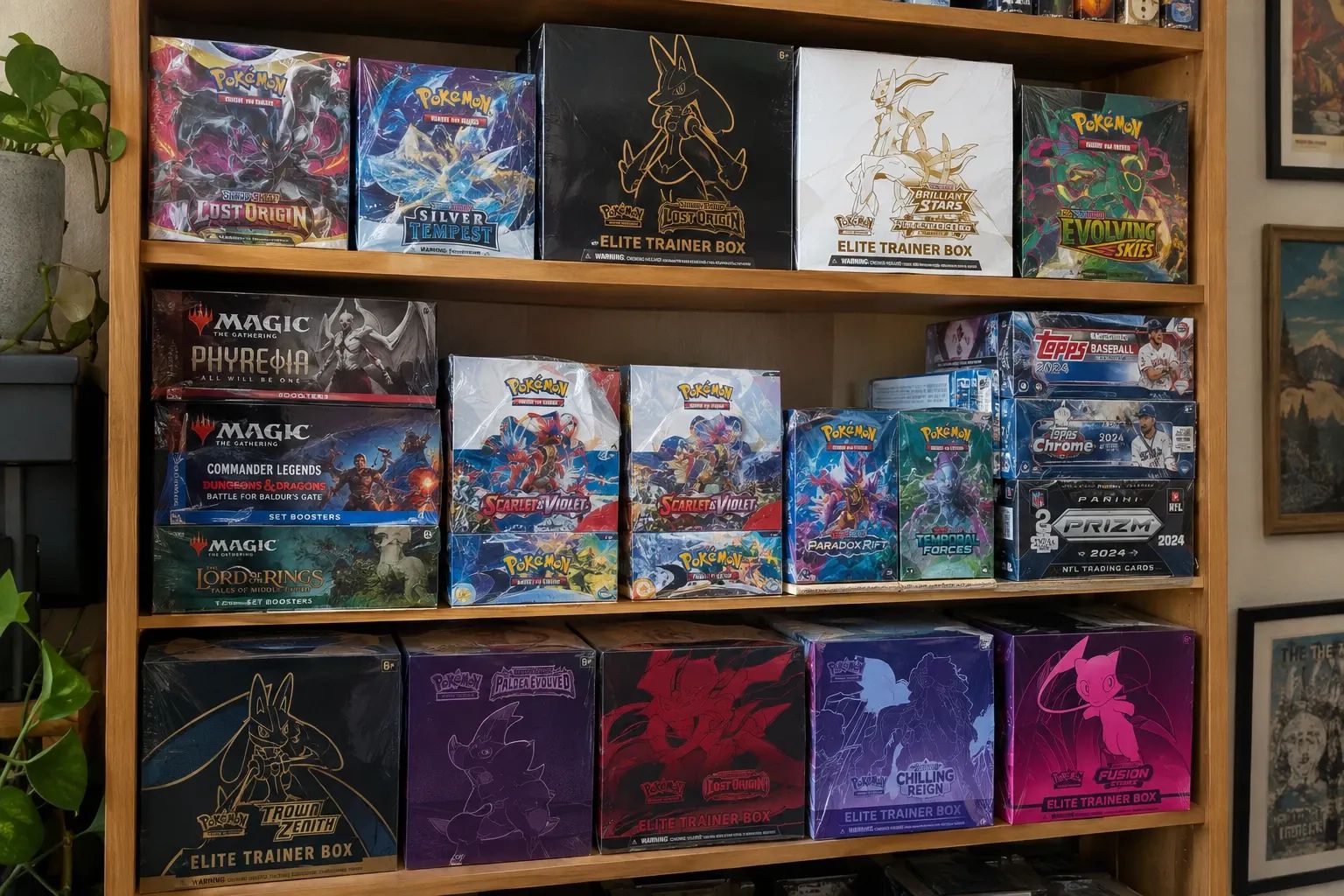
The Short Answer
- Vintage sealed product is the blue-chip investment — Base Set 1st Edition booster boxes have returned 141,000%+ from original MSRP, but entry prices are now $85,000+.
- Modern sealed product (2020-2021) has been the sweet spot — Evolving Skies boxes went from $140 MSRP to $2,650 by mid-2026, a 33% annualized return.
- Not all sealed product appreciates — Battle Styles boxes returned only 5% annualized over 5 years, roughly matching a savings account.
- Reprint risk is the biggest threat — The Pokemon Company has reprinted popular sets like 151 and Evolving Skies, increasing supply and suppressing prices.
- Scarlet & Violet era print runs are massive — modern sets may take 4-5 years to appreciate vs 2 years for Sword & Shield era sets.
- Storage condition matters — shrink wrap condition directly affects resale value; damaged wrapping can cut 20-30% off price.
- Sealed product diversifies risk — unlike single cards, a booster box spreads risk across an entire set's pull pool.
Why Invest in Sealed Trading Card Product?
Sealed trading card product — booster boxes, Elite Trainer Boxes (ETBs), and hobby boxes still in their original shrink wrap — represents one of the most reliable investment strategies in the card market. Unlike individual cards whose value depends on a single character or artwork, sealed product diversifies your exposure across an entire set. Once a product goes out of print, supply only decreases, creating a natural appreciation curve that has rewarded patient investors consistently.
The appeal is straightforward: buy a box, put it on a shelf, wait a few years, sell it for more than you paid. The pitch is backed by genuinely impressive data points. A 1st Edition Base Set booster box from 1999 that cost roughly $100 at the time has sold for over $400,000 at auction. Evolving Skies booster boxes that cost $140 at release in 2021 trade around $2,650 as of mid-2026. Even mid-range examples like Hidden Fates ETBs have more than doubled from their original retail prices.
But the pitch leaves out a lot. It leaves out the boxes that never appreciated. It leaves out storage costs, opportunity cost, the risk of reprints, and the reality that past returns in a growing market do not guarantee future returns in a mature one. This guide lays out the full picture — the wins, the losses, and the math — so you can make informed decisions about allocating money to sealed product.
Investment Tiers by Era
Sealed product performance varies dramatically by era. The general rule: the older and rarer the sealed product, the higher the potential return — but the higher the entry price. Here is how the tiers break down:
- Tier 1 (Vintage, 1999-2003): 300-1,000%+ ROI potential, but entry prices are $3,500-$150,000+
- Tier 2 (Modern Vintage, 2010-2021): 50-500% ROI, entry prices $90-$300, the sweet spot for most investors
- Tier 3 (Recent, 2022-2026): Speculative 50-150% potential, high risk due to massive print runs
Tier 1: Vintage Sealed (1999-2003)
These are the true investments. A sealed Base Set 1st Edition booster box in 2026 ranges from $85,000-$150,000+ depending on box condition and market conditions. That same box cost $45-75 in 1999-2000. Even accounting for inflation, the gains are astronomical.
Post-Base Set vintage (Jungle through Neo Genesis) is where serious sealed product investors actually operate. A Jungle 1st Edition booster box that cost $60-80 in 1999-2000 trades for $8,000-15,000 in 2026. Team Rocket, Fossil, and Gym Heroes booster boxes show similar patterns. A raw Gym Heroes 1st Edition box is running $3,500-5,500 in 2026 — down from $8,000+ in 2021, but still 4,000%+ from original MSRP.
PSA grading changes the calculus entirely. A PSA 9 Jungle 1st Edition booster case (12 boxes) can fetch $120,000-180,000. Individual PSA 10 boxes from this era command $15,000-25,000 each. However, the ROI math here assumes you bought in the original era. If you are buying 2026 asking prices, your time horizon for meaningful returns extends to 5-10+ years. Vintage sealed product is no longer a "double your money in three years" play.
| Booster Box | MSRP | Release Year | 2026 Price | ROI |
|---|---|---|---|---|
| Base Set 1st Ed. | $45-60 | 1999 | $85,000+ | 141,667% |
| Jungle 1st Ed. | $60-75 | 2000 | $8,000-12,000 | 10,667% |
| Fossil 1st Ed. | $60-75 | 2000 | $3,500-5,500 | 4,667% |
Tier 2: Modern Vintage (2010-2021)
This is where most sealed product investors actually make money. The entry prices are accessible ($90-$300), the sets have proven chase card lineups, and the appreciation timeline is 2-5 years — long enough for real gains but short enough to see returns within a collecting lifetime.
Evolving Skies is the blue-chip sealed investment of the modern era. Booster boxes were available at $85-$120 during 2022 when the market cooled and the set was still in print. By mid-2026, those boxes are trading at $2,400-$2,800. If you bought at $100, that is roughly a 25x return in about four years, or ~90% annualized. The Eeveelution alt art chase card lineup is simply too strong for this box to lose relevance.
Other strong performers in this tier include Hidden Fates (280-422% ROI from MSRP), XY Evolutions (522-678% ROI), and Crown Zenith (boxes available at $85-95 at retail now trading at $160-190, roughly 1.8-2.0x in three years, ~24-26% annualized).
The cautionary tale: Battle Styles. Boxes were available at $90-$100 at retail. Five years later, they trade at $110-$130. That is roughly 1.2-1.3x over five years, or about 5% annualized. The S&P 500 averaged about 10% annually over the same period. A weak chase card lineup and uninspiring set design meant this box never gained traction.
| Booster Box | MSRP | Release Year | 2026 Price | ROI |
|---|---|---|---|---|
| XY Evolutions | $45 | 2016 | $280-350 | 522-678% |
| Hidden Fates | $90-100 | 2019 | $280-380 | 280-422% |
| Evolving Skies | $140 | 2021 | $2,400-2,800 | 1,614-1,900% |
| Crown Zenith | $85-95 | 2024 | $160-190 | 80-124% |
| Battle Styles | $90-100 | 2021 | $110-130 | 10-44% |
Tier 3: Recent Sets (2022-2026)
Recent sealed product from the Scarlet & Violet era is the highest-risk tier. The Pokemon Company has massively increased print runs compared to Sword & Shield. The practical impact: modern sealed product has to draw down a much larger supply base before scarcity kicks in. Sets that took two years to appreciate in the Sword & Shield era might take four or five years in the Scarlet & Violet era, if they appreciate at all.
Scarlet & Violet Base booster boxes at $90-100 MSRP are trading around $85-120 in mid-2026 — essentially flat. Crown Zenith boxes at $80-95 MSRP are trading at $160-190, showing modest gains. The key difference from prior eras is print run size: Scarlet & Violet sets are printed in quantities that dwarf Sword & Shield, meaning the supply overhang is much larger.
For recent sets, the best strategy is to buy at or near MSRP when a set is still in print, then wait 3-5 years. Only invest in sets with strong chase card lineups — Eeveelution sets (Prismatic Evolutions), Charizard sets (Obsidian Flames), and nostalgia sets (151) have the best track records. Avoid sets with weak chase cards, no matter how cheap they are.
What Makes a Box Good for Investment?
Not every sealed product is worth holding. The best sealed investments share five common characteristics:
1. Chase Card Quality
The single most important factor. A booster box is only worth holding if people will want to open it in the future, and people only want to open boxes that contain desirable cards. Sets with Charizard, Umbreon, Pikachu, or popular character SARs (Special Art Rares) have proven track records. Sets with weak chase cards will sit on shelves and never appreciate.
2. Print Run Size
Smaller print runs mean faster scarcity. The Pokemon Company does not publish print run numbers, but you can estimate by watching how quickly sets sell out at distributors and how long they stay in print. Sets that sell through quickly and go out of print within 6-12 months are better investments than sets that stay in print for 2+ years.
3. Broad Collector Appeal
Sets that appeal beyond competitive players — to collectors, nostalgia buyers, and investors — have stronger long-term demand. Pokemon 151 is a perfect example: the original 151 Pokemon will always have cultural significance, which means the set will still matter to collectors in 10 and 20 years.
4. Current Price Relative to Retail
The best time to buy is at or near original retail price. If a box is already trading at 2-3x retail, much of the easy appreciation has already happened. Your upside is more limited and your risk is higher. The sweet spot: boxes still available near MSRP from sets with strong chase cards that are approaching or have already gone out of print.
5. Reprint Risk
The Pokemon Company has shown willingness to reprint popular sets. 151 received multiple print waves. Evolving Skies got reprinted. Each reprint adds supply and pushes prices back down. Check whether a set has been reprinted before buying at a premium — if it has been reprinted once, it may be reprinted again.
Risk Factors: Reprints, Overproduction & Liquidity
Sealed product investing has real risks that the success stories do not mention:
Overproduction
The biggest threat. If The Pokemon Company prints a set heavily to meet demand, sealed product may not appreciate for years because supply exceeds collector demand. Scarlet & Violet era sets are printed in significantly larger quantities than Sword & Shield era sets, which means the 2-year appreciation timeline that worked for Evolving Skies may take 4-5 years for modern sets.
Reprints
The Pokemon Company sometimes reprints popular sets, which increases supply and suppresses sealed prices. 151 has been reprinted multiple times. Evolving Skies was reprinted. Each reprint pushes prices down and delays the appreciation timeline.
Liquidity
Selling sealed product is not like selling a stock. You cannot press a button and have cash in your account by the end of the day. Selling a booster box means listing it on eBay, a marketplace, or a local sale. It means dealing with fees (typically 12-15% on eBay), shipping costs, and the risk of returns or disputes. Your money is locked up until a buyer appears and the transaction closes.
Opportunity Cost
Money tied up in sealed product is money that is not invested elsewhere. If your sealed product returns 5% annually and the S&P 500 returns 10%, you have lost money in opportunity cost. The investors who bought Evolving Skies at $100 and saw it reach $2,650 beat the market handily. The investors who bought Battle Styles at $100 and saw it reach $120 did not.
Storage and Condition Preservation
Sealed product investing requires physical storage, and condition directly affects resale value. Here is what you need to know:
- Climate control: Keep boxes in a climate-controlled environment, away from direct sunlight, moisture, and temperature extremes. Heat can warp boxes; humidity can damage shrink wrap; UV light fades packaging.
- Stacking: Stack carefully to avoid crushing. Heavy boxes on top of light boxes causes compression damage. Use shelving rather than stacking when possible.
- Shrink wrap condition: A booster box with intact, clean shrink wrap commands a 20-30% premium over one with torn or damaged wrapping. Handle sealed product carefully from day one.
- Acrylic cases: For premium products, consider acrylic display cases. These protect against shelf wear, compression, and sun bleaching while also providing display value.
- Inventory tracking: Keep a spreadsheet or use a collection tracker app to record purchase prices, dates, and current values. This is essential for tax reporting when you sell.
When to Buy and Sell
When to Buy
The best time to buy sealed product is at or near retail price when a set is still in print. Pre-order prices from distributors and local card shops offer the lowest entry points. The second-best window is shortly after a set goes out of print at distributors but before the secondary market has fully repriced upward — typically a 3-6 month lag.
Avoid buying at inflated scalper prices. If an ETB retails for $50 and is selling for $120 on eBay, the easy appreciation has already happened. Your upside is limited and your risk is higher. Patience to acquire at retail is key.
When to Sell
Most sealed Pokemon products need 2-5 years to show meaningful appreciation. Some sets appreciate faster if they go out of print quickly or if a card from the set becomes a viral chase target. Patience is the core requirement — sealed investing is not a quick-flip strategy.
Selling timelines also depend on market conditions. The card market had a massive boom in 2020-2021, a correction in 2022-2023, and has been recovering in 2024-2026. Selling into a booming market maximizes returns; selling into a correction means lower prices. Watch market indices like the Card Ladder Pokemon index for overall market direction.
For tax implications of selling sealed product, see our trading card tax guide — grading fees, purchase price, and shipping all factor into your cost basis.
Sealed Product vs Stock Market Returns
Here is the honest comparison. $1,000 invested in Evolving Skies boxes at $100 each in early 2022 would be worth $24,000-$28,000 in mid-2026. That is a 24-28x return, or ~90% annualized. The S&P 500 over the same period returned roughly 10% annually, turning $1,000 into about $1,460.
But $1,000 invested in Battle Styles boxes at $100 each in 2021 would be worth $1,100-$1,300 in mid-2026. After eBay fees (12-15%) and shipping, you are roughly breaking even. The S&P 500 would have turned that same $1,000 into $1,610.
The takeaway: sealed Pokemon product can beat traditional investments dramatically, but only if you pick winners. Average sealed product — the median set, the typical box — roughly matches or underperforms the stock market after accounting for friction costs. The asset class as a whole is not a magic money machine. It is a high-dispersion bet where the best picks dramatically outperform and the worst picks dramatically underperform, with the average landing somewhere around market returns.
The edge that knowledgeable collectors have is the ability to identify which sets will be winners before the market does. Understanding chase card quality, print run dynamics, and collector psychology gives you an information advantage over casual investors who buy whatever is trending on social media. Use PreGradeCards AI to evaluate individual cards from sets you are considering, and read our Pokemon investment guide for specific card recommendations.
Frequently Asked Questions
Is sealed Pokemon product a good investment in 2026?
Which Pokemon booster boxes are the best investment?
How long should I hold sealed Pokemon product?
What are the risks of investing in sealed trading cards?
Does sealed product condition affect value?
How do taxes work when selling sealed trading card product?
Sources & Further Reading
- Pokemon Booster Box Investment ROI 2026
- Best Pokemon Booster Boxes for Investment 2026
- Is Sealed Pokemon Product a Good Investment?
- Sealed Pokemon TCG Investment Guide
Emily Rodriguez analyzes grading cost, population, and pricing data across PSA, BGS, SGC, CGC, and TAG. She built the PreGradeCards ROI calculator and submission planner, and her market reports on grading backlog, turnaround times, and slab premiums are cited by collectors and dealers worldwide.
Create a free account and get 2 free credits — enough for 2 complete AI gradings with market pricing. No credit card required.
Sign Up Free →