The Short Answer
- Alcaraz and Sinner rookie-era cards plus Federer/Nadal/Serena legends carry the graded premiums.
- Topps Chrome is the flagship tennis set — the chrome finish shows print lines as the common 10-killer.
- The market is thin and name-dependent — maybe 8–10 players have real graded markets.
- Grand Slam results swing card value more than any stat-driven sport.
- Check sold comps on the exact player + set before paying a fee.
The tennis card market in 2026
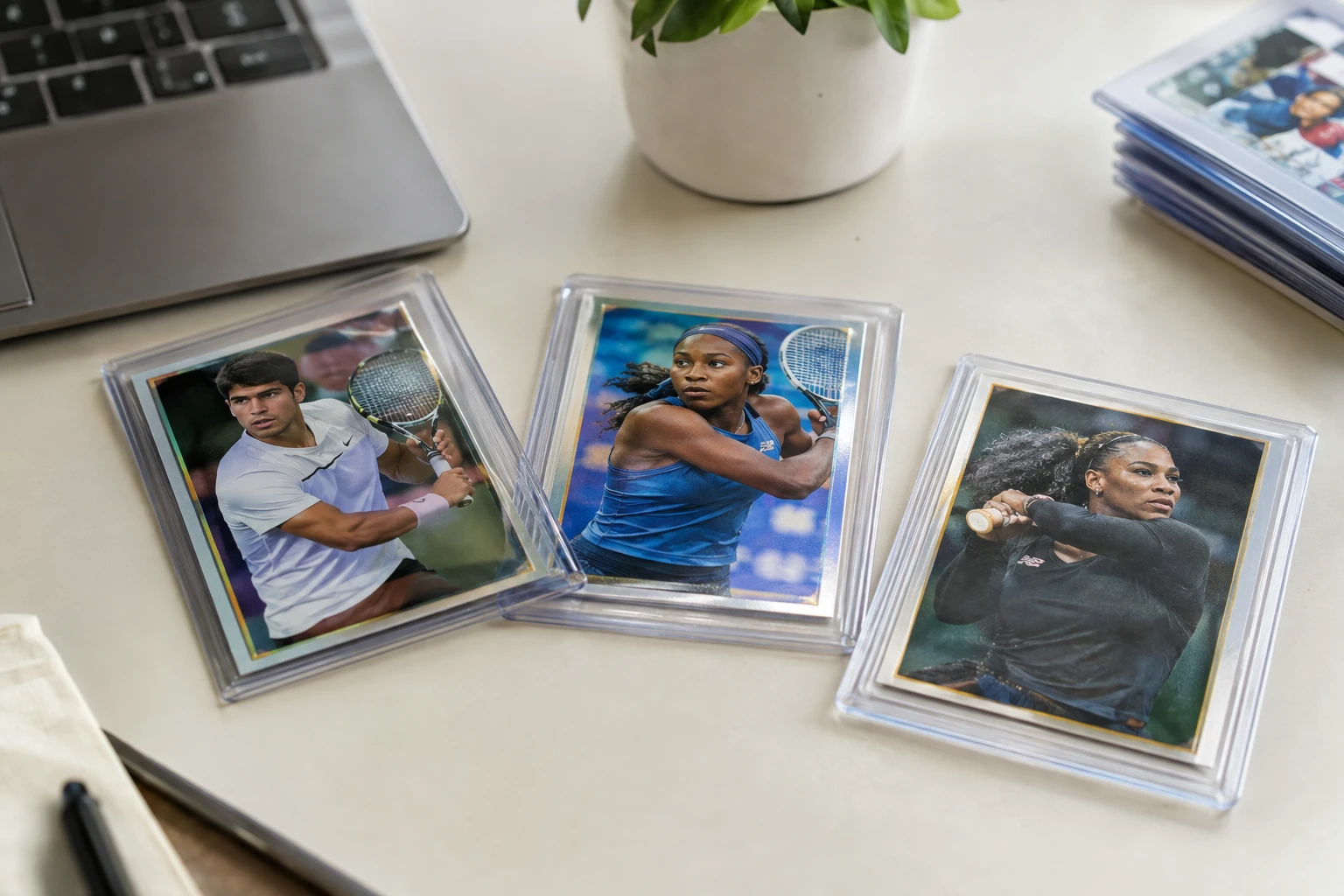
Tennis cards spent decades as a novelty — a few scattered releases, no structured market, cards that sold for pocket change. That changed when Carlos Alcaraz and Jannik Sinner created the rivalry that made tennis interesting to a generation that never watched Federer vs Nadal. Topps capitalized with Topps Chrome Tennis and the sport's first modern flagship card releases, and by 2026 there's a real graded market: Alcaraz Chrome rookies pulling $100–800 raw, Sinner's comparable cards in the same range, and the legend cards — Federer, Nadal, Serena Williams — carrying a different kind of collector demand entirely.
The market is thin in a way that resembles UFC more than basketball: real graded buyers exist for maybe 8–10 players, concentrated on the two superstars and the GOAT-tier legends. Everything else has almost no graded market. That makes tennis card grading a name-selection game first and a condition game second — the exact structure that punishes unfocused submissions hardest.
2 free credits — check the grade before the fee.
Which tennis cards are actually worth grading
Grade the superstars' flagship cards; skip everyone else:
- Topps Chrome tennis rookies — Alcaraz and Sinner debut cards are the flagship. Raw $100–800; PSA 10 carries a real premium on the liquid names.
- Numbered chrome parallels — refractors, color parallels /99 and below on the top names. Scarce enough that graded copies are genuinely rare.
- Legend cards — Federer, Nadal, Serena, Djokovic, Graf — the collectors buying these want the player, not the card market, so premiums are less volatile.
- Grand Slam victory-associated cards — cards released around major wins, which carry narrative premium.
- Autographs — on-card autos of the top names; the signature is the value, the grade certifies it.
Skip: base cards of anyone outside the top names, unnumbered inserts, and any card where the raw price is under ~$50. On a thin market, mid-tier players' cards have almost no graded buyers even in a 10.
Which players have real graded markets
The list is short and it's the whole decision:
- Superstar tier: Alcaraz and Sinner — the rivalry that built the modern market. Their rookie-era cards are the liquid core of tennis card grading.
- Legend tier: Federer, Nadal, Serena, Djokovic — collectors who buy the player rather than the market, which makes demand steadier but thinner.
- Rising names: whoever is winning Slams at print time — the list rotates with the tour.
- Everyone else: the 95% of the tour whose cards are effectively ungradeable at profit.
What makes tennis different from mainstream sports is how result-sensitive the market is. A Grand Slam win moves a player's card value more than a stat line ever could in basketball — because tennis fans collect the narrative of a champion, and the majors are where those narratives get written. Grading an Alcaraz card after a Wimbledon win means submitting into peak demand; the same card after a loss sits in a thinner market.
That result-sensitivity is the key variable in timing a tennis submission: you're not just grading a card, you're grading into a market that rewrites itself after every major.
Topps Chrome print quality and the 10-killers
Topps Chrome is the flagship finish — glossy, metallic-tinged, and beautiful when clean. It's also the finish that hides defects best:
- Surface print lines — the most common 10-killer on chrome. Faint production lines across the reflective surface, invisible at arm's length, fatal under raking light.
- Refractor-line scratches — the chrome surface picks up hairline scratches from any contact, including sleeve friction.
- Corner softness — Topps corners are slightly softer than vintage; microscopic fraying costs the 10.
- Edge chipping — the chrome edge shows chips more visibly than matte stock.
- Centering drift — usually tight on Topps, but verify.
The handling caution on tennis specifically: the collector base skews newer to cards — tennis fans who buy the player rather than card collectors — so more submissions arrive with handling wear baked in. The cards that fail a 10 are usually the ones that saw real handling before anyone considered grading.
Why pre-grading matters more on tennis
Tennis is the extreme version of the thin-market grading problem: the player list is so short that the decision isn't “which card to grade” but “does this player's market even exist.” The checklist:
- Confirm the player has a graded market. Search sold comps for a PSA 10 of the same player's comparable card — if nothing exists, don't grade it.
- Check the 10-vs-9 gap. On tennis cards the 10 premium is steep and the 9 market is thin except on the superstars — a likely 9 is usually a fee loss.
- Pre-grade the card. An AI scan catches the chrome surface issues that decide the 10-vs-9 outcome in ~30 seconds.
- Check the calendar. Slam timing matters — grading into a player's peak (post-major-win) demand is different from grading into the off-season.
On tennis specifically, the discipline is double: the card has to be a 10-candidate and the player has to have a graded market. Failing either check makes the fee a loss — and on a market this thin, most candidates fail one of them.
Free scan — know if it's a 10-candidate first.
A short history of tennis cards — and why the market is new
Tennis cards existed before Alcaraz, but barely as a market. The old NetPro issues of the 1990s and 2000s produced scattered releases of the legends — early Federer, Serena, Agassi cards that sat in the hobby's fringes for decades because tennis fans collected autographs and memorabilia, not cards. The cards existed; the market didn't.
What changed in 2023–2025 was a combination of the Alcaraz–Sinner rivalry creating a narrative the sport hadn't had since Federer–Nadal–Djokovic, and Topps putting the first modern flagship card product behind the sport. Topps Chrome Tennis gave the market structure — a canonical set, parallel tiers, a rookie framework — the things that turn a collectible category into a gradable market. The result is that tennis card grading is barely three years old as a real phenomenon, which is why the market is thin but growing fast.
That youth is also the opportunity: the cards being graded now are the first-generation slabs of a market that's still forming. Early graded copies of the superstars' rookies carry the thin-pop premiums that first-mover markets produce — the same dynamic that made early Pokemon slabs and early Clark slabs valuable before the populations grew. Whether tennis sustains that growth depends on whether the sport keeps producing the rivalries that drive collectors — but on Alcaraz and Sinner's current trajectory, the market is real enough to grade into.
The bottom line
Tennis cards are a real but extremely narrow graded market — Alcaraz, Sinner and the legends carry it, and almost nobody else has graded buyers. When the name is right, the premiums are real and the steep 10-vs-9 curve makes grade accuracy everything. Check the player first, pre-grade the card second, and only submit when both clear. On a market this thin, the fee saved on a bad submission is worth more than any single graded premium.
Frequently Asked Questions
0
1
2
3
4
5
6
7
Sources & Further Reading

Emily Rodriguez analyzes grading cost, population, and pricing data across PSA, BGS, SGC, CGC, and TAG. She built the PreGradeCards ROI calculator and submission planner, and her market reports on grading backlog, turnaround times, and slab premiums are cited by collectors and dealers worldwide.
Create a free account and get 2 free credits — enough for 2 complete AI gradings with market pricing. No credit card required.
Get Your Free Credits →