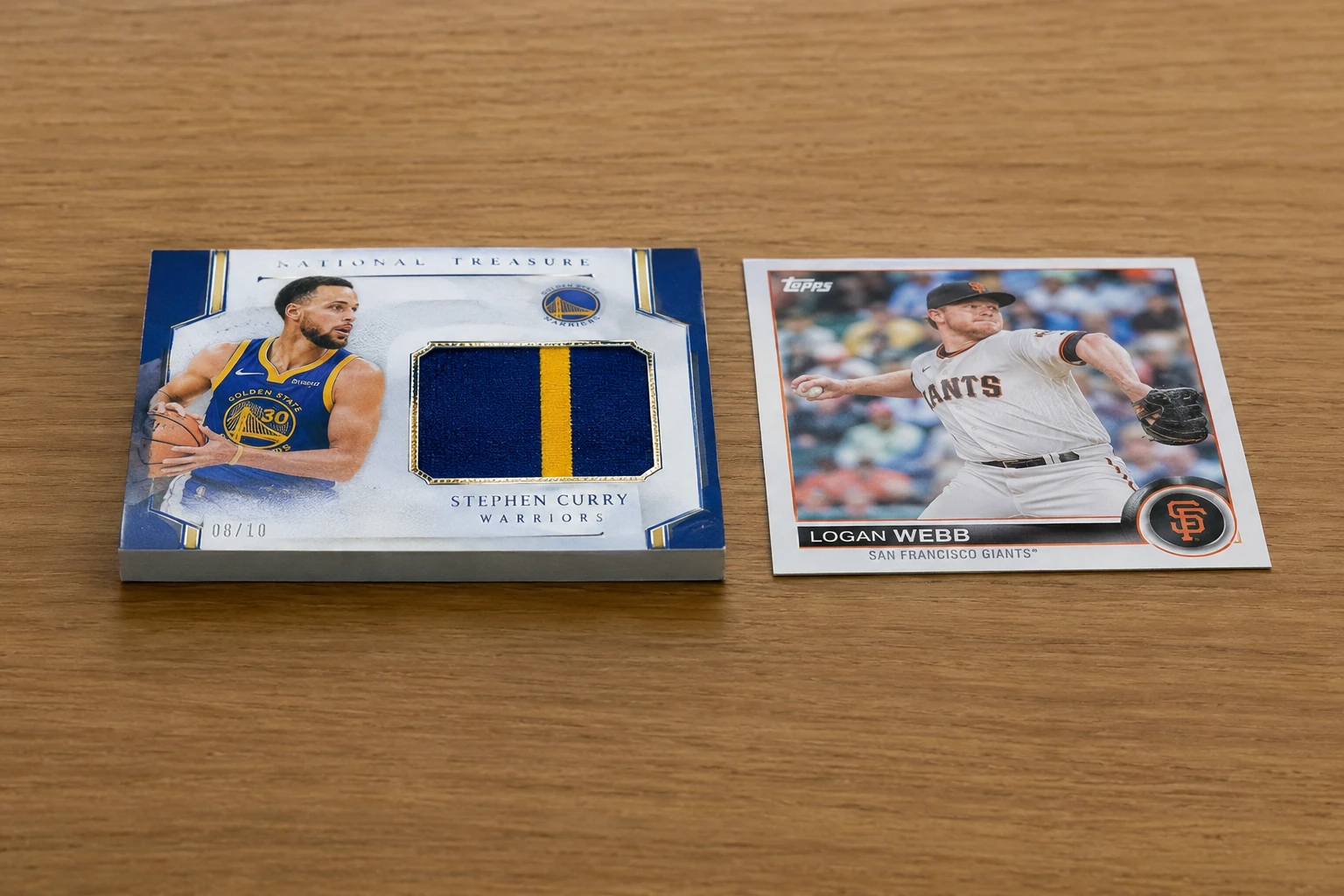
The Short Answer
- Relic cards need thick-card holders — standard slab depth doesn't fit them.
- The relic window is graded separately — scratches, fraying and adhesive issues on the swatch.
- The thick stock corners are the biggest grading weakness — they catch wear faster than standard cards.
- Premium patch cards (jumbo swatches, logos, patches) carry the strongest graded premiums.
- Pre-grade the card condition before assuming the relic makes it valuable.
What patch and relic cards actually are
Relic cards (also called memorabilia, patch, or swatch cards) embed a piece of fabric — game-worn jersey, event-used material, or in the premium cases, patches, logos and equipment pieces — into a trading card. The fabric sits behind a clear window in a card that's typically 2–5× thicker than a standard card, sometimes as thick as a smartphone.
The grading problem they create is structural: everything about a standard card grade — the flat surface, the thin stock, the simple edge — is different on a relic card. The card is thick enough to need a different holder, the relic window is a separate grading surface with its own defect types, and the heavy stock wears differently at the corners. Grading one like a normal card misses most of what matters.
2 free credits — the card-grade part of the assessment.
How memorabilia cards grade differently
A relic card gets assessed on two tracks that standard cards don't have:
- The card itself — centering, corners, edges, surface, same as always. But the thick stock changes the wear pattern: heavy corners catch damage faster, and the card's depth makes edge wear more visible.
- The relic window — the clear window and the fabric behind it are graded on their own criteria: scratches on the window, fraying or discoloration on the swatch, adhesive bleed around the fabric edges, and whether the relic is properly seated. A mint card with a damaged relic window doesn't grade like a mint card.
The third factor standard cards don't have is authenticity weight: on a game-used relic, the value is partly the card and partly the provenance of the fabric. The grading service certifies the card and the relic presentation together — which is why memorabilia grading is a distinct specialty within the services.
The relic-specific defects that cost grades
Inspect these before assuming a relic card is slab-ready:
- Corner wear on thick stock — the heavy board's corners catch damage on any edge contact; the corner tips on thick cards fray or ding faster than thin stock.
- Relic window scratches — the clear window over the swatch is a separate surface that picks up scratches and haze independently of the card face.
- Swatch fraying — the fabric edge frays or lifts inside the window, visible as threads at the swatch boundary.
- Adhesive bleed — glue seeping from the fabric edges into the card around the window.
- Window fogging/clouding — moisture or adhesive issues clouding the clear window over time.
- Edge delamination — the layered construction of thick cards separates at the edges on handling wear.
The trap on relic cards is assuming the relic makes it valuable regardless of condition. A damaged relic window or frayed swatch on a $200 card is still a damaged $200 card — grading a flawed relic wastes a fee on a card that was never a 10.
Which memorabilia cards are worth grading
Grade the premium relics; skip the mass-produced jersey cards:
- Patch cards — logo patches, jumbo swatches, multi-color patches. The premium relic tier where grading adds real value.
- Numbered relics — /99 and below. Serial-numbered memorabilia cards carry the scarcity premium.
- Game-used relics of stars — actual game-worn material of the names collectors want.
- Rookie patch autos (RPA) — the flagship modern chase card: rookie + patch + auto on one card, which is why RPAs carry the highest premiums in modern sports cards.
- Event-used/special relics — All-Star jerseys, milestone-game material, championship-worn pieces.
Skip: standard jersey relics of mid-tier players (mass-produced enough that grading doesn't add premium), plain single-color swatches on common cards, and any relic where the card itself is flawed. The relic's premium only pays when the card grading is worth it too.
The thick-card holder problem
Standard card slabs are built for standard thickness — a relic card doesn't fit. The services handle this with thick-card holders (PSA's thick-stock holder, CGC's oversized slabs) designed for cards up to several millimeters deep. You don't need to specify it — the service routes the card to the right holder — but it affects two things:
- Display. A thick-card slab is noticeably deeper, which changes how it displays and stores.
- Handling. The thicker holder is heavier and more fragile at the edges; storage needs to account for it.
There's also a practical submission note: thick cards are more likely to incur shipping damage on the way to grading because they're heavier and catch edges in packaging. Sleeve them in the manufacturer-recommended semi-rigid thick holders and pack them with more padding than standard cards — a corner ding in transit on a $300 relic is a grade point you didn't need to lose.
Storage before submission matters too: thick cards don't sit flat in a normal card box the way thin ones do, and they get dinged on the edges when stacked with standard cards. Store relics separately in their own thick-card boxes or cases until submission — a relic stored loose with bulk cards will show the wear on the corners and the window.
The RPA: why it's the king of modern sports cards
If there's one card type that defines modern sports card collecting, it's the rookie patch auto — the RPA. It stacks three premiums on one card: the rookie premium (the card every collector wants first), the patch premium (a real piece of game-worn material), and the autograph premium (a certified signature). A Panini National Treasures or Flawless RPA of a top draft pick is the flagship chase of modern basketball and football — the card that can sell for five figures on the right player.
It's also the card where grading matters most, precisely because it's the most complex. An RPA has three things to grade: the card's condition, the patch's condition, and the auto's quality. A card that's a 9 with a clean patch and a bold 10 auto is worth dramatically more than the same card with a faded auto 6 or a frayed patch. That's why RPAs are almost always dual-graded — the buyer needs all three numbers verified.
The grading math on RPAs is the steepest in the hobby: a 9.5 RPA can be a $3,000 card while a 10 of the same card is $8,000+. That premium gap is why the pre-grade is essential — an RPA that isn't a genuine 10-candidate shouldn't be submitted as one.
The bottom line
Memorabilia cards are the premium tier of the hobby and they grade under their own rules: two surfaces (card + relic window), different defect types, a heavier stock that wears differently, and a thick holder for the slab. Grade the premium relics — RPAs, patches, numbered swatches — where both the card grade and the relic condition justify the fee. Skip the mass-produced jersey cards where the relic adds a window but not value. And inspect the swatch as carefully as the card — on a relic, the fabric is half the grade.
Free scan — the card-grade assessment before the fee.
Frequently Asked Questions
0
1
2
3
4
5
6
7
8
9
Sources & Further Reading
Emily Rodriguez analyzes grading cost, population, and pricing data across PSA, BGS, SGC, CGC, and TAG. She built the PreGradeCards ROI calculator and submission planner, and her market reports on grading backlog, turnaround times, and slab premiums are cited by collectors and dealers worldwide.
Create a free account and get 2 free credits — enough for 2 complete AI gradings with market pricing. No credit card required.
Get Your Free Credits →