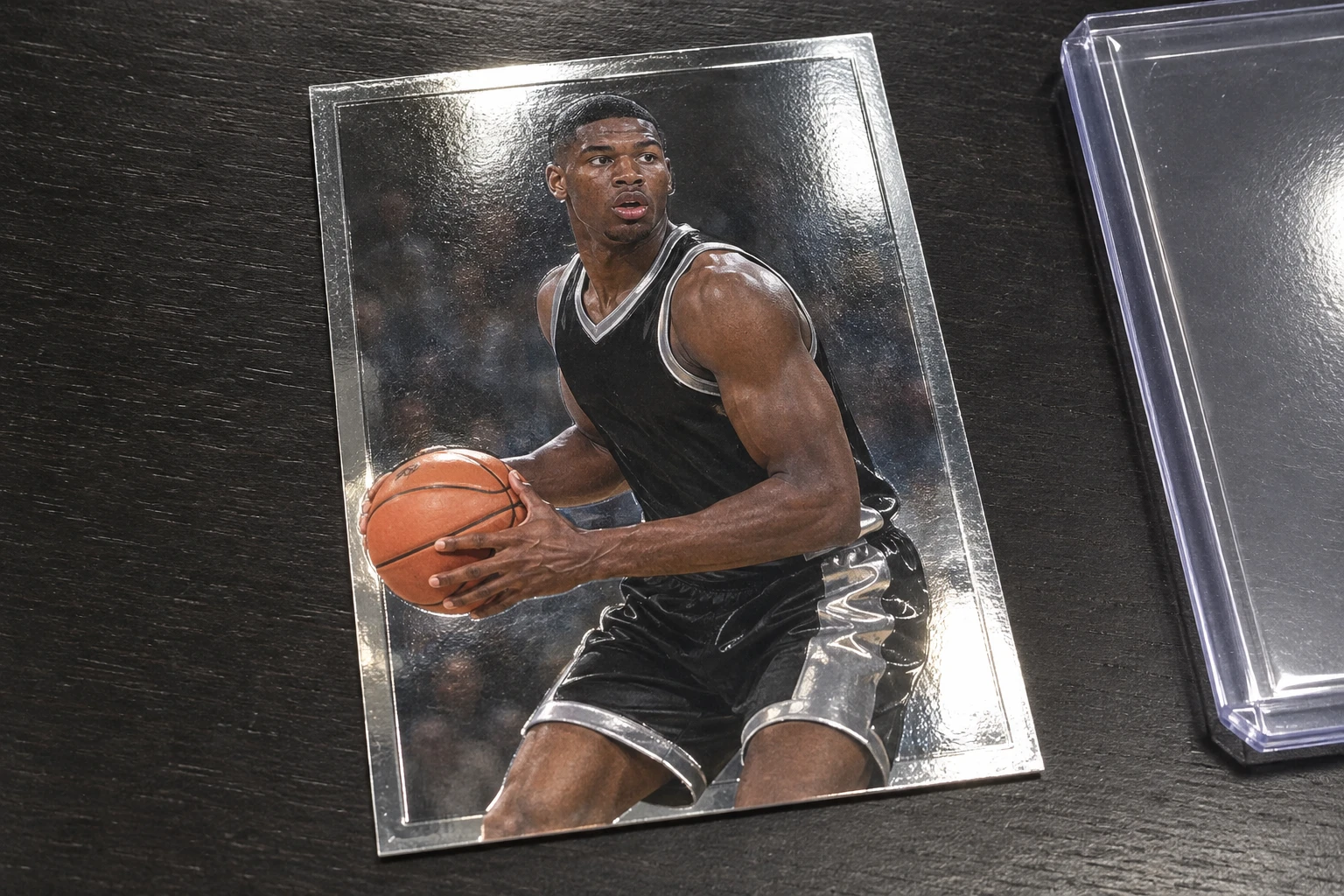
The Short Answer
- The 1997-98 Topps #115 is the cheapest Hall of Fame rookie in the series at $7 to $18 raw.
- The Topps Chrome #115 is the card that matters: $117 to $250 raw and about $830 in a PSA 10.
- Base Topps grading math is unusually favourable — a $450 gem pays for ten failed submissions.
- The 1997-98 Fleer Ultra All-Rookie insert is the best-looking cheap Duncan card at $18 to $45.
- Certified Duncan autographs run $500 to $2,000 and are much less liquid than his rookies.
- The Topps Chrome Refractor is the real grail and should be bought with four-figure care.
Why Tim Duncan's rookie is the value play of the GOAT five
Tim Duncan won five championships, three Finals MVPs and two regular-season MVPs, and his rookie card still costs less than a modern blaster. The 1997-98 Topps #115 asks $7 to $18 raw. That is not a typo and it is not a market inefficiency you can fix: the card was printed in enormous quantity at the peak of the 1990s insert boom, and Duncan was never a hobby darling.
The card that matters is the Topps Chrome #115. Chrome stock, a smaller print run and a refractor parallel made it the premium version from day one, and it asks $117 to $250 raw with a PSA 10 near $830. The gap between Topps and Topps Chrome is the entire Duncan market in one comparison.
There is also a 1997-98 Topps Chrome Refractor, which is the true grail and trades far above the base Chrome. It is scarce enough that the scan behind this article found only a handful of listings, so treat any price you see as a starting point rather than a reference.
For a collector, Duncan is the best risk-adjusted buy in the GOAT five: a five-ring Hall of Famer, a chrome rookie under $250, and a gem under $1,000. The basketball card index shows how that compares with Shaq, Kareem, Magic and Bird.
The 1997-98 season is the hinge between the junk-wax era and the modern insert market. Topps printed a huge base run, Fleer and Ultra printed mid-range sets with inserts, and Topps Chrome introduced chromium stock at a premium. Duncan was the first pick in a draft that also produced Keith Van Horn and Chauncey Billups, and the hobby treated him as a solid player rather than a phenomenon — which is exactly why his base rookie is still $15.
| Card | Raw | PSA 9 | PSA 10 | Tier |
|---|---|---|---|---|
| 1997-98 Topps #115 | $7–$18 | ~$55 | $450 | Entry |
| 1997-98 Topps Chrome #115 | $117–$250 | ~$250 | $830 | Core |
| 1997-98 Fleer #201 | $4–$8 | ~$25 | ~$60 | Budget |
| 1997-98 Fleer Ultra All-Rookie #1 | $18–$45 | ~$90 | ~$250 | Entry |
| Certified autograph | $500–$2,000 | — | — | Core |
| Topps Chrome Refractor | $1,000+ | — | — | Grail |
Graded columns are typical asks. The 1997-98 Topps Chrome Refractor is the scarce card and prices are indicative only.
1. 1997-98 Topps #115 — the affordable rookie
The base Topps rookie is the cheapest Hall of Fame rookie in this series. It asks $7 to $18 raw, and it is a genuinely good-looking card with a clean portrait and the Spurs black and silver on a white border.
Grading is rational here because the raw cost is so low: a PSA 10 asks about $450 against $15 raw, a 30x spread. The catch is that the base card has a large population, so gem rates are decent and the supply of tens is not scarce.
Check recent eBay sold prices for the 1997-98 Topps #115 →
2. 1997-98 Topps Chrome #115 — the card that matters
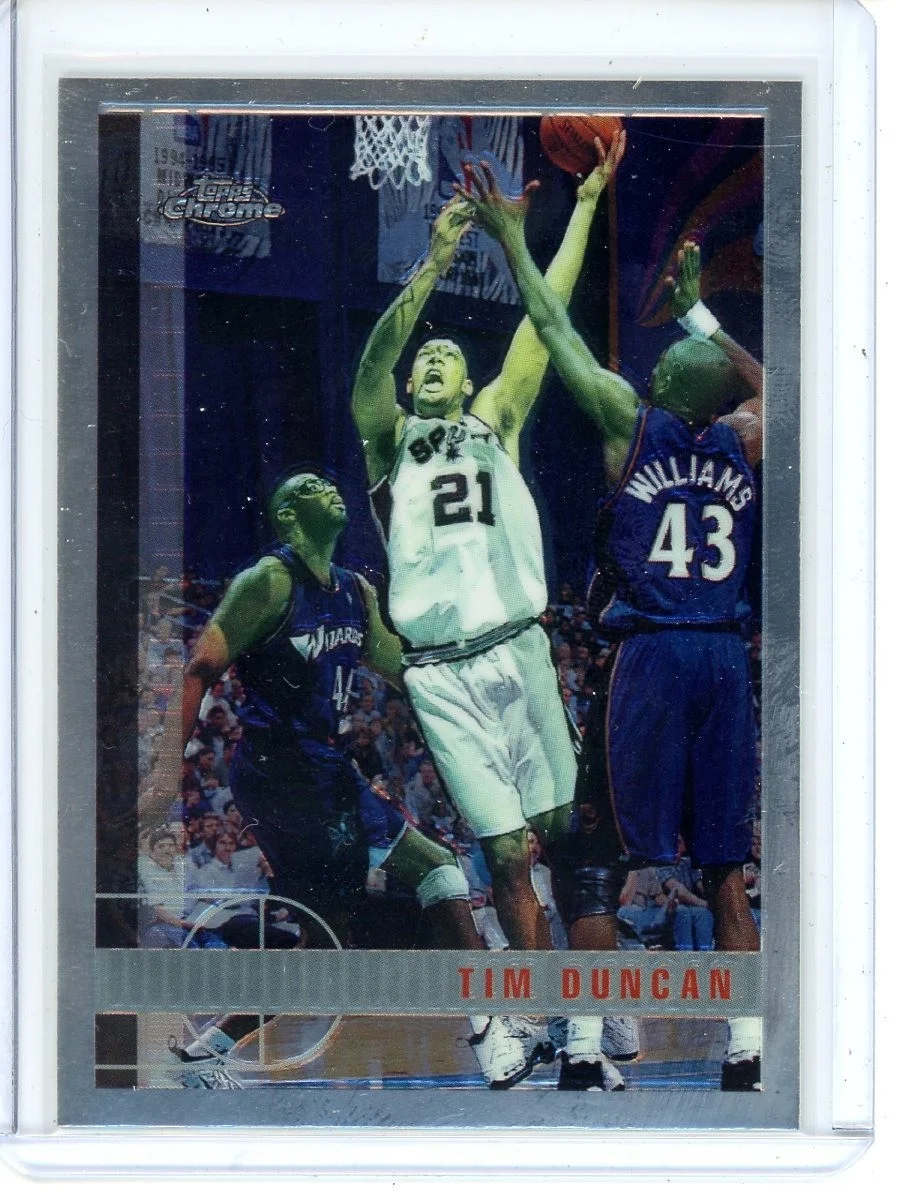
Chrome is the Duncan rookie that collectors actually chase. The chromium stock, the smaller print run and the refractor parallel made it the premium version in 1997, and the market has never stopped treating it that way.
Raw copies ask $117 to $250. PSA 9s ask about $250, and a PSA 10 asks $830. That is a real ladder for a five-ring Hall of Famer, and it is why the Chrome card rather than the base is the one to own.
Check recent eBay sold prices for the Topps Chrome #115 →
3. 1997-98 Fleer #201 — the budget rookie
Fleer's base rookie is the forgotten Duncan card. It asks $4 to $8, it is a real 1997 rookie, and it has the clean Fleer design that ages better than most of the era.
There is no grading case for it at these prices — a PSA 10 asks around $60, which is less than the cost of a submission plus shipping. Buy it for the binder.
Check recent eBay sold prices for the Fleer #201 →
4. 1997-98 Fleer Ultra All-Rookie #1 — the insert
The Ultra All-Rookie insert is the best-looking cheap Duncan card. It asks $18 to $45 raw, and the gold foil design makes it feel like a premium card even though it was an insert in a mid-range product.
PSA 9s ask about $90 and 10s near $250. At those numbers the grading math works if the copy is clean, which makes this the one Duncan card where a submission is a reasonable bet.
Check recent eBay sold prices for the Ultra All-Rookie insert →
- Mint Condition Basketball Cards — $5,000.00 on eBay →
- basketball cards — $69.72 on eBay →
- basketball cards — $350.00 on eBay →
- basketball cards — $120.00 on eBay →
Ad · Listings shown are from eBay. We may earn a commission when you buy through these eBay links. Prices and availability are set by eBay sellers and change often.
5. Certified autographs — the expensive Duncan card
Duncan does not sign often, and his certified autographs reflect it. Licensed autos ask $500 to $2,000, with low-numbered Panini and Topps cards at the top and sticker autos at the bottom.
The market is thin enough that a single sale can move the reference. If you want one, buy the card you like rather than the cheapest listing, because liquidity is worse than the rookie market.
Check recent eBay sold prices for certified Duncan autographs →
6. 1997-98 Topps Chrome #115 PSA 10 — the $830 grail
The Chrome gem is the card that ends this ladder. At about $830 it is the cheapest PSA 10 rookie of a five-ring Hall of Famer in the sport, and the population is small enough that supply does not compress the price.
The arbitrage is real but slow: a raw Chrome at $200 plus a $30 submission returns a 10 maybe one time in four, so the expected cost of a gem is roughly $900 — which is why buying the 10 at $830 is usually cheaper than chasing it.
Check recent eBay sold prices for the Chrome PSA 10 →
How to grade Duncan rookies without wasting money
Duncan is the one GOAT in this series where grading the base card makes sense. At $15 raw and $28 all-in per submission, a 10 at $450 pays for ten failed attempts, and a 9 at $55 covers the fee. The math only fails if the copy is visibly off-centre.
For Chrome, the opposite is true. A raw Chrome at $200 plus a submission is $230 with a one-in-four gem rate, so the expected cost of a gem is close to the market price. Buy the 10 or buy a 9; do not chase.
The refractor is a different market entirely and should be bought with the same care as any four-figure card: photos outside the holder, cert check, and a return policy. The vintage grading guide covers the condition standards, and the 2026-27 rookie guide shows what the current class looks like by comparison.
The base and Chrome markets behave differently enough that they should be treated as separate collections. Base Topps is a volume market: cheap cards, high populations, modest gem premiums, and a grading decision that is mostly about how many copies you can inspect. Chrome is a scarcity market: fewer copies, higher prices per card, and a gem premium that rewards buying the holder rather than submitting.
For the refractor, slow down. It is a four-figure card with a thin market, and the difference between a clean example and a scratched one is most of the value. Ask for photos outside the holder, verify the cert number, confirm the refractor designation on the label, and pay through a channel with a return policy. A 1997-98 Topps Chrome Refractor should never be an impulse buy from a listing with two blurry photos.
Storage decides the grade on Chrome more than anything else. Chromium stock is sensitive to humidity and to pressure, and cards stored in tight stacks for twenty-five years often show surface impressions that only appear under raking light. When you buy a raw Chrome rookie, ask for photos at an angle, and when you store one, use a rigid holder rather than a soft sleeve in a crowded box.
- Check centering on the white border; 60/40 or better is the bar.
- Inspect the Chrome surface under raking light for print lines and scratches.
- Confirm the card is Topps or Topps Chrome — the logos and stock are different and so are the prices.
- For the refractor, ask for photos outside the holder and verify the cert number.
- Compare the ask against PSA 9 money before submitting; the 9 is the realistic outcome.
Duncan's base rookie is the cheapest card in this series to experiment with. Run a photo through the AI pre-grade first, and check current pricing so the math is complete.
Run a free AI pre-grade on your card →
Watch and learn
A PWCC auction listing of a 1997 Topps Chrome Refractor Tim Duncan rookie in a PSA 10 holder — the scarce version of the card this guide is built around.
Video: 1997 Topps Chrome Refractor Tim Duncan ROOKIE #115 PSA 10 GEM MINT — PWCC Premier Auction on YouTube


Ad · Listings shown are from eBay. We may earn a commission when you buy through these eBay links. Prices and availability are set by eBay sellers and change often.
Frequently Asked Questions
What is a Tim Duncan rookie card worth in 2026?
Which Tim Duncan rookie card should I buy?
Is the Topps Chrome Refractor the grail?
Should I grade a base Topps Duncan rookie?
Why is Duncan cheaper than Shaq or Kareem?
Are Tim Duncan autographs a good buy?
What is the 1997-98 Fleer Ultra All-Rookie card?
How hard is the Chrome rookie to grade?
Does the 2026-27 Topps Chrome release affect Duncan prices?
Is the 1997-98 Topps Chrome Refractor rare?
Are there reprints of the 1997-98 Topps Duncan rookie?
Sources & Further Reading
- eBay sold listings — 1997-98 Topps Tim Duncan 115 rookie
- Basketball-Reference — Tim Duncan career stats
- PSA CardFacts — population reports
- CardLadder — basketball market data
- Topps — 2026-27 Flagship Basketball
- PSA — 1997-98 Topps Basketball set registry
Create a free account and get 2 free credits. No credit card required.
Get Your Free Credits →