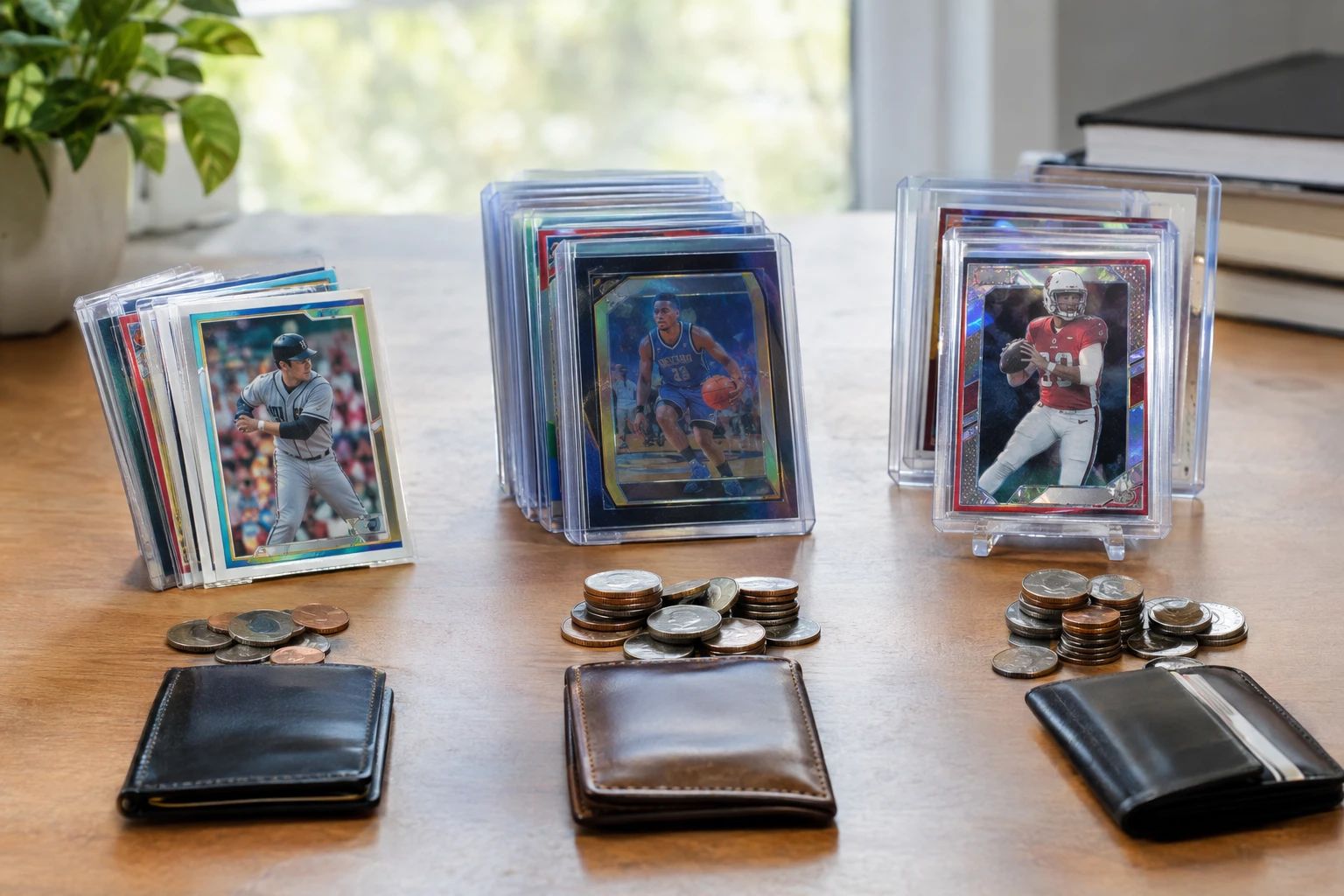
The Short Answer
- $25/month gets you started — 5-10 targeted singles or one retail blaster box per month.
- Buy singles, not packs — if you want a specific card, buying it directly is almost always cheaper than chasing it through packs.
- $100/month is the sweet spot — enough for a hobby box or 10-20 targeted singles, plus grading prep.
- Local card shops are the best place to start — walk in, tell them you are new, and most will spend 20 minutes teaching you.
- Pre-screening saves money — use AI pre-grading to avoid wasting $80 grading fees on cards that will not gem.
- Set a monthly budget and stick to it — packs are designed to make you open "just one more." Decide before you shop.
- Pokemon is the cheapest entry point — starter decks at $12-20, singles under $5, and the largest collector community.
Why Budget Matters in Card Collecting
Card collecting is one of the most accessible hobbies in the world. You can start with $5 and a trip to Target. But it is also a hobby designed to make you spend more. Packs are engineered to trigger "just one more" impulses. New sets release every month. Chase cards are advertised across social media. Without a budget, it is easy to spend hundreds of dollars before you realize it.
The single most important advice for new collectors: decide on a monthly amount before you shop and stick to it. Treat it as fun money you are happy to part with. $25/month gets you a real start. $50/month builds a focused collection. $100/month is the sweet spot where you can participate in the hobby meaningfully — buying singles, opening the occasional hobby box, and starting to grade cards.
This guide breaks down exactly what each budget tier buys across sports cards, Pokemon, and MTG. It covers the singles-vs-packs math, where to buy at each budget level, how to build toward grading, and a 12-month roadmap that works for any budget.
Tier 1: $25/Month — Casual Collector
At $25/month, you are a casual collector. This is a perfectly valid way to enjoy the hobby — you just need to be strategic about what you buy.
What $25 Buys
- Pokemon: 1-2 booster packs ($4-6 each) or 5-10 singles under $5 each
- MTG: 2-3 booster packs or a precon Commander deck every 2 months
- Sports cards: One retail blaster box ($20-25) or 5-10 targeted base rookie singles on eBay
Strategy at This Tier
Buy singles, not packs. At $25/month, you cannot afford to gamble on pack pulls. If there is a specific card you want, buy it directly from eBay or TCGPlayer. A $5 Charizard single is worth more to your collection than 5 random packs that will likely contain commons.
If you enjoy the thrill of opening packs, allocate $10 for one pack per month and $15 for singles. This gives you the excitement of ripping packs while still building a focused collection.
What to Avoid
- Do not chase expensive chase cards — they are out of reach at this budget
- Do not buy "investment" sealed product — you do not have enough capital to diversify
- Do not buy from Instagram or Facebook sellers with no reputation
- Do not buy anything advertised as "guaranteed profit" or "investment opportunity"
Tier 2: $50/Month — Building a Foundation
At $50/month, you can start building a focused collection. This is where most collectors spend their first year or two — enough to buy meaningful cards and participate in the hobby without financial stress.
What $50 Buys
- Pokemon: 1-2 hobby packs from a local card shop or 10-20 singles under $5 each
- MTG: A Commander precon deck ($40) plus a few packs, or 10-15 singles for a specific deck
- Sports cards: A hobby pack or two from your LCS, or 10-20 targeted rookie singles
Strategy at This Tier
Pick one or two players (sports) or characters (Pokemon) and focus on building a collection of their cards. A focused player collection is more satisfying and potentially more valuable than a random assortment of cards from different sets. Buy their base rookies raw, stack them, and learn about condition by examining them.
Start learning about grading. Buy a 10x jeweler's loupe ($10 on Amazon) and examine your cards. Learn to identify centering, corner wear, and surface defects. Use PreGradeCards AI to scan your best cards and get predicted grades — this teaches you what graders look for without spending grading fees.
Supplies to Buy
Invest $15 in basic supplies: a pack of penny sleeves ($3), a pack of semi-rigid holders ($8), and a basic binder with pages ($15). Protecting your cards from day one preserves their condition and their potential grading value. See our card sleeve guide for specific recommendations.
Tier 3: $100/Month — The Sweet Spot
$100/month is the sweet spot for card collecting. At this budget, you can participate in the hobby meaningfully — buying singles, opening hobby boxes, starting to grade cards, and building a collection that could appreciate over time.
What $100 Buys
- Pokemon: One hobby box every month or two ($90-120), plus singles to fill set gaps
- MTG: A Set Booster Box ($120 every 5-6 weeks) or 20-30 targeted singles
- Sports cards: One hobby box every month or two, or 15-30 targeted rookie singles, or 2-3 graded slabs under $50
Strategy at This Tier
Split your budget: 60% singles, 30% packs/boxes, 10% grading. This gives you the fun of opening packs while building a focused collection through singles. The 10% grading allocation ($10/month) means you can submit one card to CGC Economy ($20) every two months — enough to start building a graded collection.
Before submitting for grading, always pre-screen with PreGradeCards AI. At $2 per pre-grade, it saves you from wasting $20-80 grading fees on cards that will grade below 9. See our grading ROI guide for the break-even math.
Start Tracking Your Collection
At $100/month, your collection is worth tracking. Use a collection tracker app to log your cards, track values, and monitor your portfolio. This is also essential for tax purposes if you ever sell — see our trading card tax guide.
Tier 4: $250/Month — Serious Collector
At $250/month, you are a serious collector. You can build a meaningful collection, grade regularly, and participate in the investment side of the hobby.
What $250 Buys
- Pokemon: 2-3 hobby boxes per month, or 1 hobby box + 10-20 singles + 1-2 grading submissions
- MTG: A Set Booster Box + 20-30 singles, or 1-2 high-end singles ($100+)
- Sports cards: 1-2 hobby boxes + 10-20 singles, or 1-2 graded PSA 9-10 rookie cards
Strategy at This Tier
Allocate: 40% singles, 30% sealed/boxes, 15% grading, 10% sealed product investment, 5% supplies. At $250/month, you can start holding sealed product as a long-term investment — buy one booster box of a strong set at retail and hold it. See our sealed product investment guide for which sets to target.
Join the PSA Collectors Club ($99/year) for access to Value Bulk pricing ($24.99/card) and a Card Ladder subscription. This pays for itself quickly if you grade regularly.
Tier 5: $500+/Month — Investor Tier
At $500+/month, you are in the investor tier. You can build a portfolio of graded cards, sealed product, and high-value singles that could appreciate significantly over time.
What $500 Buys
- Pokemon: 4-5 hobby boxes, or 1-2 high-end graded slabs ($200-500), or a sealed booster box for investment
- MTG: High-end singles like dual lands or Reserved List cards, or sealed booster boxes
- Sports cards: High-end graded rookie cards (PSA 9-10), or 2-3 hobby boxes, or sealed hobby boxes for investment
Strategy at This Tier
Diversify across three buckets: graded slabs (50%), sealed product investment (30%), and raw singles for flipping/grading (20%). Track your portfolio with Card Ladder. Keep detailed records for tax purposes — at this spending level, you are likely a business seller, not a hobbyist. See our tax guide to understand the difference.
Consider insurance for your collection. At $500/month spending, your collection is likely worth $10,000+ within a year. Standard homeowner's insurance will not cover it adequately. See our graded card insurance guide for specialized collectibles insurance options.
Singles vs Packs: The Math
This is the advice every experienced collector gives and every new collector ignores: if you want a specific card, buy it as a single. Buying packs to chase one specific card is almost always more expensive than just buying the card directly.
Here is the math. A Pokemon booster pack costs $5 and contains 10 cards. The chance of pulling a specific Ultra Rare is roughly 1 in 30 packs (varies by set). So the expected cost of pulling that card from packs is $150. The same card as a single on TCGPlayer costs $20-$40. You would need to get extremely lucky to pull it cheaper from packs than buying it directly.
But packs are not just about chasing specific cards — they are about the experience. Opening packs is fun. The thrill of pulling a chase card is a legitimate part of the hobby. Just know which one you are doing: if you are buying packs for the experience, enjoy it. If you are buying packs to get a specific card, buy the single instead.
A good compromise: allocate 20-30% of your budget to packs (for fun) and 70-80% to singles (for building your collection). This gives you the best of both worlds without wasting money.
Where to Buy at Each Budget
Local Card Shops (All Budgets)
The best place to start. Walk in, tell them you are new, and most shop owners will spend 20 minutes teaching you what to buy and what to avoid. You will pay a slight premium over online prices, but you get to see the product, handle the cards, and learn from someone who does this every day.
eBay (All Budgets)
The largest secondary market for singles and sealed product. Use the "Sold Items" filter to see what cards actually sell for, not what sellers hope to get. The gap between listed price and sold price is enormous. eBay charges sellers about 13% in fees, which gets baked into prices.
TCGPlayer ($25-$250 Budgets)
The standard marketplace for TCG singles (Pokemon, MTG, Yu-Gi-Oh!). Verified sellers, market prices, and a cart system that lets you combine shipping. Best for buying singles under $50.
COMC ($100+ Budgets)
Consignment platform with millions of cards. Prices tend to be competitive. You can build a cart over time and combine shipping. Good for picking up base rookies and mid-range singles without overpaying.
Card Shows ($50+ Budgets)
The best deals in the hobby happen face-to-face. Sellers at shows do not pay platform fees, and that savings gets passed to you. Bring cash. Know your prices from eBay sold comps beforehand. Negotiate politely — most vendors will come down 10-20% from sticker, especially later in the day.
Whatnot ($50+ Budgets)
Live auction platform for card breaks and singles. Growing rapidly in 2024-26. Fun and interactive, but set a spending limit before you join a stream — the live auction format is designed to create urgency.
What to Avoid
- Instagram sellers with no reputation
- Facebook Marketplace listings that seem too cheap
- Any "investment group" that charges a membership fee to tell you what cards to buy
- Anyone who guarantees returns on sports cards — they are lying
Building Toward Grading on a Budget
Grading is not just for wealthy collectors. You can build toward grading at any budget level — you just need to be selective about which cards you submit. Here is how:
At $25-50/month
Focus on learning. Buy a 10x loupe ($10) and examine your best cards. Use PreGradeCards AI for free or low-cost pre-grading. Do not submit anything yet — save your money for building your collection. Learn what makes a card grade PSA 10 vs PSA 9 by reading our condition guide.
At $100/month
Start submitting. CGC Economy at $20/card (90-day turnaround) is the most affordable grading option. Submit one card every 2-3 months. Always pre-screen with AI first — do not waste $20 on a card that will grade PSA 6. Target cards worth $50+ raw that have strong PSA 10 multipliers.
At $250/month
Join the PSA Collectors Club ($99/year) for Value Bulk pricing ($24.99/card). Submit 2-3 cards per month. Start building a graded collection. Track your grading hit rate — if you are getting less than 50% PSA 10, tighten your pre-screening standards.
At $500+/month
Submit regularly at the appropriate tier for each card's value. Use PSA for high-value sports and TCG, CGC for mid-value TCG, SGC for vintage sports. Keep a spreadsheet of submissions, predicted grades, and actual grades to calibrate your pre-screening over time. See our 2026 grading survival guide for current pricing and turnaround times.
12-Month Roadmap for Any Budget
Here is a practical 12-month plan that works at any budget level. Adjust the spending amounts to match your tier:
Months 1-3: Learn and Focus
- Pick one game (Pokemon, MTG, or sports) and one focus (player, character, or set)
- Buy singles only — no packs yet
- Buy a 10x loupe and learn to evaluate card condition
- Visit your local card shop and introduce yourself
- Download a collection tracker app
Months 4-6: Build and Protect
- Start buying 1-2 packs per month for fun (20% of budget)
- Upgrade to premium sleeves (Dragon Shield or Ultra Pro matte)
- Use PreGradeCards AI to scan your best cards and get predicted grades
- Identify 3-5 cards that are grading candidates (predicted PSA 9+)
- Start tracking your collection's total value
Months 7-9: Grade and Engage
- Submit your first card for grading (CGC Economy at $20 if on a budget)
- Attend a local card show — bring cash and know your comps
- Join Reddit communities (r/PokemonTCG, r/MTG, r/sportscards)
- Start reading about sealed product investment if interested
- Reassess your budget — are you comfortable spending more? Less?
Months 10-12: Evaluate and Plan
- Review your collection — what do you have? What is it worth?
- Identify gaps in your collection and set goals for year 2
- If you have graded cards, check their current values on Card Ladder or eBay
- Consider insurance if your collection is worth $5,000+
- Plan your year-2 budget and collecting goals
The hobby is a marathon, not a sprint. The collectors who enjoy it most are the ones who set a budget, focus on what they love, and resist the urge to chase every new release. Whether you spend $25 or $500 per month, the key is consistency and focus. Build a collection you are proud of, protect it well, and enjoy the journey.
Frequently Asked Questions
How much money do I need to start collecting trading cards?
Should I buy singles or booster packs?
When should I start grading my cards?
What is the best budget for card collecting?
Where should I buy trading cards as a beginner?
Is card collecting a good investment?
Sources & Further Reading
- How to Start Collecting Sports Cards 2026 | Nerdbeak
- How to Start Collecting Trading Cards 2026 | ORB Sports Cards
- Beginner Guide to Collecting Trading Cards | iCollectEverything
- Trading Cards 101 Guide | Role-Players
Marcus Chen has evaluated over 50,000 sports cards and TCG cards across PSA, BGS, SGC, and CGC standards. Before joining PreGradeCards, he worked as a submission specialist for a major grading company and trained collectors and dealers on condition assessment.
Create a free account and get 2 free credits — enough for 2 complete AI gradings with market pricing. No credit card required.
Sign Up Free →