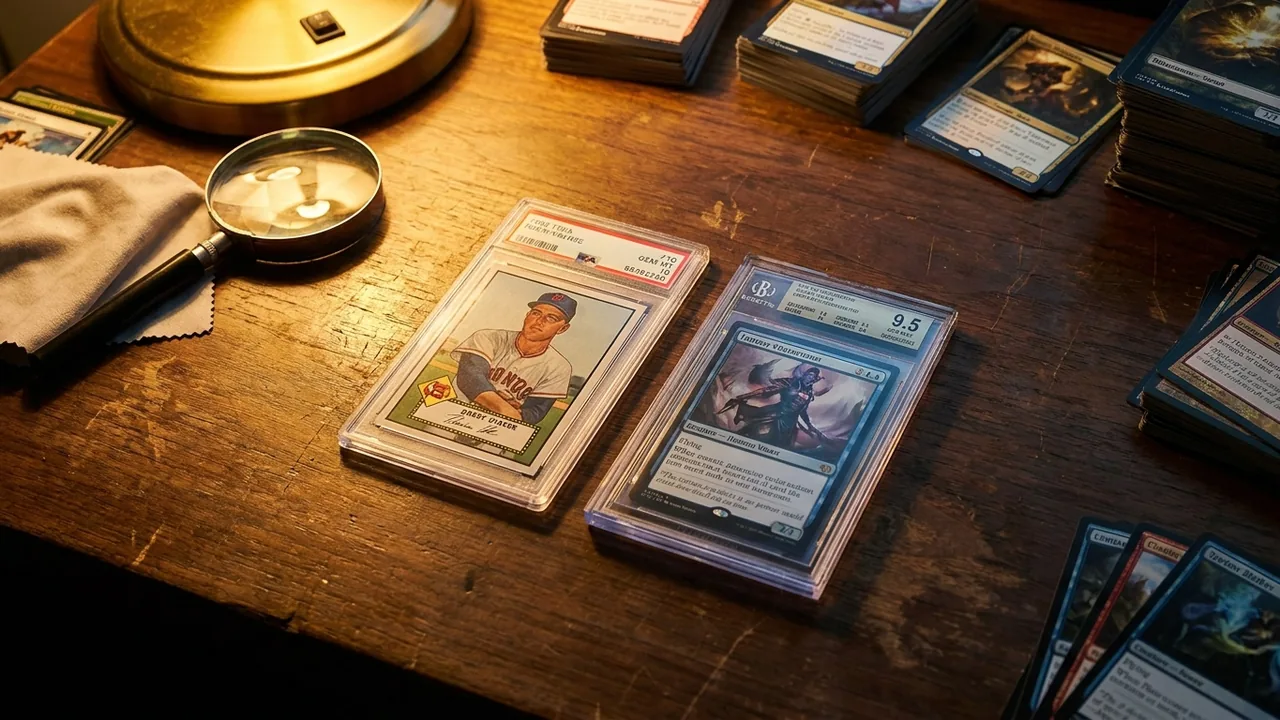
The Short Answer
- PSA Crossover evaluates your card in its CGC holder — you set a minimum grade; PSA only re-holders it if it earns that grade or higher, otherwise it comes back in the original slab.
- Crossover fees match the grading tier for the card's declared value — you pay the fee whether it crosses or not.
- CGC Pristine 10 and Gem Mint 10 are not the same bar. Pristine 10s cross to PSA 10 far more often than Gem Mint 10s, which frequently land at PSA 9.
- The PSA premium is the whole point: PSA 10s regularly sell for 1.5–3× the same card in a CGC 10 holder — the spread must exceed the crossover cost plus failure risk.
- Set your minimum grade honestly. A minimum of 10 protects you from a downgraded slab but wastes the fee if it misses; a minimum of 9 captures more outcomes but can lock in a worse sale price than the CGC 10 carried.
- Never crack a CGC slab to submit raw unless the grade inside is irrelevant to value — crossing in-holder preserves the floor if PSA declines.
How PSA's Crossover Service Actually Works
Crossover is PSA's service for cards already graded by another company — CGC, BGS, SGC, TAG, anyone. The card stays in its existing slab. PSA's graders evaluate it through the holder, and your submission specifies a minimum grade — the lowest PSA grade you'll accept.
Two outcomes:
- PSA's grade meets your minimum: they crack the card out of the CGC holder, re-slab it in a PSA holder at the new grade, and return it. You now own a PSA slab.
- PSA's grade falls below your minimum: the card comes back untouched in its original CGC slab — but you still paid the crossover fee. That's the cost of the option.
The in-holder evaluation matters more than people realize. PSA graders can't fully inspect surface texture or back edges the way they can with a loose card — the slab walls, the inner sleeve, even the CGC label itself restrict the view. That's the structural reason crossovers underperform raw submissions on the same card: PSA is grading with one hand tied behind its back, and borderline calls tend to fall toward caution.
Crossover vs crack-and-submit
The alternative — cracking the slab yourself and submitting the raw card — gives graders a cleaner look but destroys your safety net. A CGC Gem Mint 10 cracked and sent raw comes back whatever PSA says it is: could be a 10, could be an 8 you can never reassemble into the old holder. Crossing in-holder keeps the CGC 10 floor intact on failure. The tradeoff is a lower ceiling on PSA's evaluation. For most valuable slabs, protecting the floor is worth more than chasing the marginally better look.
CGC's Grading Scale Is Not PSA's Scale
The single biggest crossover mistake is treating "CGC 10" as one thing. Since CSG folded into CGC, the card scale has had two distinct 10s:
| CGC grade | What it means | PSA translation (typical) |
|---|---|---|
| CGC Pristine 10 | Top of scale — virtually flawless, sub-grades available | Strong PSA 10 candidate; some land 9 |
| CGC Gem Mint 10 | Near-perfect with allowance for a minor flaw | Crosses to PSA 9 most often; 10 on true gems |
| CGC 9.5 and below | Mint+ with visible tolerance | Usually PSA 8–9 territory |
The calibration gap is real and it's why CGC 10 slabs carry a market discount: the hobby knows a meaningful share of CGC Gem Mint 10s are PSA 9s in a different holder. Pristine 10 is the grade that maps most cleanly — it was designed to be the "better than gem mint" tier, so a Pristine 10 that legitimately earned it has a fighting chance at PSA 10.
Neither company publishes a grade-mapping table, so treat any claimed conversion rate as community folklore. The honest framing: Pristine 10s cross up more often; Gem Mint 10s cross down more often; and the in-holder handicap trims both.
What the Real Conversion Odds Look Like
PSA doesn't publish crossover success rates, and anyone quoting you a precise percentage is extrapolating from forum threads and dealer anecdotes. What the community record consistently shows across thousands of reported attempts:
- CGC Pristine 10 → PSA 10: the best-case bucket — reported success commonly lands around half to two-thirds of attempts on strong submissions, with most misses returning PSA 9. Modern ultra-clean cards (recent prints with verified 50/50-ish centering) sit at the top of that range; older stock with hidden surface issues drags it down.
- CGC Gem Mint 10 → PSA 10: materially worse — expect the majority of attempts to come back in the CGC holder (if you set min 10) or re-slab as PSA 9 (if you set min 9). Gem Mint 10's tolerance band overlaps PSA 9.
- In-holder penalty: a card that would grade 10 raw can still fail a crossover — graders working through a case will decline marginal calls. Expect crossover success to run below raw-submission success for equivalent copies.
The distribution, not the average, is what matters for your decision: a pile of CGC Gem Mint 10s indiscriminately crossed at min-10 mostly converts fees into returned slabs. A curated set of Pristine 10s — verified centering, clean surfaces — crosses well enough that the economics can work.
What a Crossover Actually Costs
Crossover is billed as a grading service at the tier matching the card's declared value — the same schedule as a normal submission. At 2026 pricing, that means Standard at $59.99 (90–100 business days, $1,000 max insured) as the realistic entry point while the Value tiers stay paused, stepping up to Priority ($79.99) and beyond as declared value climbs. Add shipping both ways and, critically, the fee is collected whether the card crosses or not.
So the true cost per attempt is fee + shipping — roughly $70–90 all-in for the open tiers — and the "cost" of a failed attempt is that full amount plus however long the card spent in transit. This is why crossover economics only work on cards where the PSA-equivalent premium is measured in hundreds, not tens, of dollars.
The upcharge wrinkle
If your card crosses into a value above the tier's insured maximum, PSA upcharges the difference — declared value matters twice: once for the tier you choose, once for the value it crosses into. A CGC Pristine 10 of a $600 card can cross into a $2,000 PSA 10 and trigger a higher-tier charge. Budget for the upside scenario, not just the fee.
The Value Math: When Crossing Pays
The crossover decision reduces to one inequality:
(PSA-grade price − CGC-holder price) × P(crossing at your minimum) > crossover cost + shipping + time
Worked example — modern TCG chase card:
| Scenario | Value |
|---|---|
| CGC Pristine 10 market price | $220 |
| Same card, PSA 10 | $480 |
| Same card, PSA 9 | $180 |
| Crossover all-in cost (min 10) | ~$75 |
At a ~60% success rate, expected value: 0.6 × $480 + 0.4 × $220 − $75 ≈ $301 vs $220 held — positive EV. At a 25% success rate it flips negative: 0.25 × $480 + 0.75 × $220 − $75 ≈ $210. The break-even probability here is ~29% — so the entire decision rides on how honestly you can assess this specific copy's odds, which is where most people go wrong. Optimism about your own card is the hidden cost nobody lists.
The flip side: if PSA 9 on failure is worth less than the CGC 10 slab is (as in this example — $180 vs $220), never set the minimum below 10 unless a 9 was your target all along.
Minimum-Grade Strategy: The Part Everyone Gets Wrong
Your minimum grade is an option contract you're writing on your own card. Three profiles:
- Minimum 10 — the purist. Only a gem result triggers the crack. Right answer when the CGC 10 holder retains meaningful value (it does for most chase cards) and only PSA 10 unlocks the premium you want. Most failures come back intact; you've paid ~$75 for information.
- Minimum 9 — the trap most people set. "I'd take a 9" sounds reasonable until you price it: PSA 9 frequently sells below the CGC 10 you surrendered. You're paying a fee to voluntarily downgrade the holder — a negative-payoff lottery ticket. Only set 9 when PSA 9 comps actually beat CGC 10 comps (common on vintage icons where the PSA brand premium dominates).
- Minimum equals current grade minus one (e.g., 9.5 slabs → min 9): for CGC 9.5 holders this is almost always wrong for modern cards — the CGC 9.5 → PSA 9 cross rarely moves value enough to cover the fee. Reserve it for vintage where any PSA holder beats the alternative holder on liquidity.
One more mechanical check before you submit: look up the pop report in both companies for the exact card/variant. A CGC Pristine 10 with a pop of 3 that becomes a PSA 10 with pop 1 jumps differently than one joining a pop-400 crowd. Population context sets the premium, and the premium is the entire reason to cross.
TCG Slabs vs Sports Slabs: Different Crossover Economics
The crossover calculus isn't uniform across categories. In TCG — Pokémon especially — the CGC-to-PSA premium is dramatic because the buyer pool is global and PSA is the default registry language. Japanese promos, alt-arts, and modern chase cards in CGC 10 regularly trade at 40–60% of their PSA 10 equivalents, which is exactly the spread where crossover math can survive a coin-flip success rate.
Sports slabs behave differently. Vintage sports (pre-1980) actually crosses well for a different reason: there, the PSA brand premium dominates at every grade — a PSA 6 of a '52 Mantle out-liquids a CGC 6 by enough that even a min-grade-that-matches cross can pay. Modern sports chromium is the worst crossover candidate: centering variance means Gem Mint 10s are plentiful, the PSA 10/9 price cliff is brutal, and a failed cross just burns the fee on a card that was already marginal.
Rule of thumb by segment: vintage icons cross at conservative minimums (PSA brand premium pays the fee), TCG chases cross at min-10 on verified-clean copies only, and modern sports cards almost never justify the attempt — sell the CGC slab or wait for the card to appreciate into a bigger spread.
Cross, Sell, or Hold: The Decision Framework
Cross it when all four are true: the card is a CGC Pristine 10 (or a Gem Mint 10 you've verified passes centering/surface at PSA 10 standards), the PSA 10 premium exceeds ~3× the all-in crossover cost, a PSA 9 wouldn't be a disaster in your plan, and the card's PSA pop supports the premium.
Sell the CGC slab when the premium spread is thin — on modern cards where PSA 10 sells for only 1.3–1.5× the CGC 10, the crossover EV math almost never survives shipping and failure rates. Take the certain $220 over the maybe-$480.
Hold raw — i.e., don't create the CGC slab in the first place — if the endgame is a PSA holder. This is the part that stings: with PSA's Value tiers paused through the backlog, CGC has been the only fully-open major grader, so collectors have been building CGC slabs that were always destined to be crossed later. If you know a card's final form is a PSA holder, grading it at CGC first is paying twice for one destination — pre-grade it, hold it raw, and submit when the right PSA tier reopens or value justifies the open tiers.
Before you cross anything, run the card through an AI pre-grade — an independent read on whether the copy clears PSA 10 standards is the cheapest filter in this whole decision. The grade calculator then runs the exact break-even math above with your card's real comps.
Frequently Asked Questions
How does PSA crossover grading work?
You submit a card still sealed in another company's slab and specify a minimum grade. PSA evaluates it in the holder — if it earns your minimum or better, PSA re-slabs it at that grade; if not, it returns in the original holder. You pay the grading fee either way.
What are the odds a CGC 10 crosses to PSA 10?
PSA doesn't publish conversion rates. Community reports consistently show CGC Pristine 10s cross to PSA 10 on roughly half to two-thirds of strong submissions, while CGC Gem Mint 10s more often land PSA 9 or return unchanged. In-holder evaluation lowers success versus submitting the same card raw.
How much does a CGC to PSA crossover cost?
The crossover is billed at the grading tier matching the card's declared value — realistically ~$60/card at PSA's Standard tier (Value tiers remain paused) plus shipping, so ~$70–90 all-in. The fee applies whether the card crosses or not.
Is CGC Pristine 10 the same as PSA 10?
No. CGC Pristine 10 is CGC's top grade, designed to be stricter than their Gem Mint 10. It maps closest to PSA 10 but is not equivalent — a real share of Pristine 10s grade PSA 9 on crossover, and PSA 10 versions of the same card still sell for a premium over CGC Pristine 10 slabs.
Should I crack my CGC slab and submit raw instead?
Usually no. Cracking forfeits the CGC grade — if PSA returns an 8, you can't un-crack it. Crossover preserves the CGC-holder value on a miss. Crack-and-submit only makes sense when the original grade adds no value (a CGC 8 on a card where only a 10 matters).
What minimum grade should I set on a crossover?
Set it at the grade whose comps actually exceed what your current slab sells for. For most CGC 10 → PSA attempts that's min-10 — PSA 9 versions of modern cards often sell below the CGC 10 slab, so accepting a 9 means paying a fee to lose value.
Sources & Further Reading
Marcus Chen has evaluated over 50,000 sports cards and TCG cards across PSA, BGS, SGC, and CGC standards. Before joining PreGradeCards, he worked as a submission specialist for a major grading company and trained collectors and dealers on condition assessment.
With submission floors rising, pre-screening is no longer optional. Use our AI Pre-Grade Calculator to score a card's PSA 10 odds before you pay, and the Submission Planner to pick the right tier.