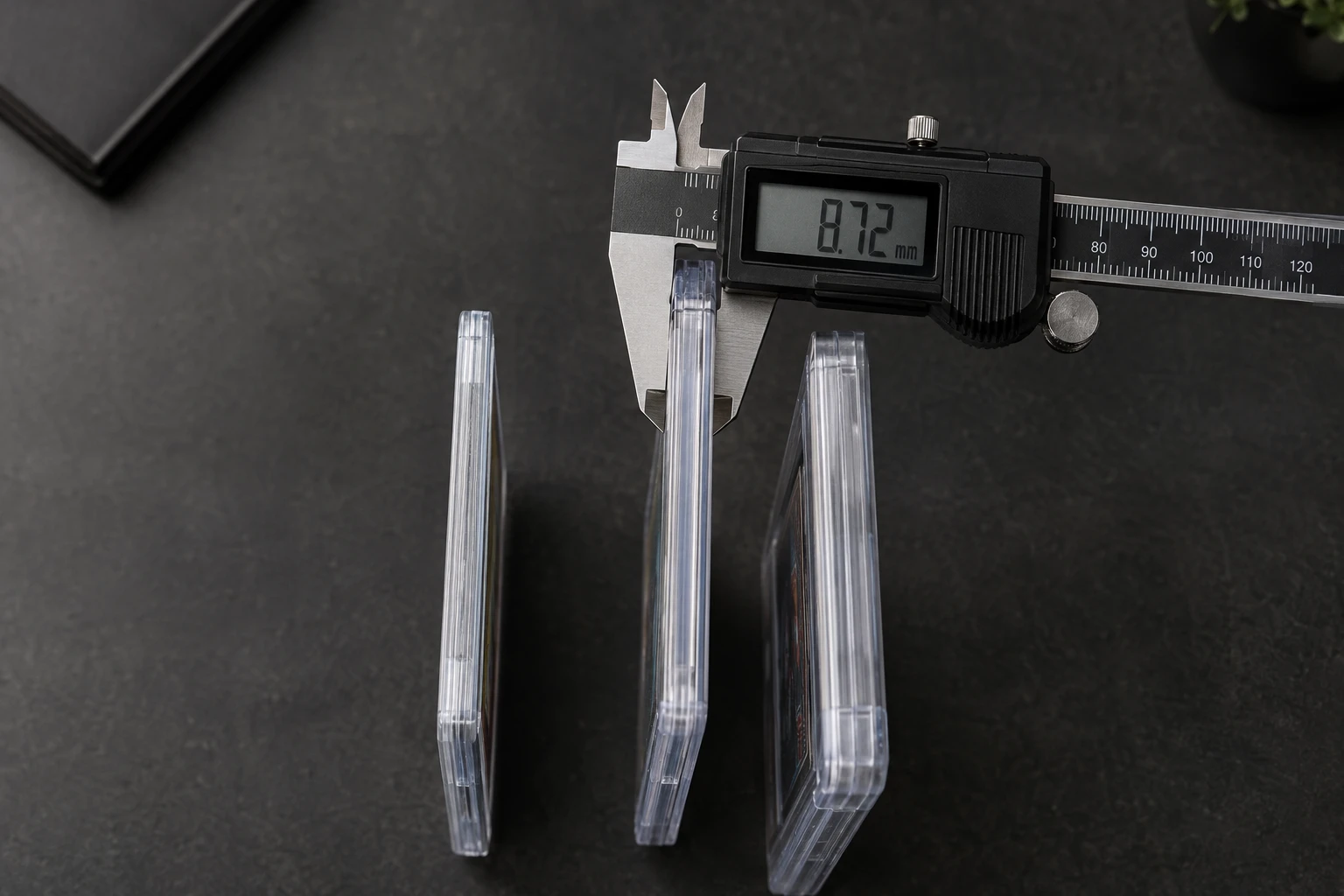
The Short Answer
- A standard PSA slab measures about 135.75 x 80.25 x 6.25 mm in independent caliper tests — not the 2.5 x 3.5 inch card size.
- BGS is shorter but thicker (about 130.75 x 83 x 8.5 mm); SGC has the largest standard footprint (about 138.5 x 86.25 x 8.5 mm); CGC and TAG sit close to PSA.
- Only CGC and TAG publish a holder footprint. PSA publishes the largest card each holder accepts, and BGS and SGC publish no outside size at all.
- A 12-inch storage row holds about 55 PSA slabs, 47 TAG, 43 CGC, 42 SGC and 38 BGS slabs once nested.
- Thick and tallboy holders are different sizes — PSA thick is about 10.25 mm deep, CGC thick about 12.5 mm, and CGC tallboy about 195 mm tall.
- A slot that takes every measured standard holder needs roughly 195 x 115 x 12.5 mm of internal space; add about 0.5 mm of clearance for a printed or cut fit.
- Slabs are rigid, so they ship as parcels, not letters — weight and thickness matter more than card count.
Graded slab dimensions: the quick answer
If you are buying a case, cutting foam or printing a holder, start with the outside dimensions of the bare slab. The table below uses independent caliper measurements published by accessory makers in 2026. Treat them as a starting spec, not a manufacturing guarantee: holder generations vary by a few tenths of a millimetre.
| Grader | Height | Width | Thickness | Inches (H x W x T) |
|---|---|---|---|---|
| PSA standard | 135.75 mm | 80.25 mm | 6.25 mm | 5.34 x 3.16 x 0.25 |
| BGS standard | 130.75 mm | 83.00 mm | 8.50 mm | 5.15 x 3.27 x 0.33 |
| CGC standard | 135.00 mm | 80.25 mm | 7.50 mm | 5.31 x 3.16 x 0.30 |
| SGC standard | 138.50 mm | 86.25 mm | 8.50 mm | 5.45 x 3.40 x 0.33 |
| TAG standard | 134.75 mm | 80.00 mm | 7.25 mm | 5.31 x 3.15 x 0.29 |
The first thing to unlearn is the card size. A standard trading card is about 63.5 x 88.9 mm (2.5 x 3.5 in). A PSA slab is roughly 136 x 80 mm, because the holder adds a label band, a border and a sealed edge. If a listing quotes 2.5 x 3.5 inches as the slab size, it is quoting the card inside it.
Measured figures checked November 2026 against Card Capsule, Slabster, Slabium and PrismGuard Pro. Holder generations change; confirm against the slab in your hand before cutting a tight fit.
How these numbers were measured
The measurements above come from digital calipers on bare holders, three samples per type, with the slab at room temperature. They exclude sleeves, bumpers and outer cases. That distinction matters: a slab in a 0.5 mm sleeve is wider and thicker than the bare holder, and a stack of five sleeves changes the row count.
Published vs measured
- PSA publishes the largest card each holder accepts (for example, a standard holder caps at 2 11/16 x 3 13/16 in), not the outside size of the holder.
- BGS publishes no outside size for its trading-card holder on its site.
- SGC publishes no outside size for its standard holder.
- CGC publishes an approximate outside footprint of 3.15 x 5.30 in for its standard holder.
- TAG publishes its slab footprint at 5.25 x 3.125 in.
That is why online tables disagree. Some quote the card, some quote the inside well, some quote an old holder generation, and some measure a slab in a bumper. Our rule: if you are designing something with a tight tolerance, caliper your own slab and design to that number plus clearance. Use the table for planning and for checking whether a product will fit at all.
Why every holder is a different size
Grading holders are engineered around different sealing methods, not around a shared standard. That is why a mixed collection cannot use one tight case.
- PSA uses a thin, sonically welded polycarbonate shell. It is the thinnest standard holder measured at about 6.25 mm, and its narrow width makes it the easiest to stack.
- BGS seals the card in an inner sleeve inside a heavier welded holder. That construction makes it the shortest standard holder at about 130.75 mm and the thickest of the major four at about 8.5 mm.
- CGC keeps almost the same footprint as PSA — about 135 x 80.25 mm — but adds roughly 1.25 mm of thickness.
- SGC has the largest standard footprint at about 138.5 x 86.25 mm, with a prominent locking ridge on the back.
- TAG is the narrowest at about 80 mm and uses a thinner shell than BGS or SGC.
The practical consequence is simple: PSA-cut slots are the least compatible. A row cut for PSA will not take a BGS slab, which is about 2.75 mm wider, or an SGC slab, which is about 6 mm wider and 2.75 mm taller. A row cut for SGC takes every standard holder, but wastes space around PSA and TAG slabs.
Thickness is the number most people underestimate. A case with a 7 mm internal depth will take a PSA slab and refuse a CGC or SGC slab. If you are buying a display or a printed holder, check the internal depth before the internal width.
Storage fit: how many slabs fit in a row
Storage capacity is not height divided by thickness. Slabs nest, because the front and back faces are not flat: the locking ridge, the label recess and the welded edge create a lip. The effective pitch per slab is larger than the bare thickness, and it differs by grader.
| Grader | Effective pitch | Slabs per 12 in row |
|---|---|---|
| PSA | 5.44 mm | 55 |
| TAG | 6.44 mm | 47 |
| CGC | 6.94 mm | 43 |
| SGC | 7.13 mm | 42 |
| BGS | 7.94 mm | 38 |
Two rules follow. First, a row cut for SGC is the universal row: it takes every standard holder, at the cost of about 13 fewer PSA slabs per 12 inches. Second, a mixed collection should not buy a PSA-only case and expect to fit BGS. The BGS slab is 2.75 mm too wide, and the SGC slab is 6 mm too wide, so a tight PSA row will not accept them at all.
Thick holders change the count sharply. A PSA thick holder measures about 10.25 mm, roughly 64 percent thicker than a standard PSA slab. A 12-inch row that holds 55 standard PSA slabs holds about 32 of the thick ones. One thick slab in a row barely matters; a row that is one-fifth thick slabs drops from 55 to roughly 48.
Shipping weight and postage tier
No grader publishes an official slab weight. Collector weigh-ins put a standard PSA slab at roughly 45-50 g with a card inside, and BGS and SGC slabs at roughly half again that weight because of their thicker shells. Treat these as planning numbers, not certified specs.
| Load | Estimated weight | Shipping implication |
|---|---|---|
| 1 PSA slab + mailer | 60-90 g | Rigid, so it ships as a parcel; a padded envelope is not a letter. |
| 5 PSA slabs + box | 300-450 g | Ground/parcel tier; insurance is the bigger cost than weight. |
| 5 BGS/SGC slabs + box | 450-650 g | Same tier, but thicker foam and a deeper box. |
| 20 mixed slabs + box | 1.4-2.0 kg | Higher weight band; dimensional weight can apply. |
Because slabs are rigid, most carriers treat a single-slab mailer as a parcel, not a machinable letter. Thickness is the reason: a 6.25 mm PSA slab plus a padded mailer is already outside the letter flexibility rules. Budget parcel postage from the first slab, and add insurance based on declared value rather than weight.
For a submission to a grader, the shipping math is different: you are sending raw cards in semi-rigid holders, not slabs. Our grading shipping and packaging guide covers that flow, including box-in-box packing and declared-value insurance.
Display cases and 3D-printed slots
If you are designing a display, a drawer insert or a 3D print, design to the largest holder in the collection plus clearance. The measured envelope that accepts every standard holder in this guide is about 195 x 115 x 12.5 mm (CGC tallboy height, BGS tallboy width, CGC thick depth). That is the safe universal slot, not a typical one.
- Single-grader display: use that grader's height and width plus 0.5 mm total clearance, and its standard thickness plus 0.5 mm.
- Mixed standard collection: 139 x 87 x 9 mm internal is enough for PSA, BGS, CGC, SGC and TAG standard holders, with a little room for a sleeve.
- Thick or tallboy mixed: 196 x 116 x 13 mm internal covers every measured holder, including PSA thick at 10.25 mm and CGC thick at 12.5 mm.
- Stacked rows: pitch the row at the effective pitch, not the bare thickness — 5.44 mm for PSA, 7.94 mm for BGS.
For acrylic cases, the internal depth is the specification that fails most often. A case machined for a 6.5 mm PSA slab will not close on a CGC standard slab at 7.5 mm. If the case is sold as 'PSA compatible', assume it is PSA-only until the internal depth is stated.
For display and UV protection, see our graded card display and storage guide. For the holder-quality comparison behind these dimensions, see slab quality comparison.
Thick, tallboy and odd-size holders
Standard holders are only half the story. Thick cards, tallboys and ticket holders add depth or height, and they are not interchangeable between graders.
| Holder | Height x width x thickness | Notes |
|---|---|---|
| PSA thick | 135.75 x 80.25 x 10.25 mm | Standard footprint, deeper shell for cards over 40pt. |
| PSA tallboy | 183.75 x 107.5 x 7.35 mm | Taller and wider than standard. |
| BGS tallboy | 181.5 x 115 x 9.15 mm | Widest tallboy measured. |
| SGC thick | 138.5 x 86.25 x 9.5 mm | Same footprint as standard, 1 mm deeper. |
| SGC tallboy | 184.25 x 101.5 x 7.5 mm | Narrower than PSA's tallboy. |
| CGC thick | 135 x 80.25 x 12.5 mm | Thickest graded holder measured. |
| CGC tallboy | 195 x 113.5 x 10 mm | Tallest of the measured holders. |
TAG grades cards up to about 50pt and does not offer a thick holder, so a 130pt patch card will not fit its standard case. PSA, BGS, CGC and SGC all handle thick stock, but the depth ranges differ. If the card is a booklet, die-cut or oversized issue, check eligibility before assuming a holder exists — our odd-size card grading guide covers the eligibility side.
The physical lesson is the same at every size: height, width and depth are three independent limits. A holder can be tall enough and still too thick, or wide enough and still too short.
Buying and fit checklist
- Measure your own slab. Calipers at the widest point, including the locking ridge. Write the number on the case or insert spec.
- Check internal depth first. A 7 mm case fits PSA and TAG, but not CGC, SGC or BGS standard holders.
- Do not trust 'PSA compatible' as a universal claim. It usually means PSA-only.
- Buy one, test it, then buy the run. Holder generations change; a case that fit last year's PSA slab can feel different on a newer one.
- Plan the row pitch, not the slab count. 55 PSA slabs per 12 inches, 38 BGS — the difference is a whole shelf over a large collection.
- Weigh a sample shipment. Slab weight varies by grader and by card stock; a kitchen scale is more reliable than a table.
If you are about to submit cards and want to know whether the grade justifies the holder, run them through our AI pre-grade first. A $39.99-$59.99 grading fee plus shipping is a lot to spend on a card that will not clear the threshold.
Frequently Asked Questions
What are the dimensions of a PSA slab?
Are BGS and PSA slabs the same size?
How many PSA slabs fit in a 12-inch row?
How thick is a graded card slab?
How much does a graded slab weigh?
What size slot fits every graded slab?
Do PSA slabs fit in standard toploaders?
Did the 2024 PSA holder change size?
Can I stack different graders in one case?
Sources & Further Reading
- Card Capsule — PSA slab dimensions measured in millimetres
- Card Capsule — how many PSA slabs fit in a case
- Slabster — slab sizes PSA vs BGS vs SGC vs CGC vs TAG
- Slabium — PSA slab dimensions in mm and inches
- PrismGuard Pro — graded card slab dimensions
- CGC Cards — cards we grade and holder limits
- TAG Grading — slab features and dimensions
- PSA — Meet the New Standard (2024 holder)
Marcus Chen has evaluated over 50,000 sports cards and TCG cards across PSA, BGS, SGC, and CGC standards. Before joining PreGradeCards, he worked as a submission specialist for a major grading company and trained collectors and dealers on condition assessment.
Create a free account and get 3 free credits — enough for 3 complete AI gradings with market pricing. No credit card required.
Get Your Free Credits →