The Short Answer
- There is no single odd-size rule. Each grader has its own size envelope, holder range and case-by-case policy.
- PSA's tall boy holder takes a card up to about 88.9 x 131.2 mm; its ticket holder goes to about 92.1 x 190.5 mm.
- CGC is the most explicit about odd sizes: it grades within a size and thickness envelope, uses a tall boy holder for larger cards, and may label an undersized hand-cut card Authentic with a Hand Cut attribute.
- TAG grades cards up to about 50pt and does not offer a thick holder, so a 130pt patch card is out.
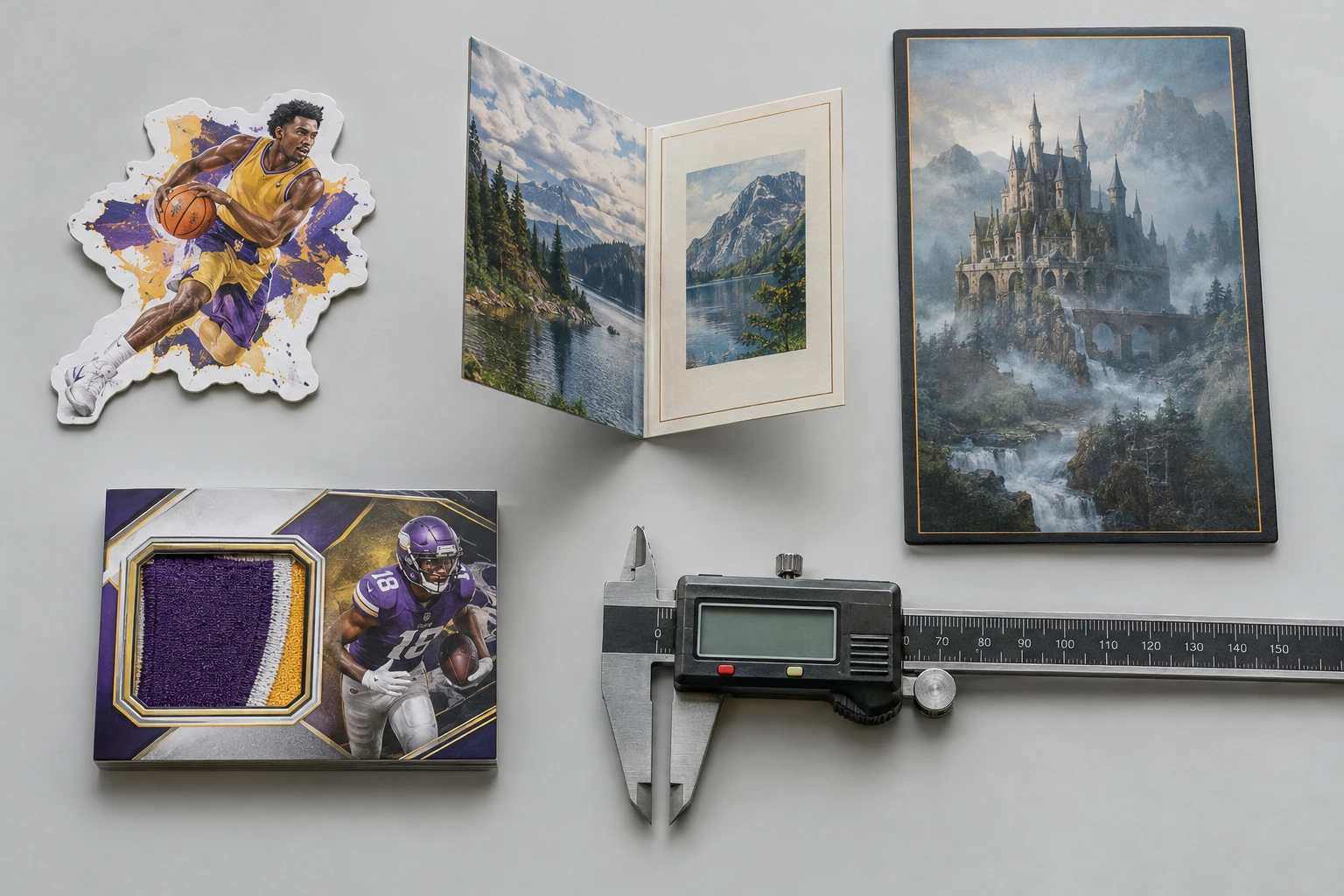
- Die-cut cards are graded on the die-cut shape, not a rectangular border; centering is judged on the printed design.
- Booklets are the hardest class: the item is folded, not flat, and acceptance is case by case.
- Measure thickness with calipers before submitting; an oversized or over-thick card can be returned ungraded.
What counts as an odd-size card
A standard trading card is about 63.5 x 88.9 mm (2.5 x 3.5 in). Anything materially different is an odd-size card, and the grading path changes.
- Tall boy: taller than standard, often vintage or international issues.
- Oversized: larger in both dimensions, such as box-topper or jumbo cards.
- Die-cut: a shaped card, not a rectangle — stars, logos, character silhouettes.
- Booklet: a folded multi-panel card, usually with a relic or autograph inside.
- Panel or multi-card: two or more cards still attached from the factory sheet.
- Thick: a patch, relic or memorabilia card that is 100pt or more.
The key point is that odd-size is not one category. A die-cut standard-footprint card may fit a normal holder; a tall boy needs a different holder; a booklet may not be gradeable at all. Check the specific form against the specific grader.
Eligibility by grader
The table below is a planning summary, not a guarantee. Each grader reserves the right to refuse an item that cannot be authenticated or safely encapsulated.
| Grader | Size posture | Practical notes |
|---|---|---|
| PSA | Publishes maximum card sizes for standard, tall boy, supersized ticket, supersized check and T-3 holders. PSA chooses the holder. | Hand-cut from a panel may qualify if the required border survives; sheet-cut copies normally sold as singles are excluded. |
| CGC | Grades virtually all sizes within a published size and thickness envelope; tall boy holder since December 2025 (US) and June 2026 (Shanghai). | Most explicit about odd sizes. Factory-cut odd sizes may qualify; undersized hand-cut cards can get Authentic with a Hand Cut attribute. |
| BGS | Grades thick and tallboy cards but publishes no outside holder size. | Tallboy holder measured around 181.5 x 115 x 9.15 mm. Confirm thickness limits before submitting a very thick patch. |
| SGC | Case-by-case; altered, oversized, custom-cut, non-standard and fragile items can fall outside grading or encapsulation. | Tall boy around 184.25 x 101.5 x 7.5 mm; thick around 9.5 mm. Ask before shipping an unusual item. |
| TAG | Grades cards up to about 50pt; no thick holder. | Standard holder only; a 130pt patch card is not eligible. |
If the card is valuable, get a written answer before you ship. Customer service can usually tell you whether a specific size or thickness is accepted, and a pre-submission email is cheaper than a return shipment.
Die-cut cards
A die-cut card is stamped into a shape, so the usual rectangular-border measurements do not apply. Graders judge the card on four things:
- The die-cut shape: clean edges, no tears or crushed points, the intended silhouette intact.
- Centering of the printed design: the artwork and text alignment inside the shape, not the shape's margins.
- Surface and print: scratches, foil lifting and print defects on the shaped face.
- Structural integrity: a thin arm or point that is bent or cracked is a major defect.
PSA, CGC and BGS all grade die-cuts that fit a holder. SGC is more case-by-case. The common failure is a die-cut with a fragile protrusion that cannot be safely encapsulated; the grader may return it rather than risk damage.
Do not assume a die-cut is automatically more valuable. It is scarcer, but the buyer pool is narrower. Check recent sold prices for the exact die-cut, not the base card, before paying for grading.
A die-cut's grade also depends on registration: if the printed art sits offset inside the die-cut silhouette, centering suffers even when the paper margins look even. Photograph the card against a dark background so the silhouette is visible before you submit.
Booklet cards
Booklets are the hardest odd-size class. A booklet is a folded card — often two or more panels with a relic or autograph inside — and it does not lie flat like a single card.
- Acceptance is case by case. PSA and CGC can encapsulate some booklets; others are returned Authentic or rejected because the fold, thickness or panel size does not fit a holder.
- The fold is a condition factor. Creasing at the spine, panel separation and edge wear on the fold are graded.
- The autograph or relic may need a separate service. A booklet with a signature can require autograph authentication in addition to card grading.
- Display and storage are harder. A booklet holder is larger and often thicker than a standard slab; check the dimensions before buying a case.
If you have a high-value booklet, ask the grader before submitting and photograph the spine and all panels. A booklet that is rejected after shipping costs you both ways and may come back with a handling mark.
Booklets also have a panel count. A two-panel booklet and a four-panel booklet are different items, and the grader needs to know which one it is. A booklet that has been opened flat and re-creased is a condition issue, not a variant.
Tall boys, panels and oversized cards
Tall boys and oversized cards are a size problem, not a shape problem. The card is rectangular, but it does not fit a standard holder.
| PSA holder | Largest card it accepts | Typical use |
|---|---|---|
| Standard | About 68.3 x 96.8 mm | Modern cards. |
| Tall Boy | 88.9 x 131.2 mm (3.5 x 5 1/6 in) | Vintage tall boys and larger issues. |
| Supersized (Ticket) | 92.1 x 190.5 mm (3 5/8 x 7 1/2 in) | Tickets and long stubs. |
| Supersized (Check) | 108 x 254 mm (4 1/4 x 10 in) | Checks and long ephemera. |
| T-3 | 146.1 x 203.2 mm (5 3/4 x 8 in) | Large vintage cabinet cards. |
Panels and multi-card items are a separate question. A factory-cut panel may be graded as a panel if it can be authenticated and encapsulated; a panel cut from a sheet by hand is treated as hand-cut, and a sheet-cut copy of a card normally sold as a single is usually excluded. If the panel is the value, ask first; the wrong cut can turn a gradeable item into an Authentic-only return.
Thick cards and patches
Thickness is the dimension collectors underestimate. A standard card is about 20pt (0.02 in); a patch or memorabilia card can be 100pt, 130pt or more.
| Grader | Approx. thick-holder depth | Note |
|---|---|---|
| PSA | 10.25 mm | Standard footprint, deeper shell; PSA picks the holder. |
| CGC | 12.5 mm | More than one thick depth exists; this is one measured size. |
| SGC | 9.5 mm | Same footprint as standard, about 1 mm deeper. |
| TAG | None | Grades up to about 50pt; no thick holder. |
| BGS | Varies | Grades thick cards; confirm the current limit for very thick items. |
A 130pt card is roughly 3.3 mm of card stock before the holder. That is within PSA's 10.25 mm thick holder and CGC's 12.5 mm, but not within TAG's standard-only case. If the card is a booklet with a thick spine, the combined depth is what matters.
Measure with calipers at the thickest point, including any raised patch window or memorabilia. A card that measures 9.8 mm may fit a 9.5 mm holder one day and not the next; leave margin.
A thick card also changes the holder footprint less than people expect: PSA's thick holder keeps the standard footprint and only deepens the shell, which is why it still fits standard rows but not standard-depth cases.
Holders and measurement
Before you submit, measure three numbers: height, width and thickness at the thickest point. Compare them to the grader's holder, not to the card's nominal size.
- Height and width: the holder's internal opening must exceed the card on both axes. A tall boy that fits the height can still be too wide.
- Thickness: the internal depth must exceed the thickest point, including the patch window and any fold.
- Shape: a die-cut's protrusions need clearance; a booklet's spine needs depth.
For standard-slab storage and shipping, see the graded slab dimensions guide. For ticket-sized items, see the ticket grading guide, because a ticket holder is a different size again.
How to submit an odd-size card
- Identify the exact issue. Year, set, card number, parallel and the fact that it is a die-cut, booklet, tall boy or panel. A grader needs to match the item to a catalog entry.
- Measure it. Height, width and thickness. Photograph the calipers next to the card.
- Ask the grader. Send the measurements and photos to customer service and ask which holder, whether the item is eligible, and whether it will be graded numerically or Authentic.
- Pack it flat and rigid. A die-cut needs a rigid sleeve or a cut-to-size holder; a booklet needs a flat, padded sandwich. Do not fold a booklet to fit an envelope.
- Declare the value. The tier and the insurance cap depend on it; see the claims and liability guide.
- Expect a different grade basis. Die-cut corners and edges are judged on the shape, and a booklet fold is a condition factor. Do not assume a standard-card grade translates.
If the item is fragile or one-of-a-kind, consider a hand-delivery or a specialist middleman rather than a parcel. The grading fee is small compared with the risk on a high-value odd-size card.
Value and liquidity
Odd-size cards are scarcer but less liquid. That trade-off should drive the grading decision.
- Population is lower. Fewer examples exist, so a high grade can be a genuine pop-top.
- The buyer pool is narrower. A die-cut or booklet appeals to a specialist, not the whole card market. Selling can take longer.
- Grading adds provenance. For an odd-size item, the holder and label confirm the shape and authenticity, which matters more than for a standard card.
- The fee is the same. A $39.99-$59.99 submission plus shipping is a bigger percentage of a $150 odd-size card than of a $1,500 one.
Check sold comps for the exact issue and form, not the base card. A die-cut insert and its base card can share a player and a year and differ by an order of magnitude. Our value estimator and sold comps tool can help build the comparison before you submit.
If the card is a standard size after all, run it through AI pre-grading before spending a submission fee.
Channel matters as much as grade for odd-size cards. An eBay auction reaches the widest pool; a specialist consignment can get a better price for a rare die-cut but takes longer and charges a fee. Match the channel to the buyer, not to the slab.
Frequently Asked Questions
Does PSA grade die-cut cards?
What is the largest card PSA will grade?
Does CGC grade odd-size cards?
Can PSA grade a booklet card?
What is the maximum thickness for a graded card?
Will PSA grade a hand-cut card?
Is an odd-size card worth grading?
What does Authentic with Hand Cut mean?
Can TAG grade thick patch cards?
Sources & Further Reading
- PSA — card holders and maximum card sizes
- PSA — cards we grade and hand-cut policy
- CGC Cards — cards we grade (size and thickness envelope)
- CGC Cards — tall boy holders
- Slabster — slab sizes and thick/tallboy holders
- TAG Grading — what TAG grades (thickness limit)
- SGC — terms and conditions (case-by-case refusal)
- PreGradeCards — graded slab dimensions
Marcus Chen has evaluated over 50,000 sports cards and TCG cards across PSA, BGS, SGC, and CGC standards. Before joining PreGradeCards, he worked as a submission specialist for a major grading company and trained collectors and dealers on condition assessment.
Create a free account and get 3 free credits — enough for 3 complete AI gradings with market pricing. No credit card required.
Get Your Free Credits →