The Short Answer
- Thick cards get oversized slab holders — most companies encapsulate them the same way but the card stock is fundamentally different
- Factory-cut thick cards almost always show imperfect edges — expect 8-9 grades, not 10s
- BGS 9.5 is realistically the ceiling for most thick cards; true 10s are rare events
- Patch windows and relics can be damaged or displaced inside the card — inspect before grading
- Authentication alone justifies grading high-value thick cards (NT, Immaculate, The Cup)
- Booklets and oversized cards may need custom or specialty tiers at some companies
The Cards That Never Quite Fit
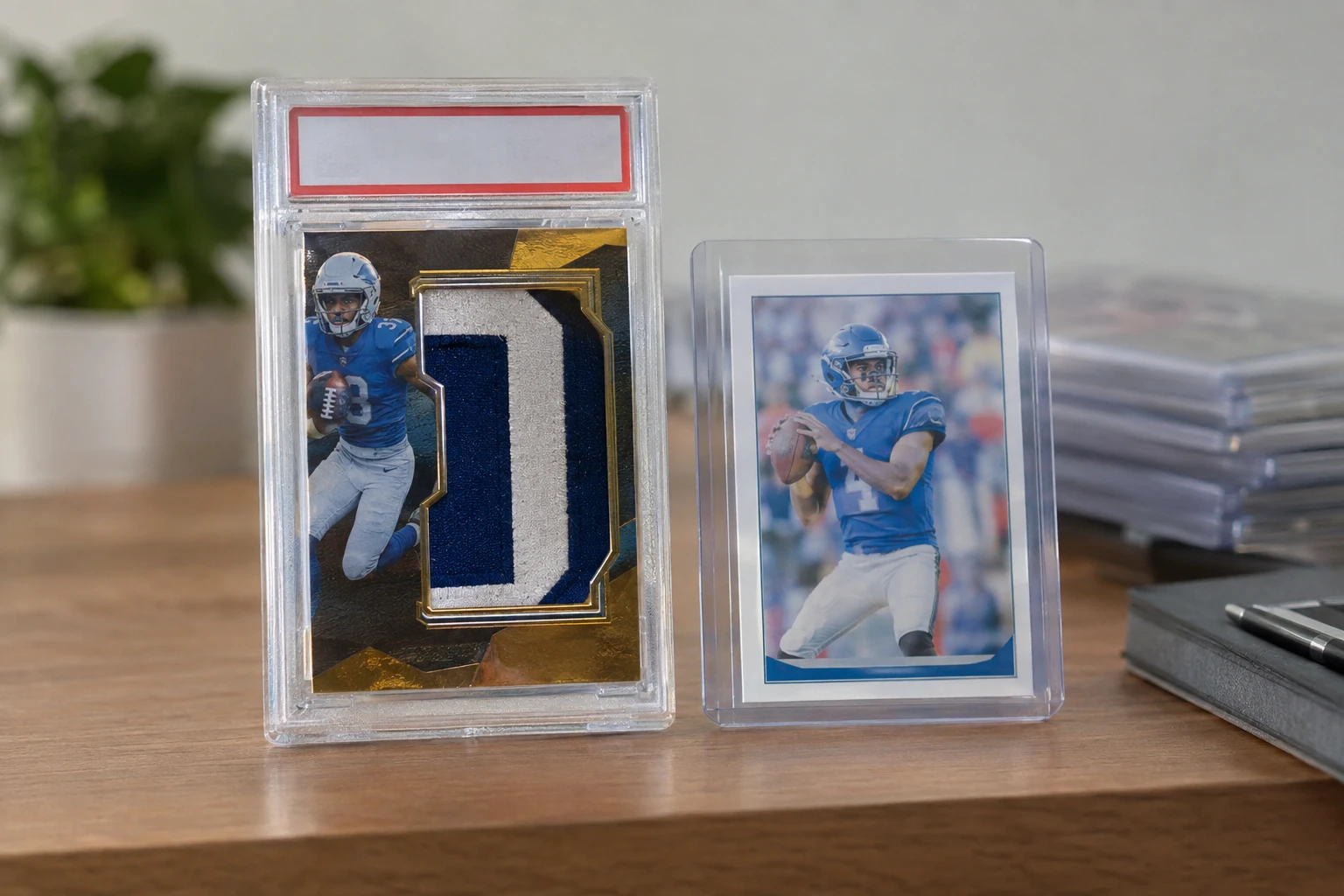
Thick cards — memorabilia relics, patch autos, RPAs, booklets, cut signatures — are the hobby's premium products and grading's hardest category. They arrive from the factory with imperfect edges, they bulge where the memorabilia sits, and a 10 grade on one is genuinely rare.
If you collect National Treasures, Immaculate, The Cup, Exquisite, or high-end TCG equivalents, understanding how thick cards are graded — and why the standard outcome is a 9, not a 10 — saves you money and sets correct expectations.
What Counts as a Thick Card
Anything substantially thicker than a standard ~20-24pt card:
- Relic/memorabilia cards — jersey, patch, ball, and equipment swatches embedded in ~35-130pt stock
- RPAs (rookie patch autos) — the flagship modern high-end card type
- Booklet cards — folding multi-panel cards, sometimes 200pt+
- Cut signatures / manufactured patches — embedded materials
- Metal/acetate cards — non-paper premium stock
Graders typically encapsulate these in thicker holders (PSA, BGS, SGC all have jumbo/thick slabs), and most companies charge standard rates for standard-size thick cards — jumbo formats may push into oversize tiers.
Why Thick Cards Grade So Much Harder
Factory edges. Thick stock doesn't cut as cleanly as standard card stock — most thick cards leave the pack with slightly rough or imperfect edges that would cap a thin card at 9 but are graded more leniently as era/product-typical on thick stock.
The relic bulge. The embedded patch or jersey creates a raised window — the card is literally not flat, and the memorabilia itself can shift, fray, or partially detach inside.
Corner geometry. Thick stock corners are physically harder to keep sharp — the material compresses and rounds more easily.
Window seams. The cut edge where the relic window meets card stock is a defect generator — lifting, glue show, and edge irregularity are endemic.
Weight and bulk. A heavy thick card in a pack damages itself and its neighbors; pack-fresh mint thick cards are structurally rare.
Realistic Grade Expectations
| Grade | Likelihood on Thick Cards | Context |
|---|---|---|
| PSA 10 / BGS 10 / CGC 10 | Rare event | Some products essentially never produce them; pops reflect this |
| PSA 9 / BGS 9.5 | Achievable ceiling | Best realistic outcome for a clean specimen |
| PSA 8 / BGS 9 | Typical pack-fresh | Factory edges alone often cap here |
| Below 8 | Common on older/handled cards | Wear on thick stock compounds |
Check the pop report first: for any specific product, pull the grade distribution at our population tool or psacard.com — if a card has never produced a 10 in 500+ submissions, don't pay a premium tier chasing one.
Pre-Submission Inspection for Thick Cards
Thick cards need a modified checklist:
- Relic window: is the patch centered, fully seated, undamaged, with no glue show or lifting at the edges?
- Edge quality: run a finger along all four edges — feel for notches and rough cuts that light alone misses.
- Face flatness: sight across the surface — bulges beyond the relic window indicate warping.
- Auto quality: streaky, smudged, or fading autographs count — check it under angled light.
- Corners: thick corners compress-damage; check all eight (front and back views of each corner).
- Booklets: hinges and interior panels get graded too — check spine wear and interior page edges.
Photo pre-screening works on thick cards too — AI grading reads surface, edges, and centering from front/back shots, though memorabilia-specific issues (window seating) still want a hand check.
Which Company for Thick Cards
- PSA: the resale king. PSA-graded NT/Immaculate RPAs carry the highest premiums. Thick cards go in PSA's thick holders. Grading is relatively lenient vs the myth — a clean thick card can still 9.
- BGS: subgrades shine here — a 9.5 with 9.5 centering/edges/corners/surface documents exactly what held it back, and BGS's thick slab is excellent. Black Label 10s on thick cards are whale-grade collectibles.
- SGC: respected, vintage-friendly; thinner vintage relic-era coverage but handles thick fine. Now $50 at Standard post-September.
- CGC: cheapest open tiers; growing TCG-relic credibility; weaker sports-card resale premium than PSA.
- TAG: precise scoring appeals to thick-card collectors wanting defect documentation — but availability is drop-limited.
Default: PSA for resale, BGS when subgrades tell the story, CGC when value doesn't justify premium fees.
When Grading a Thick Card Pays
Grade thick cards when:
- The card is a genuine premium product — NT, Immaculate, The Cup, Exquisite RPAs — where authentication + encapsulation protects real value. A $500 RPA raw vs slabbed is a trust difference, not just a grade.
- The card is a star player RPA in clean condition — the 9-vs-raw premium easily exceeds fees.
- You need authentication — high-end thick cards are the most-faked category in the hobby (patch swaps, fake RPAs); a slab kills that risk for buyers.
Skip when: the card is a low-end retail relic worth less than the all-in grading cost, or it's obviously beat-up — thick-card flaws are cheap to spot and graded low values underwater.
Pre-screen expensive candidates first: AI pre-grading plus a comp check tells you whether the expected grade clears the fee hurdle.
Frequently Asked Questions
Can thick relic cards get graded?
Why do thick cards rarely get PSA 10?
What is the best grading company for thick cards?
Should I grade a relic card worth under $100?
Do graders check the patch/relic itself?
Sources & Further Reading
The PreGradeCards Research Team combines machine-learning engineers, grading analysts, and collector-education specialists to produce accurate, data-driven guides on AI card grading, professional grading standards, and collecting strategy.
With submission floors rising, pre-screening is no longer optional. Use our AI Pre-Grade Calculator to score a card's PSA 10 odds before you pay, and the Submission Planner to pick the right tier.