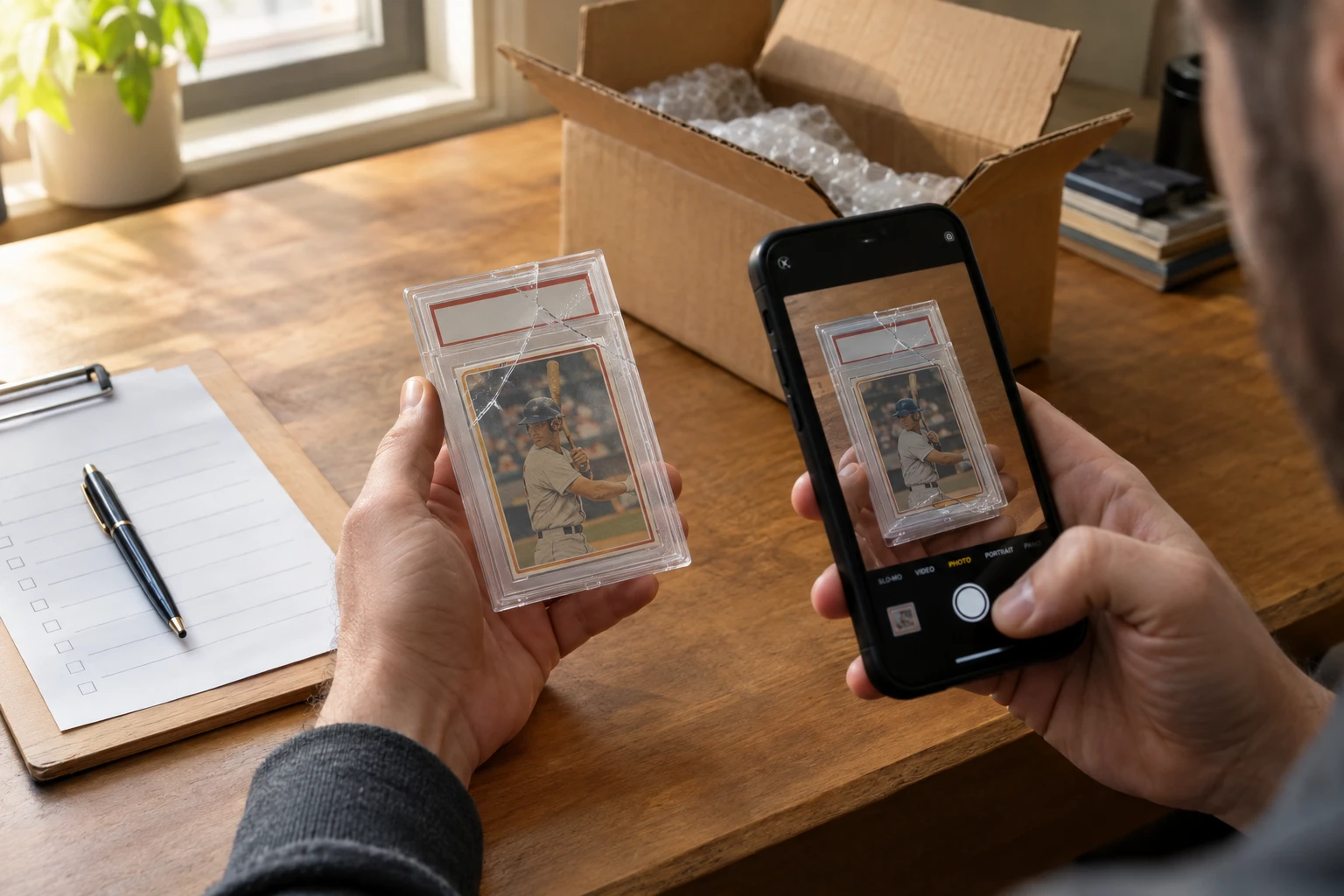
The Short Answer
- The payout cap is usually the lesser of fair market value and the declared value you put on the submission form — not the card's retail price and not the grading fee.
- Under-declaring to save on the tier is the most common own-goal: a $3,000 card sent under a $500 Value tier is capped near $500.
- Coverage generally starts when the grader confirms receipt, not when you hand the box to the carrier. Inbound loss is your carrier's claim, not the grader's.
- A grade guarantee is a different claim from loss or damage: it pays the difference between the wrong grade and the correct grade, often capped at the grading fee for the original submitter.
- PSA, CGC and SGC all exclude consequential damages, lost profits and foregone appreciation.
- Document the card before shipping: front, back, corners, label and declared-value evidence. A claim without a pre-ship photo set is a negotiation, not a case.
- This is a consumer guide, not legal or tax advice. Terms change; check the live policy before you ship.
The cap formula in one minute
When a grading company loses or damages a card in its possession, the standard payout formula across the major graders is:
minus any amount already paid, subject to the grader's terms and exclusions
Three things follow from that formula, and they explain most claim disputes.
- The grading fee is not the measure. Losing a $2,000 card in a $59.99 submission does not cap the claim at $59.99. The fee is the service price; the declared value is the insurance ceiling.
- Declared value is a ceiling, not a floor. If you declare $500 for a $3,000 card, the grader can pay $500 even though the card was worth $3,000. Under-declaring to get a cheaper tier transfers the risk to you.
- Fair market value is determined by the grader. PSA, CGC and SGC all reserve the right to set FMV using their own market information. Your comps are evidence, not the final number.
PSA's terms put it directly: PSA's liability is limited to the lesser of the card's fair market value or the maximum insured value declared on the submission form, and that remedy is the submitter's sole remedy. CGC's declared-value policy says compensation will not exceed the declared value listed on the submission form. SGC's terms use the lesser of declared value and fair market value as determined by SGC. Different words, same shape.
When coverage starts and ends
The most misunderstood part of a grading claim is the timeline. A card is not covered from the moment you seal the box.
PSA states that its guarantee of the item begins when PSA confirms receipt of the submission. The inbound leg is the submitter's responsibility. That is why PSA offers optional carrier insurance through its submission flow and why a declared-value box without carrier insurance is a gap, not a belt-and-braces extra.
The same logic applies on the return leg. Once the grader hands the package to the return carrier, transit risk shifts again. If the box is lost on the way back, the claim is usually a carrier claim, with the grader's declared-value documentation as the evidence.
Declared value vs insured value vs fair market value
These three numbers are related but not interchangeable, and mixing them up is where claims go wrong.
| Term | What it means | Who sets it |
|---|---|---|
| Declared value | Your good-faith estimate of the card's current value, printed on the submission form. | You. |
| Maximum insured value (MIV) | The ceiling for the service tier you bought. PSA Value caps at $500, Standard $1,000, Priority $1,500, Express $2,500. | The grader's tier table. |
| Fair market value (FMV) | What the card would sell for in its condition at the time of loss. | The grader, using market data; your comps support it. |
| Diminution in value | The drop in value caused by damage when the card is returned rather than lost. | The grader, with your evidence. |
The declared value does two jobs at once. It selects your tier (and therefore your price and turnaround) and it sets the insurance ceiling. That is why a $3,000 card cannot be safely submitted under a $500 Value tier. The tier is not a discount for optimism; it is a cap you are accepting in writing.
The tier ceilings move when the graders change prices. In November 2026, PSA's open tiers ran from Value at $39.99 with a $500 cap to Premier at $599 with a $10,000 cap. CGC and SGC publish their own declared-value ceilings per service. Confirm the current table on the grader's site before you fill in the form.
The cap math with worked examples
Numbers make the rule concrete. The examples below use round figures and assume the grader accepts liability; they are illustrations, not quotes.
| Scenario | FMV | Declared | Likely cap |
|---|---|---|---|
| $400 card, Value tier, declared honestly | $400 | $400 | $400 |
| $3,000 card, Value tier, declared $500 | $3,000 | $500 | $500 |
| $3,000 card, Express tier, declared $3,000 | $3,000 | $3,000 | $3,000 |
| $1,200 card, declared $2,000 | $1,200 | $2,000 | $1,200 |
| $800 card damaged but returnable | $800 | $1,000 | Diminution, not full FMV |
The fourth row is the one that surprises people. Declaring more than FMV does not raise the payout, because the cap is the lesser of the two. It may also push you into a higher tier and cost more. Declare the honest number: high enough to protect the card, low enough not to overpay for a service you do not need.
PSA liability in plain English
PSA's terms are the template most collectors encounter first. Section 10 is the liability clause that governs lost, damaged and misgraded items. Read it with four questions in mind.
- What is covered? Items in PSA's possession. The guarantee begins when PSA confirms receipt. Inbound and outbound transit are separate risks.
- How much? The lesser of the item's fair market value and the maximum insured value declared on the submission form. PSA determines FMV using what it considers reliable market information.
- What is the remedy? PSA may return the item and pay the diminution in value, or retain the item and pay the value. The choice is PSA's, and the remedy is exclusive.
- What is excluded? Consequential damages, lost profits, foregone appreciation and similar indirect losses. The clause also requires timely notice; late claims can be waived.
The practical takeaway is not that PSA is unfair. It is that the declared value is the number that matters, and the submission form is the contract. If you write $500 on the form, you have agreed to a $500 ceiling. If you write $3,000 and buy the tier that accepts $3,000, you have bought the protection.
CGC, SGC and Beckett differences
The shape is similar; the wording and limits are not identical.
| Grader | Loss/damage measure | Notable terms |
|---|---|---|
| PSA | Lesser of FMV or declared MIV. | Sole remedy; may return item plus diminution; coverage starts at confirmed receipt. |
| CGC | FMV, not exceeding declared value. | May adjust the tier if it decides the card was under-declared, and charge the difference. Excludes consequential damages. |
| SGC | Lesser of declared value and FMV as determined by SGC. | Exclusive remedy; may require a release; claims subject to the limitation-of-liability section. |
| Beckett | Declared-value-based, per current terms. | Confirm the live terms; Beckett also grades tickets and non-card items with separate service terms. |
Two differences matter in practice. First, CGC explicitly reserves the right to re-tier an under-declared card and charge the difference. That protects CGC against a $5,000 card submitted at a $200 tier, but it also means the declared value is audited. Second, SGC's terms state that the declared value is for maximum insurance coverage only, and that FMV may be lower. Do not read 'declared' as 'guaranteed'.
For current tier caps and fees, see our 2026 grading price comparison.
Grade guarantee vs loss or damage
These are different claims, with different proof and different caps.
- Loss or damage: the card was destroyed, lost or physically harmed while in the grader's custody. The measure is value, capped by the declared value. You need pre-ship photos, the submission record and FMV evidence.
- Grade guarantee: the card was graded, but you believe the grade is wrong. The usual remedy is a review or regrade; if the grade is corrected lower, the guarantee may pay the difference between the value at the wrong grade and the value at the correct grade.
- Original-submitter limit: CGC's guarantee caps compensation for the original submitter at the grading fees actually paid for the certification. That is a very different number from the card's value, and it is why the grade guarantee is not a substitute for insurance.
- Authenticity guarantee: covers a counterfeit or altered item that the grader certified as genuine. The remedy is usually a refund or purchase at the declared value, subject to the terms.
The takeaway: buy shipping insurance for loss, and read the grade guarantee for grading errors. Do not assume one covers the other. A card that arrives intact but graded a 7 instead of an 8 is a grade-guarantee question, not a loss claim, and the payout formula is different.
How to file a claim that pays
Most claims fail on evidence, not on the merits. Build the file before you ship, then add to it at each step.
- Photograph the card and the packaging. Front, back, all four corners, the surface under angled light, and the sealed box with the label visible. Timestamped photos are stronger than undated ones.
- Keep the submission receipt and the declared-value record. A screenshot of the form is enough; the number on the form is the number that governs.
- Keep the carrier receipt and tracking. Inbound loss is a carrier claim; the grader's coverage starts at confirmed receipt.
- Report promptly. Open the claim as soon as you discover the loss or damage. PSA, CGC and SGC all require timely notice, and late claims can be waived.
- Document FMV. Recent sold comps for the same card in the same grade, with dates and sources. Use sold prices, not asking prices. Our value estimator and sold comps tool can help build the file.
- Keep the damaged item. Do not discard or repair it until the claim is resolved. The grader may ask to inspect it or may elect to retain it.
- Get the remedy in writing. Confirm whether the grader is returning the item plus diminution or retaining it and paying value, and confirm the payment amount and timing.
If the claim stalls, escalate in writing to the grader's customer-service supervisor and, for a carrier claim, to the carrier's claims department. Keep every message. The paper trail is the case.
Preventing claims before you ship
The cheapest claim is the one you never file. Five habits remove most of the risk.
- Declare honestly. Use recent sold comps, not what you hope the card is worth. The declared value sets both your tier and your ceiling.
- Insure the inbound leg. The grader's coverage starts at receipt; the carrier is your only protection before that. Declare the same value to both.
- Pack for the journey, not the shelf. Cards in semi-rigid holders, taped between cardboard, inside a snug box with padding. A padded envelope is not enough for a $1,000 submission.
- Photograph everything. The pre-ship set is your evidence if the card arrives damaged or is lost. Include the box and the carrier label.
- Use tracked, signed delivery. A signature is proof of receipt and starts the grader's custody window.
Packing detail matters more than most collectors think. Our grading shipping guide covers box-in-box packing, semi-rigid holders and carrier choices. If you are shipping slabs rather than raw cards, check the slab dimension and weight guide so the box and postage tier match the load.
Frequently Asked Questions
What happens if PSA loses or damages my card?
Is the grading fee the maximum I can recover?
What if I under-declare a card to get a cheaper tier?
Does the grading company insure my package before it arrives?
What is the difference between a grade guarantee and a loss claim?
How do I prove my card's value in a claim?
How long do I have to file a grading claim?
Does CGC pay fair market value for a lost card?
Is a grading company's liability the same as insurance?
Sources & Further Reading
- PSA — Terms and Conditions (Section 10 liability)
- PSA — Declared value and service tiers
- CGC Cards — Declared Value Policy
- CGC Cards — Certification Guarantee
- CGC Cards — Services Terms and Conditions
- SGC — Terms and Conditions
- Beckett — grading terms and services
- PreGradeCards — 2026 grading price comparison

Sarah Williams leads PreGradeCards educational content and collector onboarding. She has been a full-time collector and dealer for 12 years, specializing in modern sports cards and Pokémon TCG, and has written grading guides read by over 300,000 collectors.
Create a free account and get 3 free credits — enough for 3 complete AI gradings with market pricing. No credit card required.
Get Your Free Credits →