The Short Answer
- A slab label is an identity document: year, set, card number, subject, variety, grade, qualifier and cert number.
- PSA has six qualifiers — MK and MC are required, while OC, ST, PD and OF are optional and may be replaced by a lower number.
- PSA has no 9.5. Half grades run from 2.5 to 8.5, and 1.5 is Fair, not a bump from a 1.
- BGS shows four subgrades; a Black Label is a 10 Pristine with four 10 subgrades.
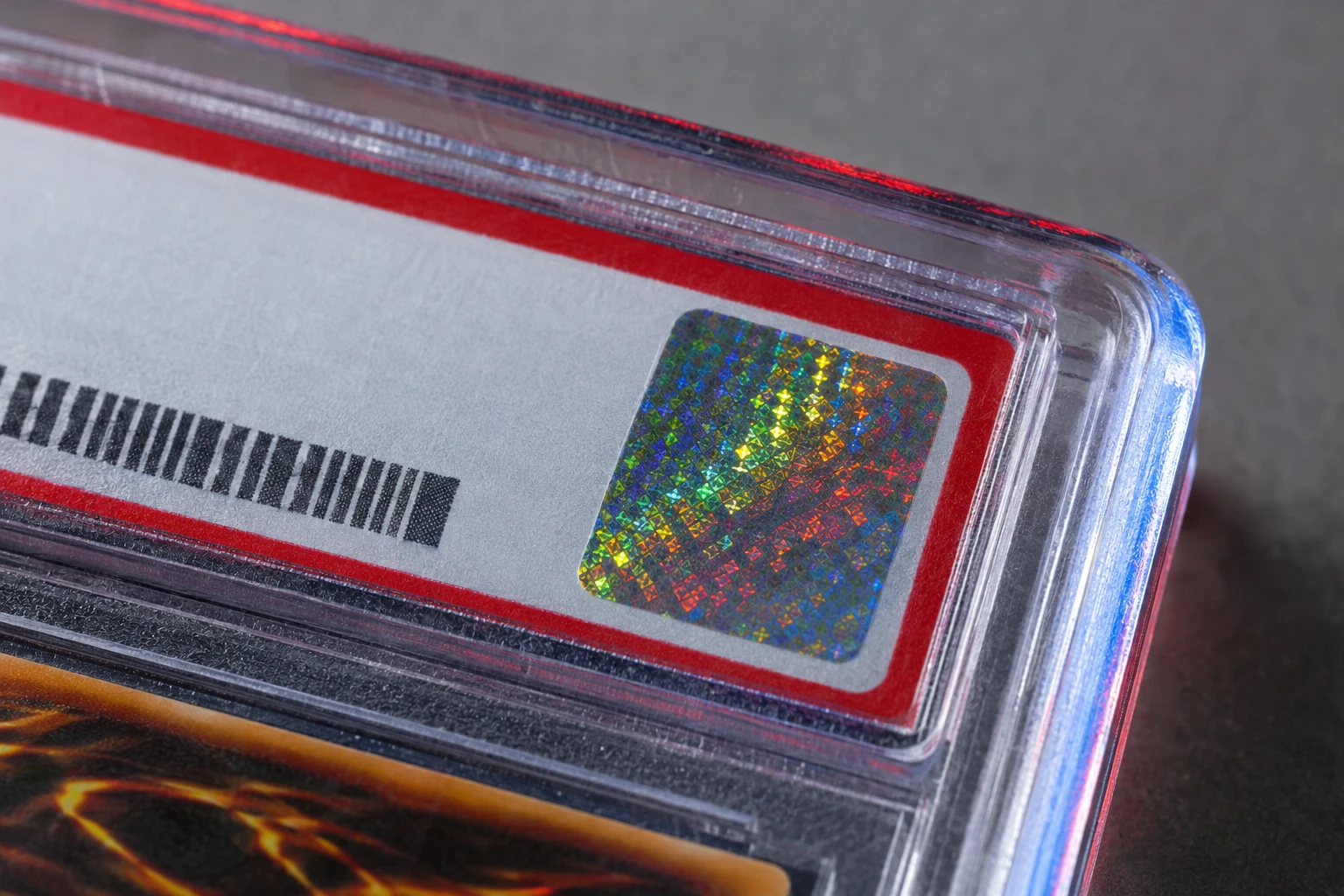
- PSA label color is not decoration: red is the item, and blue marks an autograph-only designation on labels issued since June 19, 2024.
- The cert number is the first thing to verify, but a valid cert does not prove the holder is genuine — check the label, hologram and QR too.
- Words like OC, MK, AA, Authentic and Altered change the value more than a half-point of grade.
The six fields to read on any graded card label
Every grader lays out the label a little differently, but the information falls into the same six buckets. Read them in this order and you will not miss the part that changes the price.
- Identity: year, set name and card number.
- Subject and variety: player or character, plus any parallel, insert or autograph designation.
- Grade: the number and the word beside it (GEM-MT 10, MINT 9, NM-MT 8).
- Qualifier or designation: OC, MK, ST, PD, OF, MC, Authentic, Altered, or a grader-specific code.
- Cert number: the unique serial used for verification.
- Security marks: barcode, QR code, hologram or embedded strip.
The order matters because the grade is the most visible field and the least informative on its own. A PSA 9 is not the same card as a PSA 9 (OC), and a BGS 9.5 is not the same as a BGS 10 Black Label. The words beside the number and the subgrades underneath it are where the value lives.
PSA label anatomy, top to bottom
PSA's label is the template most collectors learn first. A modern PSA label reads in this order:
- Year and set on the top line, for example 2018 Topps Chrome.
- Card number and subject on the next line, for example #150 Shohei Ohtani.
- Variety or parallel if applicable — Refractor, SP, autograph, error.
- Grade and descriptor on the right side; since February 12, 2008 the number sits directly below the grade word.
- Cert number at the bottom, usually 7-9 digits.
- Barcode or QR on newer labels, linking to the cert page.
The red band at the top is not universal across all PSA products, and it is not a grade signal. It is part of the label design. The grade and the cert number are the fields that carry meaning.
Cert formats by grader
Cert numbers are not a universal length. Use the exact string printed on the label; do not add or drop leading zeros.
| Grader | Typical cert format | Lookup note |
|---|---|---|
| PSA | 7-9 digits; older certs are shorter | psacard.com/cert or the PSA app; newer labels have a QR code. |
| BGS | 10-digit serial | Beckett lookup lets you choose BGS, BVG or BCCG; the prefix matters. |
| CGC | 7-10 digits | CGC Cards verify page; the label also carries a barcode. |
| SGC | 7-8 digits | SGC lookup; the label design has changed several times. |
| TAG | Alphanumeric ID | TAG's digital report is the primary record; the label is the summary. |
The cert number answers one question: does this number exist in the grader's database, and does the returned record match the card in the holder? It does not answer whether the holder itself is genuine. A counterfeiter can copy a real cert number onto a fake slab. That is why the lookup is step one, not the whole verification.
For a full lookup walkthrough, see our PSA cert lookup guide and the cross-grader cert verification guide.
Grade numbers and the words beside them
The number is a shorthand; the word is the standard. PSA's scale runs from Poor 1 to Gem Mint 10, with half grades from 2.5 to 8.5 and no 9.5. A PSA 1.5 is Fair, not a half-step above a 1.
| PSA label | Meaning | What buyers assume |
|---|---|---|
| GEM-MT 10 | Virtually perfect; front centering about 55/45 to 60/40. | Top grade, strongest premium. |
| MINT 9 | One minor flaw; front centering about 60/40 to 65/35. | High grade, but not a 10 premium. |
| NM-MT 8 | Near mint-mint; light wear allowed. | Collector-grade, not investment-grade on modern cards. |
| EX-MT 6 / EX 5 | Visible wear; corners and edges show it. | Vintage value, modern discount. |
| AUTHENTIC | Genuine, but no numeric grade. | Often altered, oversized or explicitly requested. |
Other graders use their own words. BGS has 10 Pristine (Black Label), 10 Gem Mint and 9.5 Gem Mint. CGC has 10 Pristine, 10 Gem Mint and 9.5 Mint+. SGC has 10 Pristine and 10 Gem Mint. TAG publishes a 1-10 scale with a digital report. Do not translate a 9.5 across graders as if the scales were identical; they are not.
The grade word also tells you what the grader was willing to say. A PSA 9 with no qualifier met the centering standard for a 9. A PSA 9 (OC) met every other standard but not centering. That distinction is worth more than the half-point between an 8.5 and a 9 on many cards.
Qualifiers and designations decoded
PSA has six qualifiers. Two are required, and four are optional, meaning PSA may instead lower the numeric grade. A qualified grade is a statement about one flaw, not a second grade.
| Code | Meaning | Required or optional |
|---|---|---|
| MK | Marks: writing, ink, pencil or an impression left by writing. | Required. |
| MC | Miscut: an atypical cut for the issue, including part of another card. | Required. |
| OC | Off-center beyond the tolerance for the grade. | Optional. |
| ST | Staining. | Optional. |
| PD | Print defect. | Optional. |
| OF | Out of focus or out of register. | Optional. |
A qualified card usually trades near a card two grades lower, not at the number printed. That is the market's way of pricing the flaw the qualifier names. If you are buying, compare the qualified card to a clean example two grades down before deciding what to pay. If you are selling, the qualifier is a disclosure you cannot talk around; a sharp photo of the flaw is better than a long description.
Designations are different from qualifiers. Authentic means the item is genuine but ungraded. Authentic Altered means genuine but trimmed, recolored, restored or cleaned. CGC prints Authentic and Authentic Altered in the grade box and uses its own codes for altered and restored items. ACE appends OC when centering is two grades or more below the overall grade. The practical rule: any word that is not a number is a limitation, so read it before you read the number.
Our deeper guide to PSA qualifiers covers the value impact of each code.
Subgrades: BGS, CGC and TAG
PSA compresses the four criteria into one number. BGS shows them. A BGS label carries centering, corners, edges and surface subgrades, and the overall grade is derived from those four. That is why two BGS 9.5s can look different on the label: one may be 9.5/9.5/9.5/9.5 and another 10/9.5/9.5/9.
- BGS 10 Pristine (Black Label): all four subgrades are 10. This is the strictest top grade in the major-grader market and carries a large premium on modern cards.
- BGS 10 Gem Mint: a 10 overall without four 10 subgrades.
- BGS 9.5 Gem Mint: the common high grade; subgrades tell you which criterion is holding it back.
- CGC: shows subgrades on the label in some services; 10 Pristine and 10 Gem Mint are distinct, and 9.5 Mint+ sits between 9 and 10.
- TAG: the slab label is a summary; the digital report carries the detailed sub-scores and images. Scan the code, not just the label.
Subgrades matter most when you are comparing two examples of the same card at the same overall grade. A BGS 9.5 with a 10 centering subgrade is a better candidate for a PSA crossover than a 9.5 with an 8.5 centering subgrade, even though the labels both say 9.5. For the value math, see subgrades explained.
Autograph and dual-grade labels
An autographed card can carry two numbers on one label: the card grade and the autograph grade. PSA writes them as something like PSA 9 | Auto 10. The card grade scores the cardboard; the auto grade scores the signature's boldness, completeness and ink condition. They are independent.
- PSA/DNA and authentication-only labels: the item is authenticated, not numerically graded. On PSA labels issued since June 19, 2024, blue marks an autograph-only designation, while red is the item. Before January 1, 2019, PSA/DNA used blue labels across the board, so older blue labels are not a red flag.
- Witnessed vs unwitnessed: a witnessed autograph was signed in front of an authenticator. An unwitnessed signature is authenticated by exemplar comparison. Both can be genuine; the witnessed route is stronger evidence.
- Sticker vs on-card: a sticker autograph was signed on a separate sheet and applied later. The card is usually pack-fresh, so the auto grade carries most of the variation.
- Facsimile: a printed signature is not an autograph. Labels should say facsimile or the card should be described as a replica; a facsimile card graded as an autograph is a misdescription.
Read the autograph line before the card grade on a signed card. A card graded 9 with an Auto 10 is a different asset from a card graded 10 with an Auto 6, and the market prices them differently. Our autograph grading vs authentication guide explains when you need one service rather than both.
Variety, label color and security
The identity block is where most buying mistakes happen, because the label can be technically correct and still describe a different card than the one you thought you were buying.
- Variety/parallel: Refractor, Holo, SP, SSP, Gold, Black Label, first edition, error. A base card and a refractor can share a card number and a grade and differ by 10x in value.
- Pedigree: PSA prints some provenance lines, such as a named collection. A pedigree is a story, not a grade; value it only if the market pays for it.
- Population: labels do not print population. The cert page may link to it. Treat a seller's 'pop 1' claim as a claim to verify, not a label fact.
- Set Registry: registry points and GPA are separate from the label. A high registry rank does not make an individual card more valuable.
The label's job is to tell you exactly which card is in the holder. If the variety line is blank, the card is the base printing unless the set has no parallels. If the year and set line is abbreviated, look up the cert to see the full description. If the label says 'Authentic' with no number, the card is genuine but the condition is ungraded — do not price it as a numeric grade.
Label color and security marks
Label color is grader-specific and changes over time, so use it as a clue, not a verdict.
| Grader | Color note | Security note |
|---|---|---|
| PSA | Red for the item; blue for an autograph-only designation since June 19, 2024. Blue PSA/DNA labels before 2019 are normal. | Tamper-evident holder, label, hologram and QR on newer slabs. |
| BGS | Black Label means 10 Pristine with four 10 subgrades, not a different company. | Barcoded serial; inner sleeve inside the holder. |
| CGC | Uses a green label where the grade itself is not covered by its guarantee; Authentic and Altered print in the grade box. | Barcode; verify the cert and read the label legend on CGC's site. |
| SGC | Black-and-white 'tuxedo' design; label generations vary. | Cert lookup; inspect the holder seam and insert. |
| TAG | Minimal label; the digital report carries the detail. | QR/report link; verify the report against the slab. |
Security is a stack, not a single feature. A genuine cert number plus a fake holder is still a fake slab. Check the holder seam, the label print quality, the hologram behavior in light, and the QR destination. If the QR opens a lookalike domain instead of the grader's own site, stop.
For the full fake-slab checklist, see how to spot fake PSA slabs.
Cert lookup workflow and red flags
Verification takes about a minute per slab once you have the workflow down.
- Photograph the label before you pay, including the cert number and any qualifier.
- Look up the cert on the grader's own site or app. Use the exact number, including leading zeros.
- Match every field: year, set, subject, card number, variety, grade and qualifier.
- Check the image if the grader shows one. Compare the card's centering, corners and print defects, not just the name.
- Check the holder against a known example: seam, label edges, hologram, QR destination.
- Check the population if a scarcity claim is part of the price.
Red flags that justify walking away: a cert that returns a different card, a label with a font or spacing that looks off, a holder with a rough or reglued seam, a QR that opens a third-party domain, a seller who will not send a cert photo, a price far below market for a high grade, and a 'pop 1' claim that the grader's population page does not support.
Once you know what the label says, the next question is whether the card is worth grading at all. Run it through AI pre-grading to see the likely grade before you pay a submission fee.
Frequently Asked Questions
What is the difference between MK and MC on a PSA label?
Does PSA have a 9.5 grade?
How many digits is a PSA cert number?
Why is a PSA label blue instead of red?
What does Authentic mean on a graded card label?
How do I verify a graded card label?
What is the difference between a card grade and an auto grade?
How do I read a qualifier like 9 (OC) on a graded card?
What do four 10 subgrades mean on a BGS label?
Sources & Further Reading
- PSA — grading standards and qualifiers
- PSA — frequently asked questions (qualifiers, cert verification)
- PSA — Set Registry glossary (cert number, GPA)
- Blake Crosley — Reading a graded card's label: PSA, BGS, CGC and the rest
- CGC Cards — certification guarantee
- Beckett — grading scale and label guide
- TAG Grading — help center
- SGC — certification lookup
Marcus Chen has evaluated over 50,000 sports cards and TCG cards across PSA, BGS, SGC, and CGC standards. Before joining PreGradeCards, he worked as a submission specialist for a major grading company and trained collectors and dealers on condition assessment.
Create a free account and get 3 free credits — enough for 3 complete AI gradings with market pricing. No credit card required.
Get Your Free Credits →