The Short Answer
- Serial-numbered cards have guaranteed scarcity — the /25 stamp is itself the value driver
- On /25 and lower, raw vs graded premium often favors grading less than on unnumbered cards
- On /99+ parallels, the grade matters more — the number alone isn't scarce enough to carry value
- 1/1s and low-numbered cards (/10, /5) are worth grading mainly for authentication and protection
- Numbered cards get graded differently too — foil-stamped numbering areas attract handling damage
- Check gem rates on numbered parallels before submitting — stamped cards often grade worse
The Built-In Scarcity Question
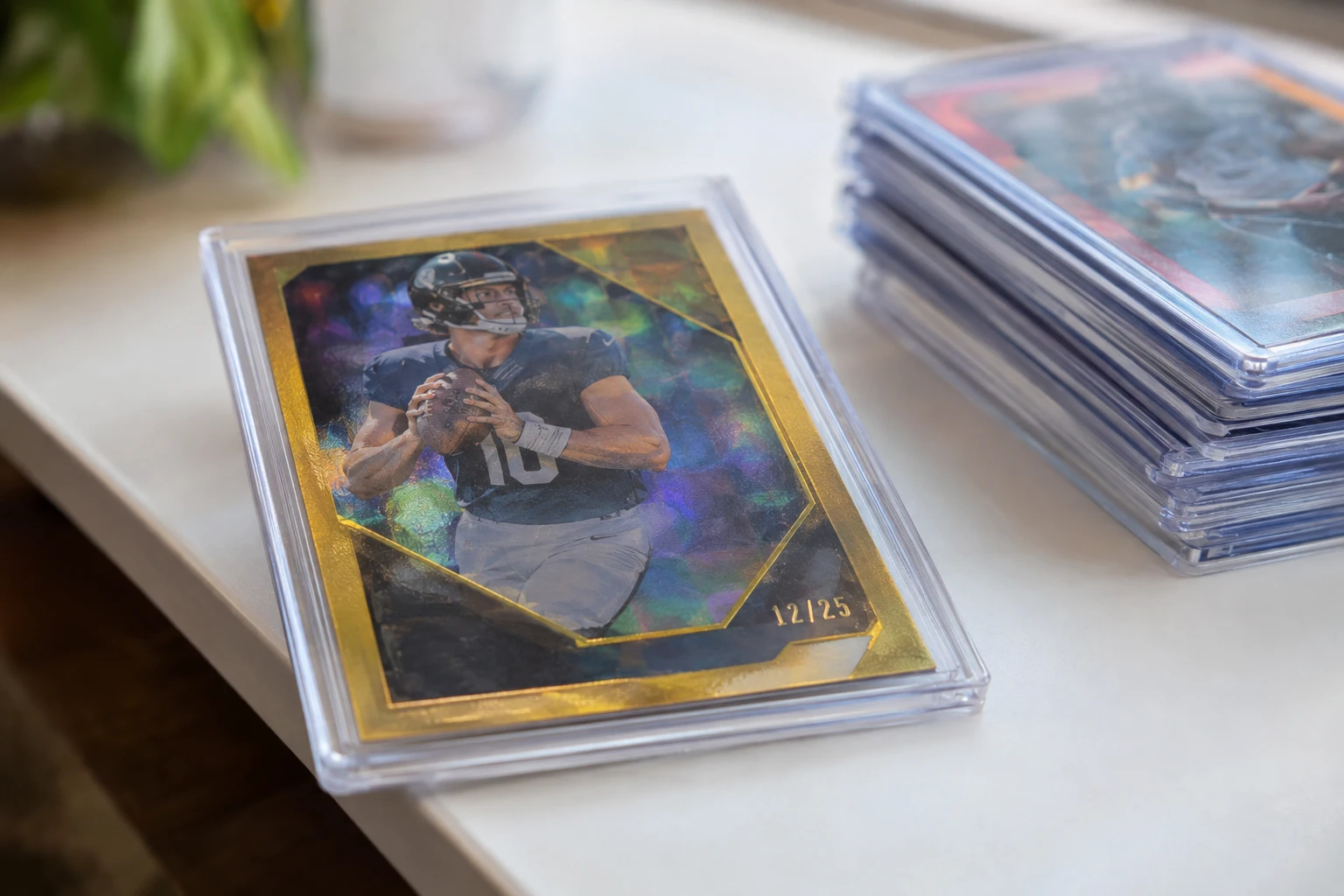
A serial-numbered card arrives with scarcity already printed on it — "/25" means 25 exist, full stop. That changes the grading calculus fundamentally: you're no longer buying a grade to create scarcity, you're grading to protect and certify it.
The right submit decision for a numbered card depends on which serial band it sits in, what the graded premium actually is for that card, and whether the number or the condition is doing the value work. This guide gives you the framework.
Why Numbered Cards Grade Differently
Three structural differences from unnumbered parallels:
1. The number does the scarcity work. A PSA 9 /25 and a PSA 10 /25 are still both 1 of 25 — the grade premium is real but compressed, because the serial stamp caps the supply either way. Compare a non-numbered parallel where the 10 is worth multiples of the 9.
2. Print production hurts condition. Numbered parallels are typically on thicker stock, with foil or holographic finishes and stamped numbering areas — all of which are condition-hostile. Edge and surface issues are endemic on products like National Treasures, Flawless, and optic-style parallels.
3. Authentication is the hidden product. On genuinely rare cards (/10 and under), the slab's authentication and protection functions carry real value independent of the numeric grade — buyers pay for certainty on scarce items.
Grading Math by Serial Band
| Serial Band | Value Driver | Grade Premium | Grading Verdict |
|---|---|---|---|
| 1/1, /5, /10 | Extreme scarcity | Low relative — number is the value | Grade for authentication/protection, not margin |
| /11-/49 | Scarcity + condition | Moderate — grade adds 15-40% at top | Grade if clean; meaningful premium at 9-10 |
| /50-/99 | Condition increasingly matters | Moderate-high | Grade only strong candidates |
| /199+ / high-number | Essentially a normal parallel | Standard premium math | Treat like a base parallel — 10-or-skip |
The crossover point is around /50-/99: below it, the number itself anchors value and grading is a protection play; above it, the card behaves like any other parallel and needs a top grade to profit.
Inspecting Numbered Cards Before Submission
Numbered cards have defect zones normal cards lack:
- The serial stamp itself: foil-stamped numbering can be mis-struck, weakly stamped, or scratched — a damaged stamp hurts the card even though it's not "wear." Check the stamping is crisp and intact.
- Number-window edges: the stamped/printed numbering area attracts surface scrutiny.
- Thick-stock edges: numbered cards on premium stock (NT, Immaculate, Flawless) share thick-card problems — rough factory edges cap grades. Our thick-card guide covers the specifics.
- Foil/parallel surfaces: the shiny finishes that carry serial stamping are fingerprint and scratch magnets — inspect under angled light.
- Centering on bordered parallels: color-bordered numbered parallels show centering errors glaringly.
Jersey Numbers, 1/1s, and Special Serials
Jersey-numbered cards (the serial matching the player's jersey — e.g., 23/23 Jordan) command meaningful premiums over other numbers of the same print run. Grade them — the premium is real and the slab locks in the special-number provenance.
First and last numbers (01/25, 25/25) carry modest premiums at auction — worth noting when pricing a graded sale.
1/1s are essentially grading-proof on the upside — there's no comp curve, the grade matters least of all. Grade a 1/1 for authentication and protection, not margin: the slab makes it easier to insure, sell, and authenticate, which is worth real money on a unique card.
Booklet/multi-player numbered cards: same logic, thick-card handling applies.
Grade vs Sell Raw — The Decision Framework
Run this sequence on any numbered card:
- Identify the band. /10 and under → protection play; /11-/99 → conditional; /100+ → standard premium math.
- Check the graded premium. Pull sold comps at PSA 9 and PSA 10 vs raw. If the premium doesn't clear all-in grading cost (~$50-95), sell raw.
- Check the pop report. A /99 with 40 already-graded 10s is a different market than one with 6. Population data lives at our pop tool.
- Screen the card honestly. A numbered card that grades 7 is usually worth raw-less-fee. AI pre-grade it before committing.
- Decide the purpose: resale margin → strict math; collection piece → authentication alone may justify it.
Submission Strategy for Numbered Cards
- Grade everything /10 and under that's genuinely valuable — the slab's authentication and protection functions carry the card, regardless of the numeric outcome.
- On /11-/99, grade only screened candidates — centering, edges, surface all pass muster; the grade premium is real but fragile.
- On /100+, grade nothing that can't hit the top grade. High-number parallels behave like any other modern card — 10-or-skip.
- Never grade for a jersey number alone. /23 Jordan matters because Jordan matters; a random player's matching-number card adds ~nothing.
- Handle numbered cards with extra care pre-submission — a fresh fingerprint on foil during packing is a real way to lose a grade point you already paid for.
Frequently Asked Questions
Are serial-numbered cards worth grading?
Is a PSA 9 numbered card worth more than raw?
Should I grade a 1/1 card?
Do jersey-numbered cards sell for more?
Do serial-stamped cards grade worse?
Sources & Further Reading
- PSA Grading Standards
- PreGradeCards Population Tool
- PreGradeCards ROI Calculator
- PSA Population Report

The PreGradeCards Research Team combines machine-learning engineers, grading analysts, and collector-education specialists to produce accurate, data-driven guides on AI card grading, professional grading standards, and collecting strategy.
With submission floors rising, pre-screening is no longer optional. Use our AI Pre-Grade Calculator to score a card's PSA 10 odds before you pay, and the Submission Planner to pick the right tier.