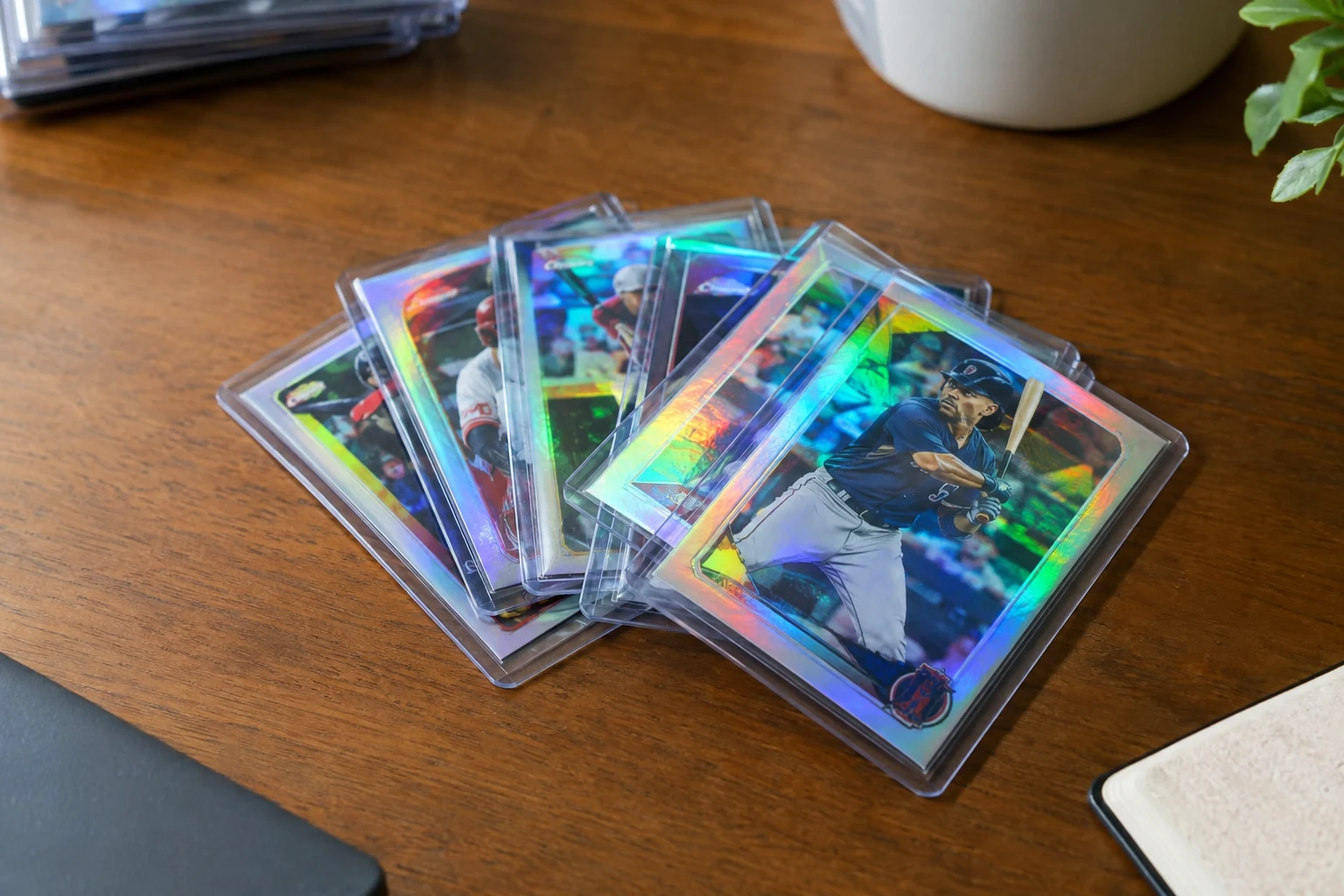
The Short Answer
- Chrome is the modern baseball grading standard — PSA 10 rookies carry the resale premiums
- Refractor ladder: base → Refractor → numbered colors (/499 down) → Orange/Red /25 /5 → SuperFractor 1/1
- Chromium stock shows print lines and edge chips that paper hides — tilt-check every candidate
- Base Chrome rookies need a 10 to pay the fee; numbered refractors have downside cushion
- Logofractors and SuperFractors are trophy-tier — grade regardless of condition outcome
- PSA dominates Chrome resale; CGC Economy is the margin lane for mid-tier refractors
Chrome Is the Modern Grading Standard — Here's How to Play It
Topps Chrome is the single most-graded modern baseball product — the refractor rainbow built the modern rookie market, and PSA 10 Chrome rookies are the default currency for player investments.
But chromium stock grades differently than paper, and the refractor hierarchy changes the ROI math at every tier. This guide covers what to submit from Chrome rips — and what to leave raw.
Why Chrome Grades Differently
- The stock: chromium (foil-backed) card stock — rigid, reflective, and it fails differently: print lines, edge chips, and surface scratches replace paper's whitening-and-wear profile.
- The market: Chrome rookies are the default modern investment card — the PSA 10 premium structure is the most liquid in the hobby.
- The volume: Chrome is printed heavily — base cards flood PSA pops, so premiums concentrate on numbered parallels and the true rookies.
The Refractor Ladder
| Tier | Parallels | Grading Logic |
|---|---|---|
| Base / base Refractor | unnumbered | Stars/rookies only, flawless — pop is huge |
| Low numbered | /499, /199, /99, /75 | Stars/rookies — serial floor cushions mid grades |
| Premium numbered | /50, /25, /10, /5 | Grade any decent player — scarcity props value |
| SuperFractor | 1/1 | Always grade — trophy regardless of player |
| Logofractor | limited | Grade — ultra-scarce parallel |
The serial-numbered grading guide covers the general logic; Chrome adds the wrinkle that unnumbered refractors of hot rookies still carry premiums.
The Chromium Defect Profile
- Print/roller lines: faint lines across the chrome field — the #1 killer. Tilt under a lamp; they vanish head-on and appear at ~30°.
- Edge chipping: rigid chrome stock chips rather than bends — check all four edges for exposed white/dark spots.
- Surface scratching: in-pack card contact produces micro-scratches; chrome shows them as spidering in light.
- Dimples: pressure points show as small depressions on the mirror field.
- Centering: standard modern drift — measure on the centering checker.
- Refractor-specific: color-line defects (uneven refractor bands) on numbered parallels — check the shine pattern is uniform.
Screen first with AI pre-grading — it reads chrome surface defects that are easy to miss by eye.
What to Grade from Chrome
Always (after screening):
- Numbered refractors /25-or-better of any roster player
- Top rookie base refractors and autos — the year's first-round picks and call-ups
- Star base Refractors of the very top names (Ohtani class) — flawless only
- Any 1/1 or Logofractor
Screen first:
- Base Chrome rookies — pop counts balloon; only strict-screen survivors
- /99-/499 refractors of mid players — check comps for the specific parallel
- Inserts — only the demanded ones (ultra-rare inserts, retro homages)
Skip: veteran base, low-numbered parallels of nobody players, most inserts.
ROI Analysis
Base rookie example: raw ~$5-15 → PSA 10 ~$60-150 on a top rookie — thin margin; needs a 10. At ~$70 all-in PSA, many lose; CGC Economy ($20) shifts the math.
Numbered refractor example: star rookie /75 raw ~$40-80 → PSA 10 ~$200-400, PSA 9 ~$80-120 — the serial floor means a 9 roughly breaks even; the 10 profits. Positive expected value on clean copies.
The Chrome asymmetry: unnumbered cards need the 10; numbered cards survive the 9. Screen accordingly — run the numbers per card on the ROI calculator.
Submission Notes
- Handle chrome by the edges: fingerprints etch into the surface — sleeve immediately after inspection.
- Tier by declared value: base rookies and /99+ fit Standard; premium parallels of stars can exceed $1,000-1,500 graded — check the declared value guide.
- PSA vs CGC: PSA owns Chrome resale premiums. CGC Economy is the margin play on mid-tier refractors where CGC comps hold — check card-specific data at the pop tool.
- Autographs: Chrome autos are sticker autos on most products — verify the sticker sits cleanly (peeling/misaligned stickers hurt grades).
Frequently Asked Questions
Are Topps Chrome cards worth grading?
What is a SuperFractor?
Do Chrome cards grade differently than paper cards?
What PSA tier should I use for Topps Chrome?
Is a PSA 9 on a numbered refractor worth it?
Sources & Further Reading
- Beckett — 2026 Topps Chrome
- Topps — Chrome Products
- PSA Population Report
- PreGradeCards Population Tool
The PreGradeCards Research Team combines machine-learning engineers, grading analysts, and collector-education specialists to produce accurate, data-driven guides on AI card grading, professional grading standards, and collecting strategy.
With submission floors rising, pre-screening is no longer optional. Use our AI Pre-Grade Calculator to score a card's PSA 10 odds before you pay, and the Submission Planner to pick the right tier.