The Short Answer
- 2026 Sapphire: $649.99/box, 8 cards/pack × 4 packs, 1 auto + 3 numbered parallels per box
- Parallel ladder: Gold /50 (1:7), White /30 (1:12), Orange /25, Black /10, Red /5, Padparadscha 1/1
- Chromium stock shows print lines and edge chips that standard stock hides — screen every card
- Base rookies (Ohtani, top rookies) run thin margins — numbered parallels and autos are the grade targets
- Sapphire gem rates run lower than paper Chrome — the stock scratches on pack contact
- PSA dominates Sapphire resale; a numbered-parallel PSA 10 carries strong premiums
Sapphire: The Premium Chrome Trap (and Opportunity)
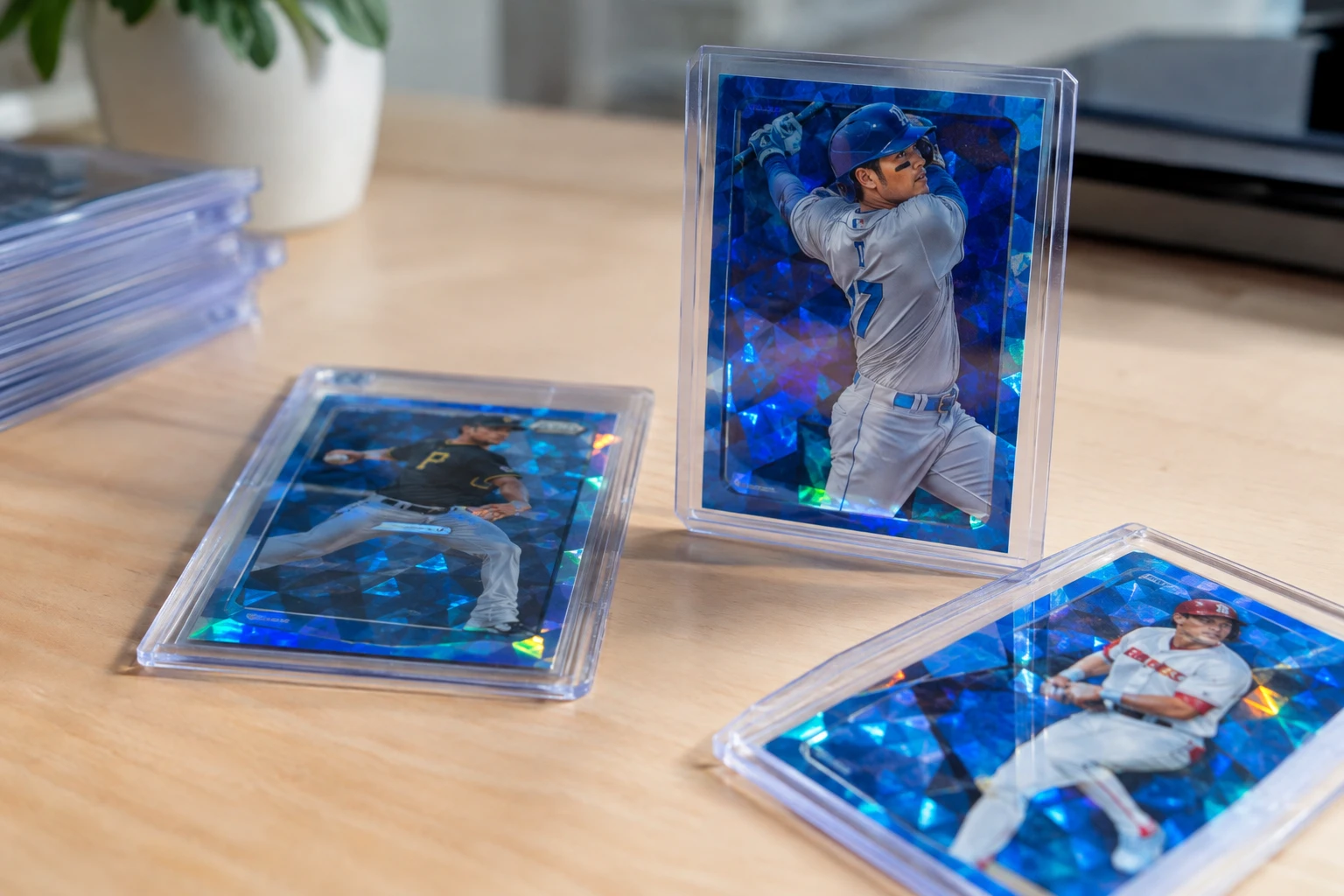
2026 Topps Chrome Sapphire Edition dropped August 26, 2026 at $649.99 per hobby box — 300-card Sapphire-finished set, one on-card auto numbered /199 or less, and three numbered parallels per box. It's the online-exclusive jewel finish on flagship Chrome, and it produces some of the year's most photogenic graded cards.
It's also a grading minefield: the chromium surface that makes Sapphire beautiful shows every defect. This guide covers the parallel structure, the stock's known issues, and what actually justifies the fee.
2026 Sapphire: Box Economics
- Price: $649.99/box ($6,499.99/case of 10)
- Configuration: 8 cards/pack × 4 packs = 32 cards/box
- Guarantees: 1 on-card auto (/199 or less) + 3 numbered parallels
- Checklist: 300-card base (mirroring 2026 Topps Chrome) + 50 Image Variations + Hidden Gems insert + two auto sets
- Distribution: online-exclusive (Topps direct) — supply-constrained vs retail Chrome
At ~$20/card average, the box math is thin: you need the auto and parallels to carry. The grading question concentrates on those hits plus the top-rookie base cards.
The Parallel Ladder
| Parallel | Numbering | Pack Odds | Grading Verdict |
|---|---|---|---|
| Base Sapphire | — | — | Only stars/rookies, flawless |
| Gold | /50 | 1:7 packs | Grade stars/rookies |
| White | /30 | 1:12 packs | Grade stars/rookies |
| Orange | /25 | 1:14 packs | Grade |
| Black | /10 | 1:35 packs | Grade |
| Red | /5 | 1:70 packs | Grade |
| Padparadscha | 1/1 | 1:344 packs | Always grade — trophy |
Plus the guaranteed auto (/199 or less, on-card) and Sapphire Selections autographs. Numbered parallels of stars and top rookies are the core grading targets — serial-numbered scarcity plus the sapphire finish means graded copies of premium parallels carry strong premiums. See our serial-numbered grading guide.
Chromium Stock: The Defect Profile
Sapphire uses the same chromium-card stock as Topps Chrome — and it fails differently than paper:
- Print lines: roller lines across the chrome surface, often invisible at normal angles but fatal under grading light. Tilt-check every card.
- Edge chipping: the rigid chrome stock chips on edges and corners rather than bending — a chip is a surface defect, not a corner defect, and caps grades hard.
- Surface scratches: cards in a pack rub against each other face-to-face; chrome micro-scratches are common even pack-fresh.
- Dimpling: pressure dimples show on the smooth chrome field.
- Centering: standard Chrome-era drift — measure it.
Practical result: Sapphire gem rates run below comparable paper products. Screen before submitting — AI pre-grading reads surface lines and edge chips from photos.
What to Grade from a Box
Always grade (after screening):
- The box auto if it's a star/rookie — on-card autos of names carry real premiums
- Any numbered parallel of a top rookie or star (Ohtani, top-5 rookies)
- Any 1/1 — Padparadscha and printing plates are trophies regardless of player
Screen first:
- Base rookies — only flawless copies of top names; Sapphire base PSA 10s carry modest premiums
- Numbered parallels of mid-tier players — check comps; serial number alone doesn't save a nobody
- Image Variations — a 50-card SSP subset; SSP status helps, screen for condition
Skip: veteran base, non-numbered filler — the fee exceeds any premium.
The ROI Math
Example — star rookie Gold /50: raw ~$50-150 → PSA 10 ~$300-600 → comfortably clears PSA Standard or even Priority on a strong name.
Example — base star rookie: raw ~$10-30 → PSA 10 ~$60-120 → thin; only flawless copies at CGC Economy ($20).
The Sapphire edge: because gem rates are suppressed by the stock, a clean PSA 10 on a numbered parallel carries a scarcity premium inside an already-scarce print run. Screen ruthlessly — ROI calculator per card.
Submission Notes
- Declared value: numbered parallels and autos of stars can comp past $1,000 at PSA 10 — check the tier cap before submitting (Standard is $1,000).
- No handling shortcuts: chrome stock picks up fingerprints — handle by edges with sleeves ready.
- PSA vs CGC: PSA dominates baseball Sapphire resale. CGC is viable for budget lanes on mid-tier cards where CGC comps hold.
Full flow: PSA submission guide.
Frequently Asked Questions
How much is a 2026 Topps Chrome Sapphire box?
What are the Sapphire parallel odds?
Are Topps Sapphire cards worth grading?
What is a Padparadscha card?
Do Sapphire cards grade worse than regular Chrome?
Sources & Further Reading
- Topps — 2026 Chrome Sapphire Launch
- Beckett — 2026 Topps Chrome Sapphire Checklist
- PSA Population Report
- Degree Grading — Sapphire Checklist
The PreGradeCards Research Team combines machine-learning engineers, grading analysts, and collector-education specialists to produce accurate, data-driven guides on AI card grading, professional grading standards, and collecting strategy.
With submission floors rising, pre-screening is no longer optional. Use our AI Pre-Grade Calculator to score a card's PSA 10 odds before you pay, and the Submission Planner to pick the right tier.