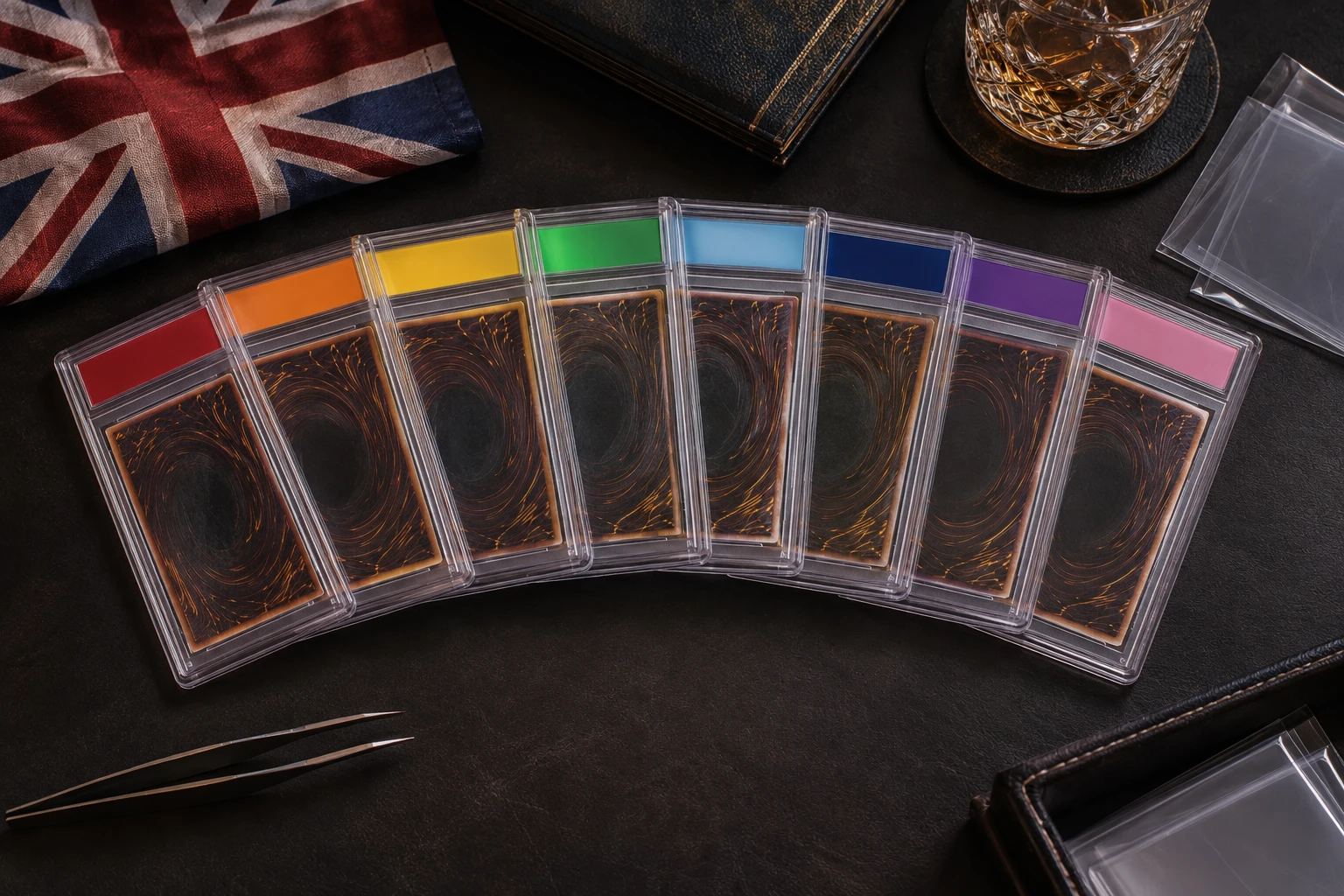
The Short Answer
- A UK card grading label solves one problem — the card never crosses a customs border — and creates another: above the eBay UK guarantee threshold your buyer pool shrinks.
- Of the eight names on the circulating shortlist, only ACE, Imperium, MGC, TFG and PG grade in the UK with a schedule you can actually price. WCG and PGS are US companies, AOG is German, and no Iconic grading service could be verified.
- ACE's live pricing page on 14 November 2026 lists Basic at £18 and Luxury at £100, but its own help-centre table still shows the June 2026 ladder up to £120. Budget the higher figure.
- Imperium's homepage carried an All services closed status pill while its pricing panel showed only Gold and Platinum closed. Get written confirmation of the open tier before you post cards.
- eBay UK's Authenticity Guarantee covers PSA, SGC, CGC/CSG and BGS only — no UK boutique label is inside the programme, at any price.
- Liquidity is a property of the label, not the grade: an ACE 10 sold for £1,230.70 on eBay UK in 2026, while MGC, TFG and PG slabs realistically trade at or near raw outside the UK.
- Route anything above roughly £250-500 to PSA or CGC. Below that, the domestic label's fee and speed usually beat a label premium you would not collect anyway.
Why UK card grading labels exist at all
Every UK card grading label exists for the same reason: the card never crosses a border. You pay in pounds, you post to an address with a UK postcode, and the slab comes back without a customs form attached to either leg. For a card worth £30 that is the whole argument — a £18 fee on a £30 card is already hard to justify, and it becomes impossible once transatlantic postage, dealer handling and 20 percent import VAT are added to a US submission.
The second reason is speed. UK labs publish ladders in business days rather than months, and the fastest tiers are measured in days, not seasons. That matters when the card is for a set, a show or a birthday rather than a portfolio.
The third reason is that the UK market is trading-card-game heavy. Pokémon, One Piece and Lorcana sellers work in small batches and repeat constantly, which suits a domestic lab that takes a five-card order without a dealer in the middle.
Routes and customs maths live in our UK and Europe submission guide and the football card route breakdown. This page is the part nobody publishes: a scored comparison of the labels.
Screen the shortlist before you score it
The shortlist circulating in UK collector groups in 2026 is a mix of domestic labs, foreign labs and names that no longer function as described. Screen first, then score, or you end up comparing a UK service with a company that answers email from another continent.
| Name on the shortlist | Where it actually grades | Status checked 14 Nov 2026 | Scored here |
|---|---|---|---|
| ACE Grading | England | Open, full public ladder | Yes |
| Imperium | UK | Partly open; site contradictory | Yes |
| MGC (Majesty) | UK | Open; fees third-party sourced | Yes |
| TFG | UK | Open, published comparison | Yes |
| PG Grading | UK (Poole) | Open; fee third-party sourced | Yes |
| WCG (World Class Grading) | United States, est. 2001 | Own FAQ: not accepting individual submissions | No |
| AOG | Germany | Regional label, no UK schedule found | No |
| PGS | United States | Legacy small-label tier, no active UK schedule | No |
| Iconic | No service verified | iconicgrading.com served a placeholder page | No |
| Edge / FCG | United States | No UK resale evidence to score | No |
Being German or American is not a fault. It simply means the label cannot solve the UK problem, and the same names already appear in our small grading company breakdown and the worldwide alternative directory. The five that survive the screen are the ones a UK collector can actually buy from this week.
The 2026 UK boutique scorecard
Four axes, one rule: a row earns a mark only if we confirmed it in a browser on 14 November 2026. Unverified presence scores zero, which is deliberately harsh — an unpublished population report is a resale problem whether or not it exists.
| Label | Entry fee | Fastest tier | Liquidity /4 | Slab transparency |
|---|---|---|---|---|
| ACE | £18 Basic | £100 Luxury, 2 days | 4 | Four subgrades, measured centering, pop report, cert lookup |
| Imperium | £12 Bronze | £35 Platinum, 1-2 days (listed closed) | 3 | Subgrades, defect photos, centering data, QR cert lookup, pop report |
| MGC | from £12.99 | Not published | 1 | Single 1-10 grade |
| TFG | £10 Economy, min 3 | Not published | 1 | Single 1-10 grade |
| PG Grading | £13 Standard, min 3 | Not published | 1 | Sub-scores for centering, corners, edges, surface |
The spread between cheapest and dearest entry is £8 per card — real money on a twenty-card batch, irrelevant on a single £400 card. And the two labels with a full reporting stack are the two most expensive, which is what you are buying.
Fees and turnaround: read the invoice, not the homepage
ACE publishes a seven-level ladder. On 14 November 2026 the live pricing page listed Core at £12 for 75 business days and Value at £14 for 60 days, both restricted to paying members, then Basic £18 for 30 days, Standard £22 for 15, Premier £28 for 10, Ultra £50 for 5 and Luxury £100 for 2. Membership is £199 a year. Label options add £1 for colour match and £3 for an ACE label; the standard label is free.
The trap: ACE's help-centre article, last updated in July 2026, still lists Standard at £25, Premier at £32, Ultra at £60 and Luxury at £120. Two live pages, two ladders. Use the higher number when you price a flip; you will never be surprised by a bill that comes in under it.
Imperium lists Bronze £12, Silver £15, Gold £25 and Platinum £35, art label £3 extra, one-card minimum. On the same day its pricing panel marked Gold and Platinum as currently closed while a status pill on the homepage read All services closed. Both statements were live at once, so ask for written confirmation of the tier and queue before posting cards.
MGC, TFG and PG quote from £12.99, £10 and £13 respectively, with three-card minimums on the last two. Those figures come from third-party comparison tables, not the labs' own price pages. Every fee here is per card and excludes postage in both directions plus insurance; budget another £10-15 for a tracked return on a small order.
Resale liquidity: which local label actually sells
Liquidity is not quality and it is not price. It is the number of buyers who will pay a premium for the name on the label without asking what the label is. A domestic lab can pass every quality test and still fail this one.
We scored four checks: public population report, public cert lookup, a documented eBay UK sold result in the last twelve months, and recognition outside the UK. Every boutique label fails eBay UK eligibility, so that check sits outside the score and applies to all five.
ACE is the only UK label with a documented five-figure-ish domestic sale we could verify: an ACE 10 Pikachu with Grey Felt Hat 085 sold for £1,230.70 on eBay UK in 2026 (spot-checked 5 September 2026). One sale proves a pool exists, not that it is deep, so read it as a ceiling rather than a baseline. Imperium's slab sells on documentation — a QR code, defect photos and a written rationale a buyer can inspect — which helps at £100-300 and stops mattering at £1,000, where the buyer wants a PSA label.
MGC, TFG and PG behave like personal-collection labels on resale. Expect to sell at or near raw value to a buyer who does not know the name, and price accordingly. Our comparison of SGC slab resale against PSA shows how even a long-established second label carries a discount.
- Sports Card Auto and Mem and Graded cards pack — $10.00 on eBay →
- graded sports trading card singles — $80.00 on eBay →
- sports cards graded 10 — $150.00 on eBay →
- sports card singles graded — $35.00 on eBay →
Ad · Listings shown are from eBay. We may earn a commission when you buy through these eBay links. Prices and availability are set by eBay sellers and change often.
Subgrades and slab quality: what the label tells a buyer
A subgrade is a receipt. It tells the buyer why the card got the number, and it lets them disagree with one axis instead of the whole grade. That is why a four-subgrade UK slab is easier to sell than a bare 1-10.
ACE grades on a 19-point scale from 10 to 1 in half steps, with subgrades for centering, corners, edges and surface and centering measured front and back. The cert page carries the numbers, and the population report lets a buyer see how many examples sit at the top of the scale. Imperium publishes subgrades, high-resolution defect call-outs, centering measurements and a written rationale for every card; its Red Label requires a perfect 10 across every subgrade at a 51/49 centering standard, a stricter published bar than most of the market.
PG publishes sub-scores for centering, corners, edges and surface and states a 60/40 centering tolerance at its top grade, which is looser than PSA's 55/45 and worth knowing before you assume a PG 10 crosses. MGC and TFG publish a single 1-10 grade. That does not make them wrong; it makes them harder to resell to a stranger.
On the holder, ask two questions: is the weld tamper-evident, and is there a UV claim in writing? A slab that yellows in a sunny room is a slow loss.
eBay UK acceptance is the real gate
eBay UK launched its Authenticity Guarantee for trading cards on 6 May 2026. Eligible cards ship to a physical authentication facility, are inspected by PSA, tagged with a tamper-evident QR label and sent on by tracked next-day delivery. It costs buyers and sellers nothing, and it applies on both sides of a return.
The eligible brands are PSA, SGC, CGC (including CSG) and BGS. That is the entire list. No UK boutique label is inside the programme, and no amount of subgrade detail changes it. Note the threshold carefully: launch coverage in May and September 2026 described £500 and above, while eBay UK's own eligibility page, checked 14 November 2026, states £250 or more. Assume the lower number, and trust the blue badge on the listing rather than any article — including this one.
The practical consequence is not that a boutique slab cannot be sold on eBay UK. It is that above the threshold the buyer is carrying verification risk with no programme behind them, so they price the risk in. A £600 PSA 9 and a £600 ACE 10 are not competing for the same buyer, and the gap widens with value.
Below the threshold the programme does not apply to anybody, which is exactly why cheap domestic flips still work. If your average sale is £40-£150, eBay UK acceptance is a non-issue and the domestic fee is the only variable that matters.
When a boutique label is the right call
Use a UK label when the card is not really for sale. Personal collection, display, a binder upgrade, a gift — grading is then a preservation and presentation purchase, and paying for a US label premium you will never collect is waste.
- Cards under about £100. A £12-£18 fee plus £10 postage is the entire margin on a £60 card; keep the round trip domestic and the maths survives.
- Deadline work. A show, a set completion or a birthday in three weeks. A 5-10 business day tier fixes it; a 60-day international round trip does not.
- UK-only buyer base. If you sell through UK card shows, Facebook groups and Discord servers, the label is already recognised by your buyer.
- Documentation over grade. If you want defect photos and a written rationale so you can decide whether to resubmit, Imperium's report is more useful than a bare number.
- Batch authentication. Twenty cheap cards verified and sealed without two international shipping legs and two insurance charges.
The honest summary is that a boutique label is a service purchase, not an investment. Buy it when the service is the thing you want. If you want to know whether the card is worth grading at all, run it through our AI pre-grade first — the fee is small, but so is the card.
When PSA or CGC is the better answer
Route the card out when the label is part of the value. That is a specific condition, not a loyalty position: the card must be expensive enough that a percentage premium exceeds the extra cost and the extra weeks.
As of late 2026, a UK dealer route to PSA was quoted at roughly £22-23 per card at the value bulk level, and CGC through its UK office at about £27 plus VAT on a two-card modern bulk minimum — both figures from a published comparison checked in July 2026, both excluding dealer handling and return postage on the dealer route. Add the dealer margin and the round trip and you are looking at £35-£45 all-in per card, against £28-£33 all-in for a domestic boutique order.
So the crossover is where the label premium is worth more than about £10-£15 per card. On modern Pokémon that tends to happen somewhere above £250; on vintage sports cards it can happen earlier, because the buyer wants the label they already trust. Above £500 the eBay UK guarantee threshold makes the decision for you: if the card is going to sell with the blue badge, it has to be in an eligible holder.
Set-registry work, population-driven pricing and any sale to a US collector all point the same way. Check current pricing on our pricing page before you commit, and remember that a fail on a $30 card in a $45 holder is the same loss in any currency.


Ad · Listings shown are from eBay. We may earn a commission when you buy through these eBay links. Prices and availability are set by eBay sellers and change often.
Frequently Asked Questions
Which card grading companies are actually based in the UK?
What does ACE Grading charge per card in 2026?
Is Imperium Grading taking submissions right now?
How long does a UK boutique grading order take?
Do UK boutique slabs sell on eBay UK?
Does eBay UK Authenticity Guarantee cover ACE or Imperium?
Are UK subgrades comparable to BGS subgrades?
Is grading in the UK cheaper than using PSA?
What is MGC grading in the UK?
Sources & Further Reading
- ACE Grading — current service level pricing (checked 14 Nov 2026)
- ACE Grading Help Centre — cost per submission level (updated 21 Jul 2026)
- Imperium Grading — UK slabs, subgrades and certification lookup
- TFG — card grading comparison table (UK and international graders, Jul 2026)
- PG Grading — UK grading scale and sub-scores
- eBay UK — Authenticity Guarantee for trading cards (eligibility, checked 14 Nov 2026)
- eBay — Authenticity Guarantee for trading cards launches in the UK (6 May 2026)
- World Class Grading — FAQ (individual submissions status)
- Galar Alerts — UK card grading companies compared (31 Oct 2026)
Sarah Williams leads PreGradeCards educational content and collector onboarding. She has been a full-time collector and dealer for 12 years, specializing in modern sports cards and Pokémon TCG, and has written grading guides read by over 300,000 collectors.
Create a free account and get 2 free credits. No credit card required.
Get Your Free Credits →