The Short Answer
- CGC is genuinely competitive with PSA for TCG resale — CGC 10 Pokémon sells for 70-80% of PSA 10 equivalent, much closer than the sports card gap.
- TCGplayer (10.75% commission) is the standard for TCG singles — use it for organized inventory, eBay for high-value slabs.
- Vintage TCG (WOTC Pokémon, 1st Edition) requires grading — authentication risk is too high for raw sales of high-value vintage.
- Foil and holo TCG cards are extremely prone to surface scratches — always check under oblique light before listing.
- AI pre-grading works for all TCGs — the same four criteria (centering, corners, edges, surface) apply across Pokémon, MTG, Yu-Gi-Oh!, and more.
- Japanese Pokémon cards generally center better than English — expect higher PSA 10 rates on Japanese prints.
- Alt-art and special rarity TCG cards have the highest grading premiums — PSA 10 alt-arts can sell for 3-5x raw value.
The TCG Card Market in 2026
The TCG market in 2026 is booming. Pokémon continues its dominance with the Mega Evolution—Pitch Black expansion (July 17) and the 30th Celebration expansion (September 16). Magic: The Gathering is releasing crossover sets with The Hobbit, Marvel, and Star Trek. Yu-Gi-Oh! has the Chaos Origins set with Starlight 2.0 rares. One Piece TCG continues its global expansion with OP-17. Lorcana is growing with the Attack of the Vine! set. Dragon Ball Super, Flesh and Blood, Digimon, and a dozen other TCGs all have active competitive and collector markets.
For sellers, this means opportunity — but also complexity. Each TCG has its own rarity systems, card types, buyer demographics, and marketplace dynamics. A strategy that works for Pokémon alt-arts may not work for MTG Reserved List cards. This guide covers the unique selling strategies for each major TCG, with a focus on how pre-grading tools help you maximize profit across all of them.
How TCG Selling Differs from Sports Cards
While the four grading criteria are identical (centering, corners, edges, surface), the TCG selling landscape differs from sports cards in several important ways.
Grading Company Dynamics
For sports cards, PSA commands such a dominant resale premium that other graders are often not worth considering. For TCG, the landscape is different. CGC has closed the gap significantly on modern Pokémon and is genuinely competitive. A CGC 10 Pokémon card sells for 70-80% of the PSA 10 equivalent — much closer than the 50-60% ratio seen in sports cards. This means CGC Economy at $20 is a viable option for TCG cards where PSA Regular at $80 would not be profitable.
Marketplace Dynamics
TCGplayer is the default marketplace for TCG singles — it does not exist for sports cards. TCGplayer offers organized inventory management, condition grading standards specific to TCG (NM, LP, MP, HP, Damaged), and a buyer pool specifically looking for TCG singles. For high-value TCG slabs, eBay is still the best platform for price discovery.
Card Construction
TCG cards are constructed differently from sports cards. The foil/holo layer on TCG cards is softer and more prone to surface scratches. TCG cards generally have better factory centering than sports cards (especially modern Pokémon). Vintage TCG (WOTC-era Pokémon, early MTG) has significant counterfeit risk that sports cards do not face at the same scale.
Buyer Demographics
TCG buyers are often players as well as collectors. A Magic: The Gathering player buying a card for a tournament deck cares about condition differently than a Pokémon collector buying for investment. Players may accept Lightly Played condition for gameplay; collectors demand Near Mint or better. This affects how you price and list TCG cards — you need to appeal to both audiences.
Choosing a Grader for TCG Cards
The grader choice for TCG cards depends on the game, the card value, and your target buyer.
| Grader | TCG Resale Premium | Best TCG Use Case | Cost |
|---|---|---|---|
| PSA | Highest (100% baseline) | High-value TCG, vintage Pokémon, alt-arts | $79.99 |
| CGC | 70-80% of PSA | Mid-value TCG, modern Pokémon, MTG | $20-$55 |
| BGS | 60-70% of PSA | Premium MTG, Black Label candidates | $79.95 |
| ACE | Emerging | Perfection-focused, 50/50 centering | Varies |
Decision Framework
- TCG card worth $300+ in PSA 10: PSA Regular ($79.99). The PSA premium justifies the cost.
- TCG card worth $50-$300 in PSA 10: CGC Economy ($20) or CGC Standard ($55 for faster turnaround). The 70-80% resale ratio makes CGC economically viable.
- TCG card worth under $50: Sell raw with AI condition report. Grading is not profitable at any tier.
- Vintage TCG (WOTC Pokémon, 1st Edition): PSA only. Authentication trust is critical for vintage TCG.
- Premium MTG (Black Lotus, Reserved List): PSA or BGS. BGS sub-grades are valued by MTG collectors.
Pokémon Card Selling Strategy
Pokémon is the largest TCG market and has the most developed grading and selling ecosystem. Here is the complete selling strategy for Pokémon cards in 2026.
Modern Pokémon (Sword & Shield, Scarlet & Violet, Mega Evolution)
- Alt-art and special rarity cards: These have the highest grading premiums. A PSA 10 Charizard VMAX alt-art from Evolving Skies sells for $1,400 vs $700 raw — a 2x premium. Pre-grade before submitting.
- Common and uncommon cards: Sell raw on TCGplayer. Not worth grading unless the card has cult popularity.
- Holo rares ($20-$100): CGC Economy ($20) if the AI predicts 10. Sell raw with AI report if predicted 9 or below.
- Promo cards: Check pop reports. Some promos have very low PSA 10 populations, making grading highly profitable.
Vintage Pokémon (WOTC Era: Base Set, Jungle, Fossil, Team Rocket)
- Authentication is critical: Vintage Pokémon has significant counterfeit risk. Grading is essentially mandatory for high-value vintage — buyers will not pay market price for raw vintage Pokémon due to fake risk.
- Centering is the main challenge: WOTC-era Pokémon has notoriously inconsistent centering. Pre-grade to check centering before submitting.
- Even low grades have value: A PSA 5 Base Set Charizard still sells for $1,500+ because the slab provides authentication. Grade even if the condition is poor.
- 1st Edition and Shadowless: These command massive premiums. Always grade — the authentication and condition verification are worth the fee.
Japanese Pokémon Cards
Japanese Pokémon cards generally have better factory centering than English prints. If you source Japanese cards for grading, expect higher PSA 10 rates on centering alone. However, the resale market for Japanese PSA 10s is smaller than English — price accordingly. Use the TCG Card Identification tool to identify Japanese cards and get pricing data.
Magic: The Gathering Selling Strategy
MTG has the most complex selling landscape of any TCG due to the Reserved List, multiple card types (creatures, lands, artifacts, enchantments), and the distinction between tournament-playable and collector cards.
Reserved List Cards
The Reserved List (Black Lotus, Mox Pearl, Underground Sea, etc.) represents the highest-value MTG cards. These should almost always be graded — the slab provides authentication and condition verification that buyers demand for four-figure and five-figure cards. PSA is the preferred grader for Reserved List, though BGS is also respected by MTG collectors for its sub-grade breakdown.
Tournament Staples
Cards that see competitive play (fetch lands, dual lands, staple creatures) have strong demand from both players and collectors. For tournament staples worth $50-$200:
- Near Mint copies: Pre-grade with AI. If predicted 9-10, submit to CGC Economy ($20). CGC is well-accepted in the MTG community.
- Lightly Played copies: Sell raw on TCGplayer with accurate condition grading. Players buy LP for decks.
Modern MTG Sets
Modern MTG cards (2020+) with alternate arts, serialized cards, and special treatments have collector value similar to Pokémon alt-arts. Pre-grade before deciding to submit. Serialized cards (numbered /500, /250, /100) should almost always be graded — the serial number plus the grade creates a unique collectible.
Yu-Gi-Oh! Card Selling Strategy
Yu-Gi-Oh! has a unique market structure. The game has been continuously popular since 2002, and certain cards — Ghost Rares, Starlight Rares, 1st Edition Legend of Blue-Eyes White Dragon — command enormous premiums in PSA 10.
High-Value Yu-Gi-Oh! Cards
- Ghost Rares: These have holographic foil that changes with viewing angle. Surface scratches are the main issue. Pre-grade with AI to check surface before submitting.
- Starlight Rares: The rarest modern Yu-Gi-Oh! rarity. PSA 10 Starlight Rares can sell for $500-$5,000+. Always pre-grade before submitting.
- 1st Edition LOB (Legend of Blue-Eyes White Dragon): Vintage Yu-Gi-Oh! with strong collector demand. Grade with PSA for authentication and maximum resale premium.
Tournament Staples
Yu-Gi-Oh! tournament staples worth $20-$100 should be sold raw on TCGplayer with AI condition reports. CGC Economy is viable for $50+ cards predicted 9-10. The Yu-Gi-Oh! community is increasingly accepting of CGC slabs.
One Piece, Lorcana, Dragon Ball, and Other TCGs
One Piece TCG
One Piece is one of the fastest-growing TCGs. Alternate art Leader cards and Treasure Rares from OP-17 are the highest-value targets. Pre-grade alt-art Leaders before submitting to PSA. The One Piece collector community is growing rapidly, and PSA 10 premiums are increasing as the player base expands.
Disney Lorcana
Lorcana is growing with the Attack of the Vine! set (July 2026) introducing dual-ink cards. Enchanted rarity cards are the top-tier collectibles. Pre-grade Enchanted cards before submitting. CGC Economy is viable for mid-value Lorcana cards.
Dragon Ball Super
DBS has SCR (Special Campaign Rare) and God Rare cards that command high premiums in PSA 10. The Fusion World 2026 Championship is driving interest in prize cards. Pre-grade SCR and God Rare cards before submitting.
Flesh and Blood, Digimon, Star Wars: Unlimited
These emerging TCGs have smaller but passionate collector bases. Pre-grade high-value cards before submitting. For these TCGs, CGC is often the best choice due to lower fees and growing acceptance. Use the TCG Card Identification tool to identify cards from any TCG and get pricing data.
TCG Marketplaces: TCGplayer vs eBay vs Whatnot
TCG sellers should use multiple marketplaces. Here is how to split your TCG inventory across platforms.
TCGplayer (10.75% commission)
Use TCGplayer for:
- Organized singles inventory — Pokémon, MTG, Yu-Gi-Oh!, One Piece, Lorcana
- Set-build buyers who purchase multiple cards from one seller
- Cards in the $2-$500 range
- Both raw and graded (TCGplayer supports graded listings)
Use the Quick Condition Check tool to generate TCGplayer-compatible condition labels. The AI condition assessment is more consistent than human eyeballing.
eBay (13.25% commission)
Use eBay for:
- High-value TCG slabs ($500+)
- Vintage TCG (WOTC Pokémon, 1st Edition)
- Alt-art and special rarity cards where the buyer pool extends beyond TCGplayer
- Raw cards with AI pre-grade reports (eBay buyers respond well to condition verification)
Whatnot (~9.5% effective fee)
Use Whatnot for:
- Sealed TCG product (booster boxes, packs, ETBs)
- Live breaks and group breaks
- Hot release-window product
- TCG lots and mystery packs
Pre-Grading Workflow for TCG Sellers
The pre-grading workflow for TCG cards is the same as for sports cards, with a few TCG-specific considerations.
Step 1: Photograph Front and Back
TCG cards need front and back photos. The back of a TCG card often has the set symbol and edition information, and back centering matters for grading. Use even lighting — foil cards need special attention to avoid glare that hides surface defects.
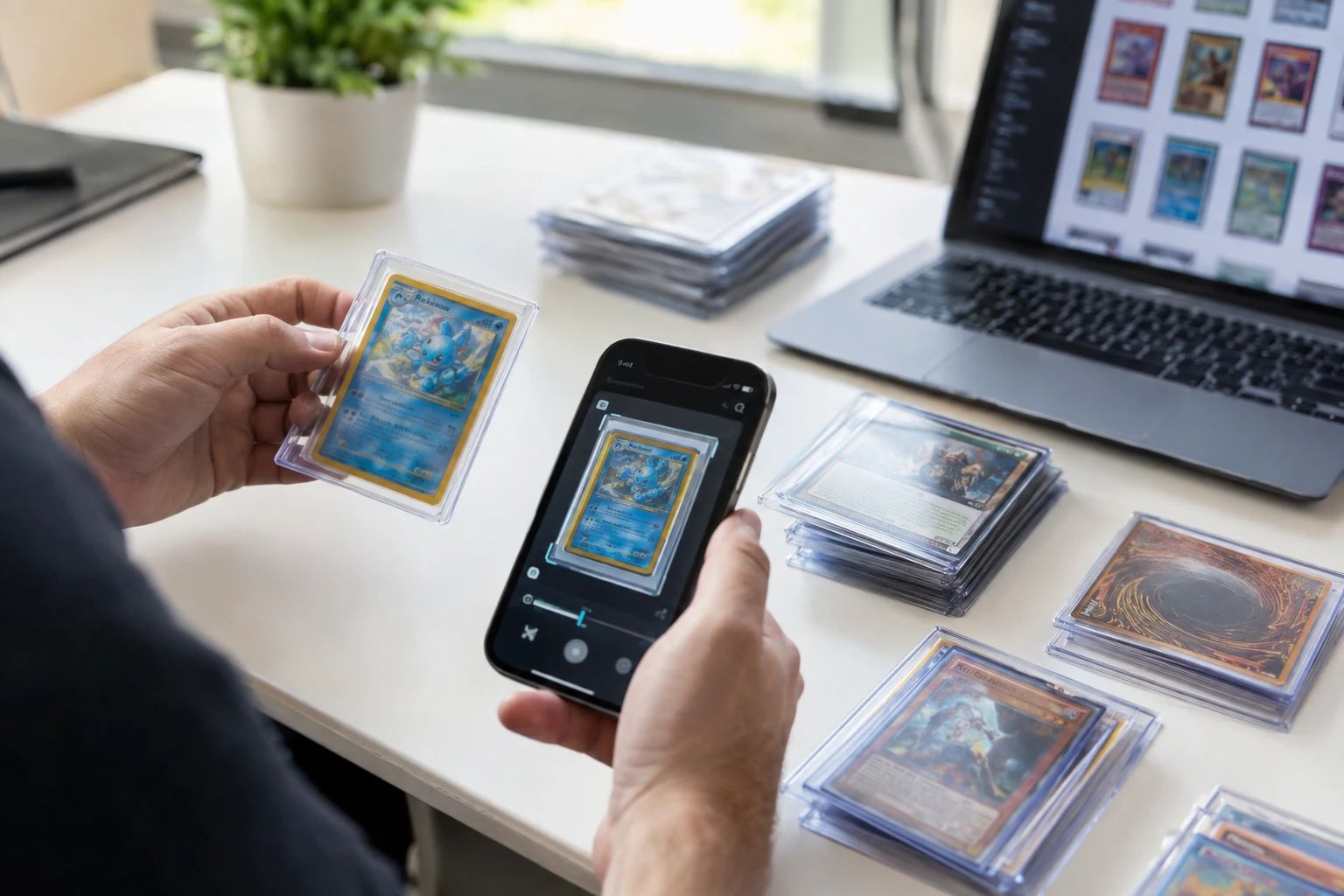
Step 2: Run AI Pre-Grading
Upload to PreGradeCards Complete Card Grading. The AI evaluates all four criteria and returns predicted PSA/CGC/BGS grades with sub-grade breakdowns. For TCG cards, pay special attention to the surface sub-grade — foil and holo cards are prone to surface issues that are invisible under flat lighting.
Step 3: TCG-Specific Decision Tree
- AI predicts PSA 10, card worth $300+: Submit to PSA Regular ($79.99)
- AI predicts PSA/CGC 10, card worth $50-$300: Submit to CGC Economy ($20)
- AI predicts PSA 9, card worth $100+: CGC Economy ($20) — the CGC 9 resale premium may justify the fee
- AI predicts 8 or below: Sell raw on TCGplayer with AI condition report
- Card worth under $50: Sell raw on TCGplayer — grading is not profitable
- Vintage TCG (WOTC, 1st Ed): Grade with PSA regardless — authentication is the primary value
Foil and Holo Surface Issues: The TCG Seller's Nemesis
Foil and holo TCG cards are the most condition-sensitive cards in the hobby. The foil layer is softer than standard card stock, making it extremely prone to scratches, scuffs, and print lines. Surface defects are the #1 reason foil TCG cards do not grade PSA 10.
How to Check Foil Surface
- Tilt the card under direct light at 15-30 degrees. Surface scratches and scuffs become visible at oblique angles that are invisible under flat overhead lighting.
- Look for print lines. These are linear defects from the printing process that run across the foil. They are common on modern Pokémon and MTG foil cards.
- Check for dimples and indentations. These appear as small depressions in the foil that catch light differently.
- Look for holo bleed or ghosting. Some holo patterns have manufacturing artifacts that look like double-printing.
AI Surface Analysis for Foil Cards
AI pre-grading tools analyze the card photo for surface defects. For foil cards, the AI can detect scratches, print lines, and dimples that are difficult to see with the naked eye. However, the photo quality is critical — take foil card photos under angled lighting to give the AI the best chance of detecting surface issues.
Pricing Foil Cards with Surface Issues
If the AI detects surface defects on a foil card, adjust your pricing and listing strategy:
- Minor surface issues (AI surface sub-grade 8.5-9): Sell raw with AI report disclosing the issue. Price at 80% of raw market median.
- Moderate surface issues (AI surface sub-grade 7-8): Sell raw with full disclosure. Price at 60-70% of raw market median.
- Severe surface issues (AI surface sub-grade below 7): Sell as "Damaged" on TCGplayer or as part of a lot. Do not submit for grading.
Vintage TCG: Authentication and Grading
Vintage TCG cards — WOTC-era Pokémon (Base Set, Jungle, Fossil, Team Rocket), early MTG (Alpha, Beta, Arabian Nights), and 1st Edition Yu-Gi-Oh! (LOB, MRD, MRL) — face a unique challenge that modern cards do not: counterfeit risk. High-value vintage TCG has been heavily counterfeited, and buyers are rightfully skeptical of raw cards.
Why Grading Is Mandatory for Vintage TCG
For vintage TCG cards worth $100+, grading is essentially mandatory. The slab provides three critical functions:
- Authentication: PSA, CGC, and BGS all verify authenticity before grading. A slab is proof the card is real.
- Condition verification: The grade provides objective condition assessment that buyers trust.
- Liquidity: Slabbed vintage TCG sells faster and at higher prices because buyers do not need to authenticate or evaluate condition themselves.
Pre-Grading Vintage TCG
Even though vintage TCG should almost always be graded, pre-grading is still valuable. It helps you:
- Estimate the grade so you can set realistic expectations for resale value
- Identify centering issues that are common in WOTC-era Pokémon
- Detect surface problems that may limit the grade
- Decide between PSA and CGC based on the predicted grade and card value
Bulk TCG Selling Strategy
For sellers with large TCG collections, bulk selling is an important strategy. Here is how to handle bulk TCG inventory efficiently.
The Bulk Sorting Workflow
- Sort by set and rarity. Group cards by set and rarity tier. This makes TCGplayer listing faster.
- Batch pre-grade high-value cards. Use the Batch Grading tool to process 20 cards at once. Identify PSA/CGC 10 candidates.
- Send 10 candidates to CGC Economy. At $20/card, CGC Economy is viable for $50+ TCG cards.
- List mid-value cards on TCGplayer. Use the Quick Condition Check for condition labels. Price at TCGplayer market price.
- Sell bulk commons and uncommons as lots. Bundle by set. Sell on eBay as "100 card [Set Name] lot" or sell to a bulk buyer.
Bulk Buyer Options
For truly bulk TCG (commons, uncommons, low-value rares), bulk buyers purchase cards at $0.01-$0.05 each. This is the fastest way to liquidate bulk. Use bulk buyers for cards worth under $1 that are not worth listing individually.
Frequently Asked Questions
Should I grade my Pokémon cards before selling?
Is CGC good enough for TCG cards?
Where is the best place to sell TCG cards?
How do I check foil TCG cards for surface damage?
Should I grade vintage Pokémon cards?
Can I use AI pre-grading for TCG cards?
What TCG cards are worth grading in 2026?
How do I sell bulk TCG cards?
Sources & Further Reading
- The Card Shop Finder — How to Sell Trading Cards 2026
- TCGplayer — Seller Guide
- PreGradeCards — AI TCG Grading Guide
- PreGradeCards — AI Pokémon Card Grading Guide
- PreGradeCards — AI MTG Card Grading Guide
- PreGradeCards — AI Yu-Gi-Oh Card Grading Guide
- Hall of Cards — Best Sports Card Marketplaces 2026
Sarah Williams leads PreGradeCards educational content and collector onboarding. She has been a full-time collector and dealer for 12 years, specializing in modern sports cards and Pokémon TCG, and has written grading guides read by over 300,000 collectors.
Create a free account and get 1 free credit — enough for 1 complete AI grading with market pricing. No credit card required.
Sign Up Free →