The Short Answer
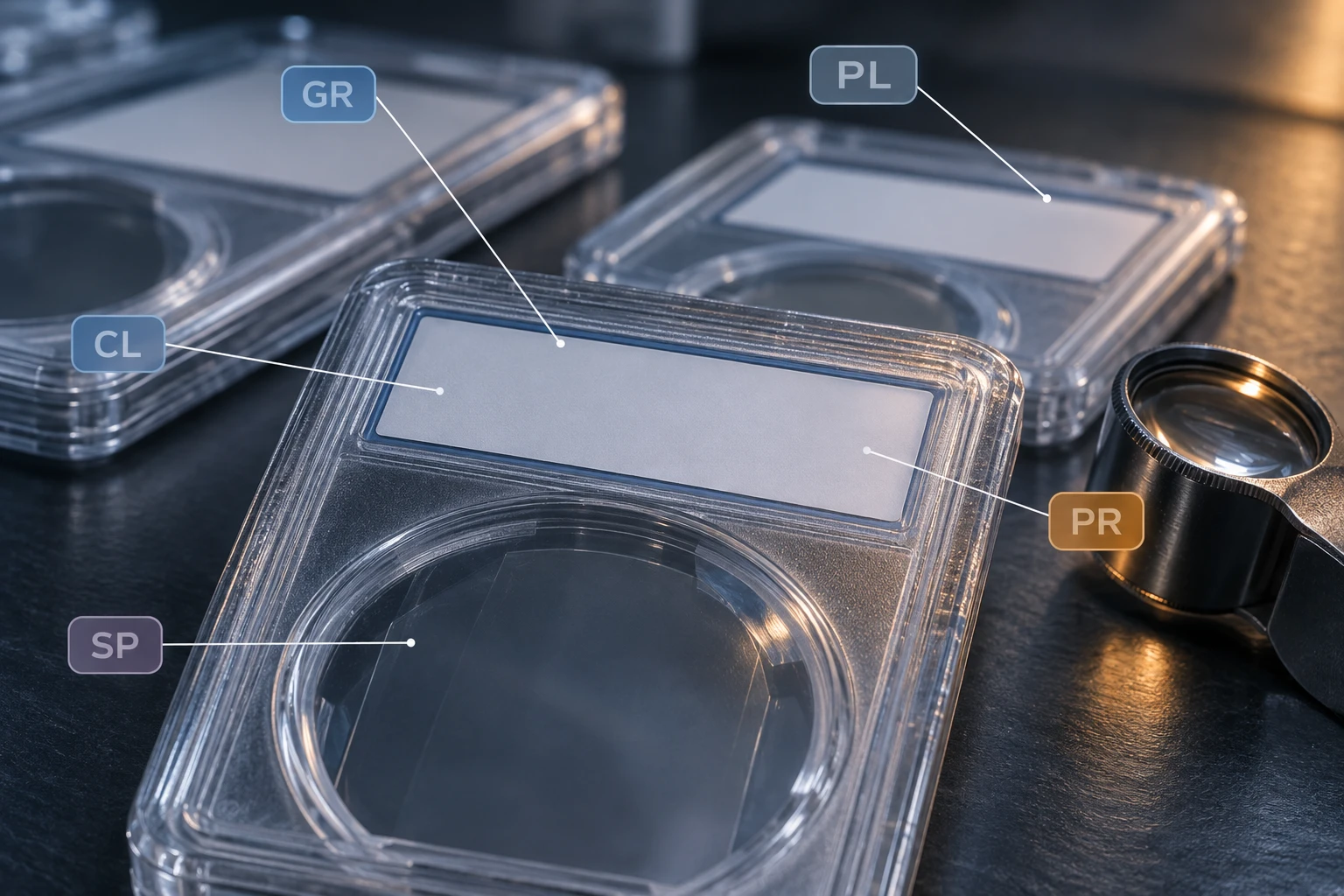
- A qualifier is not a penalty bolted onto a grade: PSA prints OC, ST, PD, OF or MK when a card meets every standard for the number except one.
- Grade scales are not directly comparable. CGC, SGC and TAG split the top into Pristine 10 and Gem Mint 10, while Beckett's Gem Mint is 9.5 and its only 10 is Pristine.
- Raw condition codes run NM, LP, MP, HP and DMG, and they describe the card, not the grade it would receive.
- BGS is the grader that still prints four subgrades for centering, corners, edges and surface, and its Black Label requires a 10 in all four.
- Marketplace shorthand such as RC, SP, SSP, parallel, refractor and 1/1 changes what a card is, not just how it is described.
- Cert lookup is the only reliable way to confirm a slab: check the number against the grader's own database before trusting the label.
The 12 terms that matter most
Card grading abbreviations are a small vocabulary that carries a lot of money. The twelve that come up most often are: grade, qualifier, subgrade, centering, OC, MK, PD, ST, RC, SP, SSP and parallel. Everything else is a variation on those.
A grade is the number, usually 1 to 10. A qualifier is a two-letter code printed beside it when a card meets the standard everywhere except one area. A subgrade is a component score for centering, corners, edges or surface. Centering is the ratio of the printed border on opposite sides.
OC, MK, PD and ST are PSA qualifiers: off-center, marks, print defect and staining. OF, for out of focus, completes the set. RC is a rookie card, SP and SSP are short print and super short print, and a parallel is a differently coloured or finished version of the same card.
The rest of this guide decodes the labels, the raw condition codes and the marketplace shorthand, and links out to the deep dives rather than repeating them. It is a reference, not a grading-scale tutorial.
Definitions checked November 2026 against the graders' own published standards.
Grade scales: PSA, BGS, CGC, SGC and TAG
The scales look similar and are not. The number means different things at different companies, and the top of the scale is worded differently at every one.
| Grader | Range | Top grades | What separates the top two |
|---|---|---|---|
| PSA | 1 to 10, no half grades | Gem Mint 10 | One 10, about 55/45 front and 75/25 back |
| BGS | 1 to 10, half grades | Pristine 10, Gem Mint 9.5 | Four subgrades; Black Label needs all four at 10 |
| CGC | 1 to 10, half grades | Pristine 10, Gem Mint 10 | Pristine requires 50/50 front centering |
| SGC | 1 to 10, half grades | 10 PRI, 10 GM | Pristine and Gem are separate 10s |
| TAG | 1 to 10 plus a 1,000-point score | Pristine 10, Gem Mint 10 | Score 990-1000 is Pristine, 950-989 is Gem |
PSA has one 10. A PSA 10 allows centering up to about 55/45 on the front and 75/25 on the back, which is looser than the Pristine standards at other companies.
Beckett is the odd one out. Its Gem Mint is a 9.5, not a 10, and its only 10 is Pristine. A Black Label is a Pristine 10 with all four subgrades at 10; a Gold Label Pristine allows one subgrade at 9.5.
CGC retired its Perfect 10 grade, keeps Gem Mint 9.5 legacy labels mapped to Gem Mint 10, and now has two 10s: Pristine at 50/50 and Gem Mint at about 55/45.
SGC also has two 10s, printed as 10 PRI and 10 GM. TAG adds a 1,000-point score underneath the 1-10 grade, so you can tell a strong 10 from a weak one.
Raw condition terms: NM, LP, MP, HP, DMG
Raw condition codes describe what a card is like now. They are not a prediction of a grade, and the mapping between the two is loose.
| Code | Means | Typical grade band |
|---|---|---|
| NM | Near Mint | About 7 to 9 |
| EX | Excellent | About 5 to 6.5 |
| LP | Lightly Played | About 5 to 7 |
| MP | Moderately Played | About 3 to 5 |
| HP | Heavily Played | About 1.5 to 3 |
| DMG | Damaged | Below a numeric grade or Authentic |
The bands are guides, not rules. A collector's NM can be a 7, a seller's NM can be an 8, and a marketplace's NM can be a 6. That is exactly why grading exists: the number is a third-party opinion rather than a word with no fixed meaning.
Sports cards usually use NM, EX-MT, EX, VG-EX and so on, following the vintage paper scale. Trading card games usually use NM, LP, MP, HP and DMG, which follows the way players handle cards. The card condition guide has the full definitions and photos.
Qualifiers and designations: OC, MK, PD, ST, OF, MC
A qualifier is printed beside the grade when a card meets every standard for the number except one. It is a note about a single flaw, not a separate grade.
| Code | Means | What it flags |
|---|---|---|
| OC | Off Center | Centering beyond the standard for the grade |
| MK | Marks | Writing, ink, pencil or an impression from writing |
| PD | Print Defect | A printing flaw beyond what the grade allows |
| ST | Staining | Staining that affects the grade |
| OF | Out of Focus | Image out of focus or out of register |
| MC | Miscut | Listed by some sources as a qualifier; PSA files miscut under its N-codes instead |
How to read one. A PSA 8 (OC) is a card that would be an 8 except for its centering. It is not a 6 with a note, and it is not evidence that the card would have graded higher without the flaw. In practice buyers price a qualified card below the same grade without one, and the rough rule of thumb is that a qualifier costs about two grade steps of value.
The MC confusion. PSA's glossary lists five qualifiers: OC, ST, PD, OF and MK. Miscut sits in the N-codes, which are the designations for cards that come back without a numeric grade, alongside trimming, restoration, recolouring and minimum size. Many hobby guides still print MC as a qualifier, which is where the disagreement comes from. When in doubt, read the label and the grader's own glossary rather than a third-party list.
Other designations. Authentic means the card is genuine but not numerically graded. Altered means trimming, recolouring or restoration was detected. Questionable Authenticity is a polite term for counterfeit. The PSA qualifiers guide goes deeper on each one and on when to opt out of a qualifier at submission.
Subgrades and what moves them
A subgrade is a component score. Beckett is the grader most associated with them, and it is the one that still prints all four on the label.
The four pillars. Centering measures the printed border on opposite sides, front and back. Corners are checked for sharpness, whitening and fraying. Edges are checked for chips, print lines and roughness. Surface is checked for scratches, print lines, indentations and gloss breaks.
How they combine. Beckett's overall grade is derived from the four subgrades, and the top labels are defined by them. A Black Label Pristine 10 needs all four at 10. A Gold Label Pristine 10 allows one subgrade at 9.5. Below that, the lowest subgrade tends to pull the overall grade down.
Who else prints them. CGC stopped offering subgrades on its standard labels when it retired Perfect 10. PSA does not print subgrades. SGC and TAG publish detailed condition reports rather than four subgrades, with TAG additionally issuing a 1,000-point score.
Why they matter at resale. A 9.5 with four 9.5s is a different card from a 9.5 with one 10 and three 9s, even though the label number is the same. Buyers who care about the difference will pay for it, and buyers who do not will ignore it. The subgrades guide covers the value impact in detail.
Autograph terms and dual grading
Autograph cards add a second vocabulary, and the difference between the terms is the difference between a signature being part of the card and being applied to it.
| Term | Means |
|---|---|
| On-card | Signed directly on the card surface |
| Sticker auto | Signed on a sticker that is then applied to the card |
| Facsimile | Printed signature, not hand-signed |
| In-person | Signed outside an official signing event |
| Witnessed | Signed in front of a grader's representative |
| Dual grade | Separate grades for the card and the autograph |
| Auto 10 | Autograph grade of 10, usually printed separately from the card grade |
On-card beats sticker. Collectors consistently pay more for an on-card signature because it is harder to produce and harder to fake convincingly. The gap is largest on modern rookies and smallest on older sets where both formats were used.
Facsimile is a veto. A printed signature is part of the design, not an autograph, and cards from sets like Heritage or Archives often carry facsimile signatures on every base card. Treat any facsimile card as unsigned for valuation purposes.
Dual grading. PSA, Beckett and CGC all offer a separate autograph grade, usually printed as a second number on the label. A card can be a 9 with an Auto 10, and the two numbers move independently.
Authentication. A signature alone is not proof. The grader's authentication arm, or a specialist authenticator, is what turns ink into a documented autograph, and the certificate is what a buyer checks.
Marketplace shorthand: RC, SP, SSP, /99, 1/1, parallel
Marketplace shorthand describes the card itself. Misreading it is how buyers pay a base-card price for a short print, or a short-print price for a base card.
| Term | Means | Why it matters |
|---|---|---|
| RC | Rookie card | Usually the player's first flagship card |
| SP | Short print | Shorter run than the base card |
| SSP | Super short print | Much shorter run, often case-hit level |
| Parallel | Colour or finish variant of a base card | Changes the card and the price entirely |
| Refractor | Reflective foil finish | A specific parallel family, not a generic shiny card |
| /99 | Serial-numbered to 99 | Print run, not a grade or a year |
| 1/1 | Only one copy exists | The top of the rarity ladder |
| Alt art | Alternative illustration | Usually a rarer printing of the same card |
| SIR, AR, SAR | Special illustration rare and related tiers | TCG rarity codes, set-specific |
The parallel trap. A parallel is a different card from the base, and the price can be ten times higher or lower. The word in a listing is not evidence that the card in the photo is the parallel being sold, so check the finish, the serial number and the set code before paying a premium.
Serial numbers are print runs. A /99 card has 99 copies, so the number tells you scarcity rather than condition. A grade of 9 next to a /99 means a graded card from a 99-copy run, not a 9-out-of-99 score.
Language and set codes. Japanese, Chinese and Korean printings use different set codes and numbering, and a card with the same artwork can carry a different collector number. Identify the language before comparing comps.
How to read a label and verify a cert
A slab label carries five things worth reading: the grader, the card identity, the grade, any qualifier or second grade, and the certification number.
The identity line. Year, set, player or character, variant and card number. This is the part that tells you whether the slab is the card the listing claims.
The grade line. The number, then any qualifier in brackets, then an autograph grade if there is one. Read the words as well as the number, because a CGC 9.5 and a CGC Gem Mint 10 are not the same thing even when a seller writes them in the same sentence.
The cert number. Every major grader publishes a lookup. Type the number into the grader's own database and compare the returned card, grade and variant against the label. A mismatch is a red flag; a number that returns nothing is a bigger one.
The slab itself. Check the weld, the label print quality and the holder for tampering. The cert lookup guide walks through the process, and the fake slab guide covers the physical tells.
For the full anatomy of a label across all five graders, read how to read a graded card label, and for the scales behind the numbers, the grading scale guide. A free AI pre-grade is the fastest way to get a condition read before you buy or submit.
Frequently Asked Questions
How do I read a qualifier such as PSA 8 (OC)?
What do MK, PD, ST and OF mean?
Is MC a PSA qualifier?
What is the difference between a Gem Mint 10 and a Pristine 10?
Why is a Beckett Black Label valued above a Gold Label?
What do NM, LP, MP, HP and DMG mean?
What does RC mean on a card listing?
What is the difference between SP and SSP?
What does /99 mean on a card?
How do I verify a graded card certificate?
Sources & Further Reading
- PSA grading standards and grade definitions
- PSA glossary of grading terms
- CGC grading scales
- TAG Grading scale and 1,000-point score
- Rip.fan: CGC versus SGC scales and labels
- Rip.fan: CGC Pristine, Perfect and Gem Mint explained
- Blake Crosley: reading a graded card label
- CardboardFile: PSA qualifiers explained
Dr. Andrew K. founded PreGradeCards in 2023 after building computer-vision systems for medical imaging and industrial defect detection. He holds a Ph.D. in machine learning, has published peer-reviewed work on convolutional neural networks for surface analysis, and oversees the grading model pipeline that has analyzed over 1.2 million cards.
Create a free account and get 2 free credits. No credit card required.
Get Your Free Credits →